 Calc
Specific Heat Solver – Solve Q = mcΔT for Q, m, c or ΔT
 Created by Anna Kowalski · Physics Editor · Heat & Atoms · Last updated: November 2026
Use this free Specific Heat Solver to rearrange Q = mcΔT and solve for any one unknown — the heat energy Q, the mass m, the specific heat capacity c, or the temperature change ΔT. Choose what to solve for, then enter the other three values.
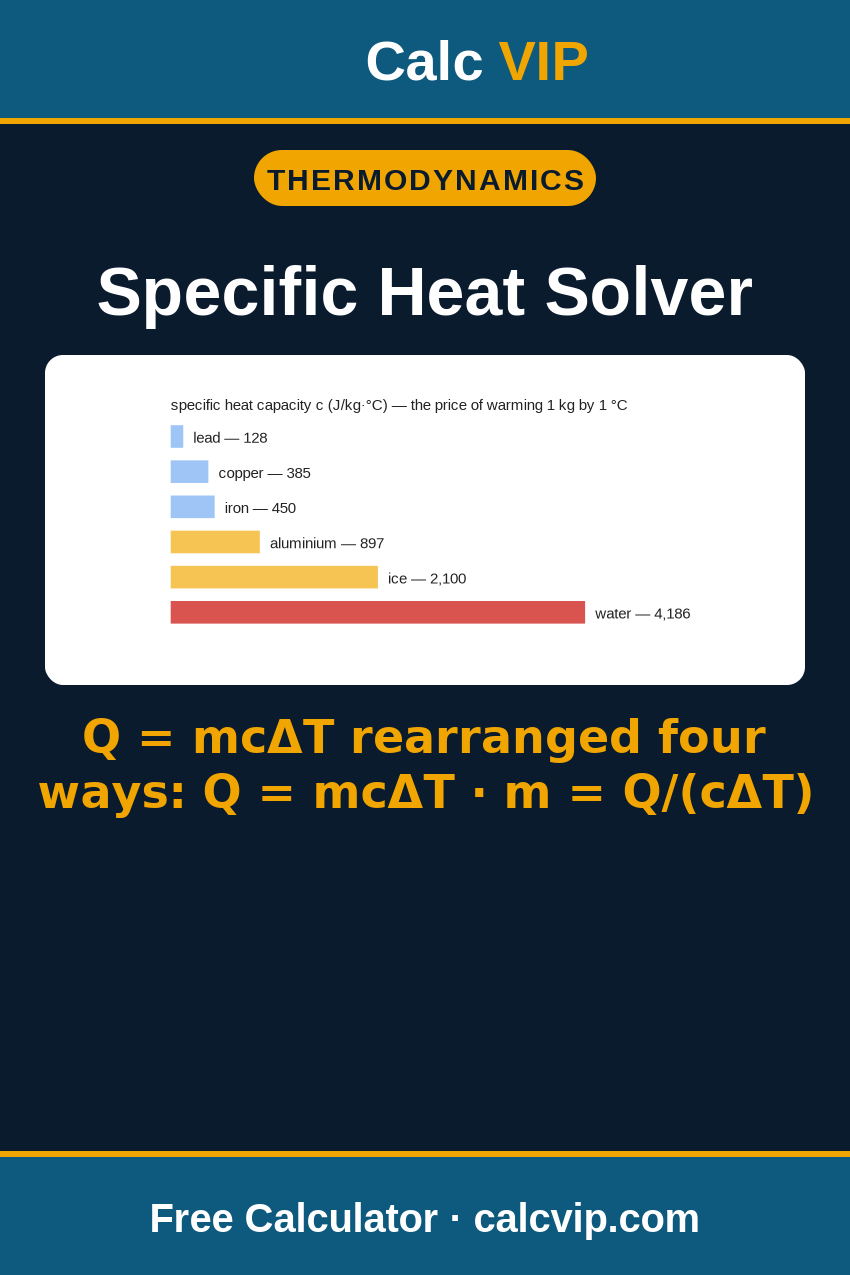
Specific heat capacity is a material's thermal personality: how much energy a kilogram of it must absorb to warm by one degree. The numbers could hardly differ more. Lead surrenders at 128 J/kg·°C — a breath of heat and it is warm. Copper takes 385, aluminium 897, and water, the great outlier of everyday substances, demands 4,186 J/kg·°C, more than thirty times lead's price and nearly five times aluminium's. Almost every thermal fact of daily life is this table acting itself out: why the sea warms and cools so reluctantly, why a cast-iron pan holds its heat through dinner, why the kettle is the hungriest appliance in the kitchen. The solver on this page treats c not as a lookup chore but as one of four equals in Q = mcΔT — any of them can be the unknown.
That four-way flexibility is what makes the equation a laboratory instrument. Solve forwards for Q and you are sizing a heater or timing a kettle. Solve for ΔT and you are predicting how hot a component will get. Solve for m and you are weighing by warming. And solve for c — feed in a measured energy, a known mass and an honest temperature rise — and you are identifying an unknown material by its thermal fingerprint, the standard calorimetry experiment that has filled school laboratories for a century. Each rearrangement is the same physics read from a different chair, and the calculator simply turns the chair for you.
One boundary must be respected: this equation prices temperature changes only, within a single state of matter. If the warming crosses a melting or boiling point, the temperature stalls on a plateau while latent heat is paid, and that part of the bill belongs to Q = mL — the two formulas together, slopes and plateaus, price any journey completely, as the latent heat page shows. Within its territory, though — solids warming, liquids cooling, gases at constant pressure — Q = mcΔT is exact enough for kitchens, engines and examination halls alike, and it is probably the most-used equation in all of thermal physics.
Formula
Q = mcΔT rearranged four ways: Q = mcΔT · m = Q/(cΔT) · c = Q/(mΔT) · ΔT = Q/(mc). Here m is mass (kg), c is specific heat capacity (J/kg·°C) and ΔT is the temperature change (°C or K — the step size is the same).
Read the equation as a sentence: the energy needed is the amount of stuff (m), times how reluctant that stuff is to warm (c), times how far you want to push it (ΔT). The product mc on its own is worth naming — it is the heat capacity of the particular object, in J/°C: a 2 kg pan of aluminium has mc = 2 × 897 = 1,794 J/°C, whatever it is used for. Two habits keep calculations clean. Work in kilograms and joules throughout (c values in J/kg·°C demand it), and remember that ΔT is a difference: heating water from 20 °C to 100 °C is ΔT = 80, not 100. Most wrong answers with this formula are one of those two slips wearing a disguise.
| Symbol | Meaning | Units |
|---|---|---|
| Q | heat energy transferred | J |
| m | mass of the substance | kg |
| c | specific heat capacity of the material | J/kg·°C (same in J/kg·K) |
| ΔT | temperature change = final − initial | °C or K (identical size) |
| mc | heat capacity of the whole object | J/°C |
Why water is the exception: energy with somewhere to hide
A temperature rise means particles moving faster — but absorbed energy is free to go elsewhere, and in water much of it does. Water molecules are knitted together by hydrogen bonds, and warming water spends a large share of its income loosening, bending and rearranging that knitting instead of speeding the molecules up. The energy is genuinely absorbed — it will all come back out on cooling — but it registers only partially as temperature. Hence the giant c: you must pay 4,186 joules to buy a single degree from a kilogram of water, because so many of those joules are diverted into the bond network's endless renegotiation. Substances without such internal diversions — the metals, with their simple structures — show their whole income as temperature at once, and their c values are correspondingly small.
The consequences cascade through the natural world. Because water hoards heat, the oceans act as the planet's thermal flywheel: they absorb summer and release winter, flattening the seasons near every coast, and they carry warmth around the globe in currents that decide the climates of continents. Land, made of rock and soil with c values a fifth of water's, heats and cools five times as fast for the same sunshine — hence deserts that scorch by day and freeze by night a few hundred kilometres from a mild shore. Your own body, mostly water, is stabilised by the same physics: at 4,186 J/kg·°C per kilogram of you, fevers and chills alike are slowed by an enormous thermal inertia.
The comparison can be made visceral. Pour 41,860 J — the output of a small heater for half a minute — into a kilogram each of three materials. The water warms by exactly 10 °C. The aluminium warms by 41,860/897 ≈ 46.7 °C. The iron warms by 41,860/450 ≈ 93 °C, from room temperature to nearly boiling. Same energy, same mass, three different worlds — c is the exchange rate between energy and temperature, and it is set by the microscopic places a substance can hide its wealth.
How to use
- Pick the quantity you want to find from the "Solve for" drop-down.
- Enter the other three values — the box for the quantity being solved can be left blank (it is ignored).
- Click "Solve" to get the missing value.
- Common c values: water 4186, ice 2100, aluminium 897, iron 450, copper 385 J/kg·°C.
- Check the answer's scale against those landmarks: a c of 41,860 for a mystery liquid is a misplaced decimal, not a discovery — nothing common exceeds water by much.
Worked examples
Example 1 — solving for Q. Heat m = 2 kg of water (c = 4186 J/kg·°C) by ΔT = 30 °C.
Q = 2 × 4186 × 30 = 251,160 J = 251.16 kJ
Example 2 — solving for c. If 251,160 J raises 2 kg of a liquid by 30 °C, then c = 251,160 / (2 × 30) = 4186 J/kg·°C — the liquid is water.
Example 3 — solving for ΔT. A 0.5 kg aluminium pan (c = 897) absorbs 44,850 J from the hob.
ΔT = 44,850 / (0.5 × 897) = 44,850 / 448.5 = 100 °C — an empty pan left on the ring climbs fast, which is why empty pans warp and why chefs heat pans with oil or food in them as a thermal brake.
Example 4 — solving for m. A heater delivers 100,000 J to an iron block (c = 450) and its temperature rises by 20 °C. How heavy is the block?
m = 100,000 / (450 × 20) = 100,000 / 9,000 ≈ 11.11 kg — weighing by warming, a trick used for awkward objects from ingots to engine blocks.
Example 5 — identifying a metal by its c. In a calorimetry experiment, 5,000 J raises 0.25 kg of an unknown metal by 50 °C.
c = 5,000 / (0.25 × 50) = 5,000 / 12.5 = 400 J/kg·°C — closest to copper (385) among common metals, so the sample is copper or a copper-rich alloy. This is Example 2's trick used as detective work.
Example 6 — the storage heater's overnight charge. The brick core of a storage heater — model it as 10 kg of water-equivalent storage for a hot-water tank instead: 10 kg of water cooling from hot to warm gives back its heat. Cooling by just 5 °C:
Q = 10 × 4186 × 5 = 209,300 J released. Scale that to a real 200-litre tank cooling 5 °C and the release is twenty times larger — over 4 MJ — which is why water is the storage medium of choice wherever heat must be banked.
Specific heat in real life
The kettle's appetite. Heating 1.5 kg of water from 20 °C to boiling is ΔT = 80, so Q = 1.5 × 4186 × 80 = 502,320 J — half a megajoule for one kettle. At 3,000 W that is 502,320/3,000 ≈ 167 seconds, about 2 minutes 47 seconds, matching every kitchen's experience. Water's huge c, not the kettle's weakness, sets that time — and the nation's morning electricity surge is this example multiplied by millions.
Coastal climates. The sea beside a coastal town absorbs the summer's heat with barely a shrug — each kilogram needs 4,186 J per degree — and returns it through the winter. Inland, rock and dry soil at a fifth of the c swing wildly with the same sunshine. The maritime-versus-continental climate divide is, at root, a specific heat divide.
Engine coolant. A car's cooling system needs a fluid that can absorb the engine's rejected megajoules and carry them to the radiator without boiling or freezing. Water's unmatched c makes it the irreplaceable base: a litre of coolant sweeping through the engine at ΔT = 10 carries away 41,860 J per pass. Antifreeze is water with bodyguards, not a replacement.
Cast iron versus aluminium pans. Chefs argue about pans in the language of this formula without knowing it. Iron's low c (450) means the pan itself stores little per degree — but a thick iron pan's large m restores the product mc, the heat capacity, so it sears steadily. Thin aluminium (c = 897 but small m) responds instantly and cools the moment food lands. The equation holds both truths at once.
Hot-water bottles and heat packs. A 2-litre hot-water bottle filled at 80 °C and cooling to 40 °C releases 2 × 4186 × 40 = 334,880 J — a third of a megajoule of gentle warmth through the night. No safe solid of the same mass comes close, which is why the bottle is filled with water and not with sand.
Sauna stones and steam. The stones in a sauna are chosen for the opposite trick: heated for hours, they store a large mcΔT, and water ladled onto them flashes to steam, dumping the stored heat into the room in seconds. The löyly — the burst of steam — is a specific-heat battery being short-circuited on request.
Calorimetry: measuring c honestly
Example 5's detective work has a professional form. In a proper calorimetry run, the sample is heated electrically — energy known exactly as power × time — inside an insulated container, and the temperature rise is logged until losses can be estimated. The refinements are all about honesty: stir so the temperature is uniform, insulate so the measured ΔT belongs to the sample and not the room, and repeat at several energies to average out the container's own heat capacity, which is measured in a blank run and subtracted. Done carefully, the method pins c to within a percent or two — good enough to distinguish copper (385) from the 400 of Example 5's rough school measurement, and to catch adulterated metals, watered fuels and mislabelled alloys, all of which confess through their c. The humble school experiment and the forensic laboratory are running the same rearrangement of the same equation.
Quick reference: specific heat capacities
| Substance | c (J/kg·°C) | Character |
|---|---|---|
| water | 4,186 | the champion — coolant, climate, kettles |
| ice | 2,100 | frozen water keeps half the talent |
| ethanol | 2,440 | a respectable liquid second tier |
| air (at constant pressure) | 1,005 | per kilogram — but a kilogram of air is 830 litres |
| aluminium | 897 | the highest of the common metals |
| glass / brick | ≈ 840 | building materials, thermal mass |
| iron / steel | 450 | pans, engines, radiators |
| copper | 385 | conducts superbly, stores modestly |
| lead | 128 | warms if you so much as look at it |
Notice the table's quiet lesson: liquids beat solids, and light molecules beat heavy ones. Per kilogram, the energy goes into jiggling molecules, and a kilogram of a light substance simply has more molecules to feed — one reason hydrogen, the lightest of all, holds the absolute record at roughly 14,300 J/kg·°C.
Common mistakes
- Entering the final temperature instead of the change. Heating water "to 100 °C" from 20 °C is ΔT = 80. Typing 100 overstates the energy by a quarter — the single most common slip with this formula, and it hides inside perfectly reasonable-looking questions. Always subtract the starting temperature first.
- Carrying on through a phase change. If the substance melts or boils on the way, Q = mcΔT prices only the slopes. Add the plateau with Q = mL, using the c of each state separately (ice's 2,100 is not water's 4,186 — using one c for the whole journey is the same mistake in a second costume).
- Mixing kilojoules and joules. c is sometimes tabulated in kJ/kg·°C (water: 4.186). Feeding 4.186 into a joules calculation shrinks the answer a thousandfold. Pick one system — this page uses joules throughout — and convert any table value that arrives in kilojoules.
- Grams for kilograms. Laboratory masses come in grams; the formula wants kilograms. A 250 g sample entered as "250" inflates m — and every answer downstream — by a thousand. The solver's Example 5 uses 0.25 kg for exactly this reason.
- Assuming c never changes. c drifts modestly with temperature (and jumps at phase changes). Over a few tens of degrees the tabulated value is fine; over hundreds of degrees — furnace work, cryogenics — use the value for the range, or an average, and treat the result as an estimate.
FAQ
How do I find the specific heat of an unknown material?
Heat a known mass with a measured amount of energy, record the temperature rise, then solve for c with this calculator. This is the standard calorimetry experiment done in school labs.
Why does ΔT work in both °C and K?
Only the size of the change matters, and a change of 1 °C is exactly the same size as a change of 1 K — unlike formulas such as the Carnot efficiency, no absolute temperature is needed here.
What if the substance melts or boils during heating?
Then Q = mcΔT alone is not enough — you must add the latent heat for the change of state, Q = mL, for the melting or boiling part.
What is the difference between specific heat capacity and heat capacity?
Specific heat capacity c is per kilogram — a property of the material. Heat capacity mc is for the whole object — a property of the thing. A teaspoon and a tanker of water share the same c but wildly different mc, which is why the tanker takes a season to warm and the teaspoon a second.
How much energy does it take to heat a bath?
A modest bath is about 100 kg of water. Raising it by 30 °C (from cold mains to comfortable) costs Q = 100 × 4186 × 30 = 12,558,000 J ≈ 12.6 MJ — about 3.5 kilowatt-hours, which at typical electricity prices is the most expensive item in the bathroom by a wide margin. Water's c sends the bill.
Why does the sea take so long to warm up in spring?
Mass times c. The top metres of ocean over a single square kilometre are millions of kilograms of a 4,186 J/kg·°C substance; the spring sunshine, generous as it feels on land, is spread across that enormous mc. The sea is still paying off winter in June — and still spending summer's savings in November, which holidaymakers in October are grateful for.
Is the calorie related to specific heat?
Intimately: the calorie was defined as the heat needed to raise 1 gram of water by 1 °C, so water's c is exactly 1 cal/g·°C by the old definition — 4,186 J/kg·°C in modern units, with 1 cal = 4.186 J. Food energy "Calories" (kilocalories) are a thousand of those. Water's specific heat is not just measured by the calorie system; it created it.
Do gases have one specific heat or two?
Two, and the difference matters. A gas heated at constant volume spends everything on temperature; heated at constant pressure it also expands, spending some energy on pushing the surroundings back — so its c at constant pressure is larger. For air, cp ≈ 1,005 and cv ≈ 718 J/kg·K. Solids and liquids barely expand, so one value serves for both, which is why this page needs only one.
Why do chefs rest a pan off the heat instead of just turning it down?
Because the pan is a charged battery: its mcΔT above the food's temperature keeps delivering heat after the hob is off. Resting lets that stored energy finish the cooking gently and evenly. Turning the hob down stops new energy arriving, but the equation says the pan's own store must still be spent somewhere — into the food, as intended.
Can specific heat capacity identify a substance on its own?
It narrows the field powerfully — a measured c of 385 is copper until proven otherwise, and 4,186 is water beyond argument — but neighbours exist (several alloys and plastics share the 400–500 band), so careful work combines c with density and other tests. As a first fingerprint, though, few measurements are cheaper or more honest.