 Calc
Temperature Converter – Celsius, Fahrenheit, Kelvin & Rankine
 Created by Anna Kowalski · Physics Editor · Heat & Atoms · Last updated: November 2026
Use this free Temperature Converter to convert between Celsius (°C), Fahrenheit (°F), kelvin (K) and Rankine (°R). Enter a value in any one scale and this calculator shows all four scales at once — handy for physics problems, where kelvin is the required SI unit.
Four scales for one quantity is three too many, and the reason we have them is pure history. Celsius anchored his scale to water — 0° at freezing, 100° at boiling — and it fits everyday life so well that most of the world uses it. Fahrenheit chose different anchors and finer divisions, and survives mainly in the United States. Kelvin and Rankine are the scientists' answer: both begin at absolute zero, the coldest temperature that can exist, so their readings are true measures of thermal energy rather than positions on an arbitrary ruler. Kelvin pairs with Celsius (same degree size), Rankine pairs with Fahrenheit (same degree size), and this converter moves between all four at once.
The distinction that matters in physics is between a temperature reading and a temperature difference. A difference of 1 °C is exactly a difference of 1 K, and a difference of 1 °F is exactly 1 °R — the offsets cancel. But a reading must be shifted as well as scaled: 20 °C is not "twice as hot" as 10 °C in any physical sense, whereas 586 K really is twice 293 K. Every gas law, every radiation law and every thermodynamics formula on this site quietly assumes kelvin for exactly that reason: only an absolute scale supports ratios.
Absolute zero itself deserves a moment. At 0 K the particles of a substance have the minimum energy quantum mechanics allows — not quite zero motion, but the ground state, with nothing left to give away as heat. No refrigerator can reach it (the third law of thermodynamics forbids arriving in any finite number of steps), but laboratories have come within billionths of a kelvin. Every temperature you will ever convert sits on the ladder that starts there: 273.15 K for melting ice, about 310 K for your body, 5,778 K for the surface of the Sun.
Formula
Celsius to Fahrenheit: °F = (9/5) × °C + 32 • Celsius to kelvin: K = °C + 273.15 • Kelvin to Rankine: °R = (9/5) × K
Every conversion runs through these three moves. Fahrenheit inverts as °C = (5/9) × (°F − 32) — note the order: subtract the 32 before scaling, because the offset belongs to the reading, not the degree size. Rankine inverts as K = (5/9) × °R. The two degree sizes differ by the factor 9/5 = 1.8: a Fahrenheit or Rankine degree is smaller, so the same warmth needs more of them — which is why weather reports in Fahrenheit use bigger, finer-grained numbers. For differences the offsets vanish: ΔT of 10 °C = 10 K = 18 °F = 18 °R. This converter reports all four readings at once, and refuses — as physics does — any temperature below 0 K.
| Symbol | Meaning | Units |
|---|---|---|
| °C | Celsius — water freezes 0°, boils 100° | degrees Celsius |
| °F | Fahrenheit — water freezes 32°, boils 212° | degrees Fahrenheit |
| K | kelvin — absolute scale, 0 K = absolute zero | kelvin (no degree sign) |
| °R | Rankine — absolute Fahrenheit-sized scale | degrees Rankine |
Why kelvin has no degree sign — and why ratios need an absolute scale
Look at the symbols: we write 25 °C and 77 °F, but 298 K with no little circle. That is deliberate. The kelvin is an SI base unit like the metre or the second — a count of something real, the thermal energy scale itself — so it takes no "degree". Since 2019 it has been defined by fixing Boltzmann's constant, tying temperature directly to the average energy of particles: a kelvin is not a mark on a thermometer-maker's tube any more, but a unit of energy in disguise.
The practical consequence is the ratio rule. Because Celsius and Fahrenheit readings include an arbitrary offset, ratios of readings are meaningless: 40 °C is not twice as hot as 20 °C (in kelvin those are 313.15 K and 293.15 K — barely 7% apart). But heat radiation grows as T⁴, gas pressure grows in direct proportion to T, and molecular speeds grow as √T — all computed in kelvin. Feed Celsius into any of those and the answers are not slightly wrong but absurd, including negative pressures and imaginary speeds. Converting to kelvin is not pedantry; it is the price of admission for half of physics.
There is also a quieter trap in the opposite direction: differences. Because the offsets cancel in a difference, a rise of 1 K is a rise of 1 °C but only 1.8 °F — and specifications, climate targets and engineering tolerances are almost always differences. A datasheet that promises a device works over a "40 °F range" is promising 22.2 K of range, not 40; a climate goal of "2 °C" is 3.6 °F, not 2. The converter's four readings are for points on the scale; for spans, remember to convert with the 9/5 factor alone and leave the 32 out of it entirely.
How to use
- Type the temperature you know into the value box — a reading from a thermometer, a textbook or a weather report.
- Choose which scale that value is in: Celsius, Fahrenheit, kelvin or Rankine.
- Click "Convert Temperature" to see the same temperature in all four scales at once.
- For physics calculations, take the kelvin figure. If the answer comes out below absolute zero, the calculator says so — no real temperature can be entered there by mistake without a sign or scale error upstream.
Worked examples
Example 1 — the boiling point of water. Convert 100 °C:
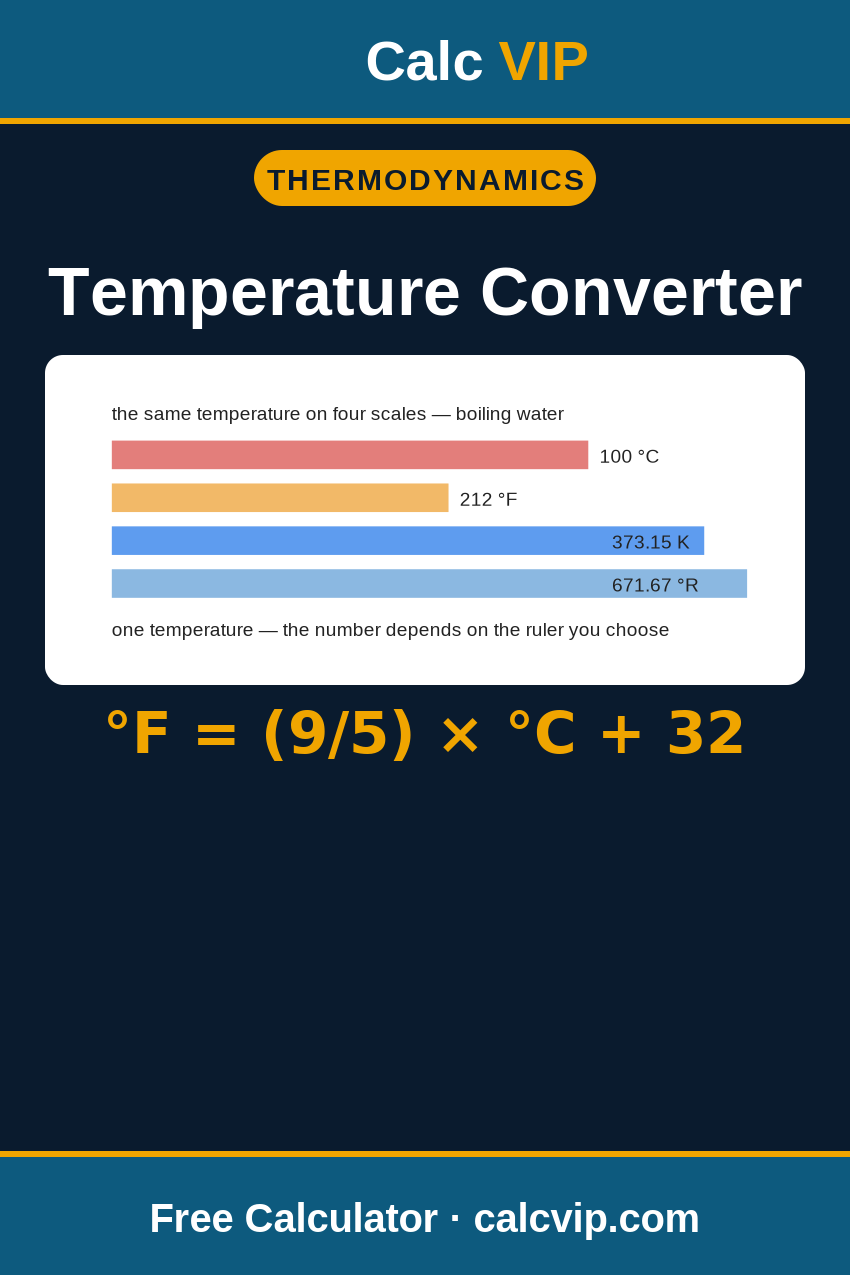
°F = (9/5 × 100) + 32 = 212 °F • K = 100 + 273.15 = 373.15 K • °R = 373.15 × 9/5 = 671.67 °R. One kettle of boiling water, four correct descriptions.
Example 2 — body temperature. A healthy body runs at 37 °C: °F = (9/5 × 37) + 32 = 98.6 °F, K = 310.15 K, °R = 558.27 °R. The famous 98.6 is just 37 °C wearing Fahrenheit clothes — and a fever of 39.5 °C converts to 103.1 °F, the number an American thermometer would show.
Example 3 — the crossover point. At −40 the two everyday scales agree: −40 °C = −40 °F exactly. In absolute terms that is 233.15 K and 419.67 °R — a bitterly cold day on either scale, and a handy check that a converter is working.
Example 4 — starting from Fahrenheit. A US weather report says 98.6 °F: °C = (5/9) × (98.6 − 32) = (5/9) × 66.6 = 37 °C, and K = 310.15 K. Subtracting the 32 first is the whole trick — scale before subtracting and the answer comes out wrong.
Example 5 — absolute zero. 0 K converts to −273.15 °C and −459.67 °F, and 0 °R. These are the floors of the universe: the converter will accept 0 K but rejects anything below it, because there is nothing below it.
Example 6 — a comfortable room. 25 °C becomes 77 °F, 298.15 K and 536.67 °R. Room temperature near 298 K is worth memorising — it is the T that appears in more back-of-envelope physics than any other.
Temperature conversion in real life
Cooking across the Atlantic. A British recipe's 200 °C oven is 392 °F; an American recipe's 350 °F is 177 °C. Baking is chemistry with narrow margins, and a scale mix-up here ruins dinner, not just homework.
Weather and travel. A forecast of 30° means a heatwave in Celsius and a hard frost in Fahrenheit. Converting before dressing — or before booking the holiday — is the difference between sandals and snow boots.
Medicine. Clinical thresholds are scale-bound: 38 °C (100.4 °F) defines a fever, 35 °C (95 °F) defines hypothermia. Devices sold across markets must convert flawlessly, because a misplaced scale is a misdiagnosis.
Engineering with Rankine. US power-plant and aerospace practice still runs steam tables and gas-turbine cycles in Rankine, the absolute partner of Fahrenheit. A turbine inlet at 1,200 °F is 1,659.67 °R — the number that belongs in the efficiency formula.
Cryogenics. Liquid nitrogen boils at 77.15 K (−196 °C); liquid helium at about 4.2 K. Nobody quotes these in Celsius day-to-day, because near absolute zero the kelvin figure is the one that shows how close to the floor you are.
Climate science. A "1.5 °C rise" is a difference, so it is also 1.5 K — but 2.7 °F, because differences scale by 9/5 with no offset. International reports switch between the three, and knowing which rule applies keeps the numbers honest.
A short history of the four scales
Each scale is a fossil of the instrument-making of its century. Fahrenheit, a Polish-Dutch instrument maker, built the first reliable mercury thermometers around 1714 and set his zero at the coldest mixture he could make in the laboratory — ice, water and ammonium chloride — with body temperature near 96° on his original reckoning; the scale was later re-anchored so that water boils at exactly 212° and freezes at 32°, keeping his degree size. Celsius proposed his scale in 1742, originally upside down (0° at boiling, 100° at freezing) and flipped after his death into the form we use. Kelvin's contribution in 1848 was conceptual rather than mechanical: thermodynamics implied a floor to temperature, and a scale counted from that floor needs no reference substance at all. Rankine, a Scottish engineer, performed the same construction on Fahrenheit's degree in 1859, for the steam-engine calculations of the industrial revolution.
The modern settlement keeps all four because each owns a territory: Celsius for daily life and most science communication, Fahrenheit for American daily life, kelvin for science itself, Rankine for a shrinking but real corner of American engineering. Conversion is the toll paid at the borders — and the reason a converter that shows all four at once, as this one does, is the right design: most real questions ("is 350 a hot oven?", "what is 77 K in the units of this old paper?") are border questions.
The extremes the scales must span are worth a glance, because they justify the absolute scales' open-endedness. The coldest natural place known, the Boomerang Nebula, sits near 1 K — colder than the 2.7 K background glow of the universe itself, chilled by its own adiabatic expansion. The coldest artificial temperatures, made by laser and evaporative cooling, reach below a billionth of a kelvin. At the other end, the quark–gluon plasma created in heavy-ion colliders has been estimated around 5 × 10¹² K — five trillion kelvin — the hottest temperature ever produced on Earth. A scale anchored to water's freezing and boiling points can still express all of these (the plasma is also about 5 × 10¹² °C, the offset being beneath notice), but only the absolute scales make their meaning transparent: each is a height above the floor, and the floor is the same everywhere in the universe.
The triple point: where the kelvin used to be defined
For most of the twentieth century the kelvin was defined by a single reproducible state of water: its triple point, where ice, liquid water and water vapour coexist in equilibrium. That happens at exactly 273.16 K (0.01 °C) and a pressure of 611.7 Pa — about 0.6% of atmospheric pressure. It made a superb definition because nature reproduces it perfectly anywhere, with no artefacts to guard in a vault. The 2019 redefinition via Boltzmann's constant kept the size of the kelvin unchanged, so 273.16 K remains the triple point — it is simply no longer the definition, just a very well-measured fact. Notice the 0.01 K gap between the triple point (273.16 K) and the ice point (273.15 K): the Celsius scale's zero is the freezing point at atmospheric pressure, which sits a hair below the triple point.
Quick reference: landmark temperatures
| Landmark | °C | °F | K |
|---|---|---|---|
| absolute zero | −273.15 | −459.67 | 0 |
| liquid nitrogen boils | −196 | −320.8 | 77.15 |
| scales agree | −40 | −40 | 233.15 |
| water freezes | 0 | 32 | 273.15 |
| human body | 37 | 98.6 | 310.15 |
| water boils | 100 | 212 | 373.15 |
| hot oven | 200 | 392 | 473.15 |
| surface of the Sun | 5,505 | 9,941 | 5,778.15 |
Read the kelvin column as heights above the floor of the universe and the table turns into a map: chemistry happens in the first few hundred rungs, and even a star's surface is only twenty times higher than a kettle.
Two rows reward a second look. Liquid nitrogen at 77.15 K is the working fluid of a thousand laboratories precisely because it parks a system far down the ladder for pennies. And the −40 row is the one conversion nobody needs a calculator for — the scales' single handshake — which makes it the perfect first test of any converter, including this one: enter −40 in either everyday scale and the other must answer −40.
Common mistakes
- Scaling before subtracting the 32. Fahrenheit to Celsius is (5/9)(°F − 32), in that order. Doing 5/9 × °F − 32 turns 98.6 °F into a wrong 22.8 °C instead of 37 °C.
- Adding 273 instead of 273.15. Fine for rough work, but it shifts every downstream ratio. Precision gas-law answers expect the .15.
- Using °C inside ratios and powers. P₁/T₁, T⁴ radiation and √T speeds all demand kelvin. A Celsius input can produce negative pressures and other nonsense that still "looks like a number".
- Treating a difference like a reading. "Warmer by 10 °C" is warmer by 10 K but by 18 °F — the offset must NOT be added to a difference. Adding 32 here is the classic conversion blunder.
- Writing "degrees kelvin" or °K. The unit is the kelvin, symbol K, no degree sign — a small point that examiners and journals both enforce.
FAQ
Why do physics formulas need kelvin?
Gas laws and thermodynamics are built on absolute temperature. Ratios like P₁/T₁ = P₂/T₂ only work in kelvin — using °C would give wrong (even negative) pressures.
What is the Rankine scale?
Rankine is the absolute version of Fahrenheit: 0 °R is absolute zero, and each Rankine degree equals one Fahrenheit degree. It is used in some engineering fields in the United States.
Where do Celsius and Fahrenheit agree?
At −40: −40 °C = −40 °F. It is the only point where the two scales read the same number.
How do I convert Fahrenheit to kelvin in one step?
K = (5/9)(°F − 32) + 273.15. For 98.6 °F: (5/9)(66.6) + 273.15 = 37 + 273.15 = 310.15 K. This calculator does the same thing by routing through Celsius.
Can a temperature be below absolute zero?
No. 0 K is the ground state — the least thermal energy a system can have. Negative kelvin values appear in exotic physics as a population-inversion bookkeeping device, but they describe systems that are, paradoxically, hotter than any positive temperature, not colder than zero.
Why is the kelvin defined from Boltzmann's constant now?
Since 2019 the SI defines the kelvin by fixing k = 1.380649 × 10⁻²³ J/K exactly, so temperature is defined through energy itself. Any laboratory can realise the unit from first principles, with no water cell or artefact to maintain.
Is a 2 °C rise the same as a 2 K rise?
Yes — for differences the two are identical, because the degree sizes match. The same rise is 3.6 °F, since Fahrenheit degrees are smaller by the factor 9/5.
What temperature is the inside of the Sun?
About 15 million kelvin at the core (15,000,000 °C differs by only 273 — at such sizes the offset stops mattering, which is why astronomers quote kelvin and Celsius almost interchangeably for stars).
Why does this converter show Rankine at all?
Because US engineering — steam tables, gas turbines, some HVAC and aerospace work — still specifies absolute temperatures in Rankine. If a datasheet says 1,000 °R, that is 555.56 K, and this converter bridges the two.
How accurate is 273.15?
Exact by definition: 0 °C is defined as 273.15 K. The older "273" shortcut is an approximation that costs you 0.15 K — invisible in weather, visible in careful calorimetry.