 Calc
Speed of Sound Calculator – Sound Speed in Air by Temperature
 Created by David Okafor · Physics Writer · Waves & Light · Last updated: November 2026
Use this free Speed of Sound Calculator to find how fast sound travels in air at any temperature. Enter the air temperature, and optionally a frequency to get the wavelength of that sound as well.
"The speed of sound" sounds like a fixed constant of nature, like the speed of light. In air it is nothing of the sort: it is a property of the weather. Sound travels through air by molecules bumping the disturbance into their neighbours, so anything that changes how fast the molecules themselves move changes the speed of sound — and the dominant factor is temperature. On a frosty morning sound dawdles at about 325 m/s; on a hot afternoon it hurries along at 355 m/s. The rule connecting them is simple enough to do in your head: the speed rises by roughly 0.6 m/s for every degree Celsius.
The famous figure of 343 m/s is just one point on that sliding scale — the value at a comfortable 20 °C. Pilots breaking the sound barrier, orchestras drifting out of tune in cold halls, thunder arriving seconds after the lightning flash: all of these are the temperature rule wearing different clothes. Because the speed also fixes the wavelength of every note through λ = v/f, a change of temperature quietly stretches or squeezes every sound wave in the air, which is why this calculator offers a frequency box as well: give it a pitch and it returns that pitch's wavelength at your temperature.
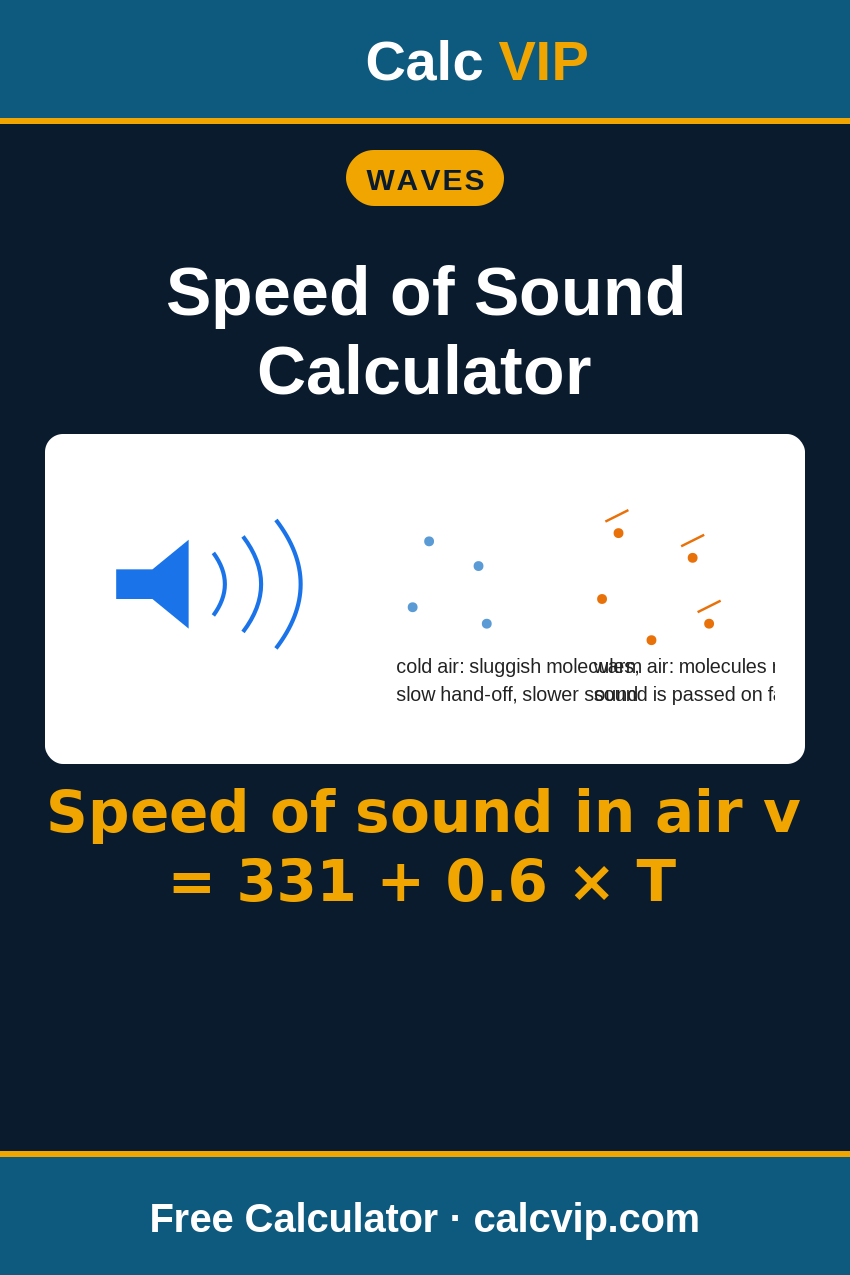
The linear formula used here, v = 331 + 0.6 × T, is an approximation — an excellent one across the whole range of temperatures humans live in. Behind it sits an exact law, v proportional to the square root of the absolute temperature, which the depth section below unpacks. But for thunder-counting, echo experiments, organ tuning and examination questions, the straight-line rule is the working tool, accurate to within a fraction of a percent from deep frost to heatwave.
Formula
Speed of sound in air v = 331 + 0.6 × T • v in metres per second (m/s), T in degrees Celsius (°C)
Wavelength λ = v / f
The constant 331 is the speed at 0 °C, and the 0.6 is the price of a degree: each additional degree Celsius buys 0.6 m/s more. The formula is deliberately the practical form of a deeper law — the exact relation is v = 331.3 × √(TK / 273.15), with TK the absolute temperature in kelvin. At 20 °C that gives 331.3 × √(293.15/273.15) ≈ 343.3 m/s, matching the line's 343 m/s to within a rounding step, which is why the straight line is safe everywhere in the weather range. The wavelength companion, λ = v/f, reminds you what the speed is for: it converts any frequency into the physical size of its wave, the quantity that decides diffraction, resonance and instrument dimensions. Enter temperatures in Celsius — the formula is calibrated for it, and Fahrenheit figures must be converted first.
| Symbol | Meaning | Units |
|---|---|---|
| v | speed of sound in air | m/s (× 3.6 for km/h) |
| T | air temperature | °C |
| TK | absolute temperature, T + 273.15 | kelvin (K) |
| f | frequency of the sound | hertz (Hz) |
| λ | wavelength, λ = v/f | m |
Why temperature rules the speed of sound
Sound is a relay race. A vibrating source shoves its neighbouring air molecules; they shove theirs; the shove — not the air itself — travels. The speed of the wave is therefore set by how quickly molecules can receive and pass on the push, and that depends on how fast they are already moving. Temperature is precisely a measure of that molecular motion: warm air's molecules are sprinting, collide sooner and hand the disturbance along faster; cold air's molecules loiter, and the hand-off dawdles. This is also why the exact law involves the square root of absolute temperature — molecular speeds grow with √TK, and the wave speed faithfully follows the molecules.
Equally instructive is what does not change the speed. In air, to a very good approximation, the pitch does not matter: a bass note and a whistle travel together, which is why a distant band still sounds coordinated rather than smeared. Loudness does not matter either (until amplitudes become violent, as in explosions, where shock waves genuinely do outrun ordinary sound). Air pressure, surprisingly, cancels out — denser air has more inertia but proportionally more springiness — leaving temperature, plus a small humidity effect, as the weather variables that count. Moist air is slightly less dense than dry air at the same temperature, so humid days raise the speed a little beyond the formula's value, by up to a few tenths of a percent.
How to use
- Enter the air temperature in degrees Celsius. Sound travels faster in warm air than in cold air.
- Optionally enter a sound frequency in hertz to find the wavelength of that sound at this temperature.
- Click "Calculate Speed of Sound" to see the speed in m/s and km/h (and the wavelength, if a frequency was given).
- For quick estimates away from the keyboard, remember the anchor points: 331 m/s at 0 °C and 343 m/s at 20 °C, adjusting by 0.6 m/s per degree from either.
Worked examples
Example 1 — a mild day. On a day when the air is 20 °C:
v = 331 + 0.6 × 20 = 331 + 12 = 343 m/s.
A sound of 686 Hz at this temperature has wavelength λ = 343 / 686 = 0.5 m.
Example 2 — a freezing morning. At −10 °C, v = 331 + 0.6 × (−10) = 331 − 6 = 325 m/s. Sound is 18 m/s slower than on the mild day of Example 1 — enough to make a wind band's pipes, whose pitch follows the speed of sound, play noticeably flat until the instruments warm up.
Example 3 — counting the thunder. Lightning flashes and the thunder arrives 3 s later at 20 °C. The storm is about v × t = 343 × 3 = 1,029 m away — roughly a kilometre. The folk rule "count the seconds and divide by three for kilometres" is this calculation with 343 rounded to 333; on a cold day, with sound slower, the same count means the storm is a little closer than the rule suggests.
Example 4 — a heatwave wavelength. At 35 °C, v = 331 + 21 = 352 m/s, and the wavelength of concert A (440 Hz) stretches to λ = 352 / 440 = 0.8 m. The note's frequency is fixed by the instrument, but the physical wave in hot air is longer — the reason pipe-organ pitch climbs on hot days even though nobody touched the tuning.
Example 5 — Mach at altitude. A jet cruises where the air is −50 °C, so the local speed of sound is v = 331 − 30 = 301 m/s. Travelling at 250 m/s, the jet is at Mach 250 / 301 = 0.83. "Mach 1" is not a fixed speed — it is whatever this calculator says for the air the aircraft is actually in, which is why airliners' true speeds vary with the weather at altitude.
Example 6 — the edges of hearing. At 20 °C the lowest audible pitch, 20 Hz, has wavelength λ = 343 / 20 = 17.15 m — longer than a bus — while the highest, 20,000 Hz, has λ = 343 / 20,000 = 1.7 cm. The whole of human hearing spans waves from centimetres to tens of metres, all travelling at the one speed this page computes.
The speed of sound in real life
Thunder ranging. Light arrives essentially instantly, sound at a few hundred metres per second, so the flash-to-bang gap is a rangefinder: seconds × 343 = metres to the storm, as in Example 3.
Concert delay towers. At outdoor festivals, speaker towers partway down the field are delayed electronically so their sound arrives in step with the main stage's. The delay is set from the speed of sound — and engineers re-check it as the evening air cools and the speed drops.
Wind instruments and tuning. A pipe's pitch is proportional to the speed of sound inside it. Cold halls flatten flutes, clarinets and organs; warm breath and stage lights sharpen them again — orchestras tune after warming up for exactly this reason.
Ultrasonic sensors. Parking sensors, robot rangefinders and tank-level gauges time echoes and divide by the speed of sound. Good ones carry a thermometer and apply this very formula; cheap ones drift with the weather.
Aircraft and the sound barrier. Mach number is speed divided by the local speed of sound, so the "barrier" an aircraft must beat falls as the air gets colder with altitude — about 295 m/s in the stratosphere rather than 343 m/s at the ground.
School echo experiments. The classic measurement of the speed of sound — clap, time the echo from a distant wall, halve — only gives the right answer for the day's temperature, and classes repeating it in January and June genuinely get different results.
Quick reference: speed of sound versus temperature
| Temperature | Speed (m/s) | Speed (km/h) |
|---|---|---|
| −20 °C | 319 | 1,148 |
| −10 °C | 325 | 1,170 |
| 0 °C | 331 | 1,192 |
| 10 °C | 337 | 1,213 |
| 20 °C | 343 | 1,235 |
| 30 °C | 349 | 1,256 |
| 40 °C | 355 | 1,278 |
Notice how modest the whole swing is: from a hard frost to a heatwave the speed changes by barely 11%, yet that is enough to matter to pilots, tuners and echo experiments alike. Small causes, carefully multiplied, have large effects.
Other gases, and why hot afternoons create sound shadows
The exact law behind the linear rule is v = √(γP/ρ) for a gas — the square root of (a constant × pressure ÷ density). At fixed pressure, warming a gas lowers its density in step with the absolute temperature, which is where v ∝ √TK comes from. Swap the gas and density dominates the story: hydrogen, fourteen times lighter than air, carries sound at about 1,280 m/s; helium at about 965 m/s (the party-trick voice); carbon dioxide, heavier than air, slows sound to roughly 267 m/s and deepens resonances instead. A lecture-demonstration classic is to fill an organ pipe or a singer's lungs with each gas in turn and hear this page's formula change key. Divers breathing helium–oxygen mixtures live the same demonstration involuntarily: with the sound speed in their breathing gas so far from air's value, their voices turn Donald-Duck squeaky and their through-water communication systems need electronic unscrambling to stay intelligible.
Temperature gradients bend sound as well as speed it. On a hot afternoon the air near sun-baked ground is warm and fast while the air above is cooler and slower, so sound rays tilt upward, away from the ground, leaving a "shadow zone" where a distant voice or train fades out unnaturally fast. Reverse the gradient on a clear night — cold ground, warmer air aloft — and rays bend back down, returning sound to listeners kilometres away. Both effects are pure refraction, driven by nothing but the 0.6 m/s-per-degree rule applied layer by layer through the air.
The sound that went around the world
The temperature rule has been tested at planetary scale. When Krakatoa erupted in 1883, the pressure wave from the explosion was recorded on barometers around the globe, circling the Earth three and a half times — travelling, as the timings showed, at the speed of sound in the upper air, and arriving at each station when this page's arithmetic said it should. The modern descendants of those barometers form the International Monitoring System: a planetary network of infrasound stations that listens for clandestine nuclear tests. Analysts locate an event by comparing arrival times at several stations and converting the differences into distances with the speed of sound — corrected, station by station and layer by layer, for the temperature and wind of the real atmosphere. The humble v = 331 + 0.6T, dressed in weather data, stands guard over a test-ban treaty.
Common mistakes
- Using 343 m/s for every temperature. 343 is only the 20 °C value. At 0 °C the correct figure is 331 m/s, and echo or thunder calculations done with 343 on a freezing day overstate distances by about 4%.
- Feeding in Fahrenheit. The 0.6 coefficient belongs to Celsius degrees. A 68 °F day is 20 °C; typing 68 into the formula gives a fantasy speed of 372 m/s.
- Believing pitch or loudness changes the speed. In ordinary air all audible frequencies travel at the same speed, and so do quiet and loud sounds. If pitch changed the speed, distant music would smear into nonsense — bass arriving before treble or the reverse.
- Applying the air formula to water or solids. The 331 + 0.6T rule describes air near everyday temperatures only. Sound in water runs at about 1,480 m/s with its own, different temperature behaviour; sonar calculations need their own values.
- Confusing wind with sound speed. A following wind carries sound faster over the ground, but the speed through the air itself is unchanged — the air is simply moving. The formula gives the through-the-air speed; ground speed adds or subtracts the wind.
FAQ
Why does sound travel faster in warm air?
Sound is passed along by colliding air molecules. In warmer air the molecules move faster, so they pass the vibration on more quickly and the wave speed rises by about 0.6 m/s for every degree Celsius.
What is the speed of sound at 0 °C?
About 331 m/s. The formula in this calculator is a handy approximation for air near everyday temperatures; the exact value also depends slightly on humidity.
How fast is sound in water or steel?
Much faster — about 1,480 m/s in water and roughly 5,900 m/s in steel, because the particles are packed closer together and pass vibrations on more efficiently. This calculator is for air only.
What is the speed of sound at 25 °C?
v = 331 + 0.6 × 25 = 346 m/s. A standard warm room sits just 3 m/s above the famous 343 figure — small, but enough to shift a pipe organ's pitch measurably and to matter in precision echo work.
Why does breathing helium make your voice squeaky?
Sound travels in helium at about 965 m/s — nearly three times faster than in air. Your vocal cords vibrate at the same rate, but the resonances of your throat and mouth, which scale with the speed of sound, shift up, so the voice's tone colour turns cartoonish. The pitch source is unchanged; the filter above it is not.
What exactly is Mach 1?
Mach 1 is the speed of sound in the air immediately around the aircraft — a moving target that falls with altitude as the air cools. At sea level on a 20 °C day it is 343 m/s (1,235 km/h); in the cold stratosphere it is nearer 295 m/s. Pilots quote Mach numbers precisely because raw speeds would mislead.
Does humidity really change the speed?
Yes, slightly. Water vapour is lighter than the nitrogen and oxygen it displaces, so moist air is less dense and sound runs a little faster in it — up to a few tenths of a percent in very humid conditions. The calculator's dry-air formula is the standard approximation; precision acoustics adds a humidity correction.
How fast is sound on Mars?
About 240 m/s. The Martian atmosphere is thin carbon dioxide and bitterly cold, and NASA's Perseverance rover has measured the speed directly with its microphones — even finding that high and low frequencies travel at slightly different speeds there, an effect negligible on Earth.
Is the 0.6 coefficient exact?
It is a rounded slope. The exact law, v ∝ √(absolute temperature), gives a slope near 0.606 m/s per °C around room temperature, gently decreasing as temperature falls. Across −20 °C to 40 °C the straight line and the exact curve never disagree by more than about half a metre per second.
Why can you hear sounds from further away on some nights?
On clear nights the ground cools faster than the air above it, creating a temperature inversion: sound speed now increases with height, bending sound rays back down towards the ground instead of letting them escape upwards. Distant trains and motorways become audible — refraction, caused by the same temperature dependence this page calculates.