 Calc
String Frequency Solver – Solve f, L, T or μ for a Stretched String
 Created by David Okafor · Physics Writer · Waves & Light · Last updated: November 2026
Use this free String Frequency Solver to solve the stretched-string equation f = (1/2L)√(T/μ) for any one unknown — the fundamental frequency, the string length, the tension, or the mass per unit length. This is the equation behind tuning guitars, pianos and violins. Choose what to solve for, then enter the other three values.
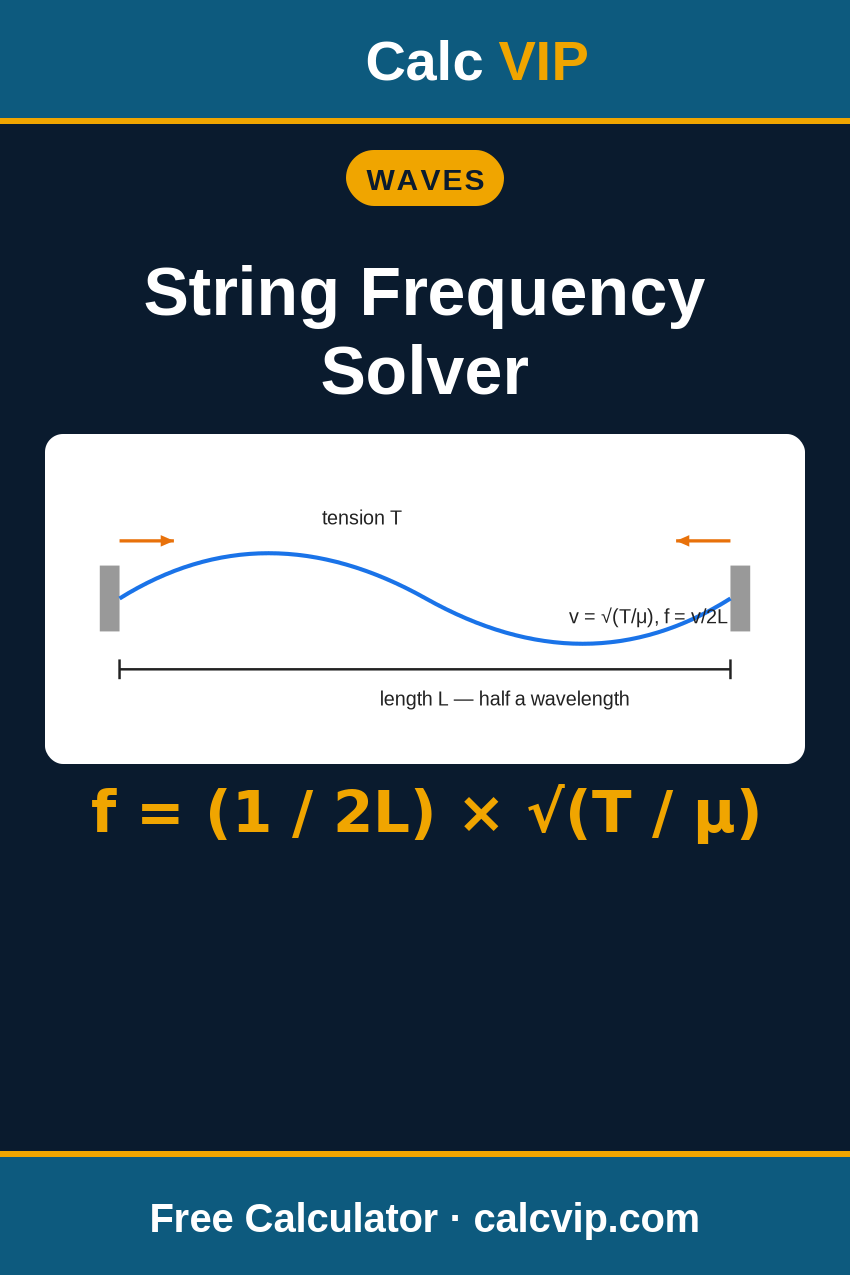
The equation has a physical picture behind it. A wave on a string travels at v = √(T/μ) — faster when the string is tight, slower when it is heavy. The fundamental is the standing wave that fits half a wavelength on the string's length, so f = v/(2L), and substituting the wave speed gives the solver's formula. Every design decision in stringed instruments is a negotiation among its four variables: pitch wants short, tight, light strings; depth of tone wants the opposite; and the player's fingers and the instrument's frame set the limits of what can be tightened, lengthened or wound with extra metal.
Most calculators only evaluate f. This one inverts the algebra in all four directions, because real questions come inverted: the luthier knows the pitch and length and needs the tension the neck must bear; the string maker knows the pitch and tension and needs the mass per unit length to wind to; the student measures f, L and T and extracts μ as a way of "weighing" a string by its note. Each inversion is the same equation wearing a different hat — T = μ(2Lf)², L = (1/2f)√(T/μ), μ = T/(2Lf)² — and the solver applies whichever you choose.
Work in SI units throughout: metres, newtons, kilograms per metre, hertz. The one quantity that trips people is μ: a typical plain guitar string is around 0.001–0.006 kg/m (1–6 grams per metre), a wound bass string ten times that. If a computed μ comes out in the hundreds, a unit has slipped — grams per metre typed as kilograms per metre is the usual culprit.
Formula
f = (1 / 2L) × √(T / μ) — rearranged: L = (1/2f)√(T/μ) • T = μ (2Lf)² • μ = T / (2Lf)².
The four forms are one physics: the wave speed v = √(T/μ) combined with the fitting rule λ = 2L. They also expose the sensitivities a player feels. Frequency is proportional to √T — so tension changes are damped: raise the pitch a semitone (×1.0595) and the tension must rise by 1.0595² = ×1.12, a 12% increase; an octave costs four times the tension. Frequency is inversely proportional to L and to √μ: halve the length (the twelfth fret) and the pitch doubles; quadruple the mass per length and the pitch halves. These square-root and inverse laws — Mersenne's laws, written down in 1636 — are the complete user manual of every stringed instrument ever built.
| Symbol | Meaning | Units |
|---|---|---|
| f | fundamental frequency | hertz (Hz) |
| L | vibrating length (nut to bridge) | metres (m) |
| T | tension in the string | newtons (N) |
| μ | mass per unit length | kg/m |
| v | wave speed on the string, √(T/μ) | m/s |
Mersenne's laws and the design of real instruments
Marin Mersenne published the three proportionalities — f ∝ 1/L, f ∝ √T, f ∝ 1/√μ — four centuries ago, and instrument design is still their negotiation. A piano must span 27.5 Hz to 4186 Hz, a frequency ratio of 152. Length alone would demand a bass string 152 times the treble's — a 10-metre piano. Tension alone would demand 152² ≈ 23,000 times the tension. So the piano splits the difference across all three variables: bass strings are longer (the case's curved spine), wound with copper to multiply μ (a wound string can be ten times heavier per metre without being stiff), and the whole set is strung at tensions totalling some 200 kN across a cast-iron frame. The guitar makes the same compromise in miniature, which is why its bass strings are wound and its scale length is a standardised 0.65 m or so.
The solver also reveals the hidden variable: wave speed. For the worked example's guitar string, v = √(100/0.005) = 141.42 m/s — a wave dawdling along at half the speed of sound in air, taking 4.6 milliseconds to cross the string. It is that slowness that makes string frequencies so manageable: geometry you can hold in your hands, divided by speeds you could nearly outrun on a bicycle, gives pitches in the heart of the musical range.
How to use
- Choose the quantity you want to find from the "Solve for" list — its input box disappears, since it is now the unknown.
- Enter the other three values: length in metres (the vibrating length, nut to bridge), tension in newtons, μ in kg/m, frequency in hertz.
- Click "Solve" to get the missing quantity — with a wave speed, a centimetre conversion or a mass-equivalent as a sanity check, depending on the mode.
- Sanity-check the answer against the real world: guitar tensions run 40–120 N per string, piano strings 600–1000 N, violin strings 40–80 N.
Worked examples
Example 1 — the guitar string, forwards and back. A guitar string has L = 0.65 m, tension T = 100 N and μ = 0.005 kg/m.
f = (1 / (2 × 0.65)) × √(100 / 0.005) = (1/1.3) × 141.42 = 108.79 Hz — close to the A2 string of a guitar (110 Hz).
Solving backwards for the tension with the same numbers gives T = 0.005 × (2 × 0.65 × 108.79)² ≈ 100 N. ✔
Example 2 — solving for length: the violin A. A violin A string must sound 440 Hz at a tension of 59 N, with μ = 0.00065 kg/m. The wave speed is v = √(59/0.00065) = 301.28 m/s, so L = v/(2f) = 301.28/880 = 0.3424 m = 34.24 cm — within a centimetre and a half of the violin's standard 32.8 cm vibrating length, the difference being the player's slightly different tension and string choice. The solver lets a maker trade those against each other before cutting a fingerboard.
Example 3 — solving for tension: the piano string. A piano's A4 string has a speaking length of about L = 0.40 m and μ = 0.006 kg/m, and must reach 440 Hz. T = μ(2Lf)² = 0.006 × (2 × 0.40 × 440)² = 0.006 × 352² = 743.42 N — the weight of a 75.78 kg person, hanging off one string. Multiply by ~230 strings and the piano's frame is holding back some 170 kN: the cast-iron plate is not decoration.
Example 4 — solving for μ: the bass guitar string. A bass guitar's low E string sounds 41.2 Hz on a scale of L = 0.864 m (34 inches) at a tension of 180 N. μ = T/(2Lf)² = 180/(2 × 0.864 × 41.2)² = 180/71.19² = 0.0355 kg/m — 35.51 grams per metre. No plain wire that thick could bend around the tuning post or flex to vibrate; that mass must arrive as a winding over a thin core, which is the entire technology of wound strings in one number.
Example 5 — the cello C string. A cello's lowest string: L = 0.69 m, T = 140 N, μ = 0.016 kg/m. v = √(140/0.016) = 93.54 m/s, and f = 93.54/(2 × 0.69) = 67.78 Hz — a touch sharp of C2 (65.41 Hz), telling the player the string wants slightly less tension or a slightly heavier winding. Diagnosis by arithmetic: exactly what the solver is for.
Example 6 — Mersenne's laws as three quick checks. Start from Example 1 (108.79 Hz). Halve L to 0.325 m (a capo at the 12th fret): f doubles to 217.58 Hz. Restore L and quadruple T to 400 N: f doubles again to 217.58 Hz by the √T law — and the string likely snaps, which is why capos exist and octave-up tuning does not. Restore T and quadruple μ to 0.02 kg/m: f halves to 54.40 Hz. Three levers, three different costs — the instrument designer's whole trade in one example.
String solving in real life
Luthiers and string makers. String sets are designed backwards from pitch and scale length: choose a tension the instrument can bear, and the solver's μ form dictates the mass per metre, which the maker achieves with a core gauge and winding schedule. The numbers on a packet of strings are this equation, tabulated.
Piano scale design. A piano "scale" — its stringing plan — is a page of this solver's outputs: speaking lengths, tensions and gauges chosen so tension stays nearly uniform across the range while μ grows towards the bass. The smooth curve of a grand piano's case is the graph of L against note, drawn in wood.
Tension calculators for players. Guitarists changing tuning or string gauge use the T form to keep the total load on the neck constant: drop a semitone and the tension falls 11%; fit a heavier gauge and μ rises to compensate. The solver is the difference between a setup and a warped neck.
Physics practicals. The sonometer experiment — a wire, a magnet, weights over a pulley — verifies Mersenne's laws by solving for μ from measured f, L and T and comparing it with the wire weighed on a balance. It remains the standard school determination of an unknown frequency, run backwards.
Cable and line engineering. The same equation governs any taut line: the hum of a power cable in wind, the standing waves on a tow rope, the resonance of a suspension-bridge hanger. Wherever tension and mass per length are known, the frequency at which the line would rather vibrate follows from f = (1/2L)√(T/μ).
Archaeology of instruments. Given a surviving string fragment's gauge (hence μ), an instrument's scale length from its bridge pins, and a plausible tension range, the solver reconstructs the pitch a historical instrument was built for — evidence in debates about the rising pitch standard across the centuries.
Beyond the ideal string: stiffness and inharmonicity
The formula assumes a perfectly flexible string. Real strings resist bending, and stiffness acts like a little extra restoring force that matters more for short, high harmonics than for the fundamental — so real overtones run progressively sharp of the exact multiples 2f, 3f, 4f. The effect is quantified by an inharmonicity coefficient growing with the string's stiffness and shrinking with L² and T. Its most famous consequence is piano tuning: because a piano string's own partials are sharp, tuners stretch octaves slightly sharp to make the partials agree, and a piano tuned by this solver's ideal formula alone would sound subtly wrong to a trained ear. Guitar and violin strings, thinner relative to their length, sit far closer to the ideal — which is why the solver's numbers land within a percent or two for them, as Examples 1, 2 and 5 showed.
Pitch standards: the solver reads history
The formula also arbitrates a musicological argument. Pitch has risen over the centuries: much Baroque music was played at A ≈ 415 Hz, a semitone below the modern A = 440 Hz. Because tension scales with f², a string tuned to the same note name at Baroque pitch needs only (415/440)² = 0.89 of the modern tension — 11% less — while a surviving Baroque instrument strung up to modern pitch is loaded 12% beyond its design. That arithmetic is why period-instrument makers shorten scale lengths or lighten gauges rather than simply tuning up, and why the solver's T mode, fed with a historical pitch standard, can reconstruct the stringing a maker intended from the instrument's dimensions alone.
Quick reference: frequency against mass per unit length (L = 0.65 m, T = 100 N)
| μ (kg/m) | μ (g/m) | Wave speed √(T/μ) | Fundamental f | Nearest guitar string |
|---|---|---|---|---|
| 0.001 | 1.0 | 316.23 m/s | 243.25 Hz | plain treble territory |
| 0.003 | 3.0 | 182.57 m/s | 140.44 Hz | middle strings |
| 0.005 | 5.0 | 141.42 m/s | 108.79 Hz | ≈ A2 string (Ex. 1) |
| 0.010 | 10.0 | 100.00 m/s | 76.92 Hz | wound bass strings |
Read down the μ column and the √μ law is visible in the raw: quadrupling μ from 0.001 to 0.004 would halve the frequency; here the tenfold rise from 0.001 to 0.010 divides f by √10 ≈ 3.16 (243.25 → 76.92 Hz). Mass is the bass-maker's lever precisely because the square root makes it a strong one that stays controllable.
Common mistakes
- Entering μ in grams per metre. The formula wants kg/m. A string of 5 g/m is μ = 0.005; typed as "5" it returns a frequency √1000 ≈ 32 times too low. The solver's μ answers come out in kg/m with a g/m conversion — read it.
- Measuring the whole string. L is the vibrating length — nut to bridge — not the full string including the part wound on the tuning post. A few centimetres of error is a few percent of pitch.
- Expecting tension to scale linearly with pitch. f ∝ √T: a semitone up costs 12% more tension, an octave four times. Players who "just tune it up an octave" discover the square law by breaking the string.
- Using the string's total mass instead of μ. μ is mass per metre: a 0.65 m string weighing 3.25 g has μ = 0.00325 kg ÷ 0.65 m = 0.005 kg/m — not 3.25, and not 0.00325. Convert the mass to kilograms, then divide by the vibrating length, always.
- Assuming the harmonics are exactly 2f, 3f, 4f on a piano. Stiffness sharpens real partials (inharmonicity, above). The solver's f is the fundamental; piano octaves are deliberately tuned stretched, so a partial-matching exercise needs the correction.
FAQ
Why do bass strings have windings of extra wire?
The frequency falls as μ rises. Winding copper wire around a bass string makes it much heavier per metre without making it stiff, so it can produce a low note at a practical tension and length.
How much must I tighten a string to raise it one octave?
An octave means doubling f, and since f ∝ √T, the tension must increase four times. That is why tuning up a full octave risks snapping the string or warping the neck.
Does this formula give the harmonics too?
Yes — the overtones of a string fixed at both ends are simply whole multiples of this fundamental: 2f, 3f, 4f, … because 2, 3, 4… half-wavelengths also fit on the string.
What tension is a guitar string actually under?
Roughly 40–120 N per string depending on gauge and pitch — Example 1's 100 N is at the firm end for an acoustic A string; a full steel-string set totals around 500–800 N. Classical nylon strings run lower, near 40 N each, which is why classical guitars can have lightly braced tops.
Can I find a string's pitch if I only know its gauge?
Gauge gives you the diameter; with the material's density that yields μ (for a plain round wire, μ = ρπd²/4). Then with L and T the solver gives f. String makers publish μ directly precisely because it collapses all of that into the one number the equation wants.
Why do frets crowd together towards the bridge?
Because pitch is inverse in L: each semitone multiplies the remaining length by 2^(−1/12) = 0.944. The 12th fret halves the string (the octave); the next octave must fit into the remaining half, so its frets crowd into half the space — Mersenne's 1/L law drawn on a fingerboard.
Does temperature change a string's pitch?
Yes, through tension: warm strings expand, tension falls, pitch sags; cold rooms sharpen them. It is why orchestras tune after the stage lights have warmed the instruments, and why the solver's T should be the tension at playing temperature.
What happens at the breaking point?
Tension is limited by the wire's tensile strength times its cross-section. Since μ grows with the same cross-section, there is a maximum f × L for any material — the reason piano trebles cannot simply be longer, and why the highest strings of any instrument live closest to their breaking strain.
Is the formula different for a string fixed at one end only?
The wave speed √(T/μ) is unchanged; the fitting rule changes. A string free at one end (rare in instruments) fits a quarter wavelength, f = v/(4L) — the same swap the closed pipe makes against the open pipe, and for the same boundary-condition reason.
How accurate is the solver for real strings?
Within a percent or two for guitar, violin and cello strings, as the examples showed. Thick, short, stiff strings — piano bass especially — deviate more through inharmonicity; the fundamental still follows the formula closely, but the partials do not, and tuning practice corrects for that by ear.