 Calc
String Tension Wave Calculator – Wave Speed v = √(T/μ)
 Created by David Okafor · Physics Writer · Waves & Light · Last updated: November 2026
Use this free String Tension Wave Calculator to find the speed of a wave on a stretched string or rope from its tension and mass per unit length. You can type the mass per unit length directly, or let the calculator work it out from the string's mass and length.
Every plucked string is a race between two properties. Tension is the string's eagerness to snap back straight — the restoring force that pulls each displaced piece back into line and hurries the disturbance along. Mass per unit length is its reluctance — the inertia each piece of string brings to being moved. Divide the eagerness by the reluctance, take the square root, and you have the speed of every wave the string can carry: v = √(T/μ). It is one of the cleanest formulas in wave physics, and it silently decides the pitch of every guitar, violin, piano and harp ever strung.
The square root is the formula's personality. It means tension is a lever with diminishing returns: to double the wave speed you must quadruple the tension, and to double it again, quadruple once more. It also means mass is an equally strong brake in the opposite direction — quadruple the mass per unit length and the speed halves. Instrument makers live inside these square roots: they are why bass strings are wound with extra wire rather than merely slackened, why a guitar string snaps long before you can tune it an octave up with the peg alone, and why the same set of strings can serve a whole family of different-sized instruments.
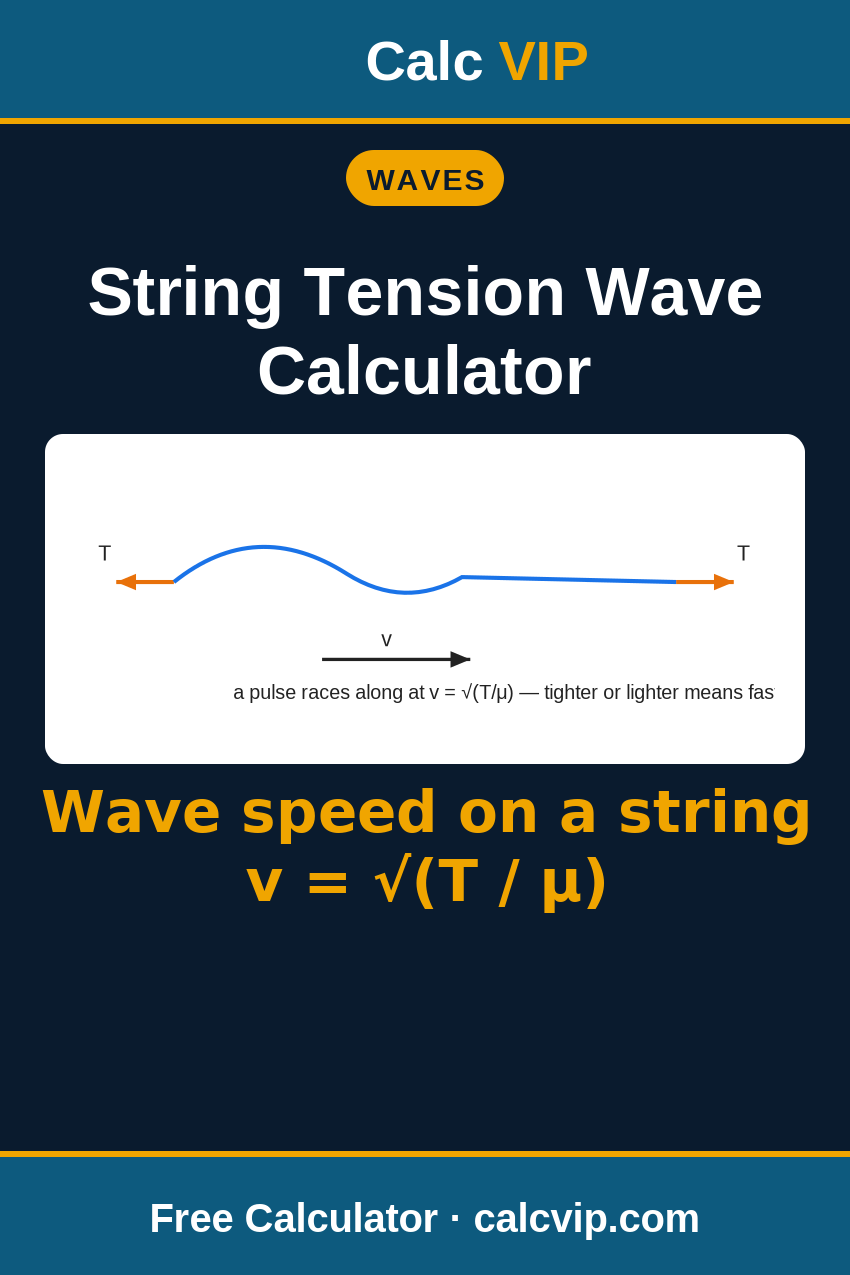
Note what the formula does not contain: the amplitude of the vibration, and the frequency. Pluck hard or soft, high harmonic or low — the waves all travel at the one speed the string's tension and build dictate. Frequency is then decided by geometry (the string's length, through the standing-wave rules), and this speed is the conversion factor between the string's physical state and its musical one. Enter a tension and a mass per unit length — or a mass and length — and this calculator gives you that speed.
Formula
Wave speed on a string v = √(T / μ) • T in newtons (N), μ = mass per unit length in kilograms per metre (kg/m), where μ = mass / length
The formula can be rearranged for design questions: the tension needed for a target speed is T = μv², and the mass per unit length that a given tension and speed imply is μ = T / v². Its musical power appears when it is combined with the standing-wave rule for a string fixed at both ends, f1 = v/(2L): substituting the speed gives f1 = (1/2L)√(T/μ), the complete pitch equation — length, tension and mass in one line. Units are strict: newtons and kilograms per metre. Strings specified in grams or in grams per centimetre (a common manufacturer's unit) must be converted first — 1 g/cm is 0.1 kg/m, a factor of ten that swallows the unwary.
| Symbol | Meaning | Units |
|---|---|---|
| v | speed of waves travelling along the string | m/s |
| T | tension — the pulling force along the string | newtons (N) |
| μ | mass per unit length (linear density) | kg/m |
| m, L | the string's total mass and length, μ = m/L | kg, m |
Why a square root? The tug-of-war inside the formula
Imagine a pulse travelling along a rope and zoom into the small curved segment at its front. The tension pulls along the string on both sides of the curve; because the string is bent there, those two pulls do not quite cancel — they leave a sideways resultant that yanks the segment back towards the straight line. That restoring yank is proportional to the tension: double T and the segment is pulled back twice as hard, so it accelerates twice as fast. But the segment's response also depends on how much mass is being yanked: for the same force, a heavier piece of string accelerates more slowly. Wave speed emerges from this contest — restoring force growing with T, inertia growing with μ — and whenever a speed is set by a ratio of a force-like quantity to a mass-like quantity, a square root appears, just as it does in the speed of sound (pressure over density) and the speed of a pendulum's swing.
The square root has a practical consequence every string player knows in their fingers. Near a string's correct pitch, the tuning peg becomes exquisitely sensitive in one direction and stubborn in the other: because f grows only as √T, dragging a string up a whole tone (12% in frequency) needs about 26% more tension, and an octave (double the frequency) needs four times the tension — far beyond what the string or the instrument's neck will bear. Pitch is changed honestly by changing length (frets, fingers) or by fitting a different string (different μ), and the peg is reserved for fine adjustment. Mersenne wrote down all three of these proportionalities in the 1630s; this calculator and the standing-wave calculator together are his laws with a user interface.
How to use
- Enter the tension in the string in newtons — how hard it is being stretched. (A hanging mass provides tension: a 10 kg mass hung from the string pulls with 10 × 9.81 = 98.1 N.)
- Choose how to give the mass per unit length μ: type it directly, or enter the string's total mass and length and the calculator will divide them.
- Click "Calculate Wave Speed" to get the speed of waves on the string.
- To turn the speed into a pitch, take it to the standing-wave rule: for a string of length L fixed at both ends, the fundamental is f1 = v/(2L).
Worked examples
Example 1 — the reference string. A string is stretched with a tension of 100 N and has a mass per unit length of 0.01 kg/m.
v = √(100 / 0.01) = √10,000 = 100 m/s.
(μ = 0.01 kg/m is what you get from a 0.005 kg string that is 0.5 m long.)
Example 2 — a guitar string, and its pitch. A light guitar string under 80 N of tension has μ = 0.001 kg/m: v = √(80 / 0.001) = √80,000 = 282.84 m/s. On a guitar with a 0.65 m scale length, its fundamental is f1 = 282.84 / (2 × 0.65) = 217.57 Hz — in the region of the A string, showing how the two calculators chain together from raw materials to a musical note.
Example 3 — a piano's wound bass string. A bass string carries 800 N of tension — piano strings are pulled hard — but its copper winding raises μ to 0.05 kg/m: v = √(800 / 0.05) = √16,000 = 126.49 m/s. Despite eight times the tension of Example 1, the wave runs barely faster, because the mass grew too. That trade is the entire design of the piano's bass end.
Example 4 — the cost of doubling the speed. Starting from Example 1 (T = 100 N, μ = 0.01 kg/m, v = 100 m/s), raise the tension fourfold to 400 N: v = √(400 / 0.01) = √40,000 = 200 m/s. Four times the tension buys exactly twice the speed — the square root collecting its tax, and the reason nobody tunes a string up an octave with the peg.
Example 5 — a loaded climbing rope. A rope with μ = 0.06 kg/m is tensioned to 600 N by a climber's weight: v = √(600 / 0.06) = √10,000 = 100 m/s. A pluck or a slip-pulse races along the rope at 100 m/s — which is why a tug on a long rope is felt at the other end essentially instantly, and why rope vibrations in climbing and sailing are over before you can react to them.
Example 6 — designing backwards. An instrument maker wants waves at 150 m/s on a string with μ = 0.004 kg/m. The required tension is T = μv² = 0.004 × 150² = 0.004 × 22,500 = 90 N — a comfortable pull for a guitar-sized instrument, confirming the design is feasible before a single string is bought.
String waves in real life
Tuning every stringed instrument. The peg changes T, the string gauge sets μ, and the formula sets v — and through f1 = v/(2L), the pitch. Every tuning session on earth is an adjustment of this equation by ear.
Wound bass strings. Guitar, piano and double-bass bass strings are wound with extra wire to raise μ without making the string stiff and unbendable. The winding is a deliberate μ-boost, letting short instruments reach low notes at sane tensions.
The monochord and the laboratory. The classic school experiment — a string over a pulley with hanging masses — is this calculator made of wood and wire: vary the hanging mass (T) or the string (μ), measure the standing-wave frequency, and verify the square roots directly.
Bridge and power cables. Long cables under tension carry waves at √(T/μ) too, and wind can feed energy into their standing waves — the galloping and humming of overhead lines, and the reason cable-stayed bridges fit dampers to spoil the resonance.
Tennis and badminton strings. Racket string tension (typically 200–300 N across the bed) sets the wave speed in the strings, which shapes how long the ball stays in contact and how the racket feels — players specifying "26 kg of tension" are setting T, hence v, hence response.
Clotheslines and skipping ropes. A pulse sent down a sagging clothesline travels slowly because the tension is low; pull the line taut and the same pulse snaps across. Children swinging a rope are exploiting the same relation to set the rope's turning rhythm.
Quick reference: tension versus speed for μ = 0.01 kg/m
| Tension T | T/μ | Wave speed v = √(T/μ) |
|---|---|---|
| 25 N | 2,500 | 50 m/s |
| 100 N | 10,000 | 100 m/s |
| 225 N | 22,500 | 150 m/s |
| 400 N | 40,000 | 200 m/s |
The tensions in the table are chosen as perfect squares on purpose: they make the square root's behaviour impossible to miss. Each doubling of speed costs a quadrupling of tension — and, on a real instrument, a quadrupling of the load trying to tear the neck off.
Stiffness: the one way real strings cheat the formula
The formula treats the string as perfectly flexible, and real strings — especially thick, short, steel ones — are not quite. A stiff string resists bending, and the resistance adds a little extra restoring force that matters more for the short-wavelength higher harmonics than for the fundamental. The result is inharmonicity: a stiff string's harmonics run progressively sharp of the perfect ladder n × f1, by an amount that grows with the square of the harmonic number. Piano tuners hear it as a fact of life and compensate by "stretching" the tuning — setting the extreme treble and bass progressively sharper and flatter than theory — producing the Railsback curve measured on every well-tuned piano. It is also why short upright pianos, with their short, thick bass strings, can never sound quite like a long grand: their μ was bought with stiffness, and the harmonics testify against them. For thin, long strings — guitars, violins, harps — the effect is tiny and v = √(T/μ) reigns unchallenged.
Reflections: where travelling waves become standing waves
Send a single pulse down a string and watch the ends. At a fixed end the pulse reflects upside down — inverted — because the clamp cancels the displacement by exerting an opposite force. At a free end it reflects the right way up. Either way the pulse survives the journey and comes back at the same speed v = √(T/μ), because the string's tension and mass have not changed. Now pluck repeatedly, or shake one end in rhythm, and the string fills with pulses chasing their own reflections; at most frequencies they scramble, but at the special frequencies where each new pulse lands exactly on the pattern of the returning ones, the motion organises into a standing wave. That is the bridge between this calculator and the standing-wave calculator: the speed found here sets how fast the reflections shuttle, and the shuttle rate decides which frequencies can build a pattern that fits.
Common mistakes
- Using the string's total mass instead of μ. The formula wants mass per unit length. Feeding in the whole mass of a 0.5 m string overstates μ by a factor of 2 and understates the speed by √2. If you know mass and length, divide first — the calculator's second mode does exactly this.
- Expecting double tension to mean double speed. Speed grows as √T: double the tension and the speed rises only by √2 ≈ 1.41. Pitch problems set "to double the frequency" require four times the tension (or a quarter of the length).
- Mixing up grams per centimetre and kilograms per metre. String data is often given in g/cm; 0.1 g/cm equals 0.01 kg/m. A factor-of-ten slip inside a square root still leaves the answer wrong by a factor of about 3.2.
- Thinking harder plucking means faster waves. Amplitude does not appear in the formula. A harder pluck makes a louder wave of the same speed and pitch — and if it did change the speed, chords would bend out of tune whenever the player dug in.
- Forgetting that tension is a force, in newtons. A "10 kg string tension" in shop language means the pull of a 10 kg mass: 10 × 9.81 = 98.1 N. Enter 10 and the calculator politely computes the speed for a nearly slack string.
FAQ
Why does tightening a guitar string raise its pitch?
The pitch is set by the standing-wave frequency, which is proportional to the wave speed. Turning the tuning peg increases the tension T, so v = √(T/μ) rises and every harmonic of the string rises with it.
Why are the bass strings on a guitar thicker?
Thicker strings have a larger μ, which lowers the wave speed and so lowers the pitch — without needing an impossibly long or slack string.
Does the wave speed depend on how hard I pluck?
No. Plucking harder makes the vibration bigger (louder), but the speed depends only on the tension and the mass per unit length of the string.
What exactly is μ, and how do I find it for a real string?
μ is the string's mass divided by its length, in kg/m. Weigh a known length of the string (a metre offcut is ideal) on a kitchen scale: 4 grams per metre means μ = 0.004 kg/m. Manufacturers also publish it, sometimes as grams per centimetre — divide g/cm by 10 to get kg/m… carefully: 1 g/cm = 0.1 kg/m.
How can I set a known tension in an experiment?
Hang the string over a pulley and attach a mass: the tension equals the weight, T = mg. A 10 kg mass gives 98.1 N. This is the standard sonometer setup, and it turns tension into something you can read off a set of laboratory masses.
Why do strings drift out of tune with temperature?
Heat expands the string (and the instrument) and the expansion relaxes the tension slightly; cold does the reverse. Since pitch follows √T, even a small tension drift is audible — which is why guitarists retune after the stage lights have warmed the room.
Does the string's material matter, or only its mass?
Only through μ. For a plain string, μ is set by the material's density and the string's thickness together (μ = density × cross-sectional area), so steel, nylon and gut strings of the same gauge have different μ and different speeds at the same tension. The formula itself neither knows nor cares what the string is made of.
How fast do waves travel on a violin string?
Of the order of a few hundred metres per second — the worked example's 282.84 m/s for a guitar string is typical of the family. The exact figure follows from each string's tension and gauge via this calculator, and the bow then excites standing waves at the harmonics of v/(2L).
Why are piano bass strings wound with copper?
A plain steel string thick enough to give the needed μ would be too stiff to vibrate cleanly — stiffness spoils the harmonic series. Winding a thin core with copper wire adds mass (raising μ, lowering v and the pitch) while keeping the string flexible: the best of both terms in the formula.
Can waves on a string be longitudinal?
Strings do support faint longitudinal waves (stretching waves), which travel much faster and account for the squeaks and "ping" overtones of bowed strings, but the musically important waves — and everything in this calculator — are the transverse waves that displace the string sideways.