 Calc
String Harmonics Calculator – First Five Harmonics of a Vibrating String
 Created by David Okafor · Physics Writer · Waves & Light · Last updated: November 2026
Use this free String Harmonics Calculator to list the first five harmonics of a vibrating string. Enter the fundamental frequency and the string length, and see each harmonic's frequency and wavelength at a glance.
Pluck a guitar string and you do not hear one frequency — you hear a family. The string vibrates as a whole at its fundamental frequency, but simultaneously in halves, thirds, quarters and fifths, each segment pattern adding its own pitch to the sound. Those segment vibrations are the harmonics, and this calculator tabulates the first five of them: their frequencies, each an exact multiple of the fundamental, and their wavelengths, each an exact fraction of twice the string length. Five rows of arithmetic that explain why instruments have tone colour, why tuning works, and why a flute and a violin playing the same written note are instantly distinguishable.
The pattern is forced by geometry. A string fixed at both ends must be still at those ends — nodes — whatever else it does. The only standing waves that fit are those with a whole number of half-wavelengths along the string: one half-wave (λ = 2L), two (λ = L), three (λ = 2L/3) and so on. Since the wave speed along the string is the same for every pattern, the frequencies inherit the same integer structure: fn = n × f₁. Nature rarely hands out exact integer relationships, but here the boundary conditions demand them. The harmonic series — 1, 2, 3, 4, 5 times the fundamental — is the same series that brass players climb with their lips and that composers have exploited for centuries.
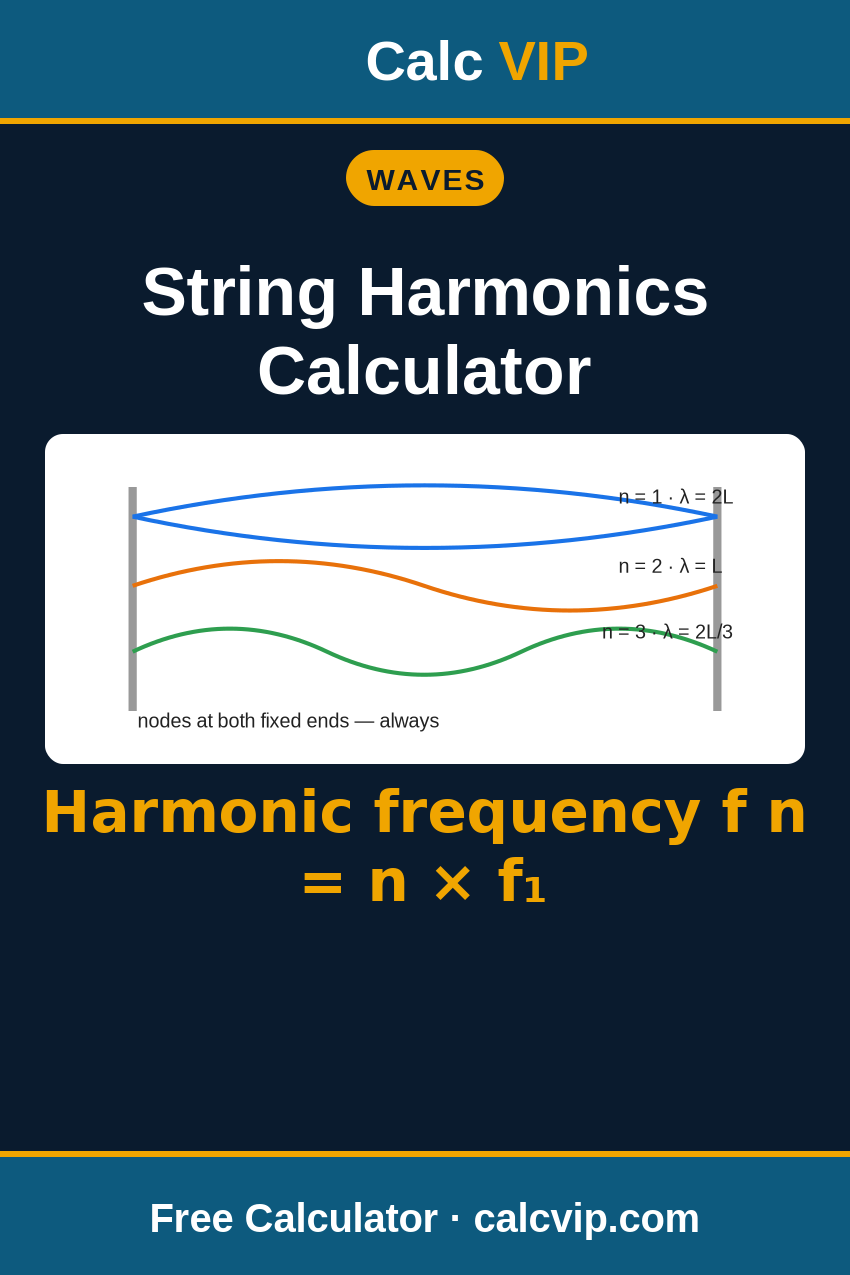
Two inputs are all the physics needs. The fundamental frequency f₁ encodes everything about the string's tension, thickness and material, compressed into a single measurable number. The length L sets the wavelengths directly through λn = 2L/n. From those two, the table follows — and with it, predictions a musician can use: where to touch the string to raise a natural harmonic, which notes will blend consonantly, and what wave speed the string is carrying (v = f₁ × λ₁ = f₁ × 2L, the hidden third quantity the table reveals — for the worked example's guitar string, 110 × 1.30 = 143 m/s, a wave crossing the string in under five milliseconds).
Formula
Harmonic frequency fn = n × f₁ • Harmonic wavelength λn = 2L / n (n = 1, 2, 3, …) • and the wave speed on the string is v = f₁ × 2L, the same for every harmonic
The two formulas are twins of the single condition "a whole number of half-wavelengths must fit": L = n × λn/2. Solve it for λn and you get 2L/n; feed that into f = v/λ with a constant v and the frequencies come out as n × (v/2L) — and v/2L is precisely f₁. The fundamental itself obeys Mersenne's laws: f₁ = (1/2L) × √(T/μ), rising with tension T, falling with length L and with mass per unit length μ. That is the physics behind every tuning peg and every fret. Note what the table quietly proves: fn × λn = n f₁ × 2L/n = 2Lf₁ = v for every row — multiply any row's frequency by its wavelength and you recover the same wave speed, a built-in consistency check on the whole table.
| Symbol | Meaning | Units |
|---|---|---|
| n | harmonic number (1 = fundamental) | — |
| f₁ | fundamental frequency | hertz (Hz) |
| fn | frequency of the n-th harmonic | hertz (Hz) |
| L | vibrating length of the string | m |
| λn | wavelength of the n-th harmonic | m |
Standing waves: how a string plays several notes at once
A travelling wave on a string, reflected at a fixed end, comes back inverted and meets itself. At most frequencies the meeting waves cancel into mush, but at the harmonic frequencies they reinforce perfectly, building a standing wave: a pattern that oscillates in place, with still points (nodes) and maximally swinging points (antinodes) frozen at fixed positions. The string does not choose one pattern — a pluck excites all of them at once, and the real vibration is their sum, a shape that looks like a skipping rope drawn by a committee. Each harmonic then leaks its own frequency into the air, and your ear receives the chord: fundamental loudest, usually, with the upper harmonics layered above in strengths that depend on where and how the string was plucked.
That dependence is a gift to musicians. Pluck near the middle and you suppress the even harmonics (they have a node where you are forcing an antinode); pluck near the bridge and the high harmonics flourish, giving a bright, nasal tone. Touch the string lightly at its midpoint while bowing and the fundamental dies but the second harmonic survives — the flautando "natural harmonic" of string playing, sounding an octave up with a glassy purity. Touch at a third of the length and the third harmonic sings, a twelfth above the open string. Every one of those tricks is a row of this calculator's table, played with a fingertip: the touch point must be a node of the harmonic you want to keep, and the node positions are L/n fractions that the wavelengths predict exactly.
How to use
- Enter the fundamental frequency f₁ in hertz — the pitch the open string is tuned to (a tuner app will read it directly).
- Enter the vibrating length L in metres — from nut to bridge on a guitar, or between the points where the string is held.
- Click "Show Harmonics" to see the first five harmonics with their frequencies and wavelengths.
- Use the wavelengths physically: the n-th harmonic has nodes at every L/n along the string, so the table doubles as a map of where to touch for natural harmonics.
Worked examples
Example 1 — the guitar A string. A guitar string has a fundamental of 110 Hz (the A string) and a length of 0.65 m.
fn = n × 110 → 110, 220, 330, 440, 550 Hz.
λn = 2 × 0.65 / n → 1.30, 0.65, 0.43, 0.33, 0.26 m.
The 4th harmonic, 440 Hz, is the standard tuning note A4.
Example 2 — a violin G string. f₁ = 196 Hz, L = 0.328 m.
Frequencies: 196, 392, 588, 784, 980 Hz.
Wavelengths: 0.656, 0.328, 0.22, 0.164, 0.131 m. The violin's shorter string squeezes every wavelength to about half the guitar's, and its wave speed is 196 × 0.656 = 129 m/s.
Example 3 — the guitar's low E. f₁ = 82.4 Hz, L = 0.65 m.
Frequencies: 82.4, 164.8, 247.2, 329.6, 412 Hz.
Wavelengths: 1.30, 0.65, 0.43, 0.33, 0.26 m — identical to Example 1, because the wavelengths depend only on L. The lower pitch comes entirely from a slower wave speed: 82.4 × 1.30 = 107 m/s, achieved with a thicker, heavier string.
Example 4 — a cello C string. f₁ = 65.4 Hz, L = 0.69 m.
Frequencies: 65.4, 130.8, 196.2, 261.6, 327 Hz.
Wavelengths: 1.38, 0.69, 0.46, 0.345, 0.276 m, and the wave speed is 65.4 × 1.38 = 90.3 m/s — the slowest yet, on the longest, heaviest string. The pattern across Examples 1–4 is Mersenne's law in action.
Example 5 — fretting the octave. Press the guitar A string at its 12th fret, halving the vibrating length to 0.325 m.
The new fundamental is v/2L = 143 / 0.65 = 220 Hz — exactly the old 2nd harmonic, now promoted to fundamental. Its own harmonics follow the table with λ₁ = 0.65 m. Every fret is a length change, and every length change re-runs this calculator.
Example 6 — finding the nodes. Where are the nodes of the 3rd harmonic on the 0.65 m guitar string?
The pattern has loops of λ₃/2 = 0.433/2 = 0.217 m, so nodes sit at 0, 0.217 m, 0.433 m and 0.65 m. Touching the string at 21.7 cm from either end while plucking isolates the 330 Hz third harmonic — the "twelfth" chime guitarists use to check intonation.
Harmonics in real life
Timbre — why instruments differ. A flute's spectrum is dominated by the fundamental with a whisper of 2nd harmonic; a violin's is rich through the 5th and beyond; a clarinet (a closed pipe, the string's cousin) emphasises odd harmonics. Same f₁, different recipe — the table is the ingredient list.
Tuning by harmonics. Guitarists tune by matching harmonics across strings — the low E string's 4th harmonic (4 × 82.4 = 329.6 Hz, touched at a quarter of its length) against the A string's 3rd (3 × 110 = 330 Hz, touched at a third) — listening for the slow beats that reveal a mismatch of a fraction of a hertz. It is this calculator's arithmetic, done by ear.
Brass and woodwind playing. A trumpet's tube fixes a harmonic series; the player's lips select which member sounds. The bugle, with no valves at all, plays entire military calls from harmonics 2–6 of a single tube.
Power-line hum and machinery. Vibrating cables, transformer laminations and engine parts all sing in harmonic series based on their size and tension. Engineers who hear a 3rd or 5th harmonic dominating know a resonance is being fed — and detune the structure by changing its effective L.
Speech and singing. The vocal folds produce a harmonic-rich buzz; the throat and mouth filter it, boosting whichever harmonics fall in their resonance bands (formants). Vowels are, acoustically, different harmonic recipes from the same fundamental machinery.
Structural safety. Suspension-bridge cables and tall chimneys have harmonic frequencies set by their lengths. If wind shedding or machinery feeds energy at one of those frequencies, amplitudes grow dangerously — the reason bridges carry dampers tuned with exactly this mathematics.
Mersenne's laws: what sets f₁ in the first place
The calculator takes f₁ as given, but f₁ itself obeys three proportionalities discovered by Marin Mersenne in the 1630s: f₁ rises with the square root of tension, and falls in proportion to length and to the square root of mass per unit length — f₁ = (1/2L)√(T/μ). Each law is a control on a real instrument. Tuning pegs adjust T: raise the tension by 4% and the pitch rises about 2%, a semitone's third. Fingers and frets adjust L: halve the length, double the frequency — the octave at the 12th fret. String choice adjusts μ: the bass strings are wound with extra metal precisely to raise μ, so a low note fits on a reasonable length at a reasonable tension; an unwound string thin enough for 82.4 Hz at guitar length would have to be slack to the point of unplayability. Worked backwards, the guitar A string's numbers give its tension: with v = 143 m/s and a typical μ of 0.006 kg/m, T = μv² ≈ 123 N — about the weight of a 12 kg mass, hanging off each string, which is why guitar necks are engineered like bridges.
Quick reference: the harmonic series of a 100 Hz string (L = 1 m)
| Harmonic n | Frequency | Wavelength | Musical interval above f₁ |
|---|---|---|---|
| 1 | 100 Hz | 2.00 m | fundamental |
| 2 | 200 Hz | 1.00 m | octave |
| 3 | 300 Hz | 0.67 m | octave + fifth |
| 4 | 400 Hz | 0.50 m | two octaves |
| 5 | 500 Hz | 0.40 m | two octaves + major third |
The interval column is the harmonic series' musical soul: octaves and fifths fall out of small whole numbers, which is why those intervals sound consonant in every culture's music — the ear is hearing arithmetic.
The pluck position is an equaliser
Where you pluck decides which rows of the table get heard. A harmonic can only sound strongly if the pluck point is a place where that harmonic actually moves — pluck exactly at a harmonic's node and that harmonic is silent, because you never displaced the string where it needed displacing. The precise rule is that the n-th harmonic's strength follows sin(nπx/L) for a pluck at distance x from one end (divided by n², which is why spectra fade upward). Pluck at the midpoint, x = L/2, and sin(nπ/2) is zero for every even n: the 2nd, 4th, 6th harmonics vanish, leaving the hollow, flute-like tone guitarists get when they play over the soundhole's centre. Pluck at L/4 instead and it is the 4th, 8th and 12th harmonics that disappear; pluck near the bridge, where x is small and sin(nπx/L) stays lively for many n, and the sound turns bright and hard. Classical players slide the right hand along the string as a tone control — they are, without writing it down, editing this calculator's table row by row.
Common mistakes
- Using λ₁ = L. The fundamental's wavelength is twice the string length, because only half a wave fits on the string. Forgetting the factor of two corrupts every wavelength and every wave speed derived from them.
- Counting the fundamental as an overtone. The fundamental is the 1st harmonic but the 0th overtone. The 2nd harmonic is the 1st overtone. Mixing the two numbering systems mislabels every row.
- Expecting the wavelengths to scale with frequency. λn = 2L/n depends only on length and n. Two strings of the same length have identical harmonic wavelengths whatever their pitches — Examples 1 and 3 prove it.
- Measuring L between the wrong points. L is the vibrating length — nut to bridge, or fret to bridge when fretted — not the total string length including the part wound on the tuning peg.
- Assuming all harmonics are equally strong. The table gives frequencies and wavelengths, not amplitudes. Real spectra fade with n and shift with pluck position; a row's presence in the table guarantees the frequency exists, not that it is loud.
FAQ
Why are the harmonics whole-number multiples?
A standing wave must have nodes at both fixed ends, so only whole numbers of half-wavelengths fit on the string. That forces the frequencies to be n × f₁.
What is the difference between a harmonic and an overtone?
The fundamental is the 1st harmonic. The 2nd harmonic (2f₁) is the 1st overtone, the 3rd harmonic is the 2nd overtone, and so on.
Why do different instruments playing the same note sound different?
Each instrument produces the same fundamental but a different mix of harmonic strengths. That blend — the timbre — is what makes a guitar and a violin sound distinct.
Why does the wave speed come out the same for every harmonic?
Because the string sets one speed, v = √(T/μ), for all its waves. Check any row: fn × λn = (n f₁)(2L/n) = 2Lf₁ = v. The n cancels — that cancellation is the harmonic series.
How many harmonics does a real string produce?
Dozens, in principle — the table stops at five for clarity. A plucked guitar string shows measurable harmonics beyond the 20th, though each is weaker, and string stiffness slightly sharpens the highest ones (a real effect called inharmonicity, important in piano tuning).
What is the wavelength of the 10th harmonic of the guitar A string?
λ₁₀ = 2 × 0.65 / 10 = 0.13 m, and f₁₀ = 10 × 110 = 1,100 Hz. The pattern extends as far as you care to take it.
Why do harmonics make consonant intervals?
Because small-integer frequency ratios (2:1 octave, 3:2 fifth, 4:3 fourth) make the combined waveform repeat simply, which the ear reads as smoothness. The harmonic series is built from exactly those ratios.
Can I hear a single harmonic on its own?
Yes — the natural-harmonic technique: touch the string lightly at a node of the desired harmonic (for the 2nd, the midpoint) and pluck. The touch kills every harmonic without a node there, leaving the chosen one ringing almost purely.
Do pipes have the same harmonic table?
An open pipe does — all integer multiples, like a string. A pipe closed at one end has only the odd harmonics (f, 3f, 5f…), because its wavelengths are 4L/(2n−1). The missing even harmonics are why a clarinet's recipe differs from a flute's.
Why does plucking near the bridge sound brighter?
A pluck at a point suppresses harmonics with a node there and favours the rest. Plucking near the end, where all the low harmonics have antinode-ish freedom but the string's displacement shape is sharply peaked, feeds many high harmonics — brightness is high-n content, and position is the mixer.