 Calc
Stopping Distance Calculator – Reaction + Braking Distance
 Created by Sarah Mitchell · Physics Editor · Motion & Measurement · Last updated: November 2026
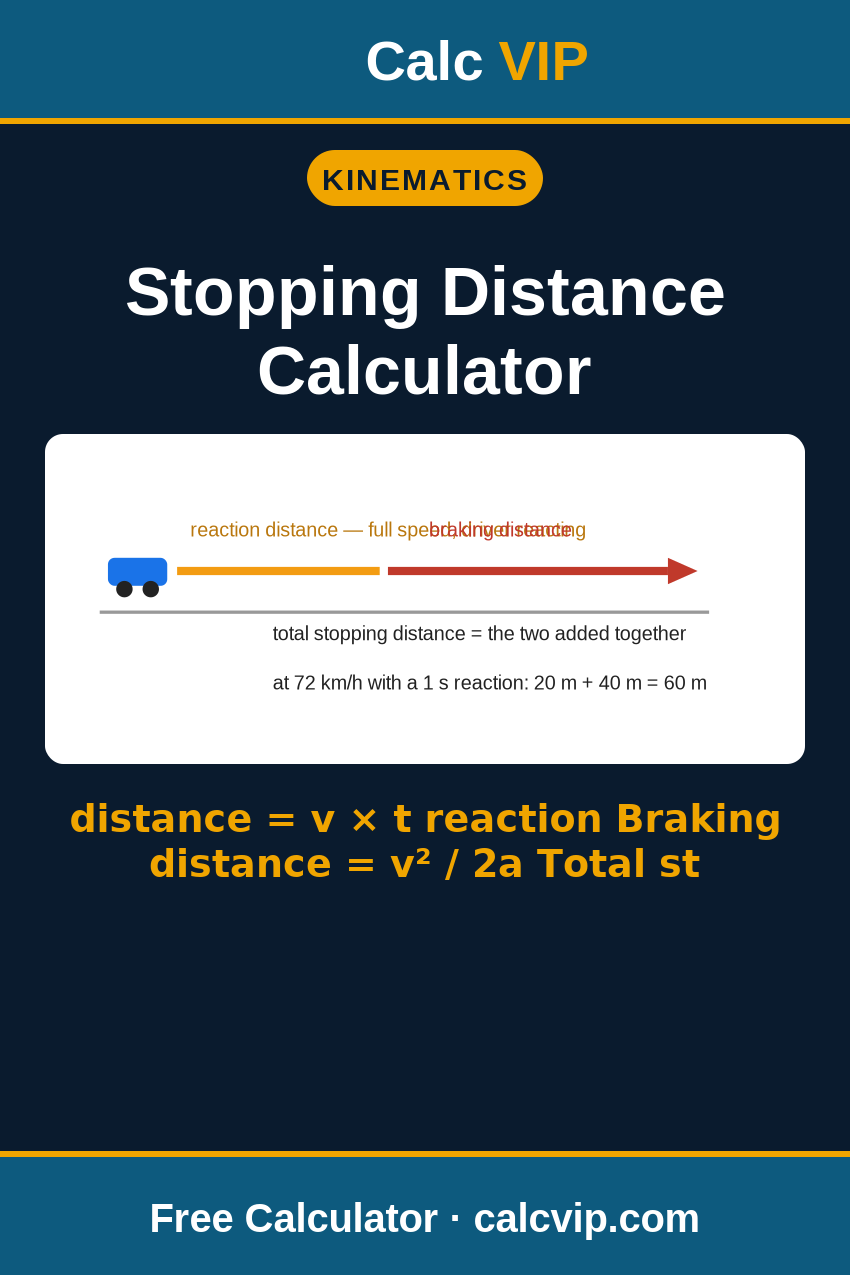
Use this free Stopping Distance Calculator to find how far a vehicle travels from the moment the driver sees a hazard until it fully stops. It adds the reaction distance (travelled while the driver reacts) to the braking distance (travelled while the brakes slow the vehicle).
A stop is not an event; it is a journey in two acts, and the first act is the one drivers forget. When a hazard appears, the vehicle continues at full speed while the driver perceives it, decides, and moves a foot to the brake pedal — typically a full second, covering what this page calls the reaction distance. Only then does the second act begin: the brakes convert motion into heat and the vehicle sheds speed over the braking distance. The total stopping distance is the sum, and it is always longer — sometimes startlingly longer — than the braking distance quoted in isolation. Every "I never had time to stop" is, in the language of this page, a reaction distance plus a braking distance that together exceeded the gap available.
The two acts scale very differently with speed, and the difference is the most important safety fact in driving. Reaction distance grows in simple proportion: twice the speed, twice the distance covered in your one second of thinking. Braking distance grows with the square: twice the speed, four times the distance, because the brakes must dispose of four times the kinetic energy at the same rate of deceleration. Add a merely proportional term to a quadratic one and the total explodes at speed — from 20 m at 36 km/h to 120 m at 108 km/h in the worked examples below, a sixfold growth for a threefold speed increase.
This calculator takes the vehicle's speed (in km/h, m/s or mph), the driver's reaction time in seconds, and the braking deceleration in m/s², and reports both parts and the total. If you know the road's friction coefficient μ instead of the deceleration, use a = μg: about 6.9 m/s² on dry asphalt (μ ≈ 0.7), about 3.9 m/s² on a wet road (μ ≈ 0.4). The examples and tables below build the intuition that driving examiners, road designers and crash investigators all share: distance, not time, is what a stop consumes.
Formula
Reaction distance = v × treaction
Braking distance = v² / 2a
Total stopping distance = reaction distance + braking distance
Tip: on a road with friction coefficient μ, the deceleration is a = μg. For example a dry road (μ ≈ 0.7) gives a ≈ 6.9 m/s², and a wet road (μ ≈ 0.4) gives a ≈ 3.9 m/s².
Each line has its own ancestry. The reaction distance is constant-speed motion, s = vt, because during the reaction the vehicle has not yet begun to slow. The braking distance is the third equation of motion, v² = u² + 2as, with the final velocity set to zero and the acceleration negative: 0 = v² − 2a·s, giving s = v²/2a. That same expression falls out of energy — the brakes must absorb kinetic energy ½mv², working against friction force μmg over the distance, and the mass cancels to leave v²/2μg — which is why a loaded lorry and a small car with equally good tyres stop in similar distances from the same speed: the energy per kilogram is identical. What mass changes is the heat the brakes must swallow, not the geometry of the stop. And because the braking term carries v², it dominates the total at any serious speed, while at town speeds the reaction term — the human term — is the larger of the two.
| Symbol | Meaning | Units |
|---|---|---|
| v | vehicle speed when the hazard appears (converted to m/s inside) | m/s |
| treaction | time from seeing the hazard to the brakes biting | s |
| a | braking deceleration the tyres and road can sustain | m/s² |
| μ | coefficient of friction between tyre and road | — (dimensionless) |
| g | acceleration due to gravity, in a = μg | m/s² (9.81) |
| v² / 2a | braking distance — the quadratic term | m |
The second that costs twenty metres
Reaction time is the only part of the stop that belongs to the driver rather than the machine, and it is cruelly expensive at speed. A typical alert driver needs about 1 second — perception, decision, foot movement — and many real drivers, surprised, tired, older, or glancing at a phone, need 1.5 to 2.5 seconds. The vehicle prices each second at its full speed: at 72 km/h the meter runs at 20 m per second, at 108 km/h at 30 m per second. Example 5 below shows a tired driver's 2-second reaction at 72 km/h doubling the reaction distance to 40 m and pushing the total from 60 m to 80 m — the length of two extra houses between the hazard and the stop, bought with nothing but attention. This is why following-distance rules are written in seconds ("two seconds behind the car ahead") rather than metres: a time gap automatically scales the space with speed, matching the reaction distance's own scaling.
The braking act belongs to physics and maintenance. Its ceiling is set by friction: the tyres can demand no more deceleration than μg before they lock or slide, which is why the same car stops in 40 m of braking on dry asphalt (a = 5 m/s² in the examples, a firm but not extreme stop) and needs 50 m on a wet road at a = 4 m/s² — and far more on ice, where μ can fall to 0.1 and a barely reaches 1 m/s². Anti-lock brakes do not shorten the ideal distance much; their gift is keeping the tyres near the friction peak and the steering alive while the distance is spent. Worn tyres, standing water and downhill gradients all tax the same term. Note the gradient's subtlety: on a slope the effective deceleration falls by g·sin(slope) — a 10% downgrade steals roughly 1 m/s² before the brakes do anything at all.
Put the acts together and the total has a personality neither act has alone. At low speed the stop is mostly the driver's second; at high speed it is mostly the square law. Cross-over in the standard configuration (1 s, 5 m/s²) happens near 36 km/h, where the two terms are equal at 10 m each. Above that speed the quadratic takes command, and the only defences are anticipation — starting the reaction earlier, which is free — and speed itself, which is the one variable that shrinks both terms at once.
How to use
- Enter the vehicle speed and choose its unit (km/h, m/s or mph).
- Enter the driver's reaction time in seconds (about 1 s for an alert driver; try 1.5–2 s to model tiredness or distraction).
- Enter the braking deceleration in m/s² — about 5 m/s² is a firm stop on a dry road; use a = μg if you know the friction coefficient.
- Click "Calculate Stopping Distance" to see both parts and the total.
- Compare the total with real gaps: a typical motorway following gap, a side street's length, the distance to the car ahead. The comparison, not the number alone, is the safety lesson.
Worked examples
Example 1 — the standard stop. A car travels at 72 km/h (= 20 m/s). With a reaction time of 1 s, the reaction distance is 20 × 1 = 20 m. Braking at a = 5 m/s², the braking distance is 20² ÷ (2 × 5) = 40 m. Total stopping distance = 20 + 40 = 60 m — fifteen car lengths from hazard to halt, at an unremarkable speed.
Example 2 — town speed. At 50 km/h (13.89 m/s), reaction 1 s, a = 5 m/s²: reaction distance 13.89 m, braking distance 13.89² ÷ 10 = 19.29 m, total 33.18 m. In town the two terms are comparable — the driver's second costs nearly as much road as the brakes do.
Example 3 — motorway speed. At 108 km/h (30 m/s), reaction 1 s, a = 5 m/s²: reaction distance 30 m, braking distance 900 ÷ 10 = 90 m, total 120 m. Tripling the speed from Example 6's 36 km/h multiplied the total sixfold — the square law collecting its debt.
Example 4 — the wet road. Same 72 km/h and 1 s reaction, but the wet surface allows only a = 4 m/s²: reaction distance still 20 m, braking distance 400 ÷ 8 = 50 m, total 70 m. The rain changed nothing about the driver and everything about the second act — ten extra metres that arrive uninvited.
Example 5 — the tired driver. Same dry road as Example 1, but the reaction time is 2 s: reaction distance 20 × 2 = 40 m, braking still 40 m, total 80 m. Fatigue and distraction are distance multipliers — the most dangerous variable in the whole formula is the one measured in seconds inside the driver's head.
Example 6 — the gentle street. At 36 km/h (10 m/s), reaction 1 s, a = 5 m/s²: reaction distance 10 m, braking distance 100 ÷ 10 = 10 m, total 20 m. The two acts tie exactly — this is the cross-over speed where human and machine contribute equally to the stop.
Stopping distance in real life
Driving tests and highway codes. The stopping-distance tables in driving manuals worldwide are this formula with standardised inputs (typically a reaction time around 0.7–1 s and a firm dry-road deceleration). Learners memorise the outputs; this page shows the machinery that generates them, so any speed can be assessed, not just the tabulated ones.
Following-distance rules. The two-second rule is the reaction distance in disguise: keeping two seconds of travel behind the vehicle ahead guarantees at least your full reaction distance of clear road, with the braking term then roughly matched because the vehicle ahead is braking too, not parked.
Road and junction design. Sight distances at junctions, the length of deceleration lanes, and the placement of warning signs are all computed from stopping distance at the road's design speed — engineers must guarantee that a driver who sees the hazard at the limit of visibility can spend both acts and still stop.
Crash investigation. A measured skid length gives the braking distance, from which v = √(2a·s) recovers the speed when braking began; adding the likely reaction distance reconstructs where the driver first could have reacted. Courts hear this formula more often than any other in physics.
Cycling and e-scooters. The same arithmetic governs two wheels, with weaker decelerations (about 3–4 m/s² before a bicycle pitches or slides): at 25 km/h (6.94 m/s) with a 1 s reaction, a cyclist needs 6.94 m of reaction plus 6.94² ÷ 7 ≈ 6.88 m of braking — about 13.8 m in all, a number city riders consistently underestimate.
Railways: the extreme case. Steel on steel gives μ so low that a train's deceleration is around 0.5–1 m/s²: from 108 km/h (30 m/s) the braking distance alone is 900 ÷ 1.6 ≈ 560 m at 0.8 m/s², before any reaction term. That single fact explains signal spacing, and why trains cannot "brake for" anything the driver can see.
Quick reference: stopping distances (reaction 1 s, a = 5 m/s²)
| Speed | Reaction distance | Braking distance | Total |
|---|---|---|---|
| 30 km/h | 8.33 m | 6.94 m | 15.28 m |
| 50 km/h | 13.89 m | 19.29 m | 33.18 m |
| 70 km/h | 19.44 m | 37.81 m | 57.25 m |
| 90 km/h | 25 m | 62.50 m | 87.50 m |
| 110 km/h | 30.56 m | 93.36 m | 123.92 m |
Watch the braking column outrun the reaction column as speed climbs: at 30 km/h the driver is the bigger term; at 110 km/h the brakes need three times the driver's distance. Any safety intervention that trims speed pays twice — once in each column — which is why a 10% speed reduction shrinks the braking term alone by 19% and the whole stop by up to roughly a fifth.
Thinking distance, braking distance, and the language of manuals
British manuals call the reaction distance the thinking distance, a name worth adopting for its honesty: the car travels it while the driver is still thinking. The manuals' totals assume a brisk, alert driver and a healthy car on a dry road — best-case inputs, deliberately, because a standard must be achievable to be teachable. Real stops add the corrections this page lets you explore: lengthen the reaction time for night, fatigue or phones; cut the deceleration for rain, ice, worn tyres or a downhill grade; and the total grows with discouraging speed. The mature use of this calculator is not to reproduce the manual's table but to interrogate your own driving with it — your reaction time, your roads, your weather.
Common mistakes
- Quoting the braking distance as the stopping distance. The reaction distance comes first and is not small: at 90 km/h it is 25 m of the 87.5 m total. Any answer that omits it describes a robot driver with the brakes already pressed.
- Assuming doubling speed doubles the stop. It roughly triples it: 33.18 m at 50 km/h becomes 87.50 m at 90 km/h and would be about 123.92 m at 110. The v² term punishes linear intuition — run the numbers instead.
- Using the dry-road deceleration on a wet day. a is a property of the tyre–road pair, not the car alone. Rain can cut it from ~6.9 to ~3.9 m/s²; ice, to under 1. The formula is only as honest as the a you feed it.
- Entering speed in km/h where the formula expects m/s. This calculator converts for you when you select the unit — but in hand calculations, v must be in m/s before squaring. 72 km/h squared is not a braking distance; 20 m/s squared, divided by 2a, is.
- Believing a heavier vehicle needs proportionally more distance. In the friction-limited model the mass cancels — a lorry and a car share the same v²/2μg. What heavy vehicles actually suffer from is brake heating and longer air-system response, which enter through a and the reaction term, not through mass in the formula.
FAQ
Why does doubling the speed quadruple the braking distance?
Because braking distance depends on v². Twice the speed means four times the braking distance — this is why speed is so dangerous in emergencies.
What deceleration should I use?
Typical values: about 3–4 m/s² for gentle braking, about 5 m/s² for a firm stop, and up to about 7 m/s² for an emergency stop on a dry road with good tyres (a = μg, μ ≈ 0.7).
Does the reaction distance matter much?
Yes. At 72 km/h the car covers 20 m in a single second of reaction time — before the brakes are even touched.
What is a realistic reaction time?
About 0.7–1 s for an alert driver expecting trouble; 1.5 s is a fair planning figure for ordinary driving, and 2 s or more for a tired, elderly or distracted driver. The Highway Code's tables assume roughly two-thirds of a second — brisk, and worth beating rather than merely matching.
How much longer is the stop on a wet road?
With μ ≈ 0.4 (a ≈ 3.9 m/s²) instead of dry μ ≈ 0.7 (a ≈ 6.9), the braking distance grows by a factor of about 6.9 ÷ 3.9 ≈ 1.77. At 72 km/h the total rises from roughly 49 m to roughly 71 m. On ice (μ ≈ 0.1) braking distance stretches roughly tenfold.
Do anti-lock brakes (ABS) shorten the stopping distance?
Slightly, on most surfaces, by holding the tyres near peak friction instead of letting them lock and slide — but their main gift is steering control during the stop. On loose gravel or deep snow a locked wheel can actually stop shorter, which is why off-road ABS modes exist.
Why do manuals give shorter distances than this calculator sometimes shows?
Different standard inputs. Manuals typically assume a quick reaction (around 0.67 s) and a strong deceleration. Change this calculator's inputs to match — 1 s to 0.67 s, a up towards 6.5 m/s² — and the totals converge. The formula is the same; the assumptions differ.
Does the stopping distance depend on the vehicle's mass?
Not in the friction model: the mass cancels between the kinetic energy and the friction force. In practice, very heavy vehicles may stop longer because their brakes heat and fade, and their systems respond slower — effects that enter through a smaller effective a, not through the formula's structure.
How does a downhill slope change the result?
It reduces the effective deceleration by about g × gradient: a 10% downgrade costs roughly 1 m/s². Enter the reduced a — for example 4 instead of 5 m/s² — and the calculator shows the longer stop. Uphill does the reverse favour.
What stopping distance should I keep from the car ahead?
At minimum, your reaction distance plus a margin — which is what the two-second rule provides, since the car ahead is also moving and braking rather than a fixed wall. Against a fixed obstacle, nothing less than the full total on this page will do.