 Calc
Tangential Velocity Calculator – v = ωr and v = 2πr/T
 Created by Sarah Mitchell · Physics Editor · Motion & Measurement · Last updated: November 2026
Use this free Tangential Velocity Calculator to find the linear speed of an object moving in a circle. Either enter the angular velocity and radius (v = ωr), or enter the radius and the time for one full revolution (v = 2πr / T).
Anything that goes around — a stone on a string, a vinyl record, a merry-go-round, the Earth itself — lives two speed lives at once. It has an angular velocity, ω, the rate at which its angle sweeps round the centre, shared by every part of the rotating system. And it has a tangential velocity, v, the ordinary speed along its path that a speedometer would report, which depends on how far from the centre the point rides. The two are welded together by the radius: v = ωr. Double the distance from the centre and the same rotation carries you twice as fast through space — the reason the rim of a wheel blurs while its hub barely crawls, though both complete every revolution together.
The word "tangential" names the direction, and the direction is half the physics. At every instant the velocity points along the tangent to the circle — at right angles to the radius, in the direction of travel. It is the velocity the object would keep if the circle suddenly let go: release the string and the stone does not fly outward, as intuition mutters, but departs along the tangent, straight as a ruler. Sparks leaving a grinding wheel, mud leaving a tyre, and a hammer thrower's release all obey the same geometry, and it is why the thrower spins inside a cage with a net positioned along the tangents.
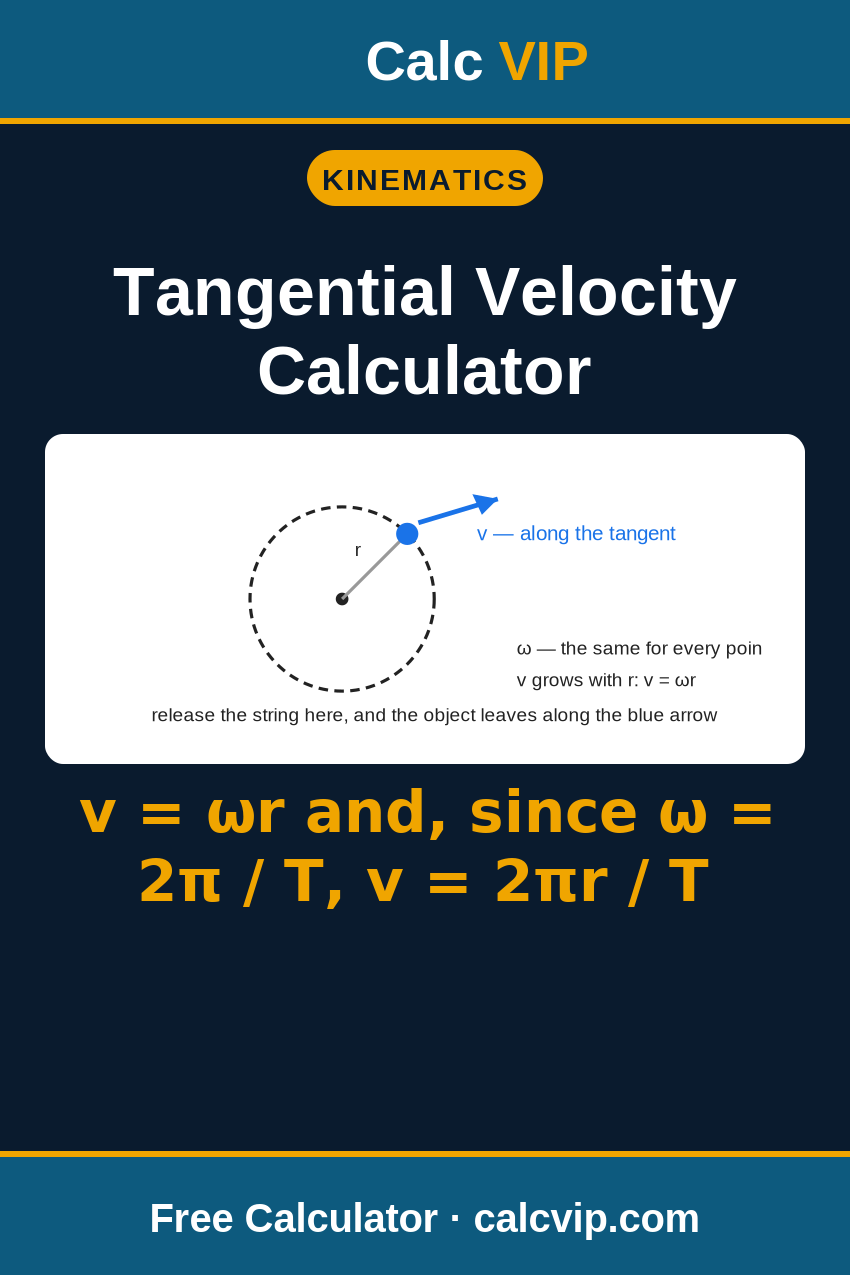
This calculator offers both doors into the same room. If you know the angular velocity ω in radians per second and the radius r in metres, it computes v = ωr. If instead you know the period T — the seconds for one complete revolution — it computes v = 2πr/T, the circumference divided by the time to traverse it, and also reports the implied ω. The examples range from playground rides to the Earth's equator, where you are, at this moment, being carried at some 463 m/s by exactly the formula on this page.
Formula
v = ωr and, since ω = 2π / T, v = 2πr / T
The two forms are one fact at two removes. The second is the more primitive: in one period T the object travels the whole circumference 2πr, so its speed is that distance divided by that time — plain distance-over-time dressed in circular clothes. The first form follows by defining ω = 2π/T, the angle swept per second (a full turn being 2π radians), and it is the form engineers live in because rotating machinery is specified by its spin rate. Converting neighbours crowd around them: frequency f = 1/T (revolutions per second), ω = 2πf, and from revolutions per minute, ω = rpm × 2π/60. Units discipline matters as always: ω must be in radians per second — not rpm, not degrees per second — before it multiplies r, and the radian's dimensionless nature is what lets ωr emerge cleanly in m/s. A close relative worth knowing: the centripetal acceleration that keeps the object on the circle is a = v²/r = ω²r, growing with the same radius that grows v.
| Symbol | Meaning | Units |
|---|---|---|
| v | tangential (linear) velocity along the circular path | m/s |
| ω | angular velocity — angle swept per second | rad/s |
| r | radius of the circular path | m |
| T | period — time for one complete revolution | s |
| f = 1/T | frequency — revolutions per second | Hz |
| 2πr | circumference — distance covered in one revolution | m |
One rotation, many speeds
A rigid rotating body is a parliament of speeds governed by a single spin. Every point completes each revolution in the same T and sweeps the same ω, yet their tangential velocities scale with their radii — v = ωr is a proportionality, not a constant. On a spinning disc the centre has nowhere to go (r = 0, v = 0), a point halfway out moves at half the rim's speed, and the rim itself sets the maximum. This gradient is not a curiosity; it is engineered everywhere. A car's wheels and the road agree at the contact patch because the tyre's rim speed must match the travel speed; a vinyl record's groove passes the stylus slower as the needle walks inward (which is why inner tracks are the hardest to press cleanly); a helicopter's blade tips approach the speed of sound while its hub turns gently, capping how fast the rotor may spin.
The tangential velocity is also the honest answer to "how fast is it moving?" for anything in orbit or rotation, because it is the velocity in the object's own equation of motion. A satellite's orbital speed — about 7.66 km/s for the space station — is a tangential velocity: at every instant it points along the tangent, while gravity pulls along the radius, and the balance of "falling towards" with "moving tangentially" is precisely what an orbit is. Remove the tangential velocity and the satellite falls straight down; remove gravity and it leaves along the tangent forever. Circular motion is the permanent negotiation between the two.
Finally, the direction deserves its due. Velocity is a vector, and in circular motion its magnitude can be perfectly constant while the vector itself rotates continuously — which is why circular motion is accelerated motion even at steady speed, and why you feel flung outward in a turning car: your body aims along the tangent (Newton's first law) while the car turns beneath you. The "outward force" is the tangent trying to happen. Every centrifuge, salad spinner and hammer throw is that sentence, industrialised.
How to use
- Choose the mode: use angular velocity ω if you know it, or the period T if you know the time for one full turn.
- Enter the value for the chosen mode, plus the radius r of the circular path in metres.
- Click "Calculate Tangential Velocity" to get the speed along the circle.
- If your spin rate is in rpm, convert first: ω = rpm × 2π ÷ 60. A 300 rpm spin is ω ≈ 31.42 rad/s.
- In period mode the calculator also reports ω = 2π/T, so you can cross-check the two modes against each other with the same r.
Worked examples
Example 1 — the stone on a string (both modes). A stone moves in a circle of radius r = 2 m with angular velocity ω = 3 rad/s. Tangential velocity v = 3 × 2 = 6 m/s. Check with the other mode: a point at r = 0.5 m completing a turn every T = 2 s has v = 2π × 0.5 ÷ 2 = 1.57 m/s. Two doors, one room — the modes agree wherever both are known.
Example 2 — the merry-go-round. A roundabout of radius 3 m turns once every 6 s: v = 2π × 3 ÷ 6 = 3.14 m/s at the rim, with ω = 2π ÷ 6 ≈ 1.05 rad/s. That is a jogging pace at the edge — and half of it, 1.57 m/s, for a child sitting halfway in, which is why the bold ride at the rim and the cautious sit near the pole.
Example 3 — the vinyl record. A long-playing record spins at 33⅓ rpm, which is ω = 33.33 × 2π ÷ 60 ≈ 3.49 rad/s. At the outer groove (r = 0.15 m) the surface passes the stylus at v = 3.49 × 0.15 ≈ 0.52 m/s; at an inner groove (r = 0.06 m) only 0.21 m/s. Same record, same ω — the music is literally engraved at different tangential speeds, and the inner tracks' tighter squeeze is an audiophile's lifelong complaint.
Example 4 — you, on the equator. The Earth turns once in 86,400 s at a radius of 6.37 × 10⁶ m: v = 2π × 6.37 × 10⁶ ÷ 86,400 ≈ 463 m/s — about 1,668 km/h, faster than the speed of sound, carried so smoothly you feel nothing. At the latitude of London the circle is smaller (r cos 51.5°) and the speed falls to about 289 m/s; at the poles it is zero. Latitude is a tangential-velocity dial.
Example 5 — the ceiling fan. A fan spinning at 240 rpm has ω = 240 × 2π ÷ 60 ≈ 25.13 rad/s. Its blade tips, at r = 0.6 m, travel at v = 25.13 × 0.6 ≈ 15.08 m/s (54.29 km/h) — highway-cycle speed at the tip of a household appliance, and the reason blade guards and balance matter.
Example 6 — the bicycle wheel. A wheel of radius 0.35 m on a bike travelling at 7 m/s must spin so its contact patch matches the road: ω = v ÷ r = 7 ÷ 0.35 = 20 rad/s, a period of T = 2π ÷ 20 ≈ 0.31 s per turn. Rolling without slipping is nothing but tangential velocity agreeing with the road, hundreds of times a minute.
Tangential velocity in real life
Grinding wheels and angle grinders. Abrasive discs are rated by maximum surface speed — a tangential velocity — because that is what the grit experiences and what throws sparks along tangents. A 115 mm disc at 11,000 rpm runs its rim at about 66 m/s; exceeding the rated v risks the disc bursting along the same tangents the sparks take.
Centrifuges. Laboratory and industrial centrifuges are specified in revolutions per minute, but the separating force depends on ω²r — and the sedimentation speed of particles on v and a at their radius. Two machines at the same rpm with different rotors are different instruments; the radius in this page's formula is the difference.
Hard drives and optical discs. A CD player varies its spin rate as the laser walks the disc, holding the tangential velocity at the reading point constant (about 1.3 m/s) so data flows evenly — the motor slows as the radius grows, v = ωr rearranged into a control strategy.
Fairground design. Ride safety limits are written in the accelerations riders feel, which trace back to v at their seat radius. The same carousel spins a toddler at the centre pole gently and a teenager at the rim briskly — one ω, a spectrum of v, deliberately arranged.
Wind turbines. A turbine's efficiency peaks at a designed ratio between blade-tip tangential velocity and wind speed (the tip-speed ratio, often 6–8). Controllers hold that ratio as winds change — v = ωr run in reverse, choosing ω for the weather.
The hammer and discus throws. The athlete's entire spin is a machine for building tangential velocity at the implement's radius; the release is timed so the tangent points down the field. A 2 m effective radius at ω = 12 rad/s yields 24 m/s of release speed — world-class distance begins in this formula.
Quick reference: from rpm to rad/s
| Spin rate | ω (rad/s) | v at r = 0.1 m | v at r = 0.5 m |
|---|---|---|---|
| 60 rpm (1 rev/s) | 6.28 | 0.63 m/s | 3.14 m/s |
| 120 rpm | 12.57 | 1.26 m/s | 6.28 m/s |
| 300 rpm | 31.42 | 3.14 m/s | 15.71 m/s |
| 1,800 rpm | 188.50 | 18.85 m/s | 94.25 m/s |
| 3,600 rpm | 376.99 | 37.70 m/s | 188.50 m/s |
The right-hand columns are why machinery guards exist: at ordinary motor speeds, half a metre of radius converts rotation into a hundred metres per second of tangential travel. Whenever a specification gives rpm, this table's first conversion — ×2π/60 — is the toll every calculation must pay before v = ωr will accept it.
Belt drives: where two radii negotiate
Join two pulleys with a belt and a beautiful constraint appears: the belt has one speed, so the tangential velocities at both rims must match — ω₁r₁ = ω₂r₂. A small driving pulley of radius 0.05 m spinning at ω = 40 rad/s sets the belt moving at 2 m/s; a driven pulley of radius 0.20 m then turns at ω = 2 ÷ 0.20 = 10 rad/s, trading speed for torque in exact inverse proportion to the radii. Every bicycle gear, every lathe's cone pulley and every old mill's line shaft is this equation in work clothes: tangential velocity is the currency exchanged between wheels of different sizes, and the exchange rate is the radius ratio.
Common mistakes
- Feeding rpm straight into v = ωr. The formula wants radians per second. 300 rpm is 31.42 rad/s, not 300 — skipping the ×2π/60 conversion inflates v nearly tenfold. This is the single most common error with this calculator; the mode selector cannot save you from it, so convert first.
- Using the diameter as the radius. Wheels and discs are sold by diameter. A 0.7 m wheel has r = 0.35 m; entering 0.7 doubles every velocity. Halve before you type.
- Believing released objects fly radially outward. They leave along the tangent. Sketches that fling the stone away from the centre contradict Newton's first law and misplace every spark guard and hammer cage designed from them.
- Assuming one v for a whole rotating body. v belongs to a radius. Quoting "the disc's tangential velocity" without saying at which r is meaningless — hub and rim differ by the full radius ratio.
- Confusing period with frequency. T is seconds per revolution; f is revolutions per second, its reciprocal. Entering f where T belongs inverts the answer — a 0.5 Hz spin has T = 2 s, and using 0.5 as T makes v four times too large.
FAQ
What does "tangential" mean?
The velocity points along the tangent to the circle at the object's position — at a right angle to the radius. If the string breaks, the object flies off along this tangent line.
Do all points on a spinning disc have the same tangential velocity?
No. They share the same angular velocity ω, but points further from the centre have a larger r, so their tangential velocity v = ωr is larger.
How do I get ω from revolutions per minute (rpm)?
Multiply rpm by 2π and divide by 60. For example 30 rpm = 30 × 2π ÷ 60 ≈ 3.14 rad/s.
What is the tangential velocity at the centre of a spinning disc?
Zero — r = 0 there, so v = ω × 0 = 0 however fast the spin. The centre is the one still point of the turning world, which is why axles can be mounted there.
How is tangential velocity different from angular velocity?
Angular velocity (rad/s) describes the rotation itself and is shared by the whole body; tangential velocity (m/s) describes one point's actual travel speed and grows with its radius. They are linked by v = ωr — neither is complete without r.
What happens to v if the string is shortened mid-spin?
If ω stayed the same, v would fall with r. In reality a pulled-in rotating object spins faster (angular momentum conservation raises ω), often enough that v rises — the figure skater's spin is this trade, performed.
Can tangential velocity be negative?
The speed along the path is a magnitude, but ω can carry a sign for clockwise versus anticlockwise rotation, and v inherits it in vector treatments. This calculator reports the magnitude, which is what design and safety questions need.
How does this relate to centripetal acceleration?
The same v sets it: a = v²/r, directed along the radius towards the centre. For Example 1's stone, a = 36 ÷ 2 = 18 m/s² — nearly 2g, supplied by the string's tension.
Why do CD players change their spin speed?
To hold the tangential velocity at the laser constant as the reading radius changes: v fixed, r growing, so ω must fall. It is v = ωr rearranged into a servo loop, running in millions of living rooms.
What is the tangential velocity of a geostationary satellite?
Its period is 24 hours and its orbital radius about 42,164 km from Earth's centre, so v = 2π × 4.2164 × 10⁷ ÷ 86,400 ≈ 3.07 km/s — exactly the speed at which its tangent and Earth's rotation stay in step, which is the whole point of the orbit.