 Calc
Calorimetry Calculator – Final Temperature of a Mixture
 Created by Anna Kowalski · Physics Editor · Heat & Atoms · Last updated: November 2026
Use this free Calorimetry Calculator to find the final temperature when two substances are mixed in an insulated container. Heat lost by the hot substance equals heat gained by the cold one, so Tf = (m₁c₁T₁ + m₂c₂T₂) / (m₁c₁ + m₂c₂).
Drop a hot horseshoe into a bucket of cold water and two certainties govern what happens next: the iron cools, the water warms, and they meet at one shared temperature in between. Calorimetry is the bookkeeping of that meeting. Because the container is insulated, no energy enters or leaves the story: every joule the iron surrenders is a joule the water receives. That single conservation statement — heat lost = heat gained — is the entire theory, and this calculator solves it: Tf is the temperature at which the two accounts balance.
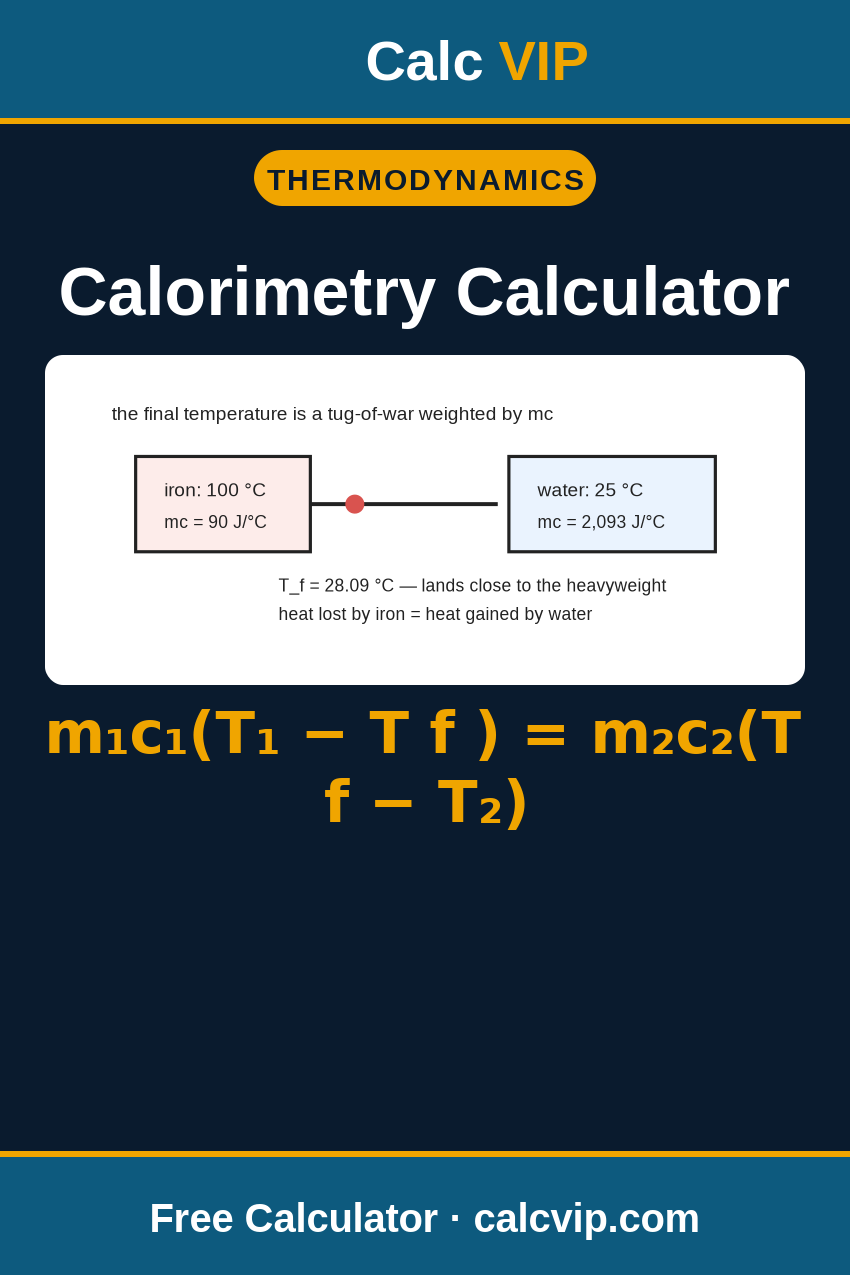
The meeting point is not the midpoint, and the reason is the real lesson. Temperature is not energy; the exchange rate between them is the heat capacity, mc — mass times specific heat. Water's specific heat, 4,186 J/(kg·°C), is freakishly large, so a modest bucket of water is a thermal heavyweight: in the worked example below, half a kilogram of it outweighs a red-hot iron block twenty-three times over, and the final temperature lands barely three degrees from the water's start. Whoever brings the bigger mc drags the meeting point toward their own temperature. That asymmetry runs everything from climate (oceans moderating coasts) to cooking (why the pan matters less than the sauce).
The formula on this page assumes the clean version of the experiment: no heat lost to the container or the room, no melting, no boiling, and specific heats that stay constant across the range. Real calorimetry — the kind that measures fuel values and reaction energies — spends most of its effort correcting for exactly those leaks, and the "water equivalent" of the container is the standard patch. But the ideal version is the right mental model, and for mixtures of ordinary liquids and solids at ordinary temperatures it is accurate to a degree or better.
Formula
Method of mixtures: m₁c₁(T₁ − Tf) = m₂c₂(Tf − T₂) • solved: Tf = (m₁c₁T₁ + m₂c₂T₂) / (m₁c₁ + m₂c₂)
Read the solved form as a weighted average: each starting temperature is weighted by its owner's heat capacity mc, and the weights are the whole physics. The equation behind it balances the two heat flows, each computed from Q = mcΔT. Because only temperature differences and ratios appear, the formula works identically in °C and kelvin — one of the rare thermodynamics formulas where Celsius is safe, and this calculator reports the answer in both. It presumes no phase change: if either substance would melt, freeze, boil or condense on the way to Tf, latent heat enters and a different (longer) balance is needed. Specific heats are treated as constants, which for water, metals and most liquids across tens of degrees is a good approximation.
| Symbol | Meaning | Units |
|---|---|---|
| Tf | final equilibrium temperature of the mixture | °C (or K) |
| m₁, m₂ | masses of the two substances | kg |
| c₁, c₂ | specific heat capacities | J/(kg·°C) |
| mc | heat capacity of a sample — its thermal weight | J/°C |
| T₁, T₂ | starting temperatures | °C (or K) |
Heat capacity: the thermal weight that decides the meeting point
Specific heat c is quoted per kilogram, but mixtures respond to the whole sample's heat capacity C = mc — how many joules the entire lump must gain or lose to change by one degree. That is the quantity doing the pulling in the tug-of-war diagram above. Doubling the water doubles its pull; swapping iron for the same mass of aluminium (c = 897, nearly double iron's 450) almost doubles the metal's say. Temperature, meanwhile, is only the scoreboard. Two samples at the same temperature can hold wildly different energy, and calorimetry is the discipline of never confusing the two.
Water's outsized c deserves its reputation. At 4,186 J/(kg·°C) it stores more heat per degree than almost any common liquid — a consequence of its hydrogen bonds, which soak up energy by bending and breaking before the molecules are free to move faster. That single molecular quirk is why coastal cities have milder climates than inland ones at the same latitude, why hot-water bottles work, why car engines are water-cooled, and why the water in Example 1 barely notices the iron. When you choose a coolant, a heat store or a thermal battery, you are shopping for c — and water is the benchmark everything else is measured against.
How to use
- For substance 1, enter its mass in kg, choose its specific heat from the list (water, iron, aluminium, copper) or select Custom and type a value, then enter its starting temperature in °C.
- Repeat for substance 2.
- Click "Calculate Final Temperature" to get Tf in °C and kelvin.
- Check the answer sits between the two starting temperatures — it must. If it does not, a mass or specific heat has been mistyped; if it sits suspiciously close to one end, that substance simply has the far larger mc.
Worked examples
Example 1 — the horseshoe in the bucket. A 0.2 kg block of iron (c = 450 J/(kg·°C)) at 100 °C is dropped into 0.5 kg of water (c = 4,186 J/(kg·°C)) at 25 °C:
m₁c₁ = 0.2 × 450 = 90 • m₂c₂ = 0.5 × 4,186 = 2,093
Tf = (90 × 100 + 2,093 × 25) / (90 + 2,093) = 61,325 / 2,183 = 28.09 °C. The water barely warms, because its heat capacity is more than 23 times the iron's.
Example 2 — mixing water with water. Pour 0.5 kg of water at 80 °C into 1 kg at 20 °C. With the same c on both sides it cancels: Tf = (0.5 × 80 + 1 × 20) / 1.5 = 40 °C — a plain mass-weighted average, and the fastest sanity check this calculator offers.
Example 3 — aluminium into water. A 0.3 kg aluminium block (c = 897) at 150 °C meets 0.4 kg of water at 20 °C: mc values are 269.1 and 1,674.4 J/°C, so Tf = (269.1 × 150 + 1,674.4 × 20) / 1,943.5 = 73,853 / 1,943.5 = 38.0 °C. Aluminium's higher c and the higher starting temperature pull the result further from the water's start than iron managed.
Example 4 — a small, very hot piece of copper. Drop 0.1 kg of copper (c = 385) at 200 °C into 0.2 kg of water at 15 °C: mc values are 38.5 and 837.2, giving Tf = (38.5 × 200 + 837.2 × 15) / 875.7 = 20,258 / 875.7 = 23.13 °C. Two hundred degrees of heat in a 100-gram lump buys the water just eight degrees — mass and c together outvote temperature.
Example 5 — the cold ingredient barely matters. Add 0.5 kg of cold iron (c = 450) at 20 °C to 2 kg of water at 60 °C: mc values 225 and 8,372, so Tf = (8,372 × 60 + 225 × 20) / 8,597 = 506,820 / 8,597 = 58.95 °C. Two kilograms of hot water shrug off half a kilogram of cold metal with a one-degree dip.
Example 6 — two liquids, custom c. Mix 0.25 kg of ethanol (custom c = 2,440) at 60 °C with 0.25 kg of water at 10 °C: equal masses, unequal c — mc values 610 and 1,046.5 — so Tf = (610 × 60 + 1,046.5 × 10) / 1,656.5 = 47,065 / 1,656.5 = 28.41 °C, noticeably below the 35 °C midpoint because water's c outweighs ethanol's.
Calorimetry in real life
The bomb calorimeter. Burn a food sample or fuel in a sealed steel bomb inside a water bath, measure the water's ΔT, and the energy released falls straight out of Q = mcΔT run in reverse. The "Calories" on food labels are born in this apparatus.
Tempering and mixing at the tap. Every shower mixer is a live calorimetry problem: hot at 60 °C, cold at 15 °C, and the flow ratio sets the weights. Example 2's mass-weighted average is why a small turn of the cold tap moves the temperature so much — the flows are the masses.
Quenching in metalwork. A blacksmith plunging hot steel into oil or water is choosing the bath's mc and boiling behaviour to control the cooling rate — too fast and the part cracks, too slow and it stays soft. The final-temperature balance sets the stage the metallurgy plays on.
Climate moderation. Oceans are Earth's calorimetry bath: their immense mc absorbs summer heat and releases it in winter, which is why islands and coasts see gentler seasons than continents' interiors at the same latitude.
Thermal storage. Night-storage heaters and solar hot-water tanks are deliberate calorimetry: charge a large mc when energy is cheap, discharge it later. Water tanks dominate because nothing cheap beats 4,186 J/(kg·°C).
Measuring an unknown c. The method of mixtures is itself the measuring instrument: drop a heated sample of known mass into water of known mc, read Tf, and solve the balance for the sample's c. Generations of students have weighed metals this way — it is Example 1 run backwards.
When the simple balance fails: phase changes and container losses
Two leaks break the clean formula. The first is the container: a real calorimeter cup warms up alongside the water, absorbing heat the simple balance never budgets for. The standard fix is to measure the cup's heat capacity once and quote it as a water equivalent — the extra grams of water that would drink the same heat — then add it to the water's mass before calculating. The second leak is a phase change. If the mixture temperature would cross a melting or boiling point, part of the energy diverts into latent heat at constant temperature, and the balance becomes a two-stage problem: cool the hot substance to the transition point, melt or freeze what the remaining energy can, and check whether any is left over. Ice dropped into warm water is the classic case — if the water's available heat cannot melt all the ice, Tf is simply 0 °C with ice left floating, an answer no weighted average will ever give you. This calculator handles the no-phase-change case; treat its result as a first estimate whenever ice, steam or boiling is in the picture.
A worked taste of the phase-change correction: drop 0.1 kg of ice at 0 °C into Example 1's 0.5 kg of water at 25 °C. Melting the ice alone costs 0.1 × 334,000 = 33,400 J of latent heat, drawn from the water; the water cooling all the way to 0 °C could supply only 0.5 × 4,186 × 25 = 52,325 J, so the ice does melt — but the budget leaves just 52,325 − 33,400 = 18,925 J of "warmth" to share among 0.6 kg of water, settling at Tf = 18,925 / (0.6 × 4,186) ≈ 7.54 °C. The naive weighted average (treating the ice as cold water) would have predicted 20.83 °C — a 13-degree error, purchased entirely by ignoring the latent heat. Whenever a phase boundary sits between the starting temperatures, pay the latent toll first, then average what remains.
Quick reference: specific heats of common materials
| Material | c (J/(kg·°C)) | mc of 1 kg (J/°C) |
|---|---|---|
| Water | 4,186 | 4,186 |
| Ice | 2,100 | 2,100 |
| Ethanol | 2,440 | 2,440 |
| Vegetable oil | ≈ 2,000 | ≈ 2,000 |
| Aluminium | 897 | 897 |
| Glass | ≈ 840 | ≈ 840 |
| Iron / steel | 450 | 450 |
| Copper | 385 | 385 |
| Lead | 128 | 128 |
A kilogram of lead has less than a thirtieth of a kilogram of water's thermal weight — which is why lead shot was historically used to transfer a temperature without disturbing it.
Common mistakes
- Averaging the temperatures. (100 + 25)/2 = 62.5 °C is the answer only when the two mc values happen to be equal. In Example 1 the true answer is 28.09 °C — the naive average is wrong by 34 degrees.
- Weighting by mass alone. Equal masses do not mean equal pull: Example 6's equal masses of ethanol and water settle at 28.41 °C, not the 35 °C midpoint, because c differs.
- Forgetting the container. In a school experiment the cup and thermometer absorb measurable heat. Ignoring them systematically biases measured specific heats low — add the water equivalent.
- Ignoring phase changes. If ice is involved, or anything boils, the weighted average is not even an approximation until latent heat has been accounted for.
- Mixing grams with kilograms. c is per kilogram. A 200 g block is 0.2 kg — entering 200 inflates its mc a thousandfold and drags Tf to the block's own temperature.
FAQ
Why is the final temperature not just the average of the two?
It is a weighted average. A substance with a large mc (like a lot of water) pulls the final temperature strongly toward its own starting temperature; a small mc barely matters.
Can I use this for two amounts of the same liquid?
Yes — mixing 0.5 kg of water at 80 °C with 1 kg at 20 °C gives (0.5×80 + 1×20)/1.5 = 40 °C, because the c values cancel out.
What does this calculator leave out?
Heat absorbed by the container itself, heat lost to the air, and any melting or boiling. For a substance that changes state you also need its latent heat — a separate calculation.
Does it matter which substance I enter as 1 and which as 2?
No. The formula is symmetric — swapping the two swaps the labels in the numerator and denominator alike and returns the identical Tf. Enter the hot one first if it helps you think, but the arithmetic does not care.
Can T_f ever be outside the range between T₁ and T₂?
Never, in an insulated mixture with no phase change and no chemical reaction. Energy conservation forbids it: the mixture cannot end hotter than its hottest ingredient or colder than its coldest. An out-of-range answer always means a data-entry error.
Why is water's specific heat so high?
Hydrogen bonding. Much of the energy added to water goes into loosening the network of bonds between molecules rather than into faster molecular motion — and temperature only counts the motion. It is the highest specific heat of any common liquid except ammonia.
How do I measure an unknown specific heat with this?
Heat a known mass of the sample to a known temperature, drop it into a known mass of water at a known temperature, and measure Tf. Then solve the balance mscs(Ts − Tf) = mwcw(Tf − Tw) for cs — the method of mixtures.
What if I mix three substances?
The weighted average extends naturally: Tf = Σ(mcT) / Σ(mc) over all three (or more). This calculator handles two; for three, combine two first, then mix the result with the third — the answer is the same.
Does the formula work in kelvin?
Yes — identically. Adding 273.15 to every temperature adds the same constant to numerator structure and cancels out, because the formula involves only a weighted average. It is one of the few thermodynamics formulas where °C and K are interchangeable.
Why do real experiments get slightly lower T_f than predicted when heating?
Because the idealisation leaks: the container absorbs heat, the surface loses heat to the air during mixing, and the thermometer itself has heat capacity. Good calorimetry minimises the time, insulates the vessel, and corrects for the container — the difference between the school answer and the laboratory one.