 Calc
Average Velocity Calculator – Displacement Divided by Time
 Created by Sarah Mitchell · Physics Editor · Motion & Measurement · Last updated: November 2026
Use this free Average Velocity Calculator to find the average velocity of an object from its start and end positions and the times at those positions. Average velocity is displacement divided by time — it cares only about where the object started and where it finished.
That indifference to the journey in between is exactly what makes average velocity so useful — and so often misunderstood. A delivery van that fights through traffic, idles at lights and sprints down a clear stretch has one single average velocity for the whole trip: its final position minus its starting position, divided by the total time. Everything that happened on the way — the stops, the bursts, the wrong turn that was later corrected — is compressed into one honest number that answers the only question asked: how fast, on balance, did the position change?
Because it is built from displacement, average velocity is a vector: it carries a direction as well as a size. Drive 60 km east and then 60 km back west in two hours and your average speed is a respectable 60 km/h — but your average velocity is exactly zero, because your displacement is zero. This is not a mathematical trick; it is the correct physical statement that, over the trip as a whole, you got nowhere. Any quantity that cares about "where did you end up?" rather than "how much road did you cover?" behaves the same way, and navigation, sport analysis and physics all ask the first question at least as often as the second.
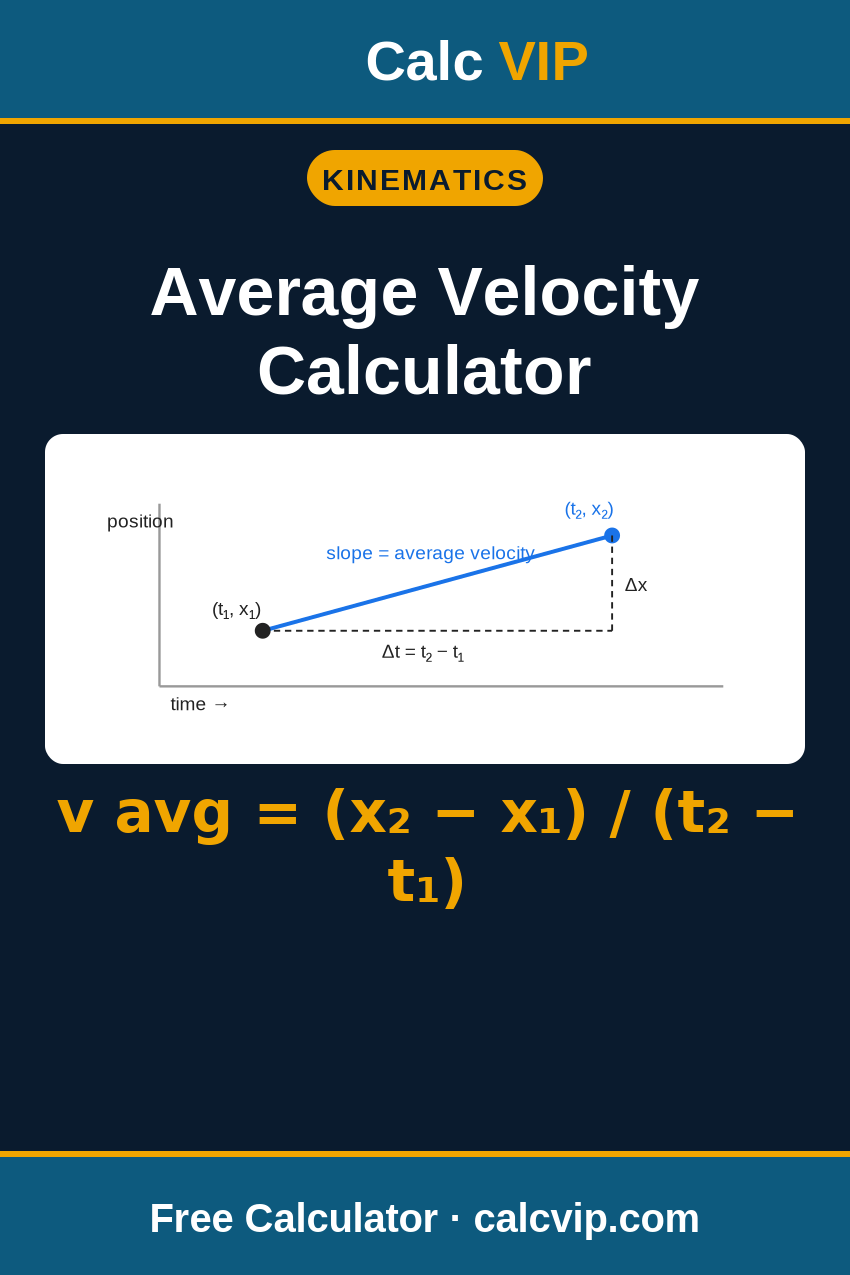
This calculator works with positions and clock times rather than distances, because that is how motion is actually recorded: a GPS logger, a timing gate, a video tracker or a linesman's notebook all produce pairs of (position, time). Feed in any two such pairs — the start reading and the end reading — and the calculator returns the displacement, the elapsed time and the average velocity between them, in metres per second and kilometres per hour. Choose any two moments of a journey, not just the first and last, and it tells you the average velocity over that stretch alone.
Formula
Average velocity = Displacement ÷ Time taken → vavg = (x₂ − x₁) / (t₂ − t₁)
The same equation rearranges to answer the other two questions it contains. To predict where an object will be: x₂ = x₁ + vavg × (t₂ − t₁) — start position plus average velocity times elapsed time. To find how long a change of position takes at a known average velocity: Δt = Δx / vavg. All three forms say one thing: displacement is what you accumulate when a velocity acts for a time. Keep the units consistent — positions in metres and times in seconds give m/s; positions in kilometres and times in hours give km/h — and convert at the end if you need the other system (multiply m/s by 3.6 to get km/h). Note what the formula does not contain: the path. Two objects that start and finish at the same readings share the same average velocity even if one travelled ten times further on the way.
| Symbol | Meaning | Units |
|---|---|---|
| x₁ | start position — where the object was at the first reading | m (or km) |
| x₂ | end position — where it was at the second reading | m (or km) |
| t₁, t₂ | the clock times of the two readings | s (or h) |
| Δx = x₂ − x₁ | displacement — the straight change in position | m (or km) |
| Δt = t₂ − t₁ | elapsed time between the readings | s (or h) |
| vavg | average velocity — displacement per unit time, with direction | m/s (or km/h) |
Two readings, one honest summary
Average velocity is deliberately a two-point quantity. It makes no claim about any instant in between: an object can surge, crawl and even move backwards during the interval, and none of it shows. What it guarantees is exact and purely bookkeeping — multiply the average velocity by the elapsed time and you recover the displacement precisely, every time. That is why physicists define it this way rather than as "the mean of the speeds": the mean of a varying speed generally does not reproduce the displacement, while this definition cannot fail to.
The sign carries the direction. Positions are measured from an origin along a chosen positive direction, so a negative displacement — finishing closer to the origin than you started, or beyond it on the other side — yields a negative average velocity. In one dimension the sign is the direction, which is why this calculator can honestly report a velocity, not just a speed, from four plain numbers. In two or three dimensions the same idea applies component by component: average velocity is the displacement vector divided by the time, pointing from start point to finish point regardless of the curve travelled between them.
There is also a quiet relationship with the journey's extremes. Unless the motion is perfectly steady, the object must at some moments move faster than its average velocity and at others slower (or backwards) — the average is the level the real motion balances around. And by the mean value theorem of calculus, for smooth motion there is always at least one instant at which the instantaneous velocity exactly equals the average over the interval: somewhere on the trip, the speedometer told the average's story precisely.
How to use
- Enter the start position x₁ in metres and the start time t₁ in seconds — the first (position, time) reading.
- Enter the end position x₂ and the end time t₂ — the second reading, which must be later than the first.
- Click "Calculate Average Velocity" to see the displacement, the elapsed time and the average velocity in m/s and km/h.
- To study one stretch of a longer journey, use the readings at the start and end of that stretch instead of the whole trip.
- Watch the sign: a negative result means the net movement was in the negative direction — the object finished behind where it began.
Worked examples
Example 1 — the runner (the classic case). A runner is at position x₁ = 10 m at t₁ = 0 s and reaches x₂ = 110 m at t₂ = 20 s. Displacement = 110 − 10 = 100 m, so the average velocity is 100 ÷ 20 = 5 m/s (18 km/h) — a steady club-runner's pace, sustained here as an average whatever the runner actually did second by second.
Example 2 — a bus across town. A bus leaves the depot (x₁ = 0) and reaches a stop 36 km away (x₂ = 36,000 m) after 45 minutes (t₂ − t₁ = 2,700 s). vavg = 36,000 ÷ 2,700 = 13.33 m/s, which is exactly 48 km/h. The bus certainly touched 70 km/h on the open stretch and sat still at lights, yet 48 km/h is the true average that the timetable is built on.
Example 3 — a drone coming home (negative velocity). A survey drone is 200 m east of its operator and, 30 s later, is 50 m east. Displacement = 50 − 200 = −150 m, so vavg = −150 ÷ 30 = −5 m/s. The minus sign is information, not an error: the drone's net movement was westward, back towards (and measured against) the chosen positive direction.
Example 4 — the round trip. A cyclist rides 3 km to a shop and 3 km back, taking 20 minutes (1,200 s) altogether. Displacement = 0 m, so the average velocity is 0 m/s — while the average speed is 6,000 ÷ 1,200 = 5 m/s. Both numbers are correct; they answer different questions, and only the velocity notices that the trip ended where it began.
Example 5 — a train between two stations. A train passes a marker at x₁ = 12 km at 08:10 and another at x₂ = 87 km at 09:10. Displacement = 75 km in exactly 1 hour, so vavg = 75 km/h = 75,000 ÷ 3,600 = 20.83 m/s — including the station stop in the middle, which is precisely why scheduled average speeds are always lower than the train's top speed.
Example 6 — the sprinter's fast stretch. Timing gates record a sprinter at x = 15 m when t = 2 s and at x = 85 m when t = 9 s. Over that stretch, vavg = (85 − 15) ÷ (9 − 2) = 70 ÷ 7 = 10 m/s. Coaches use exactly this two-gate method to measure top-speed phases without needing the whole race.
Average velocity in real life
Navigation and ETAs. Every "arriving in 23 minutes" message is an average-velocity calculation: your remaining displacement to the destination divided by the average velocity the app expects you to sustain. When traffic lowers that expectation, the ETA slips — the app is re-running this page's formula with a smaller v.
Flight planning. An aircraft's ground speed along its route — its displacement across the map divided by flight time — decides fuel stops and arrival slots. A 900 km hop completed in 1.5 hours means an average velocity of 600 km/h, even though the jet cruised at 850 km/h and spent time climbing, descending and taxiing.
Sports analysis. Split times in swimming, running and rowing are average velocities over measured stretches: a swimmer covering the last 50 m of a 200 m race in 31 s averaged 1.61 m/s over that length, and comparing splits reveals where a race was won.
River and drift problems. A boat's average velocity over the ground combines its own motion with the current's — coastguards predicting where a drifting life raft will be found multiply its average velocity (set largely by wind and current) by the hours since it was lost.
Average speed cameras. Motorway average-speed zones are this calculator enforced by law: cameras read your plate at two positions with two timestamps, and the system computes exactly (x₂ − x₁)/(t₂ − t₁) along the road. Slowing only at the cameras cannot help, because the path between them is irrelevant.
Glaciers, plates and planets. Geology runs on average velocities too small to watch: a glacier flowing 25 m in a year averages about 0.0000008 m/s, and tectonic plates drift a few centimetres per year — yet multiplied by millions of years, those averages build mountain ranges.
Reading average velocity off a position–time graph
Plot position against time and average velocity becomes something you can see: it is the slope of the straight chord joining the two readings. The real motion draws a curve — steep where the object moves fast, horizontal where it waits, dipping where it reverses — but the chord ignores all of that texture and reports only rise over run between the endpoints. This picture explains several facts at once. A round trip's graph returns to its starting height, so its chord is horizontal: slope zero, average velocity zero. A negative average velocity is a chord that falls. And shrinking the interval between the two readings slides the chord towards the curve's own steepness at a point — which is precisely how instantaneous velocity is defined, as the limit of average velocities over ever-shorter intervals.
Quick reference: one journey, several averages
| Interval | Displacement | Time | Average velocity |
|---|---|---|---|
| Runner, whole run | 100 m | 20 s | 5 m/s |
| Bus across town | 36 km | 45 min | 13.33 m/s (48 km/h) |
| Drone returning | −150 m | 30 s | −5 m/s |
| Cyclist round trip | 0 m | 20 min | 0 m/s (avg speed 5 m/s) |
| Train between stations | 75 km | 1 h | 20.83 m/s (75 km/h) |
| Sprinter, gates at 2 s and 9 s | 70 m | 7 s | 10 m/s |
Read the table as a warning against a single "the" average: every row is a different pair of readings, and changing the pair changes the answer. Always ask "average between which two moments?" before quoting an average velocity — in exams and in arguments alike, most confusion about this quantity is really confusion about the interval.
Why you cannot simply average two average velocities
Suppose a journey has two legs with known average velocities: one hour at an average of 40 km/h, covering 40 km, then two hours at an average of 70 km/h, covering 140 km. The tempting shortcut — (40 + 70) ÷ 2 = 55 km/h — is wrong. The true overall average velocity is the total displacement divided by the total time: 180 km ÷ 3 h = 60 km/h. The shortcut fails because the two legs lasted different times, so the faster leg deserves more weight. Averaging averages only works when the intervals are equal; the safe method is always to go back to endpoints — total displacement over total time — which is exactly the calculation this page performs.
Common mistakes
- Using distance instead of displacement. If the object doubled back, the odometer distance overstates the change in position. Average velocity needs x₂ − x₁ only; feeding in the total path length silently turns the answer into an average speed.
- Averaging the start and end speeds. (u + v)/2 equals the average velocity only when acceleration is constant. For a trip with stops and surges it can be badly wrong, while (x₂ − x₁)/(t₂ − t₁) is right by definition.
- Mixing units between position and time. Kilometres divided by seconds gives a meaningless hybrid. Convert first — metres with seconds, or kilometres with hours — then divide.
- Dropping the sign. Reporting 5 m/s for the returning drone throws away the direction, which is half the information a velocity carries. Keep the minus sign and say what it means.
- Assuming the average describes every moment. An average velocity of 5 m/s does not mean the object moved at 5 m/s throughout — it may never have moved at exactly that speed at all. The average summarises the interval; it does not narrate it.
FAQ
How is average velocity different from average speed?
Average speed uses the total distance travelled along the path. Average velocity uses displacement — the straight change in position. If an object returns to its start, its average velocity is zero even though its average speed is not.
Can average velocity be negative?
Yes. If the end position is less than the start position (x₂ < x₁), the object moved in the negative direction and the average velocity is negative.
What if both times are the same?
Then the time taken is zero and average velocity cannot be defined — the calculator will ask for a later end time.
Does average velocity depend on the route taken?
No. Only the start and end readings matter. A direct flight and a winding detour between the same two points, taking the same time, have identical average velocities — though very different average speeds.
What two readings should I use for a whole journey?
The position and time at the very start and the position and time at the very end. For a segment — the motorway stretch of a drive, the last lap of a race — use the readings at that segment's boundaries instead.
How do I convert the answer to km/h?
Multiply m/s by 3.6. The calculator shows both: the runner's 5 m/s is 18 km/h. To go the other way, divide km/h by 3.6.
Can average velocity be greater than every speed on the trip?
No. In one dimension the displacement cannot exceed the total distance travelled, so the magnitude of the average velocity can never beat the average speed — and the average speed is itself bounded by the top speed reached.
What is the average velocity of a satellite in a circular orbit?
Over one complete orbit it is zero: the satellite returns to its starting position, so its displacement is nil. Over half an orbit it is the diameter of the orbit divided by half the period, pointing across the circle — a neat demonstration that the interval defines the answer.
Why do exams insist on displacement rather than distance?
Because velocity is a vector, and vectors care about endpoints. Displacement is the vector change of position; distance is a scalar tally of the path. Using the wrong one changes both the size and the meaning of the result.
How is average velocity related to instantaneous velocity?
It is its building block: the instantaneous velocity at a moment is the average velocity over an interval shrunk to nothing around that moment. On a position–time graph, it is the step from a chord's slope to the curve's slope at a point.