 Calc
Average Speed Calculator – Total Distance Over Total Time
 Created by Sarah Mitchell · Physics Editor · Motion & Measurement · Last updated: November 2026
Use this free Average Speed Calculator for a journey made in two parts (legs) at different speeds — for example a trip with a motorway part and a city part. It adds up the total distance and total time to give the true average speed.
Leg 1
Leg 2
Almost every real journey is a mixture of fast and slow parts. You crawl through town, speed up on the motorway, get held up by roadworks, then crawl again at the other end. At the finish, what was your average speed? Most people are tempted to average the speeds they travelled at — and most of the time that gives the wrong answer.
The reason is time. A simple average treats every speed as equally important, but a speed you held for a whole hour matters far more than one you held for five minutes. The only method that is always correct is the definition itself: average speed = total distance ÷ total time. It automatically gives each part of the journey exactly the importance it deserves, because a part that took longer contributes more time to the total.
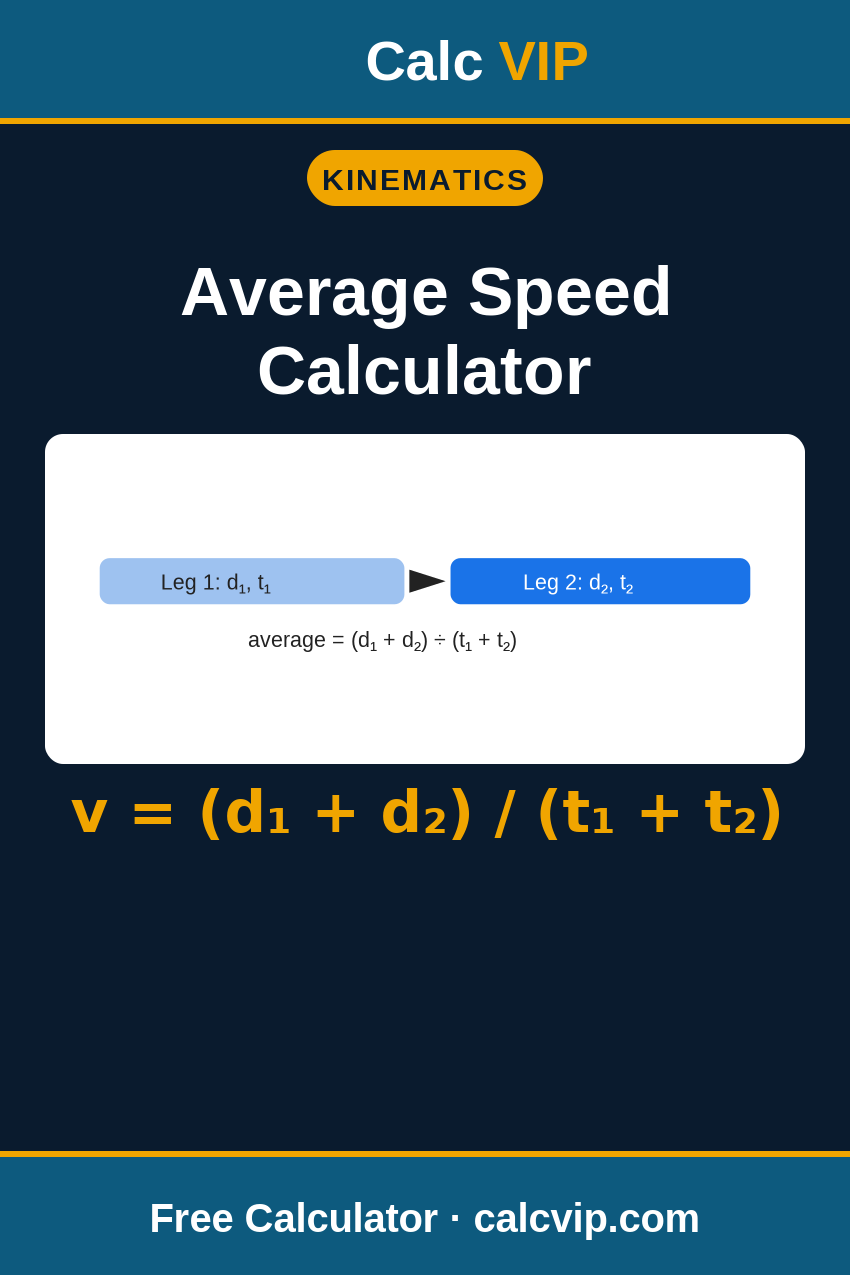
This calculator is built for the two-part journey, which covers most real trips: out of town and onto the fast road, or the fast road and then the slow streets at the far end. If your journey has more parts, the same idea extends — just add up every distance and every time.
Formula
Average speed = Total distance ÷ Total time → v = (d₁ + d₂) / (t₁ + t₂)
Each leg also has its own speed, found the same way: leg speed = leg distance ÷ leg time. The overall average is not the plain average of those leg speeds — it is their time-weighted average. A leg that lasts twice as long pulls the overall average twice as hard towards its own speed. That weighting is exactly what dividing the totals does for you, with no extra work.
Because the formula uses totals, it never matters how the speed varied inside a leg. Stops, bursts and crawls inside a leg are all included automatically, as long as the leg's distance and time are right.
| Symbol | Meaning | Units |
|---|---|---|
| v | average speed over the whole journey | km/h or m/s |
| d₁, d₂ | distance of leg 1 and leg 2 | km |
| t₁, t₂ | time taken by leg 1 and leg 2 | hours (h) |
When the simple average works — and when it fails
There is one special case where averaging the two speeds is correct: when both legs take the same time. Drive one hour at 80 km/h and one hour at 30 km/h and the average really is (80 + 30) ÷ 2 = 55 km/h — check it with the totals: 110 km in 2 hours = 55 km/h.
But when the legs take different times, the simple average fails. In Example 2 below, the two speeds are 80 km/h and 30 km/h, whose simple average is 55 km/h — yet the true average is 60 km/h, because more time was spent at the faster speed. And when the legs cover the same distance instead, the correct answer is lower than the simple average, as Example 3 shows, because more time is spent on the slow leg.
How to use
- Enter the distance (km) and time (hours) for the first part of the journey.
- Enter the distance and time for the second part. Leave Leg 2 as 0 if the journey has only one part.
- Click "Calculate Average Speed" to see the overall average in km/h and m/s.
- Times must be in hours — if a leg took 45 minutes, enter 0.75 (45 ÷ 60).
Worked examples
Example 1 — the bus. A bus travels 60 km in 1 hour, then 40 km in 1 hour. Total distance = 100 km, total time = 2 hours, so average speed = 100 ÷ 2 = 50 km/h (about 13.89 m/s). Because the two legs took the same time, the simple average of 60 km/h and 40 km/h also gives 50 km/h — the special case described above.
Example 2 — motorway then town. A car drives 120 km in 1.5 hours on the motorway (80 km/h), then 30 km in 1 hour through town (30 km/h). Total distance = 150 km, total time = 2.5 hours, so the average speed = 150 ÷ 2.5 = 60 km/h. The simple average of the two speeds would be 55 km/h — wrong, because the car spent longer at the higher speed.
Example 3 — the same road out and back. A cyclist rides 60 km at 60 km/h with a tailwind (taking 1 hour), then returns the same 60 km at 30 km/h into the wind (taking 2 hours). Total distance = 120 km, total time = 3 hours, so the average speed = 120 ÷ 3 = 40 km/h — well below the simple average of 45 km/h, because twice as much time was spent on the slow return leg. Equal-distance averages like this follow the harmonic mean, and the totals method gives the same answer automatically.
Example 5 — the delivery van. A van covers 90 km of motorway in 2 hours, then crawls through 10 km of city streets in 0.5 hours. Total distance = 100 km, total time = 2.5 hours, so average speed = 100 ÷ 2.5 = 40 km/h — far closer to the city crawl's 20 km/h than the motorway's 45 km/h might suggest, because averages listen to time, not distance.
Example 6 — the two-paced run. A runner completes the first 5 km in 0.5 hours (10 km/h) and the second 5 km in 1 hour (5 km/h) after tying a shoe and losing rhythm. Average speed = 10 km ÷ 1.5 h = 6.67 km/h — not the 7.5 km/h a simple mean of the two speeds would claim.
Average speed in real life
Journey planning. Route planners and sat-navs are average-speed machines. A 150 km trip is not estimated at motorway speed, because the software knows the first and last parts are slow. When it says 2 hours 30 minutes, it is really saying: your average speed will be about 60 km/h — exactly the answer in Example 2.
Running and cycling. Athletes talk about pace, which is average speed turned upside down (minutes per kilometre instead of kilometres per hour). A marathon runner who speeds up and slows down still lives or dies by the totals: 42.2 km divided by the finishing time. "Negative splits" — running the second half faster than the first — is a deliberate two-leg average-speed strategy.
Flying. A flight's average speed includes the slow climb and descent, not just the fast cruise. A plane cruising at 900 km/h might average only 700–750 km/h gate to gate on a medium flight, once the slow ends of the journey are included in the totals.
Logistics and delivery promises. A courier firm quoting "next day by noon" is doing this calculation with real legs: depot to city, city traffic, the last mile on foot. The leg speeds differ wildly, and it is the totals — not any single leg — that decide whether the promise survives contact with a rainy Tuesday.
Fuel and range planning. A car's remaining range is its fuel multiplied by an economy figure that itself depends on average speed: motorway legs and town legs burn fuel at very different rates per kilometre. Trip computers blend the legs by distance and time — exactly the totals method — which is why the range estimate falls so fast after an hour in traffic.
Average speed cameras
The totals method is not just textbook physics — it is enforced on real roads. Average speed camera systems (such as SPECS cameras on motorways) photograph your number plate at two points a known distance apart and time the gap between the photographs. If the distance divided by your time exceeds the limit, you were speeding on average, however carefully you slowed down while passing each camera. Braking for the camera and speeding up between them does not help, because the system never measures your instantaneous speed at all — it measures exactly what this calculator measures.
Pace: average speed turned upside down
Runners usually prefer the reciprocal: pace, the time taken per unit distance. A runner averaging 12 km/h is running at 5 minutes per kilometre (60 ÷ 12 = 5). Elite marathoners sustain close to 21 km/h for the full 42.2 km — a pace under 2 minutes 52 seconds per kilometre, held for just over two hours. Pace and average speed carry identical information; pace simply matches how runners think, because races are measured by distance markers, not by the clock on the wall. If your two legs of a run were at different paces, convert each to a time for its distance, add the totals, and divide — the same totals method again.
Example 4 — three legs. Journeys do not stop at two parts. A trip of 50 km in 1 hour, 90 km in 1.5 hours and 10 km in 0.5 hours has totals of 150 km and 3 hours, giving an average of 150 ÷ 3 = 50 km/h. To use this two-leg calculator on a longer journey, first merge any two legs into one by adding their distances and times, then combine the result with the next leg — the final average is the same.
Door-to-door versus moving average
Delivery firms and fleet managers track two different averages, and the difference is money. The moving average counts only the time the vehicle is actually travelling; the door-to-door average includes loading, traffic lights, queues and breaks. A van might show a healthy moving average of 45 km/h yet manage a door-to-door average of only 18 km/h across a shift — and it is the second number that decides how many deliveries fit in a day. This calculator gives the door-to-door figure whenever you feed it honest totals, because the formula cannot tell a traffic jam from a tea break: both are time passing without distance accumulating. When a journey estimate feels wrong, it is usually because one of these two averages was mistaken for the other.
Why your sat-nav keeps changing its mind
A sat-nav's estimated arrival time is this calculator running live, with a twist: it does not know your future legs, so it forecasts them from the road ahead — its legal speeds, its historical traffic at this hour, its live incident feed. Every time you beat or miss its forecast for the current leg, it re-weights the totals and the arrival time slides. When the ETA jumps by ten minutes at a motorway junction, nothing mystical has happened: a slow leg has been added to your totals, or a fast one removed.
The same logic explains why leaving ten minutes earlier can save thirty. Your early departure does not change any leg's distance; it changes which version of the traffic leg you get — swapping a 20 km/h crawl in the totals for a 50 km/h flow, and the weighted average rewards you out of proportion to the ten minutes you invested.
Quick reference: everyday average speeds
Keep these anchors in mind and most average-speed answers can be sanity-checked before they are calculated. Note that each is a door-to-door average including stops — a walker's moving speed is higher than 5 km/h, but crossings, hills and pauses tax the total down to it.
| Traveller | Typical average speed |
|---|---|
| walking | ≈ 5 km/h |
| cycling in a city | ≈ 15 km/h |
| car across a city | ≈ 30 km/h |
| car on a motorway trip | ≈ 90–110 km/h |
| airliner, gate to gate | ≈ 600 km/h |
| sound in air | ≈ 1235 km/h (343 m/s) |
Reading a journey off its graph
Plot distance against time for any journey and average speed becomes a slope you can see: the slope of the line joining the journey's start to its finish. Steep sections are fast legs, shallow sections slow ones, and flat sections — the graph horizontal, distance frozen — are stops, drawn honestly into the picture. The overall average is never steeper than the steepest leg nor shallower than the shallowest, which is the graph's way of repeating this page's rule that the average must lie between the leg speeds.
The graph also exposes a cheat the totals formula forgives: a journey drawn as two legs may really be twenty. Traffic lights, roundabouts and fuel stops all live inside the legs as tiny flats and shallows, invisible at this scale. The totals method does not care — distance and time accumulate the same whether the wiggles are drawn or not — which is why the graph is a portrait of the journey, but the division is its measurement.
Railway timetables are this same calculation wearing a uniform. A train advertised as covering 300 km in 4 hours averages 75 km/h, even though its moving speed between stations may touch 90 km/h — the stops are legs with distance zero and time very real, and the published average folds them in without apology. When a timetable looks slow next to the train's top speed, it is not lying; it is averaging honestly.
Common mistakes
- Averaging the speeds. The most common error of all. It only works when the legs take equal times — always divide total distance by total time instead.
- Leaving out stopped time. A motorway services break is still journey time. Leave it out and your "average" will be higher than the one you actually achieved.
- Mixing minutes and hours. The calculator expects hours. Entering 45 minutes as "45" instead of 0.75 makes that leg look sixty times slower than it was.
- Expecting the average to beat both speeds. Impossible — the true average always lies between the slowest and fastest leg speeds.
- Rounding each leg's speed before combining. If you round 6.67 km/h to 7 and 13.33 to 13 and then average, the errors compound. Always combine the raw totals — total distance ÷ total time — and round only the final answer.
FAQ
Why is the average speed not just the mean of the two speeds?
Because the two legs may take different amounts of time. The correct method always divides the total distance by the total time.
What if both legs take the same time?
Then the average speed does equal the simple mean of the two speeds — as in the worked example above.
What if both legs cover the same distance?
Then the average is the harmonic mean of the two speeds, which is always lower than the simple mean, because more time is spent on the slower leg. The totals method in this calculator handles it automatically (see Example 3).
Can I use this for one single leg?
Yes. Fill in Leg 1 only and set the Leg 2 values to 0; the result is simply distance ÷ time for that leg.
Does stopping for a break count in the average?
Yes, if you want the true journey average. The clock keeps running while you are stopped, so the break adds time without adding distance and pulls the average down.
Can the average speed be higher than both leg speeds?
No. The average is a time-weighted blend of the leg speeds, so it always falls somewhere between the slowest and the fastest one.
How do I convert the answer to m/s?
Divide km/h by 3.6. The calculator shows the m/s value alongside the km/h result — for example, 50 km/h is about 13.89 m/s.
Can I use this calculator for three or more legs?
Yes — the method generalises: add every leg's distance and every leg's time, then divide. With two legs you can run the calculator twice (combine legs 1 and 2, then combine that result's totals with leg 3), or simply add all three distances and all three times yourself and divide once.
Why does my car's trip computer show a different average from mine?
Most trip computers show the moving average or reset at each ignition cycle, quietly dropping stopped time. Your door-to-door figure — the one that decides whether you catch the train — includes every red light and coffee stop.
Should a flight's stopover count in its average speed?
For the airline's flying average, no; for your journey, absolutely. A 1000 km trip flown in 2 hours with a 3-hour stopover averages 1000 ÷ 5 = 200 km/h door to door — which is why a direct slower flight can beat a fast one with a long connection.