 Calc
Absorbed Dose Calculator – Radiation Dose in Gray and Rad
 Created by Anna Kowalski · Physics Editor · Heat & Atoms · Last updated: November 2026
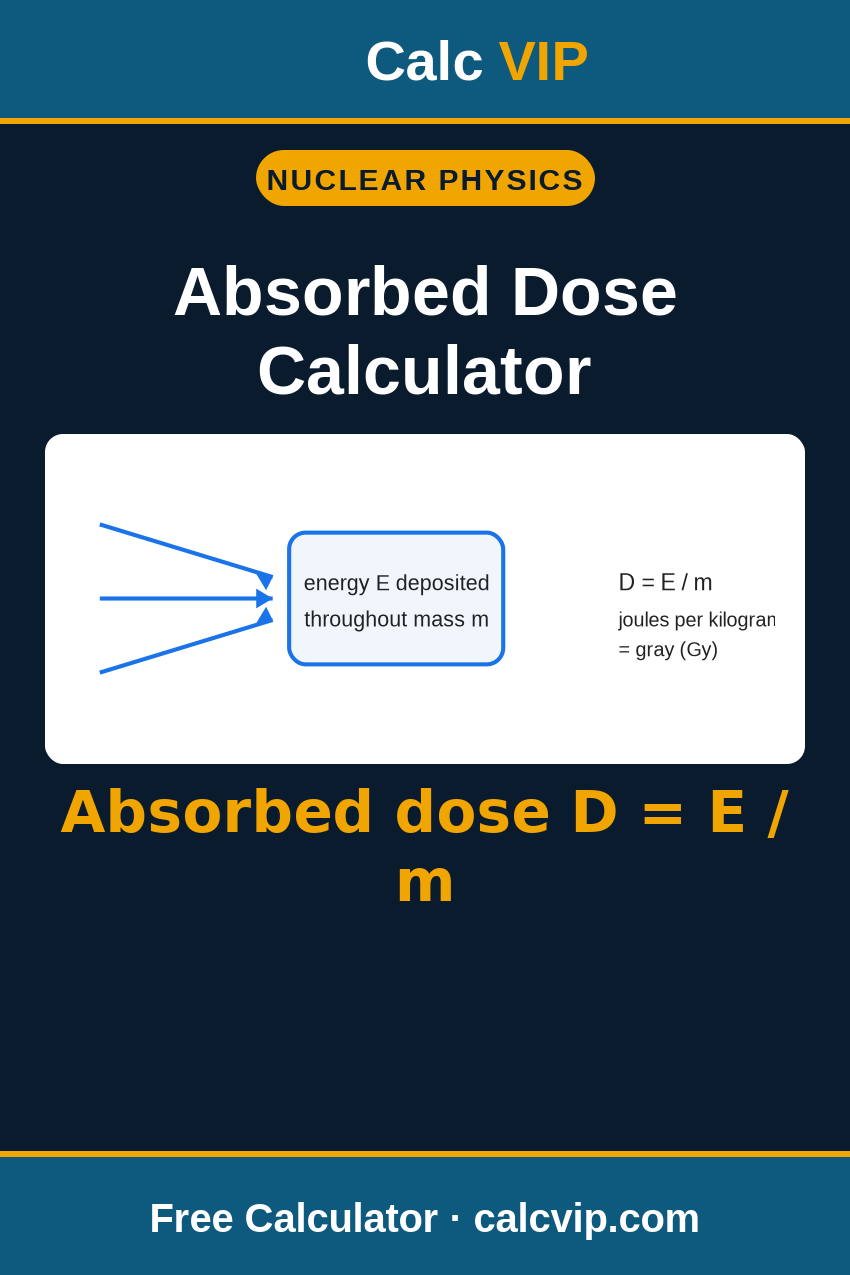
Use this free Absorbed Dose Calculator to find how much radiation energy a material or body tissue actually soaks up. Absorbed dose is the deposited energy divided by the mass — measured in gray (Gy), where 1 Gy = 1 joule per kilogram.
That simple division — energy in, divided by mass — is the foundation of all radiation dosimetry, the science of measuring what radiation actually does to matter. Notice what the definition leaves out: it says nothing about what kind of radiation delivered the energy, how fast it arrived, or what the material is. A gray is a gray, whether it was deposited by gamma rays in a hospital, by cosmic rays at cruising altitude, or by a radioactive source in a factory. That deliberate blindness is a strength and a limitation at once: absorbed dose is the honest physical measurement, the amount of energy genuinely handed over to each kilogram of stuff, and every more sophisticated dose quantity — equivalent dose, effective dose — is built on top of it by adding biological judgement. This calculator performs that first, indispensable step.
The scale of doses in everyday life is worth fixing in your mind before the examples. Natural background radiation delivers roughly 2–3 mGy to your whole body each year — a few thousandths of a gray. A chest X-ray adds about 0.1 mGy to the tissue in the beam. A CT scan delivers a few mGy. At the other extreme, a single fraction of radiotherapy delivers about 2 Gy to a tumour — nearly a thousand times a year of background, aimed at one small mass of tissue — and an acute whole-body dose around 4 Gy is life-threatening. One quantity, D = E/m, spans all of it, from the imperceptible to the lethal, which is why getting the division right — the right energy, and above all the right mass — matters so much.
There is a paradox hiding in the numbers, and it is the key to understanding radiation. The energies involved are absurdly small. A whole-body dose of 4 Gy in a 70 kg person corresponds to just 280 joules of deposited energy — about the energy of climbing a single stair step, enough to warm the body by roughly a thousandth of a degree. Spread evenly as heat it would be nothing. But radiation does not spread its energy evenly: it concentrates it into ionisation events along particle tracks, tearing electrons from molecules in dense little clusters, breaking chemical bonds and DNA strands. Absorbed dose measures the average concentration; the damage comes from how unevenly that average is delivered at the microscopic scale.
Formula
Absorbed dose D = E / m • D in gray (Gy), E in joules (J), m in kilograms (kg), with 1 Gy = 1 J/kg exactly.
The formula rearranges both ways: E = D × m if you know the dose and want the total energy deposited, and m = E / D if you know the energy and the dose and want the irradiated mass. Unit conversions ride along: 1 Gy = 1,000 mGy = 100 rad, so 1 rad = 0.01 Gy = 10 mGy, and 1 mGy = 0.1 rad. The gray is the SI unit, named after the British physicist Louis Harold Gray; the rad (radiation absorbed dose) survives mainly in older American literature. This calculator reports gray, milligray and rad from a single division. The one discipline that decides most real-world errors is the mass: it must be the mass that actually absorbed the energy — the tissue in the beam, the sample in the irradiator — not the mass of the whole patient, room or machine.
| Symbol | Meaning | Units |
|---|---|---|
| D | absorbed dose — energy deposited per unit mass | gray (Gy); also mGy, rad |
| E | radiation energy actually absorbed by the mass | joules (J) |
| m | mass that absorbs the energy | kilograms (kg) |
Why so little energy does so much damage: the ionisation picture
Run the numbers at the scale of a single cell and the paradox resolves. A typical cell has a mass of about a nanogram (10−12 kg). At an absorbed dose of 1 Gy, that cell receives 10−12 joules — which sounds like nothing until you convert it into the currency of chemistry: dividing by the electronvolt (1.602 × 10⁻¹⁹ J) gives about 6.24 million eV deposited in one cell. Creating one ion pair in tissue costs roughly 33 eV, so a single gray produces on the order of 190,000 ionisations inside every cell in the irradiated mass. Even the modest 0.2 Gy of the worked example below means roughly 38,000 ionisations per cell. Chemistry is done molecule by molecule, and radiation does its work molecule by molecule too — that is why joules-per-kilogram, trivial as heat, can be decisive as ionisation.
This is also why absorbed dose alone cannot be the whole story of risk. Two exposures with the same D can deposit their ionisations in very different patterns: gamma rays sprinkle them sparsely along long electron tracks, while alpha particles cram them into dense columns a few cells long. The gray cannot see that difference — it averages over the whole mass — which is precisely why the sievert exists: the Equivalent Dose Calculator takes the gray from this page and weights it by radiation type. Absorbed dose is the indispensable first step, the physical fact of the matter; biological interpretation is layered on afterwards.
How to use
- Enter the radiation energy actually deposited in the material, in joules — scientific notation like 5e-3 is fine. This is the energy absorbed, not the energy the source emitted; only the fraction that stops in the mass counts.
- Enter the mass that absorbs that energy, in kilograms — the sample, organ or tissue volume in the beam, not the whole body unless the whole body really was exposed.
- Click "Calculate Absorbed Dose" to get the dose in gray and milligray, plus the older rad unit.
- Sanity-check the result against the scale of everyday doses: imaging lives in the mGy range, a year of background is a few mGy, therapy fractions are ~2 Gy, and acute whole-body doses of several Gy are medical emergencies.
Worked examples
Example 1 — the reference calculation. A radiation source deposits 0.05 J of energy in 0.25 kg of tissue.
D = E / m = 0.05 ÷ 0.25 = 0.2 Gy = 200 mGy. In the older unit: 0.2 × 100 = 20 rad. For scale, that single exposure equals roughly 80 years of natural background delivered to that tissue at once — dose is about concentration in time as well as mass.
Example 2 — a CT scan. Suppose a scan deposits 0.024 J in the 8 kg of tissue it images.
D = 0.024 ÷ 8 = 0.003 Gy = 3 mGy (0.3 rad) — squarely in the "few mGy" range typical of CT, and about thirty times the dose of a chest X-ray to the examined tissue.
Example 3 — running the formula backwards for radiotherapy. A treatment plan calls for 2 Gy to a tumour of mass 0.05 kg (50 g). How much energy must the beam deposit?
E = D × m = 2 × 0.05 = 0.1 J — about the energy needed to lift a small apple ten centimetres (0.1 kg × 9.81 × 0.1 m ≈ 0.098 J). A tenth of a joule, placed precisely and delivered as ionisation, is enough to destroy a tumour over a course of fractions.
Example 4 — the lethal-dose paradox. An acute whole-body dose of 4 Gy in a 70 kg person is life-threatening without treatment. The total energy is E = 4 × 70 = 280 J. As heat, that would raise the body's temperature by 280 ÷ (70 × 3,500) ≈ 0.001 °C — utterly undetectable. The energy of one stair step (70 × 9.81 × 0.41 m ≈ 280 J) can kill, purely because of how it is delivered: as ionisation, not warmth.
Example 5 — a chest X-ray. The tissue in the beam, about 0.5 kg, receives the typical chest X-ray dose of 0.1 mGy (0.0001 Gy).
E = D × m = 0.0001 × 0.5 = 5 × 10⁻⁵ J — fifty microjoules. Diagnostic imaging works with almost homeopathically small energies; the information gained, not the energy, is the point.
Example 6 — a year of background. Natural background gives a whole-body dose of about 2.4 mGy per year. For a 70 kg person that is E = 0.0024 × 70 = 0.168 J per year — less than a fifth of a joule from all the cosmic rays, soil radioactivity and internal potassium-40 combined. Life evolved bathed in this drizzle of ionisation and repairs the damage continuously.
Absorbed dose in real life
Radiotherapy planning. Every cancer treatment plan is written in gray: a typical course prescribes 60 Gy to the tumour in 30 fractions of 2 Gy, with strict dose limits for nearby organs. Treatment-planning computers divide the patient into tiny volume elements and compute D = E/m for each one, painting the dose around the tumour's shape.
Medical imaging records. Hospitals track the absorbed dose from CT and fluoroscopy against national diagnostic reference levels, so an outlier scanner that doses patients several times higher than its peers gets caught. The doses are small — milligray — but they are measured, recorded and audited.
Personal dosimetry. The badge worn by radiation workers contains materials (thermoluminescent crystals, optically stimulated films) whose stored signal is proportional to the absorbed dose they received. The badge measures dose to itself, in mGy, and the reading is converted into the wearer's dose quantities.
Sterilising medical supplies. Syringes, gloves and implants are routinely sterilised by gamma or electron-beam irradiation at a standard dose of about 25 kGy — 25,000 joules per kilogram. A 100 g pack absorbs 2,500 J, enough ionisation to shred the DNA of every microbe in it, while the plastic barely warms.
Food irradiation. Spices, fruit and poultry are irradiated to kill pathogens and insects: doses run from about 0.1 kGy (stopping potatoes sprouting) up to 10 kGy for spices — 10,000 J/kg. The food does not become radioactive; it simply absorbs energy, exactly as this calculator describes.
Spaceflight. Astronauts on the International Space Station absorb roughly 0.5 mGy per day — about 180 mGy over a year, some 75 times the surface background rate — because the Earth's magnetic field and atmosphere no longer shield them. Mission planners budget this dose like money, and it is a central constraint on Mars missions.
Absorbed dose is not the whole dose story
Absorbed dose is the first of a family of three quantities, and confusing them is the most common error in popular writing about radiation. Absorbed dose (gray) is the physics: energy per kilogram, measured by instruments. Equivalent dose (sievert) multiplies by a weighting factor for the radiation type, because a gray of alpha particles does roughly twenty times the biological damage of a gray of gamma rays. Effective dose (also sievert) weights again by tissue, because a sievert to the lung carries a different lifetime risk from a sievert to the skin. Each step adds judgement to measurement. This calculator gives you the bedrock quantity; the weighting steps belong to the Equivalent Dose Calculator and to protection standards, and they only make sense standing on a correctly computed gray.
Dose rate: the forgotten dimension
The formula D = E/m contains no clock, yet the same total dose can be harmless or lethal depending on how fast it arrives. Cells repair ionisation damage continuously, so 2 mGy spread over a year of background is mended as fast as it occurs, while 2 Gy in a minute overwhelms repair entirely. This is why radiotherapy is fractionated — split into daily 2 Gy doses that healthy tissue can partly repair between visits while the tumour, with its poorer repair, cannot — and why dose rate (Gy per hour, or mGy per year) is quoted alongside dose in every serious protection context. When you use this calculator, you are computing the total; always ask over what time it was delivered before judging what it means.
Quick reference: typical absorbed doses
| Exposure | Absorbed dose |
|---|---|
| dental X-ray (tissue in beam) | ≈ 0.005 mGy |
| chest X-ray (tissue in beam) | ≈ 0.1 mGy |
| natural background, whole body, per year | ≈ 2–3 mGy |
| CT scan (tissue examined) | a few mGy |
| one radiotherapy fraction (tumour) | 2 Gy = 2,000 mGy |
| acute whole-body dose, life-threatening | ≈ 4 Gy |
| medical-supply sterilisation | 25 kGy |
Read the table as a ladder of concentration: the same physics, D = E/m, at every rung — what changes is how many joules are packed into each kilogram, and how quickly.
Common mistakes
- Dividing by the wrong mass. The classic error: a CT scan deposits its energy in the few kilograms actually scanned, not in the whole 70 kg patient. Using body mass understates the dose to the examined tissue by an order of magnitude.
- Confusing gray with sievert. Gy measures absorbed energy; Sv weights it for biological damage. For gamma rays the numbers coincide, but for alpha particles they differ twentyfold — quoting one when you mean the other is a serious error.
- Mixing up rad and gray. 1 Gy = 100 rad. A dose of "20 rad" is 0.2 Gy, not 20 Gy — a hundredfold slip that turns a modest exposure into a lethal one on paper.
- Assuming a small energy means a safe dose. Example 4 above is the antidote: 280 J as heat is nothing, but as ionisation spread through a body it is life-threatening. Judge dose in Gy, never in joules alone.
- Forgetting dose rate. A gray per year and a gray per minute are different universes biologically, because repair mechanisms work between ionisations. Total dose without a timescale is only half the information.
FAQ
What is the difference between gray and sievert?
The gray measures absorbed dose — the raw energy per kilogram. The sievert (equivalent dose) multiplies the gray by a weighting factor for how damaging that type of radiation is, so it better reflects biological risk.
How big is a typical dose?
A chest X-ray gives roughly 0.1 mGy to the tissue imaged, a CT scan a few mGy, and average natural background radiation about 2–3 mGy per year to the whole body.
Can absorbed dose be negative or zero?
No. Energy deposited and mass are both positive, so the dose is always zero (no exposure) or positive. This calculator simply divides the two numbers you enter.
How is absorbed dose actually measured?
With dosimeters: ionisation chambers that collect the charge radiation creates in air or gas, calorimeters that measure the tiny temperature rise, and solid-state badges whose crystals store the energy and release it as light when heated. All are calibrated back to the definition — joules deposited per kilogram.
Does absorbed dose depend on the type of radiation?
The definition does not: a gray of alpha particles and a gray of gamma rays deposit the same energy per kilogram. The biological effect differs greatly, which is handled afterwards by the weighting factors of equivalent dose — not by changing the gray.
What absorbed dose is dangerous?
Delivered acutely to the whole body: around 1 Gy causes radiation sickness, about 4 Gy is lethal to roughly half of those exposed without treatment, and 10 Gy is almost invariably fatal. Local doses are a different matter — a tumour can be given 60 Gy in fractions precisely because the dose is confined and spread over weeks.
How much energy is 1 Gy in a whole person?
For a 70 kg body, E = D × m = 1 × 70 = 70 joules — the kinetic energy of a briskly thrown cricket ball. Radiation's power is never in the size of the energy but in its microscopic concentration.
Can absorbed dose be converted straight into cancer risk?
Not directly. Risk estimates use effective dose in sievert, which folds in radiation type and tissue sensitivity, and even then they are statistical population estimates, not predictions for an individual. The gray is where the chain starts, not where it ends.
Why do radiotherapy patients survive 60 Gy?
Because the dose is neither whole-body nor instant: it is aimed at a small mass, shaped to spare healthy tissue, and split into ~30 daily fractions so normal cells can repair between visits. Total dose, volume and timing together decide the outcome — the gray alone is only one of the three.
What is the difference between dose and activity?
Activity (becquerel) counts how many atoms decay per second in a source. Dose counts how much energy per kilogram those decays deposit in a target. A very active source can deliver a tiny dose if it is far away, shielded, or its radiation escapes the target — the two quantities live at opposite ends of the story.