 Calc
Activity Calculator – A = λN in Becquerel and Curie
 Created by Anna Kowalski · Physics Editor · Heat & Atoms · Last updated: November 2026
Use this free Activity Calculator to find how radioactive a sample is, using A = λN. Enter the number of undecayed nuclei and the decay constant — get the activity in becquerel (Bq) and curie (Ci).
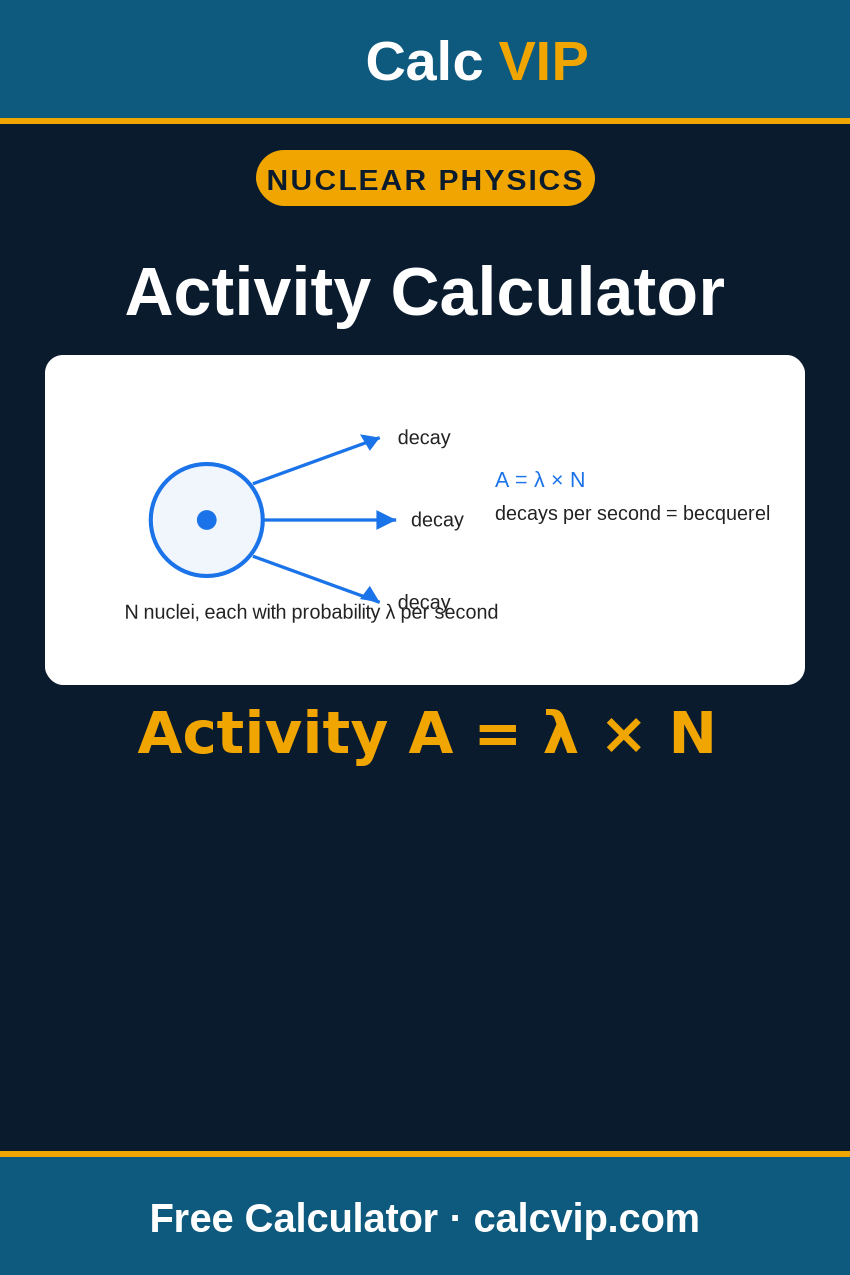
Activity is the number that turns "this material is radioactive" into "this material is this radioactive". It counts the decays actually happening — not atoms sitting quietly, but nuclei transforming, right now, every second. The recipe could hardly be simpler: activity A = λN, the decay probability per nucleus multiplied by the number of nuclei available to decay. A sample can reach a given activity by holding a huge number of sluggish nuclei (uranium ore) or a modest number of frantic ones (a fresh medical tracer), and this calculator multiplies the two factors for you, reporting the result in becquerels and in the older curie unit still used across medicine and industry.
The becquerel is a humble unit — one decay per second — which is why real-world activities arrive wearing prefixes: a banana ticks at about 15 Bq, a household smoke detector at 37,000 Bq, a hospital tracer dose at hundreds of millions, and a radiotherapy source at hundreds of trillions. The curie, defined historically as the activity of one gram of radium-226 (3.7 × 10¹⁰ Bq), survives because those prefixes get unwieldy in the clinic: a 740 MBq injection is more often prescribed as 20 mCi. This calculator speaks both languages fluently.
One warning belongs at the top of the page: activity is not danger. A becquerel of alpha decays inside the lung and a becquerel of gamma decays across the room are utterly different hazards, because harm depends on the radiation's type, energy, and where it deposits that energy — activity is only the starting count from which dose calculations begin. What activity does give you, exactly and immediately, is the strength of the source: how many transformations per second are available to image, to treat, to detect or to shield against. Everything else is built on top of A = λN.
Formula
Activity A = λ × N, measured in becquerel (1 Bq = 1 decay per second). The older unit is the curie: 1 Ci = 3.7 × 10¹⁰ Bq (the activity of 1 g of radium-226).
The formula rearranges to answer the design questions: the number of nuclei needed for a target activity is N = A / λ, and the decay constant implied by a measured activity is λ = A / N. Because λ = ln 2 / T½, activity can also be written straight from the half-life: A = N × ln 2 / T½ — the form that reveals the deep trade-off of the subject, since for a fixed number of atoms the activity is inversely proportional to the half-life. Halve the half-life and you double the activity, but the sample also exhausts itself twice as fast; total decays over all time always equal N, however you schedule them. Unit discipline: λ must be in per-second for A to emerge in becquerels. λ quoted per day or per year must be divided by 86,400 or 3.156 × 10⁷ first — the Decay Constant Calculator on this site performs exactly that conversion.
| Symbol | Meaning | Units |
|---|---|---|
| A | activity — decays per second | becquerel (Bq); 1 Ci = 3.7 × 10¹⁰ Bq |
| λ | decay constant — decay probability per nucleus per second | s−1 |
| N | number of undecayed nuclei present | atoms (count) |
| T½ | half-life, linked by λ = ln 2 / T½ | seconds (in this formula) |
Specific activity: why short-lived means intense
Divide activity by mass and you get specific activity — becquerels per gram — the figure of merit for how "concentrated" a radioactive material is. Since A = λN and a gram of any isotope holds roughly the same order of atoms (fewer for heavy nuclei, more for light), specific activity is governed mainly by λ, hence by the half-life. The spread is staggering. A gram of radium-226 (T½ = 1,600 years) manages 3.7 × 10¹⁰ Bq — the original curie. A gram of technetium-99m (T½ = 6 hours) would blaze at roughly 2 × 10¹⁷ Bq per gram if you could gather one, millions of times hotter gram for gram, which is why a full patient dose of it weighs only nanograms (Example 3). A gram of uranium-238, meanwhile, ticks at a mere 12,000 Bq or so.
This inverse marriage between intensity and endurance shapes every application. Medicine wants enormous specific activity in a vanishing mass, delivered fast and gone by tomorrow — short half-life. Industry and spaceflight want the opposite: a source that barely changes over decades accepts a modest activity in exchange for stamina, choosing plutonium-238 or americium-241. And because A = λN ties the two together, you cannot cheat the trade: for a fixed stock of atoms, nature lets you spend them quickly or slowly, never both. This calculator is the cash register for that transaction.
How to use
- Enter the number of undecayed nuclei N — scientific notation like 1e15 is fine.
- Enter the decay constant λ in per-second (use the Decay Constant Calculator if you only know the half-life).
- Click the button to get the activity in Bq and Ci.
- Convert to friendly prefixes as needed: 10³ Bq = 1 kBq, 10⁶ = 1 MBq, 10⁹ = 1 GBq, 10¹² = 1 TBq.
- Remember the result is the source's total decay rate. The dose anyone actually receives also depends on distance, shielding and exposure time — see the Radiation Distance Calculator for the distance part.
Worked examples
Example 1 — the reference sample. A sample contains 1 × 10¹⁵ nuclei with a decay constant of 1 × 10⁻⁶ per second.
A = λN = 1e-6 × 1e15 = 1 × 10⁹ Bq (one gigabecquerel).
In curies: 1e9 / 3.7e10 = 0.0270 Ci, i.e. about 27 mCi. The same result says the sample fires 6 × 10¹⁰ decays every minute — activity is a rate, and the per-minute figure is just the per-second one multiplied by 60.
Example 2 — why the curie is a gram of radium. One gram of radium-226 holds N = 6.022 × 10²³ / 226 = 2.66 × 10²¹ nuclei. Its half-life of 1,600 years gives λ = ln2 / (1600 × 3.156 × 107 s) = 1.37 × 10⁻¹¹ /s. So A = λN ≈ 3.66 × 10¹⁰ Bq — within a percent of 3.7 × 10¹⁰ Bq, the definition of one curie. Marie Curie's unit was not arbitrary: it was the activity of the gram of radium she had isolated.
Example 3 — a hospital dose weighs nanograms. A standard technetium-99m scan administers 740 MBq (7.4 × 10⁸ Bq). With λ = 3.20 × 10⁻⁵ /s, the number of nuclei required is N = A/λ = 2.31 × 10¹³ atoms — which sounds vast until you weigh it: 2.31e13 × 99 × 1.6605e-27 kg ≈ 3.8 × 10⁻¹² kg, under four nanograms. High specific activity means the chemistry of the dose is essentially tracer-free: the patient is scanned by a few billionths of a gram.
Example 4 — the smoke detector on your ceiling. Its americium-241 source has an activity of about 37 kBq (1 µCi). Americium-241's half-life of 432 years gives λ = 5.08 × 10⁻¹¹ /s, so the source holds N = 3.7e4 / 5.08e-11 ≈ 7.28 × 10¹⁴ nuclei, a mass of about 0.29 µg — a speck of oxide smaller than a grain of pollen, quietly producing 37,000 alpha decays per second for decades.
Example 5 — the banana, honestly assessed. A banana's potassium-40 gives it an activity of about 15 Bq. Potassium-40's half-life is 1.25 billion years, so λ ≈ 1.76 × 10⁻¹⁷ /s, and the banana must contain N = 15 / 1.76e-17 ≈ 8.5 × 10¹⁷ potassium-40 nuclei to sustain even that gentle tick. Your own body, holding far more potassium, runs at roughly 4,400 Bq — you are about 300 bananas, radioactively speaking, and perfectly safe, because activity alone is not dose.
Example 6 — living wood for the carbon-dating lab. Living carbon has an activity of about 0.25 Bq per gram, so a 10 kg beam of fresh timber totals 2,500 Bq of carbon-14. With λ = 3.83 × 10⁻¹² /s, that corresponds to N = 2500 / 3.83e-12 ≈ 6.5 × 10¹⁴ carbon-14 nuclei scattered among the ~1026 ordinary carbon atoms — the whisper of a signal that archaeology listens for.
Activity in real life
Prescriptions are written in becquerels. A nuclear-medicine order does not say "inject 4 nanograms"; it says "administer 740 MBq of technetium-99m at 10:00". Because the activity falls measurably every hour, the pharmacy computes backwards with A = λN and the decay law so that the syringe contains the prescribed activity at the prescribed minute.
Regulation and licensing. Every radioactive source in a school, hospital or factory is licensed by its activity. Exemption limits, transport categories and shielding requirements all begin from the Bq figure — a 37 kBq smoke-detector source and a 370 TBq irradiator live under entirely different rulebooks because of this one number.
Food and environmental monitoring. After nuclear accidents, food is screened in Bq per kilogram — the European limit for caesium-137 in foodstuffs is 600 Bq/kg — and drinking water in Bq per litre. The measurements are direct applications of A = λN run in reverse: count the decays, infer the contamination.
Smoke detectors and exit signs. The 37 kBq americium source (Example 4) ionises air in its chamber so smoke can interrupt a current. Its activity is chosen to be far above detection thresholds yet far below any health concern — a balance struck by picking N and λ together.
Space power. The plutonium-238 in a deep-space RTG is loaded by activity and heat output: each gram delivers about 0.57 W of decay heat, and a 10 kg charge starts near 6 × 10¹⁵ Bq. Mission planners watch that activity halve over 87.7 years, budgeting power for decades with this formula.
Your own body. Potassium-40 and carbon-14 make every person a ~4,400 Bq source, and a person sleeping beside you contributes a measurable — and utterly negligible — dose. Activity numbers only become meaningful alongside radiation type, energy and geometry, which is the subject of the depth section below.
Quick reference: activities you may meet
| Source | Typical activity | In curies |
|---|---|---|
| One banana (K-40) | 15 Bq | 4 × 10⁻¹⁰ Ci |
| Adult human body | ≈ 4,400 Bq | ≈ 1.2 × 10⁻⁷ Ci |
| Smoke detector (Am-241) | 37 kBq | 1 µCi |
| Tc-99m patient dose | 740 MBq | 20 mCi |
| 1 g of radium-226 | 3.7 × 10¹⁰ Bq | 1 Ci (by definition) |
| Teletherapy Co-60 source | ≈ 3.7 × 10¹⁴ Bq | ≈ 10,000 Ci |
Sixteen orders of magnitude separate the banana from the therapy source, and A = λN spans them all without changing its shape — only the inputs grow.
Activity is not dose — the three missing ingredients
Two sources with identical activities can differ a thousandfold in hazard, because activity counts decays and nothing more. To reach a dose you must also know: (1) the radiation type — alpha particles dump all their energy within micrometres of tissue (devastating inside the body, harmless outside it), while gamma rays spread theirs thinly over metres; (2) the energy per decay — a 6 MeV alpha carries roughly ten times the energy of a typical beta; and (3) the geometry — distance follows the inverse-square law, so the same source is 100 times weaker at 10 metres than at 1. Regulators fold all three into dose units (sieverts) with radiation weighting factors. Keep the hierarchy straight: this calculator gives the source strength; the Radiation Distance Calculator handles geometry; dose needs both, plus the radiation's character. Anyone quoting becquerels alone as a danger figure is showing you only the first page of the story.
Common mistakes
- Entering mass instead of atom count. A = λN needs N as a number of nuclei. One gram of cobalt-60 is not “1” — it is about 10²² nuclei. Convert with N = (mass / atomic mass) × 6.022 × 10²³ before using this calculator.
- Using λ per year or per day. Becquerels are per second. A λ of 0.13 per year must be divided by 3.156 × 10⁷ before it meets N, or the “activity” comes out 31 million times too large.
- Slipping powers of ten between Bq and Ci. 1 Ci = 3.7 × 10¹⁰ Bq — ten digits, not six. A GBq-scale hospital dose is tens of millicuries, not tens of curies; misplacing this factor misstates a source by a billion.
- Equating high activity with high danger. A GBq of tritium (feeble beta, 18.6 keV maximum) and a GBq of polonium-210 (intense alpha) are different hazards entirely. Activity is the starting point of a safety assessment, never the conclusion.
- Forgetting that activity decays. The A you compute is the activity now, with the N you entered. Come back in one half-life and the same sample reads half as much — always date an activity figure, the way pharmacies timestamp a syringe.
FAQ
What is a becquerel?
One becquerel is one nuclear decay per second. It is a very small unit in everyday terms, so activities are often quoted in kBq, MBq or GBq.
Why does activity depend on both λ and N?
Each nucleus decays at random with probability λ per second. More nuclei (bigger N) or a faster decay probability (bigger λ) both mean more decays every second.
Is a high activity always dangerous?
Not by itself — danger also depends on the type and energy of the radiation and how close you are. But activity is the starting point for every radiation-safety calculation.
What is the difference between Bq, kBq, MBq, GBq and TBq?
Just powers of a thousand: 1 kBq = 10³ Bq, 1 MBq = 10⁶, 1 GBq = 10⁹, 1 TBq = 10¹² decays per second. Everyday sources live in Bq–kBq, medicine in MBq–GBq, and industrial irradiators in TBq and beyond. The prefixes keep the numbers human-sized; the physics is identical.
Why is the curie still used if the becquerel exists?
Habit, history and convenience in the clinic. The curie (and its children, the millicurie and microcurie) was standard for a century, and North American medicine still prescribes in mCi. The conversion is fixed — 1 Ci = 3.7 × 10¹⁰ Bq exactly — so the two systems coexist without ambiguity, like miles and kilometres.
How can I find N if I only know the mass of my sample?
Divide the mass in grams by the isotope's atomic mass to get moles, then multiply by Avogadro's number, 6.022 × 10²³. One gram of cobalt-60: 1/60 × 6.022e23 ≈ 1.0 × 10²² nuclei. If the sample is a compound or a mixture, first find the mass of the radioactive element within it.
Does activity depend on the sample's temperature or chemical form?
No — for the same reason half-lives do not: decay is a nuclear process. A becquerel of iodine-131 is a becquerel whether the iodine is in a crystal, a solution or a thyroid. (What chemistry changes is where the isotope goes in the body, which affects dose, not activity.)
What does 'specific activity' mean on a supplier's label?
Activity per unit mass or volume — Bq/g or Bq/mL. It tells you how much material you must handle to get the activity you need. High specific activity (short half-life, carrier-free preparation) means nanogram quantities suffice, as in the technetium example; low specific activity means grams of material accompany your becquerels.
Can activity be negative or zero?
Zero, yes — a sample of a stable isotope has A = 0 because λ = 0. Negative, never: λ and N are both non-negative. If a calculation produces a negative activity, an input sign or unit has gone wrong upstream.
How long will a source stay above a given activity?
Activity halves with the half-life, so count halvings: a 740 MBq dose falls below 10 MBq after about six and a quarter half-lives (740 → 370 → 185 → 92 → 46 → 23 → 12 → 6). For an exact time, use t = ln(A₀/A) / λ — the same rearrangement as the decay calculator's, with activities in place of atom counts.