 Calc
Daughter Activity Calculator – Radioactive Ingrowth (Bateman)
 Created by Anna Kowalski · Physics Editor · Heat & Atoms · Last updated: November 2026
Use this free Daughter Activity Calculator to find how the activity of a radioactive daughter product grows in over time. When a long-lived parent keeps producing a short-lived daughter — as in a hospital technetium generator — the daughter's activity climbs toward the parent's activity and then tracks it.
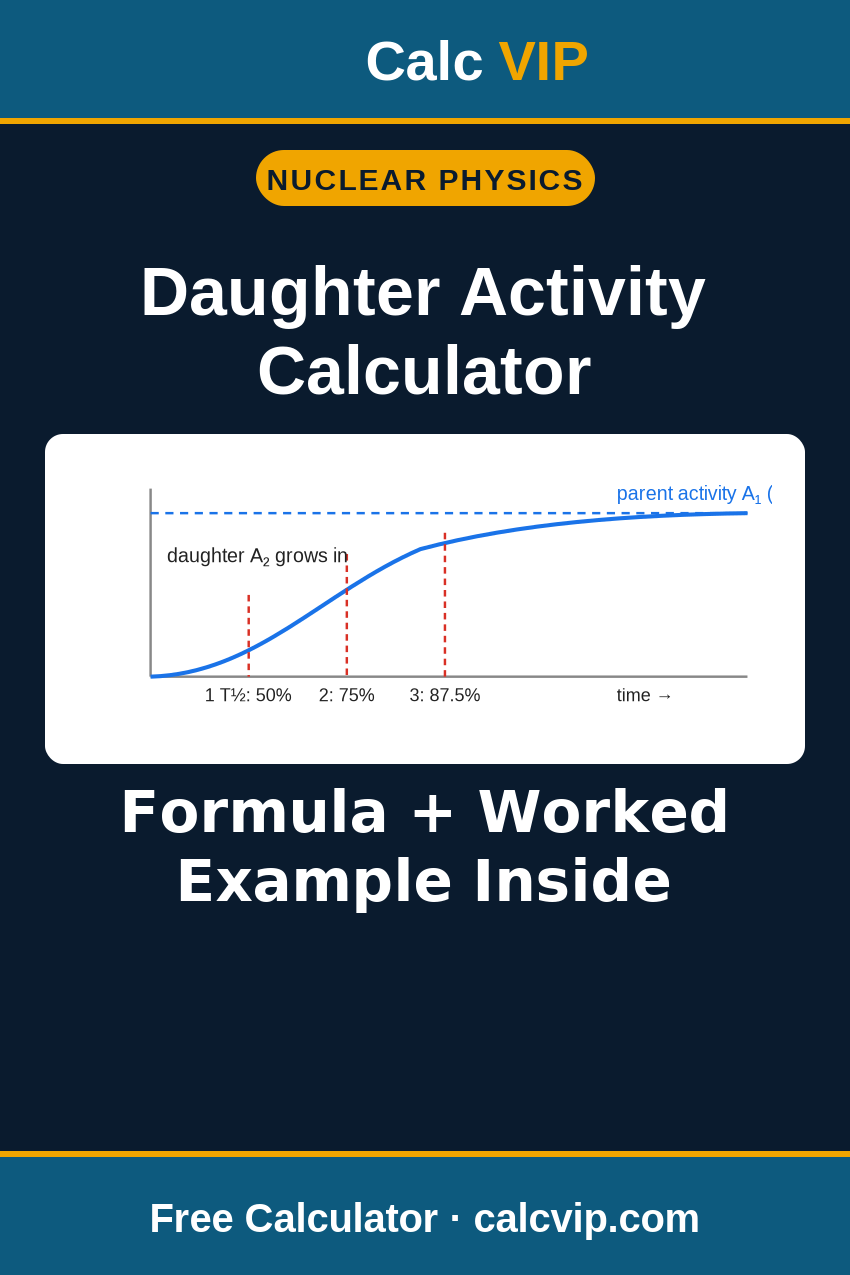
Radioactive decay chains have a rhythm of their own: a parent nucleus decays into a daughter, the daughter accumulates, and the daughter decays too. When the parent is long-lived, its activity is a nearly constant fountain, and the daughter's activity rises along a curve as predictable as the charging of a battery — half-way in one daughter half-life, three-quarters in two, seven-eighths in three. This calculator evaluates that rise, the simplified Bateman solution for a constant parent, and with it you can answer the practical questions: how long until the daughter is ready? How much will there be? When does waiting stop being worthwhile?
The balance at work is a race between production and decay. At the start there is no daughter, so nothing decays and every parent decay adds one daughter atom: the activity climbs steeply. As the daughter population grows, its own decay rate — activity A₂ itself — grows with it, cancelling more and more of the production. The climb flattens exactly when the daughter decays as fast as the parent creates it, at A₂ = A₁: secular equilibrium, the state in which the daughter's activity mirrors the parent's and both decline together at the parent's stately pace. The approach is exponential, governed by the daughter's decay constant λ₂ alone — the parent enters only as the height of the ceiling, never the speed of the climb.
The most important stage for this physics is a hospital basement. The molybdenum-99/technetium-99m generator — a small shielded column delivered weekly to hospitals worldwide — is a parent-daughter machine: Mo-99 (half-life 66 hours) continuously breeds Tc-99m (half-life 6 hours), the workhorse tracer of medical imaging, and staff "milk" the generator each morning, washing out the accumulated technetium and letting it regrow. How much they get depends on exactly the curve this calculator draws. The same mathematics governs radon building up in a sealed room, yttrium-90 growing into a strontium-90 source, and daughter products accumulating in nuclear waste.
Formula
Daughter activity A₂(t) ≈ A₁ × (1 − e−λ₂t) • λ₂ = ln 2 / T½daughter = 0.693 / T½.
Because e−λ₂t is just (1/2) raised to the number of elapsed daughter half-lives, the formula has an arithmetic twin: A₂ = A₁ × (1 − (1/2)n) with n = t / T½. After n = 1, 2, 3, 4… half-lives the daughter stands at 50%, 75%, 87.5%, 93.75%… of the parent. Inverting it, the time to reach a fraction f of A₁ is t = −ln(1 − f)/λ₂; for f = 99% that gives t = ln(100)/λ₂ = 6.644 half-lives, the figure this calculator reports alongside every answer. The approximation sign carries an assumption: the parent's activity must barely change during the ingrowth — true when the parent's half-life is at least ten times the daughter's. When the parent decays appreciably on the same timescale (Mo-99/Tc-99m is the borderline celebrity), the full Bateman equation applies and the daughter overshoots, peaks and declines — the subject of the depth section below.
| Symbol | Meaning | Units |
|---|---|---|
| A₂ | daughter activity at time t | same unit as A₁ (Bq, MBq, mCi…) |
| A₁ | parent activity (treated as constant) | same unit as A₂ |
| λ₂ | daughter decay constant, ln 2 / T½ | per unit time |
| T½ | daughter half-life | same unit as t |
| t | time since the daughter was last removed | same unit as T½ |
The percentage ladder: ingrowth in half-lives
The cleanest way to hold this curve in your head is as a ladder, each rung one daughter half-life tall, each step closing half the remaining distance to the parent. After 1 half-life: 50%. After 2: 75%. After 3: 87.5%. After 4: 93.75%. After 5: 96.875%. After 6: 98.44%. After 7: 99.22%. After 10: 99.90%. Two practical morals follow. First, patience has diminishing returns — the fifth half-life buys you only 3.1 extra percent, the seventh only 0.78. Second, schedules write themselves from the ladder: a hospital that milks its generator every 24 hours with a 6-hour daughter is harvesting at rung four, 93.75%, every single day, and waiting a full extra day would add barely 5% while the parent itself decays away underneath. The ladder is also a diagnostic: if a measured daughter activity sits far below its rung, something — a leak, a branching loss, a wrong half-life — is off.
Branching deserves its sentence here, because real chains are rarely as clean as the formula. If only a fraction b of parent decays produce the daughter of interest (the rest bypass it or feed other products), the ceiling is not A₁ but b × A₁, and every rung scales down by the same factor. Molybdenum-99 sends about 87.6% of its decays through technetium-99m; a generator's realistic ceiling is therefore about 0.876 × A₁ before elution efficiency takes its own cut. The calculator's answer is the ideal ceiling for a 100% branch — multiply by the branching fraction of your chain for the working figure.
How to use
- Enter the parent activity A₁ in any activity unit — Bq, MBq, GBq, mCi. The daughter's activity comes out in the same unit.
- Enter the daughter's half-life and choose the time unit (seconds, minutes, hours or days) that you will use for both the half-life and the time.
- Enter t, the time since the daughter was last completely removed — since the generator was milked, the sample purified, or the chain was created.
- Read off the daughter activity, its percentage of the parent, and the time needed to reach 99% of A₁ (6.644 daughter half-lives) for planning the next separation.
Worked examples
Example 1 — the hospital generator. A generator's parent has A₁ = 1,000 MBq; the daughter's half-life is 6 hours (technetium-99m from molybdenum-99). After 24 hours — exactly 4 daughter half-lives:
A₂ = 1,000 × (1 − (1/2)4) = 1,000 × (1 − 1/16) = 937.5 MBq, i.e. 93.75% of the parent. It reaches 99% of A₁ after 6.644 half-lives ≈ 39.863 hours — which is why nobody waits for 99%: the daily harvest at 94% is worth far more.
Example 2 — the generator's own ladder. Same generator, shorter waits. After 1 hour: A₂ = 1,000 × (1 − (1/2)1/6) = 109.1 MBq (10.9%). After 6 hours: 500 MBq. After 12 hours: 750 MBq. After 18 hours: 875 MBq. A radiopharmacist reads the morning's available activity straight off this ladder.
Example 3 — radon in a sealed room. Radium-226 in building materials (half-life 1,600 years — constant for any human purpose) feeds radon-222, half-life 3.82 days. Seal a room and the radon climbs: after 30 days it stands at 1 − (1/2)30/3.82 = 1 − 0.00433 = 99.57% of its equilibrium value. Ventilation is just artificial "milking" — it resets the clock this calculator counts.
Example 4 — a strontium-yttrium source. Strontium-90 (28.8 years) breeds yttrium-90, half-life 64 hours, a pure beta emitter used in therapy. From a parent of 500 MBq, after two weeks (336 hours = 5.25 half-lives): A₂ = 500 × (1 − (1/2)5.25) = 500 × 0.9737 = 486.9 MBq of Y-90, ready to be chemically separated at 97.4% of its ceiling.
Example 5 — planning a separation. A daughter with half-life 2.5 days is needed at 99% of its parent's activity for an experiment. Time required: 6.644 × 2.5 = 16.6 days. At 7 days (2.8 half-lives) it would only be at 85.6% — the difference between scheduling the experiment for next week or the week after is written in this one multiplication.
Example 6 — the ceiling with branching. A parent of 2,000 MBq decays to the wanted daughter in only 87.6% of its decays (the Mo-99 figure). The true ceiling is 0.876 × 2,000 = 1,752 MBq, and the 24-hour, 4-half-life harvest is 1,752 × 0.9375 = 1,642.5 MBq — not the 1,875 MBq the unbranched formula suggests. Branching fractions are where paper generators and real generators part company.
Daughter ingrowth in real life
The technetium generator. Several million patient scans a year depend on Example 1's curve. The generator arrives with Mo-99 adsorbed on an alumina column; saline washes the Tc-99m off (the daughter binds less tightly), and the ladder restarts. A generator's useful life is about two weeks — set by the parent's 66-hour half-life, the slow decline beneath the daily sawtooth.
Radon measurement and mitigation. Radon test kits and continuous monitors interpret their readings through ingrowth: a freshly sealed detector, like the room of Example 3, needs days to register equilibrium radon. Building codes for radon barriers are written around the equilibrium values this curve approaches.
Radioactive dating by disequilibrium. Geologists turn the formula around: if a uranium-series daughter in a coral or cave deposit sits below its secular-equilibrium value, the deficit measures the time since the system was closed — uranium-thorium dating, accurate across hundreds of thousands of years, is ingrowth used as a clock.
Therapy isotope production. Yttrium-90 (Example 4), bismuth-213 from actinium-225, and lead-212 generators all deliver short-lived therapeutic daughters from longer-lived parents, letting hospitals hold the parent and milk the medicine on demand.
Nuclear waste and decommissioning. The hazard of stored waste evolves as daughters grow in: caesium-137's barium-137m daughter produces the penetrating gamma rays that dominate its shielding requirements, arriving on a 2.55-minute half-life ladder that reaches equilibrium within the hour.
Environmental tracing. After a release, the ratio of daughter to parent activity in soil or water is a forensic clock: it reveals how long ago the parent was chemically purified, because purification zeroes the daughter and starts this calculator's curve from the origin.
When the parent won't sit still: transient equilibrium
The simplified formula assumes A₁ is constant. Molybdenum-99, with its 66-hour half-life against technetium's 6 hours, only approximately qualifies: over a day the parent falls by about 22%. The full Bateman solution, A₂(t) = A₁(0) × [λ₂/(λ₂ − λ₁)] × (e−λ₁t − e−λ₂t), tells the richer story. With λ₁ = ln2/65.94 h and λ₂ = ln2/6.01 h, the technetium activity peaks at t = ln(λ₂/λ₁)/(λ₂ − λ₁) ≈ 22.9 hours, reaching about 0.786 × A₁(0) — or ≈ 0.69 × A₁(0) after the 87.6% branching fraction. After the peak, daughter and parent decline together in transient equilibrium, the daughter's activity holding a fixed ratio above the parent's current activity — yes, above: A₂/A₁ settles at λ₂/(λ₂ − λ₁) ≈ 1.10, because the daughter is still living off yesterday's more numerous parent atoms. Use this calculator's formula freely when the parent's half-life exceeds the daughter's by a factor of ten or more; between three and ten, expect the truth to peak a little earlier and lower than the simple curve promises.
Reading the answer like a practitioner
Three habits separate a useful ingrowth estimate from a naive one. First, always state the separation efficiency alongside the activity: a generator eluted at 90% efficiency leaves 10% of the daughter behind, and that residue is a head start for the next ingrowth — real elution profiles are this calculator's curve with a raised floor. Second, decay-correct everything to a stated reference time; an activity without a timestamp is meaningless for a 6-hour isotope, losing 11% of its value every hour on the shelf. Third, remember that the daughter you harvest begins decaying the moment it leaves the parent — a 937.5 MBq elution at 8 a.m. is a 469 MBq dose by 2 p.m. Ingrowth and decay are the same exponential wearing two hats, and every working radiopharmacy plans its day at the intersection of the two curves.
Quick reference: the ingrowth ladder
| Daughter half-lives elapsed | A₂ as % of A₁ | Gap remaining |
|---|---|---|
| 1 | 50% | 50% |
| 2 | 75% | 25% |
| 3 | 87.5% | 12.5% |
| 4 | 93.75% | 6.25% |
| 5 | 96.875% | 3.125% |
| 6.644 | 99% | 1% |
| 10 | 99.90% | 0.098% |
Memorise the first four rungs and you can estimate any secular-equilibrium system — generator, radon room or waste store — to within a few percent in your head.
Common mistakes
- Putting the parent's half-life in the exponent. The climb is governed entirely by the daughter's λ₂. The parent's half-life decides only whether the constant-A₁ approximation is allowed — using it in the curve itself is the classic blunder.
- Expecting the daughter to reach A₁ quickly — or exactly. The approach is asymptotic: 99% costs 6.64 half-lives, 99.9% costs 10. Schedules built on "it should be done by now" fail by exactly the ladder's remaining gap.
- Ignoring the branching fraction. If only 87.6% of parent decays pass through your daughter, the ceiling is 0.876 A₁. Skipping this overstates every harvest, as Example 6 shows.
- Using the simple formula for a fast-decaying parent. When the parent's half-life is within a factor of a few of the daughter's, the daughter peaks and falls instead of levelling — you need the full Bateman equation and the transient-equilibrium picture above.
- Forgetting the clock restarts at separation. t is measured from the last time the daughter was removed, not from when the parent was made. A generator milked yesterday morning has been regrowing for one day, however old the generator is.
FAQ
What is secular equilibrium?
When the parent's half-life is much longer than the daughter's, the daughter's activity grows until it equals the parent's activity; from then on both decay together at the parent's slow rate. The Mo-99/Tc-99m generator in hospitals works on this principle.
When is this simplified formula not accurate?
If the parent itself decays noticeably during the ingrowth time, you need the full Bateman equation, which also includes the parent's decay constant and can make the daughter activity peak and then fall (transient equilibrium).
Why does the daughter never quite reach A₁?
The growth is exponential — it closes 50% of the remaining gap in each half-life, so it approaches A₁ but only reaches it in the limit. After about 7 half-lives the difference is under 1% and usually ignored.
What is the Bateman equation?
The general solution, published by Harry Bateman in 1910, for the amounts of every member of a radioactive chain as functions of time, given each member's decay constant. This calculator uses its simplest case — constant parent, one daughter — and the full form handles chains of any length, including parents that decay appreciably.
How often should a technetium generator be milked?
About once a day in practice. At 24 hours the daughter has regrown to ~94% of its (slowly falling) ceiling; milking twice daily yields more total activity in smaller batches, and many departments elute morning and afternoon for exactly that reason.
Can the daughter's activity ever exceed the parent's?
Under the simplified formula, no — it approaches A₁ from below. In transient equilibrium it can exceed the parent's current activity by the factor λ₂/(λ₂ − λ₁), because the daughter population was built when the parent was stronger. It can never exceed the parent's initial activity (times the branching fraction).
Does this work for granddaughters too?
Yes, with the full Bateman machinery: each generation grows in against its own parent's curve, so granddaughters lag further behind and peak later. In secular equilibrium, remarkably, every member of the chain ends with the same activity as the original parent — the basis of uranium-series analysis.
Why is secular equilibrium useful in geology?
Because it is a reference state that takes a known time to establish. A rock whose U-238 chain members all share one activity has been undisturbed for millions of years; a member out of line betrays — and dates — the disturbance, whether melting, leaching or crystallisation.
What if the daughter is stable?
Then there is no activity to grow — but the daughter atoms accumulate linearly at rate A₁, which is exactly the situation the Radioactive Dating Calculator exploits: the stockpile of stable daughter is the integral of this curve.
How accurate is the constant-parent approximation?
The error after one daughter half-life is roughly the fraction by which the parent decayed in that time. Parent ten times longer-lived: ~7% parent decay per daughter half-life at most, and the simple formula is good to a few percent. Parent only three times longer-lived: switch to the full equation.