 Calc
Binding Energy Calculator – Mass Defect, MeV & Energy per Nucleon
 Created by Anna Kowalski · Physics Editor · Heat & Atoms · Last updated: November 2026
Use this free Binding Energy Calculator to convert a nucleus's mass defect into binding energy. A nucleus always weighs less than its separate protons and neutrons — that missing mass is the binding energy, at 931.5 MeV per atomic mass unit.
Weigh a nucleus and then weigh its ingredients separately, and the two numbers refuse to match. The bound nucleus is always lighter — by a small but precisely measurable amount called the mass defect — and the missing mass is not lost but converted: it is the binding energy, the energy that was radiated away when the nucleus formed and the energy you would have to supply to tear it apart again. Einstein's E = mc² is the exchange rate, and at 931.5 MeV per atomic mass unit it turns a defect of a few hundredths of a unit into tens of millions of electron-volts. This calculator performs that conversion and divides by the nucleon count to give the binding energy per nucleon, the single best measure of how stable a nucleus is.
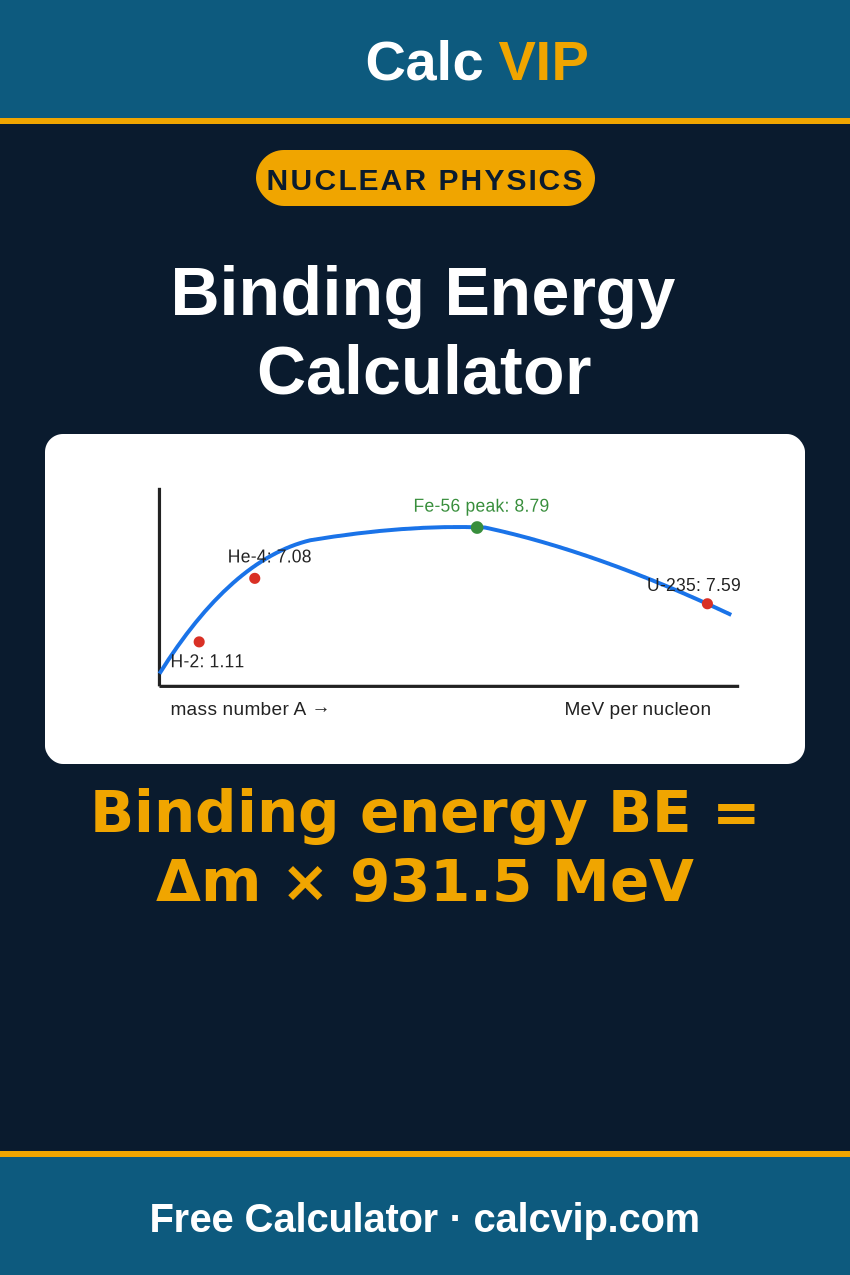
That per-nucleon figure draws one of the most consequential curves in physics. It climbs steeply from hydrogen's fragile deuterium (1.11 MeV per nucleon), spikes at helium-4 (7.08), rises through carbon and oxygen, and crests near iron-56 at about 8.79 MeV per nucleon — the most tightly bound nucleus in nature. Beyond iron it declines, gently but relentlessly, to uranium's 7.59. Every energy-releasing nuclear process is a journey uphill on this curve: light nuclei fuse toward iron, heavy nuclei fission toward iron, and iron itself is the ash that neither process can burn.
The numbers explain the violence of the nuclear world. Chemical bonds trade in electron-volts per atom; nuclear binding trades in millions of electron-volts per nucleus — a millionfold richer currency, which is why a kilogram of uranium out-yields a kilogram of coal by a factor of millions (the fission-energy calculator puts the exact figure on it). Enter a mass defect in atomic mass units and a mass number A, and this calculator returns the total binding energy in MeV and joules, and the per-nucleon value you can plot straight onto the curve.
Formula
Binding energy BE = Δm × 931.5 MeV, where Δm is the mass defect in atomic mass units (1 u = 931.5 MeV/c² = 1.6605 × 10⁻²⁷ kg). Binding energy per nucleon = BE / A — the best measure of how stable a nucleus is.
The mass defect itself is a subtraction: Δm = (Z × mH + N × mn) − matom, the mass of the separate nucleons (counted as hydrogen atoms, so the electrons balance) minus the measured mass of the whole atom. In joules the same energy is BE = Δm(kg) × c², and the calculator converts with 1 MeV = 1.602 × 10⁻¹³ J. Two rearrangements earn their keep: the defect implied by a known binding energy is Δm = BE / 931.5, and the energy released when nuclei rearrange is the difference of binding energies, products minus reactants — the principle the Q-value calculator applies reaction by reaction. Keep the bookkeeping consistent: use atomic masses on both sides of the subtraction, so electron masses cancel, and never mix kilograms into the 931.5 factor, which belongs to atomic mass units alone.
| Symbol | Meaning | Units |
|---|---|---|
| Δm | mass defect — parts minus whole | atomic mass units (u) |
| BE | binding energy — energy released on forming the nucleus | MeV (or joules) |
| A | mass number — protons + neutrons | count |
| 931.5 | energy equivalent of 1 u, from E = mc² | MeV per u |
Reading the curve: why iron is the end of the line
The binding-energy curve is a landscape with a single summit, and all of nuclear energy is the geography of its slopes. On the left slope, light nuclei gain binding per nucleon by merging: two deuterium nuclei at 1.11 MeV each that fuse toward helium-4 at 7.08 release the difference — about 6 MeV per nucleon of fuel — as the heat of the Sun and of every fusion experiment. On the right slope, heavy nuclei gain by splitting: uranium-235 at 7.59 MeV per nucleon fissioning into fragments near 8.4 gains roughly 0.8 MeV per nucleon, which over 235 nucleons is the famous ~200 MeV per fission. Both processes are the same transaction read in opposite directions: move nucleons to a tighter binding, and the increased defect leaves as energy.
Iron-56 sits at the summit because two nuclear forces strike their balance there: the strong force, which binds only near neighbours and so saturates, and the electric repulsion of the protons, which reaches across the whole nucleus and grows with Z². Past iron, each added proton's repulsion costs more than its strong-force contribution earns, and the curve bends down. Stars read this landscape literally — they fuse hydrogen to helium, helium to carbon, and so on up the left slope until their cores reach iron, where fusion stops paying. A massive star's iron core is its death certificate: with no further binding energy to extract, collapse and supernova follow. The curve on this page is, quite literally, the reason stars die.
How to use
- Enter the mass defect Δm in atomic mass units (mass of separate nucleons minus the actual nuclear mass).
- Enter the mass number A (protons + neutrons).
- Click the button to get the total binding energy and the binding energy per nucleon.
- If you need Δm first: add Z hydrogen-atom masses (1.007825 u) and N neutron masses (1.008665 u), then subtract the isotope's atomic mass from a data table.
- Compare the per-nucleon answer with the curve: near 8.8 MeV means iron-like stability; near 7.6 means a heavy nucleus with fission energy to give; near 1–2 means a light nucleus with fusion energy to give.
Worked examples
Example 1 — helium-4, the fusion ash. Helium-4 has a mass defect of about 0.0304 u and A = 4.
BE = 0.0304 × 931.5 = 28.32 MeV.
Per nucleon: 28.32 / 4 = 7.08 MeV per nucleon — helium-4 is a tightly bound, very stable nucleus. In joules the total is 28.32 × 1.602e-13 ≈ 4.54 × 10⁻¹² J: trivial for one nucleus, but a mole of helium formed from free nucleons would release 2.7 × 10¹² J — the energy of a small power station's daily output.
Example 2 — iron-56, the summit. Count iron-56's parts as atoms: 26 hydrogen (26 × 1.007825 = 26.2035 u) plus 30 neutrons (30 × 1.008665 = 30.2600 u) totals 56.4634 u, against an atomic mass of 55.9349 u. Δm = 0.5285 u, so BE = 0.5285 × 931.5 = 492.3 MeV, and per nucleon 492.3 / 56 = 8.79 MeV — the highest on the curve. Binding one mole of iron nuclei releases 492.3 × 1.602e-13 × 6.022e23 ≈ 4.75 × 10¹³ J, which is why iron formation is a star's last profitable trade.
Example 3 — deuterium, barely bound. A hydrogen atom plus a neutron weigh 1.007825 + 1.008665 = 2.016490 u; the deuterium atom weighs 2.014102 u. Δm = 0.002388 u, so BE = 0.002388 × 931.5 = 2.22 MeV, or 1.11 MeV per nucleon. Deuterium is the curve's foothill — bound by barely a fiftieth, proportionally, of iron — which is why a mere 2.22 MeV gamma ray can split it, a standard laboratory trick for producing neutrons' opposite number: free protons and neutrons on demand.
Example 4 — carbon-12, the defined atom. Six hydrogens plus six neutrons total 12.09894 u against carbon-12's exactly 12.000000 u (it defines the unit). Δm = 0.09894 u → BE = 92.16 MeV → 7.68 MeV per nucleon. Every organic molecule in your body is built around nuclei bound at this respectable mid-curve level — stable enough never to trouble you, light enough that stars could forge them profitably.
Example 5 — oxygen-16. Eight hydrogens plus eight neutrons total 16.13192 u; the oxygen-16 atom is 15.994915 u. Δm = 0.1370 u → BE = 127.6 MeV → 7.98 MeV per nucleon. Oxygen sits just below the curve's crest plateau — doubly magic (8 protons, 8 neutrons), exceptionally stable, and the third most abundant element in the universe because stars manufacture it on the way uphill.
Example 6 — uranium-235, the loaded spring. With Δm ≈ 1.915 u, uranium-235's total binding energy is 1.915 × 931.5 = 1,783.9 MeV — but per nucleon only 7.59 MeV, well below its own fission fragments at ≈ 8.4. That gap, about 0.8 MeV × 235 nucleons ≈ 190–200 MeV, is the energy a fission releases. A huge total binding energy is not stability; the per-nucleon figure is the verdict, and uranium's verdict is "metastable, handle with care".
Binding energy in real life
Why the Sun shines. Each helium-4 nucleus the Sun forges banks 28.32 MeV of binding energy (Example 1) — released as sunlight. The Sun converts 600 million tonnes of hydrogen per second along this transaction, and the binding-energy curve is its account book.
Why reactors split and experiments fuse. Power engineering is curve geography: fission plants harvest the right slope (uranium → fragments, ~200 MeV a time), fusion experiments chase the left slope (deuterium + tritium → helium, 17.6 MeV a time). Both are profitable only because iron's summit stands between them.
Supernova forging. Elements heavier than iron cannot be made by profitable fusion; they are minted in the neutron flood of supernovae and neutron-star mergers, where energy is spent, not earned, to climb down the far slope. The gold in jewellery is binding energy's receipt for a cataclysm.
Mass spectrometry. The defects on this page are not theory — modern Penning-trap mass spectrometers weigh single ions to better than one part in 10¹⁰, measuring Δm directly. Binding energies computed from those masses predict which nuclei exist, which decay, and how — the entire chart of the nuclides is surveyed with this arithmetic.
Medical isotope production. Whether a target nucleus will transmute into a wanted medical isotope, and how much energy the production reaction needs or releases, is decided by binding-energy differences — the Q-value calculation, which is this page's subtraction applied to whole reactions.
The stability of everyday matter. The elements of daily life — carbon, oxygen, calcium, iron — all sit at 7.7 MeV per nucleon or above. Matter built from loosely bound nuclei would rearrange itself energetically; the quiet solidity of the world is the binding-energy curve, experienced as furniture.
Quick reference: binding energy per nucleon
| Nucleus | Mass defect Δm (u) | Total BE (MeV) | BE per nucleon (MeV) |
|---|---|---|---|
| Hydrogen-2 (deuterium) | 0.002388 | 2.22 | 1.11 |
| Helium-4 | 0.0304 | 28.32 | 7.08 |
| Carbon-12 | 0.09894 | 92.16 | 7.68 |
| Oxygen-16 | 0.1370 | 127.6 | 7.98 |
| Iron-56 | 0.5285 | 492.3 | 8.79 |
| Uranium-235 | 1.915 | 1,783.9 | 7.59 |
Note uranium's paradox in the last row: the largest total binding energy on the table and nearly the lowest per nucleon. Totals impress; per-nucleon values decide.
Why helium-4 breaks the pattern
Scan the light end of the curve and one point refuses to follow the trend: helium-4, at 7.08 MeV per nucleon, towers over its neighbours — lithium-6 manages only about 5.3, and the (nonexistent) mass-5 and mass-8 nuclei are so unbound they fall apart in under a billionth of a billionth of a second. Helium-4's secret is completeness: two protons and two neutrons exactly fill the nucleus's first energy shell, a "doubly magic" configuration of exceptional stability. The consequences ripple outward. Stars burn hydrogen to helium-4 readily but stall at the mass-5 and mass-8 gaps, which is why the universe is rich in helium yet had to invent the triple-alpha process — three helium nuclei colliding nearly at once in hot stellar cores — to build carbon at all. And alpha decay exists precisely because helium-4 is such a favourable package to emit: heavy nuclei shed pre-formed, tightly bound alpha particles rather than single nucleons, cashing in helium's binding bonus on the way out. One anomalous point on the curve shapes the chemistry of the cosmos.
Common mistakes
- Mixing atomic and nuclear masses. If you count protons as bare protons (1.007276 u) but subtract an atomic mass, the electrons' mass is double-counted and Δm comes out wrong by Z × 0.00055 u. The safe recipe: hydrogen atoms for protons, atomic mass for the whole — electrons then cancel exactly.
- Comparing total binding energies. Uranium-235's 1,784 MeV dwarfs helium's 28 MeV, yet helium is far more stable. Stability is per nucleon; totals mostly measure size. Every “which is more stable?” question is a BE/A question.
- Feeding kilograms into the 931.5 factor. The factor converts atomic mass units to MeV. A defect in kilograms needs E = Δm × c² (and returns joules). The two routes agree only if the unit matches the constant.
- Getting the subtraction backwards. Δm = parts − whole, and it is positive for every bound nucleus. A negative defect means the masses were swapped — or that the “nucleus” cannot exist bound at all, which is real information for exotic species.
- Thinking binding energy is stored like fuel inside the nucleus. It is the opposite: binding energy is what the nucleus has already lost. The bound system holds less energy than its parts — that deficit is exactly why it stays bound, and why you must repay the full BE to dismantle it.
FAQ
Where does the mass defect come from?
When protons and neutrons bind together, some mass is converted into the binding energy that holds the nucleus together (E = mc²). The bound nucleus literally weighs less than its parts.
Which nucleus is the most stable?
Iron-56 has the highest binding energy per nucleon, about 8.8 MeV. Nuclei lighter than iron release energy by fusion; heavier ones by fission — both move toward iron.
Why use MeV instead of joules?
Nuclear energies are tiny in joules (28.32 MeV ≈ 4.5 × 10⁻¹² J) but convenient in MeV, the natural unit for particle and nuclear physics.
How is the mass defect measured in practice?
With mass spectrometers of extraordinary precision. Penning traps hold a single ion in magnetic and electric fields and measure its orbiting frequency, which gives its mass to better than one part in 10¹⁰ — enough to weigh the binding energy of a nucleus to within a few keV. The defects in the table on this page come from such measurements, compiled in the Atomic Mass Evaluation.
What is the binding energy of a single proton or neutron?
Zero. Binding energy is a property of a bound system; a lone nucleon has nothing to be bound to and no defect. That is why the curve starts at deuterium, the first true nucleus, and why free neutrons — unbound, in a sense, against beta decay — fall apart in about 15 minutes.
Why does the curve fall after iron instead of levelling off?
Because the strong force saturates while electric repulsion does not. Each nucleon binds only to its immediate neighbours, so the strong contribution per nucleon stops growing; but every proton repels every other proton across the whole nucleus, so the repulsion per nucleon keeps climbing with Z. Past iron, repulsion wins the marginal contest and BE/A declines.
How much energy would splitting iron release?
None — it would cost energy. Iron-56 has the highest BE/A, so any rearrangement of its nucleons, fission or fusion, ends at a lower binding and must be paid for. This is why iron cores end stellar fusion and why iron is the final ash of both fission and fusion power schemes.
Is binding energy the same as the Q value of a reaction?
They are the same ledger viewed at different zoom levels. Binding energy describes one nucleus; Q is the difference of total binding (equivalently, of total mass) between the two sides of a reaction. A reaction releases energy exactly when its products are more tightly bound in total than its reactants — the Q-value calculator does that subtraction directly from masses.
Why is helium-4 emitted in alpha decay rather than separate protons?
Because helium-4 is so tightly bound (28.32 MeV) that emitting it as a unit costs far less energy than ejecting two protons and two neutrons separately. The alpha particle's binding bonus often makes the difference between a decay that is energetically allowed and one that is forbidden — which is why alpha decay, not proton shedding, is the heavy nucleus's preferred exit.
Could we extract energy by building nuclei heavier than iron in fusion?
No — beyond iron, fusion is endothermic: it consumes energy rather than releasing it, because the products sit lower on the BE/A curve. Nature builds those elements only where energy is being spent wholesale — in supernovae — and no reactor can run a process whose books balance negative.