 Calc
Carbon Dating Calculator – Age from Carbon-14 Remaining
 Created by Anna Kowalski · Physics Editor · Heat & Atoms · Last updated: November 2026
Use this free Carbon Dating Calculator to estimate the age of once-living material from the carbon-14 left in it. Living things keep a steady C-14 level; after death it decays with a half-life of 5,730 years, so the percentage remaining works like a clock.
Every living thing is slightly radioactive in a very specific way. Cosmic rays striking the upper atmosphere manufacture carbon-14, which mixes through the air, enters plants by photosynthesis and animals by eating, and settles in every living tissue at the same steady level: roughly one carbon-14 atom per trillion ordinary carbon atoms, ticking at about 0.25 decays per second in every gram of carbon — some 15 decays per minute. While the organism lives, eating and breathing keep topping the level up. The moment it dies, the top-up stops — and the carbon-14 already inside begins its long halving, 5,730 years at a time, with nothing replacing it. The fraction remaining is a clock that started at death, and this calculator reads it.
The arithmetic is the decay law turned inside out. If 50% remains, one half-life has passed and the sample is 5,730 years old; at 25%, two half-lives, 11,460 years; at 10% the answer is no longer a whole number of halvings but the same formula handles it — t = T½ × log₂(100 / % remaining) — giving about 19,000 years. Willard Libby, who built the method in the late 1940s and received a Nobel Prize for it, called the effect "radiocarbon dating", and it detonated a quiet revolution: for the first time, archaeology had absolute dates instead of relative sequences, and everything from the Dead Sea Scrolls to the peopling of the Americas had to be re-shelved.
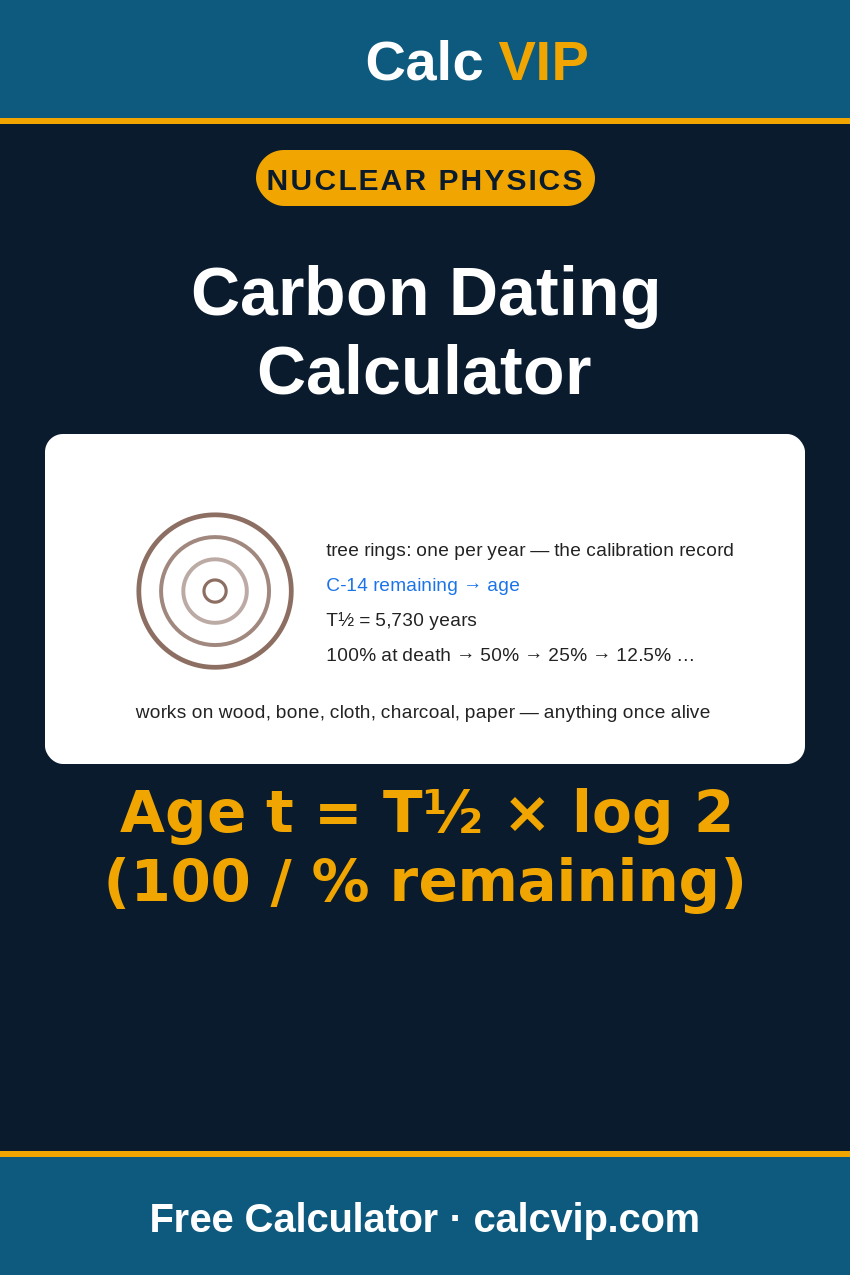
Honesty about precision belongs on this page too. The raw percentage gives a raw age, but the atmosphere's carbon-14 level has wobbled over the millennia — with solar activity, geomagnetic field changes, fossil-fuel burning and nuclear tests — so laboratories calibrate radiocarbon ages against tree rings and other independent clocks, and quote ranges rather than single years. This calculator gives the clean, uncalibrated figure: the right starting point, the number behind every headline age, and an estimate typically within a few percent of the calibrated truth.
Formula
Age t = T½ × log2(100 / % remaining), with T½ = 5,730 years for carbon-14. Equivalently t = −(T½ / ln 2) × ln(fraction remaining).
The two forms are one law in two dialects. The log₂ version counts half-lives directly: the percentage remaining, turned upside down, is 2 raised to the number of half-lives, so taking log₂ counts them — including fractions, which is where the method's power lies, since real samples are never exactly 25% or 12.5% of anything. The natural-log version exposes the mean lifetime τ = T½/ln 2 = 8,267 years: t = −τ × ln(fraction), the form laboratories actually use. Both demand the same input discipline: the percentage is measured relative to the living level (modern reference carbon), not relative to the sample's total carbon — and it must lie between 0 and 100, since a sample cannot hold more carbon-14 than a living thing, nor a negative amount. Enter the percentage and this calculator returns the half-lives elapsed and the age in years.
| Symbol | Meaning | Units |
|---|---|---|
| t | age — time since the organism died | years |
| T½ | carbon-14 half-life | 5,730 years |
| % remaining | C-14 level versus the living (modern) reference | percent |
| τ | mean lifetime of C-14, T½ / ln 2 | 8,267 years |
Where carbon-14 comes from — and why the clock starts at death
Carbon-14 is not primordial; the Earth was born with none that survives. It is manufactured continuously in the stratosphere, where cosmic-ray neutrons strike nitrogen-14 nuclei and knock a proton loose, transmuting nitrogen into carbon-14. The fresh isotope oxidises to CO₂, mixes worldwide within a few years, and enters the food web. Because production and decay balance, the atmosphere holds a near-steady ratio — about one C-14 per 10¹² ordinary carbon atoms — and every living cell, exchanging carbon daily, mirrors that ratio exactly. A tree, a bone and this page's paper all tick at the living rate while their owners live.
Death cuts the supply line. From that moment the tissue is a closed box: its C-14 decays at λ = 3.83 × 10⁻¹² per second and none arrives to replace it, while the stable carbon-12 stays put as a permanent denominator. The ratio therefore falls by half every 5,730 years with metronomic indifference to burial, burning (charcoal dates beautifully), or freezing. Two measurement technologies read the ratio: beta counting, which listens for decays and needs grams of material and weeks of patience, and accelerator mass spectrometry (AMS), which counts the C-14 atoms themselves in a milligram of sample within an hour. AMS shrank sample sizes a thousandfold — a single seed, a fleck of parchment, a sliver of bone is now enough — and it is the reason radiocarbon dating keeps reaching smaller, rarer and more precious objects.
How to use
- Measure (or enter) the percentage of carbon-14 remaining compared with a living sample — 100% means freshly dead, 50% means one half-life old.
- Click the button to get the estimated age in years and the number of half-lives passed.
- Interpret the result as an uncalibrated radiocarbon age: for publication-grade dates, laboratories calibrate against tree-ring curves, which can shift the figure by a few hundred years either way.
- Check the sample qualifies: it must be once-living material (wood, bone, cloth, charcoal, paper, shell with care) and younger than roughly 50,000 years.
Worked examples
Example 1 — the textbook artefact. A wooden artefact has 25% of its carbon-14 remaining.
25% = (½)², so exactly 2 half-lives have passed.
Age = 2 × 5,730 = 11,460 years old — older than farming, older than the wheel: a Mesolithic tool, from the world just after the ice sheets retreated.
Example 2 — one half-life exactly. Charcoal from a hearth measures 50% remaining. Age = 1 × 5,730 = 5,730 years — roughly 3730 BCE, the era of the earliest Egyptian and Mesopotamian cities. Round percentages like this are rare in the laboratory, where 48% or 53% is typical, but they anchor the intuition: each halving is another 5,730 years.
Example 3 — an ice-age bone at 10%. A bison bone retains 10% of its C-14. Half-lives = log₂(100/10) = log₂(10) = 3.32, so age = 3.32 × 5,730 ≈ 19,036 years — deep in the last glacial maximum, when ice sheets stood over Canada and northern Europe and the bison's steppe was cold, dry grassland.
Example 4 — Ötzi the Iceman. Ötzi died about 5,300 years ago in the Alps. Run the clock forward instead: the fraction of C-14 left in his tissue today is (½)(5300/5730) = 52.7%. A laboratory measuring Ötzi would find a little over half the living level — and, inverting with this calculator, would recover his age to within a few decades of the calibrated truth (he died around 3230 BCE).
Example 5 — the Dead Sea Scrolls. The scrolls are about 2,000 years old, so their parchment retains (½)(2000/5730) ≈ 78.5% of its carbon-14. When Libby's successors dated scroll fragments to the centuries around the turn of the era — matching palaeography's estimates — it was an early public proof that the clock worked, achieved with a signal that had faded by barely a fifth.
Example 6 — near the limit at 1%. A mammoth bone at 1% remaining: half-lives = log₂(100) = 6.64, age = 6.64 × 5,730 ≈ 38,069 years. Beyond this the signal dwindles toward the method's floor: at 0.3% the age is about 48,000 years, and a fingerprint's worth of modern contamination can drag an older sample's apparent age down toward this ceiling — the reason the oldest dates are quoted with the widest caution.
Carbon dating in real life
The Shroud of Turin. In 1988 three AMS laboratories independently dated a corner of the Shroud to 1260–1390 CE — medieval, not first-century — from a sample the size of a postage stamp. Whatever one's view of the artefact, the episode showcased the method's maturity: milligram samples, blind protocols, and a result robust across three continents.
Rewriting prehistory. Radiocarbon showed that European megaliths predate the Egyptian pyramids they were once assumed to copy, and that agriculture reached Britain around 4000 BCE. The "radiocarbon revolution" demoted diffusion-from-the-East theories wholesale — absolute dates beat plausible stories.
Dating the peopling of continents. Charcoal from ancient hearths fixed human arrival in Australia to at least 50,000 years ago (at the very edge of the method) and continues to refine the timeline of the Americas, where every century of the Clovis debate is argued in calibrated radiocarbon years.
Forensics and the bomb pulse. Atmospheric nuclear tests doubled the C-14 level by 1963; its decline since is a second, sharper clock. Forensic scientists date human remains, ivory and vintage wine by matching their C-14 to the bomb-pulse curve — resolving years, not millennia, for anything formed after 1950.
Art authentication. A "17th-century" painting on canvas whose fibres carry bomb-pulse carbon is a forgery, full stop. Radiocarbon has unmasked fake old masters, counterfeit antiquities and mislabelled wine vintages — the clock cannot be argued with, only misread.
Climate science. The ages of deep-sea sediment layers, ancient groundwater and glacial ice organics — the raw archive of past climate — rest heavily on radiocarbon for the last 50,000 years, the interval that contains the whole of the last ice age's end and humanity's entire agricultural career.
Quick reference: percentage remaining versus age
| C-14 remaining | Half-lives passed | Age (years) |
|---|---|---|
| 90% | 0.152 | 871 |
| 75% | 0.415 | 2,378 |
| 50% | 1 | 5,730 |
| 25% | 2 | 11,460 |
| 10% | 3.32 | 19,036 |
| 5% | 4.32 | 24,765 |
| 1% | 6.64 | 38,069 |
| 0.3% | 8.38 | 48,022 |
Notice the bargain the table strikes: the first 10% of loss covers only 871 years, while the last 1% stretches across millennia. Young samples demand precision in the percentage; old samples forgive it — the logarithm is kind at both ends in opposite ways.
Calibration: why laboratories adjust the raw age
The formula assumes the atmosphere's C-14 level has always been today's. It has not. Solar cycles and geomagnetic wobbles have nudged production up and down by a few percent; the industrial revolution diluted the air with C-14-free fossil carbon (the Suess effect); nuclear tests spiked it sharply after 1950. A few percent in the starting level becomes a few hundred years in the answer, so laboratories calibrate: they measure C-14 in tree rings of independently counted age — some bristlecone and oak chronologies run unbroken past 12,000 years — and build a wiggly conversion curve (the IntCal series) from raw radiocarbon years to calendar years. This calculator's output is the raw age, the honest first number; the calibrated range quoted in journals is that number passed through the curve. For most samples the shift is modest, but in some eras the curve doubles back on itself and one raw age maps to two possible calendar ranges — a famous trap that only calibration can even reveal.
The contamination ceiling
Suppose a truly ancient sample — 100,000 years old, its own C-14 long extinct — picks up just 1% modern carbon from groundwater, handling or conservation glue. This calculator, fed 1%, returns 38,069 years: the contamination, not the sample, has been dated. That is why the oldest radiocarbon claims cluster suspiciously below 50,000 years and why laboratories pretreat samples aggressively — acid-base washes, ultrafiltration of bone collagen, single-compound isolation — to strip away everything that is not original tissue. The clock itself never fails; the art lies in guaranteeing that what you feed it is the sample's own carbon.
Common mistakes
- Trying to date rocks, metals or fossils-turned-to-stone. Carbon dating needs original once-living carbon. A dinosaur bone that has mineralised into rock holds no C-14 of its own — and at 66+ million years, even perfect tissue would have halved 11,000 times. Dinosaurs are dated by the volcanic layers around them, with potassium-argon clocks.
- Entering the fraction as a decimal in a percent box. 0.25 and 25% are the same fraction but wildly different entries: this calculator wants the percent (25). A decimal entry of 0.25% returns an age near 49,500 years instead of 11,460 — always check which dialect your number is speaking.
- Assuming the raw age is the calendar age. Atmospheric C-14 has wobbled, so raw ages are systematically off by up to several hundred years in places. The calculator's figure is the correct radiocarbon age; calendar truth needs the IntCal calibration curve.
- Ignoring reservoir effects. Ocean water and some lakes hold “old” carbon, so fish, seals and the people who ate them can appear centuries too old. A coastal Viking's bones may date older than his longhouse timbers — the timbers are telling the truth about the man.
- Trusting a date from a contaminated or tiny old sample. Near the 50,000-year limit, 1% of modern carbon fabricates a plausible-looking 38,000-year date out of thin air. The oldest results deserve the most scepticism, not the biggest headlines.
FAQ
How far back can carbon dating reach?
About 50,000 years. Beyond that, so little C-14 remains (less than 0.3%) that it can no longer be measured reliably.
Can carbon dating age rocks or metal?
No — it only works on material that was once alive (wood, bone, cloth, paper), because only living things exchange carbon with the atmosphere.
Is the result exact?
It is an estimate. The atmospheric C-14 level has varied slightly over history, so laboratories calibrate the raw age against tree-ring records for better accuracy.
Who invented carbon dating?
Willard Libby, a University of Chicago chemist who had worked on the Manhattan Project, developed the method in the late 1940s and published the first dates in 1949 — famously checking his clock against wood from Egyptian tombs of known age and getting them right. He received the 1960 Nobel Prize in Chemistry for it.
Why do laboratories quote a range instead of one year?
Two reasons: measurement statistics (counting decays or rare atoms has inherent noise) and calibration (the wiggly IntCal curve can stretch or compress a range). A result like '3,450 ± 40 BP, calibrating to 1880–1690 BCE' is the honest form — the calculator's single figure is the centre of that process, not a rival to it.
Can carbon dating tell me when a stone tool was made?
Not the stone itself — but the charcoal in the hearth where it was knapped, the bone of the animal it butchered, or the wooden haft it was mounted on. Archaeologists date the organic company an artefact keeps, which is why excavation records context so obsessively.
What is the 'bomb pulse' and how is it used?
Above-ground nuclear tests roughly doubled atmospheric C-14 by 1963; since the test ban it has been falling back as oceans and forests absorb it. Anything grown since carries a C-14 level stamped by its year on that falling curve, letting forensic scientists date modern ivory, human tissue and wine vintages to within a year or two — radiocarbon running in reverse and at high resolution.
Does the sample get destroyed by dating?
Beta counting needed grams and effectively consumed them; AMS needs about a milligram and destroys only that. Curators therefore permit AMS dating of objects — a sliver of the Turin Shroud, a seed from a museum jar — that no one would sacrifice to the older method. The trend continues: some techniques now date the carbon in a single amino acid extracted from bone.
Why 5,730 years and not Libby's original 5,568?
Libby's half-life was the best measurement of his era; the modern value is 5,730 ± 40 years. By convention, laboratories still compute raw ages with Libby's 5,568-year figure and let calibration absorb the difference, so published 'BP' ages are comparable across seventy years of literature. This calculator uses the modern 5,730, so its raw ages run about 3% older than a laboratory's conventional BP figure for the same percentage — a known, documented offset, not an error.
Can carbon dating prove the age of the Earth?
No — it is a short-range clock, exhausted after about 50,000 years, a millionth of Earth's history. The Earth's 4.57-billion-year age comes from long-lived clocks — uranium-lead and rubidium-strontium — applying this same exponential law with half-lives of billions of years. Carbon dating governs the human timescale; its cousins govern the geological one.