 Calc
Decay Constant Calculator – λ from Half-Life & Mean Lifetime
 Created by Anna Kowalski · Physics Editor · Heat & Atoms · Last updated: November 2026
Use this free Decay Constant Calculator to turn a half-life into the decay constant λ = ln 2 / T½ and the mean lifetime τ = 1/λ. λ tells you how quickly a radioactive substance decays; τ is the average time a single nucleus survives before decaying.
If the half-life is the public face of radioactivity, the decay constant λ is its working machinery. λ is the probability that one nucleus decays per unit time — a rate, not a schedule. A λ of 0.13 per year means each nucleus of that isotope carries roughly a 13% chance of decaying within the next year, a 0.036% chance within the next day, and exactly the same chance in every year after that, however long it has already survived. Multiply λ by the number of nuclei present and you get the activity; put λ in an exponent and you get the whole decay curve. Nearly every other calculator in this section needs λ first, and this one exists to supply it.
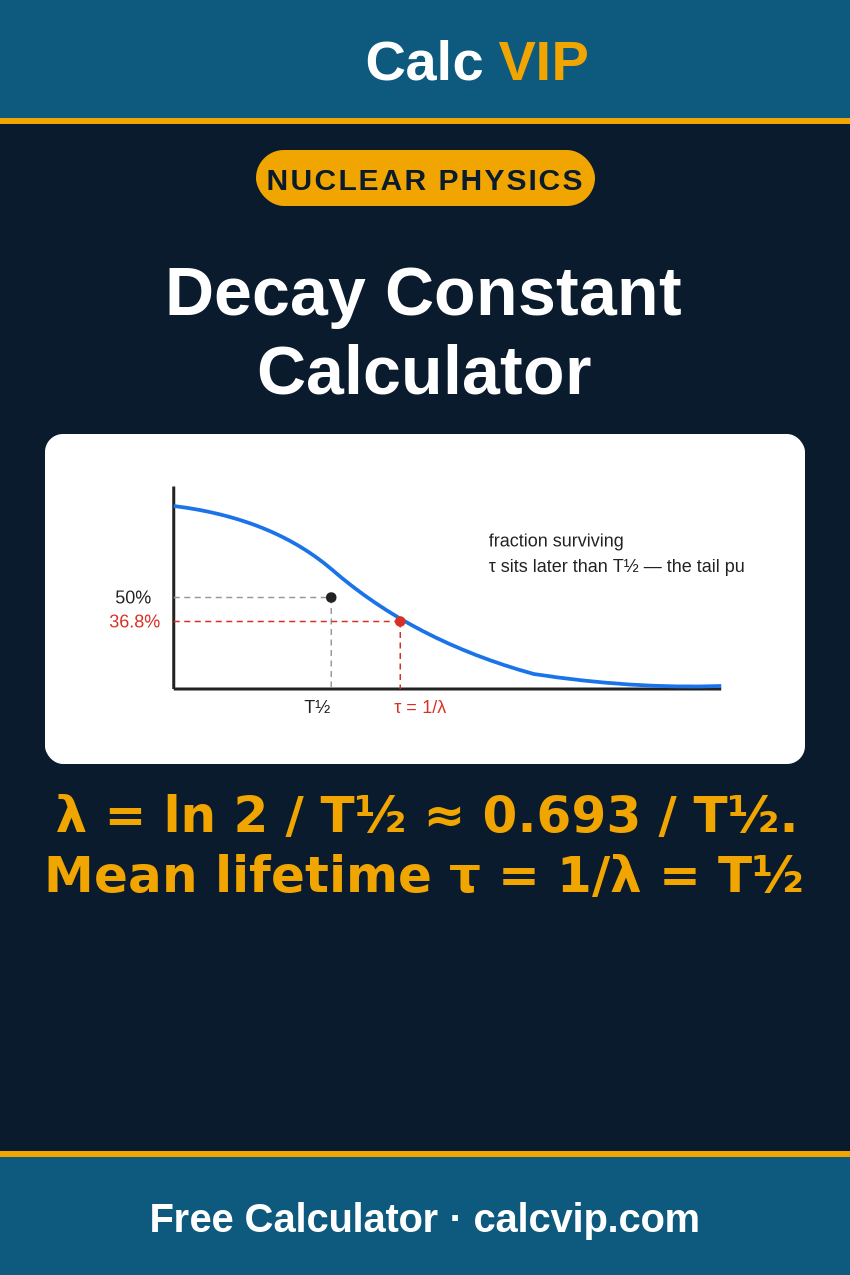
Its partner quantity, the mean lifetime τ = 1/λ, answers a subtly different question: not "when will half be gone?" but "how long does one nucleus live, on average?" The answer is always longer than the half-life — about 1.44 times longer — because the exponential distribution has a long tail. Half the nuclei die quickly, but a stubborn few survive ten, twenty, fifty half-lives, and those Methuselahs drag the average upward. At t = τ exactly, the surviving fraction is e−1 ≈ 36.8% — a landmark worth remembering alongside the 50% point of the half-life.
λ values span an almost absurd range. Uranium-238 ticks at λ ≈ 4.9 × 10⁻¹⁸ per second, so feeble that a single nucleus waits billions of years on average; polonium-214, at the other extreme, has λ ≈ 4,200 per second and a mean life of a quarter of a millisecond. One formula covers them all, and this calculator converts any half-life — entered in seconds, minutes, hours, days or years — into λ in that same unit, λ in SI per-second, and the mean lifetime in both, ready to feed into decay, activity or dating calculations.
Formula
Decay constant λ = ln 2 / T½ ≈ 0.693 / T½. Mean lifetime τ = 1/λ = T½ / ln 2 ≈ 1.443 × T½ — the average lifetime of one nucleus, always longer than the half-life.
The constant ln 2 ≈ 0.693 appears because the half-life is defined by the point where e(−λt) = ½, and solving that equation puts a natural logarithm of 2 in the answer. The three quantities trade places freely: T½ = ln 2 / λ recovers the half-life from λ, and once λ is known the whole decay story follows — the amount remaining is N(t) = N0 e(−λt) and the activity is A = λN. Unit discipline matters more here than anywhere else in the topic: λ inherits the inverse of whatever time unit the half-life arrived in. λ = 0.13 per year and λ = 4.2 × 10⁻⁹ per second are the same physical constant for cobalt-60, but mixing the two versions in one calculation is the single most common source of billion-fold errors — which is why this calculator always reports both.
| Symbol | Meaning | Units |
|---|---|---|
| λ | decay constant — probability of decay per unit time | s−1 (or per min/h/day/year) |
| T½ | half-life — time for half the nuclei to decay | s, min, h, days, years |
| τ | mean lifetime — average survival time of one nucleus, 1/λ | same time unit as T½ |
| ln 2 | natural logarithm of 2 ≈ 0.693 | dimensionless |
A probability, not a schedule: why nuclei never age
It is tempting to read λ as a timetable — as if a nucleus with a 5-year half-life is somehow "due" at year five. The truth is stranger and simpler. λ is a constant probability per unit time, and it does not accumulate: a cobalt-60 nucleus that has already survived a century faces exactly the same 13% chance of decaying in the coming year as a nucleus minted this morning. Physicists call this memorylessness, and the exponential distribution is the only distribution that has it. It follows from the mechanism: alpha decay is quantum tunnelling through a barrier the nucleus attempts trillions of times per second with a fixed success chance per attempt; beta decay is a weak-force lottery drawn afresh every instant. Nothing wears out, because there is nothing to wear.
This is also why λ cannot be argued with. Temperature, pressure, chemistry and magnetism act on electrons; λ is set by the nuclear interior and the tunnelling barrier, sealed away from all of them. The one honest lever on λ is choosing a different isotope — nature's catalogue runs from λ ≈ 5 × 10⁻¹⁸ /s (uranium-238) to λ ≈ 4,200 /s (polonium-214, half-life 164 microseconds), twenty-one orders of magnitude of "how radioactive" from a single formula. When a problem gives you a half-life, converting it to λ with this calculator is almost always step one, because λ — not T½ — is what the exponential, the activity and the mean lifetime are actually built from.
How to use
- Enter the half-life of the substance.
- Pick the unit that half-life is measured in (the result is given in that unit and per second).
- Click the button to get λ and the mean lifetime τ.
- Use the per-second λ whenever you need activity in becquerels (A = λN), and the per-unit λ when your times are in days or years.
- Sanity-check with the ratio: τ should always come out about 1.44 × the half-life you entered. If it does not, a unit has slipped.
Worked examples
Example 1 — cobalt-60. Cobalt-60 has a half-life of 5.27 years.
λ = 0.693 / 5.27 = 0.1315 per year (about 4.17 × 10⁻⁹ per second).
Mean lifetime τ = 1 / λ = 7.60 years — an average cobalt-60 nucleus lives about 7.6 years before decaying.
Example 2 — iodine-131. With T½ = 8.02 days: λ = 0.693 / 8.02 = 0.0864 per day, which is 0.0864 / 86,400 ≈ 1.00 × 10⁻⁶ per second — a conveniently round SI value. The mean lifetime is τ = 8.02 / 0.693 = 11.57 days: half the iodine is gone in 8 days, but the average atom survives eleven and a half.
Example 3 — technetium-99m. The workhorse of medical imaging has T½ = 6.01 hours. λ = 0.693 / 6.01 = 0.1153 per hour = 3.20 × 10⁻⁵ per second, and τ = 8.67 hours. A λ this large is why a dose loses about 11% of its activity every hour on the shelf — schedulers plan injections around this constant.
Example 4 — carbon-14. With T½ = 5,730 years: λ = 0.693 / 5730 = 1.21 × 10⁻⁴ per year = 3.83 × 10⁻¹² per second, and τ = 8,267 years. That τ is the number inside the carbon-dating formula: age = −τ × ln(fraction remaining). One nucleus in eight thousand decays per year — slow enough to date a pharaoh, fast enough to measure.
Example 5 — radon-222. T½ = 3.82 days gives λ = 0.693 / 3.82 = 0.1815 per day = 2.10 × 10⁻⁶ per second, and τ = 5.51 days. Each radon nucleus in a basement has an 18% chance of decaying today — the constant behind radon risk models, which multiply λ by the number of atoms inhaled.
Example 6 — uranium-238. T½ = 4.47 × 10⁹ years gives λ = 1.55 × 10⁻¹⁰ per year = 4.91 × 10⁻¹⁸ per second, and τ = 6.45 billion years — longer than the Earth has existed. A uranium nucleus minted at the Earth's formation has, on average, not yet reached its expected decay date, which is why half of it is still here.
The decay constant in real life
Step one of every decay problem. Activity, dating, dose planning and waste inventories all run on λ. Laboratories publish half-lives because they are intuitive; physicists immediately convert with λ = ln 2 / T½ because every working formula — N(t) = N₀e−λt, A = λN, age = −τ ln(fraction) — is written in λ.
Measuring λ from a graph. Count a sample's activity over time, plot the logarithm of the counts against time, and the exponential becomes a straight line whose slope is −λ (Diagram 2). This log-linear fit is how the half-lives of newly synthesised isotopes, sometimes made a few atoms at a time, are first measured.
Radiopharmacy scheduling. A PET centre lives by λ: fluorine-18's λ = 0.105 per hour (T½ = 110 min) dictates that a dose synthesised at 6 a.m. holds only about half its activity by 8 a.m., so production batches are sized backwards from appointment times using exactly this constant.
Environmental radon models. Radon's λ (0.18 per day) competes with ventilation: in a sealed room radon accumulates until its decay rate λN balances the rate it seeps in; open the windows and the balance resets. The equilibrium concentration in every radon map is λ doing arithmetic against airflow.
Reactor physics. After a reactor shuts down, decay heat from fission products falls along a sum of exponentials, each with its own λ — the composite curve that cooling systems must handle for years. The famous "decay heat curve" is this calculator applied to dozens of isotopes at once.
Choosing isotopes for the job. Engineers pick isotopes by λ as much as by radiation type: large λ for tracers that must vanish from a patient quickly, small λ for a pacemaker battery or a deep-space power source (plutonium-238, T½ = 87.7 years) that must deliver steady power for decades.
Quick reference: decay constants of famous isotopes
| Isotope | Half-life | λ (per second) | Mean lifetime τ |
|---|---|---|---|
| Technetium-99m | 6.01 h | 3.20 × 10⁻⁵ | 8.67 h |
| Iodine-131 | 8.02 days | 1.00 × 10⁻⁶ | 11.6 days |
| Radon-222 | 3.82 days | 2.10 × 10⁻⁶ | 5.51 days |
| Cobalt-60 | 5.27 yr | 4.17 × 10⁻⁹ | 7.60 yr |
| Carbon-14 | 5,730 yr | 3.83 × 10⁻¹² | 8,267 yr |
| Uranium-238 | 4.47 × 10⁹ yr | 4.91 × 10⁻¹⁸ | 6.45 × 10⁹ yr |
Read the λ column as "fraction of the sample decaying each second": technetium sheds 32 millionths of itself per second, uranium less than five quintillionths — yet the same N₀e−λt governs both.
Converting λ between units is pure bookkeeping, but it must be done deliberately. A rate "per year" becomes a rate "per second" by dividing by the number of seconds in a year (3.156 × 10⁷): cobalt-60's 0.1315 per year ÷ 3.156 × 107 = 4.17 × 10⁻⁹ per second, the figure in the table. Going the other way — per second to per day — multiply by 86,400: iodine-131's 1.00 × 10⁻⁶ per second × 86,400 = 0.0864 per day. The mean lifetime converts in the opposite direction to λ, since τ = 1/λ: a τ of 7.60 years is 2.40 × 10⁸ seconds. Every factor is just the count of small units inside the big one — the physics never changes, only the ruler.
The 36.8% landmark: surviving one mean lifetime
Half-lives get the headlines, but τ has its own milestone. At t = τ, the surviving fraction is e−1 = 0.368 — not a half but a little over a third. Processes across physics are quoted in these "e-folding" times because the mathematics is cleanest there: after one τ, down to 36.8%; after two, 13.5%; after three, 5.0%. Carbon dating is secretly written in this language — age = −τ ln(fraction) — with τ = 8,267 years for carbon-14, and the same e-folding idea sets the discharge time of capacitors and the cooling time of a cup of tea. When you see τ from this calculator, read it as the isotope's natural time step: the time in which the sample falls, not to a half, but to 1/e of itself.
Common mistakes
- Using λ = 1/T½. The most common slip in the topic. The correct constant is ln 2 / T½ ≈ 0.693/T½; dropping the ln 2 overstates every decay rate and activity by 44%.
- Confusing τ with T½. Mean lifetime and half-life differ by a factor of 1.44 — using one for the other is not a rounding error but a 44% error, and it compounds inside exponentials.
- Mixing λ units mid-calculation. λ = 0.13 per year inside e^(−λt) with t in days gives nonsense. Convert λ to match your time unit (divide per-year by 365.25 for per-day, by 3.156 × 10⁷ for per-second) — or let this calculator's dual output do it.
- Assuming λ shrinks as the sample decays. λ is a property of the isotope, not the sample. A billion nuclei and the last surviving nucleus share the identical λ; what falls is N, and with it the activity A = λN.
- Reading λ as an exact fraction. λ = 0.13 per year is a probability rate, exact only for short intervals: the true fraction decaying in one full year is 1 − e^(−0.13) = 12.2%, not 13.0%. The distinction is invisible for small λt and glaring for large ones.
FAQ
What does the decay constant actually mean?
λ is the probability that a given nucleus decays in the next unit of time. λ = 0.1315 per year means each cobalt-60 nucleus has about a 13% chance of decaying in the next year.
Why is the mean lifetime longer than the half-life?
Half the nuclei decay within one half-life, but the survivors can last a very long time, pulling the average up. The mean works out to T½ / ln 2 ≈ 1.44 × T½.
How is λ used in the decay formula?
The number remaining is N(t) = N₀ e^(−λt). Once you know λ you can predict the amount (and the activity A = λN) at any time.
Why does ln 2 appear in the formula?
Because the half-life is defined by the moment the exponential reaches one half: e^(−λT½) = ½. Taking natural logarithms of both sides gives λT½ = ln 2, so λ = ln 2 / T½. The 0.693 is not an empirical fudge — it is the logarithm of the 'half' in half-life.
Can λ be greater than 1?
Yes, and it often is. λ is a rate, not a fraction: polonium-214 has λ ≈ 4,200 per second. It only behaves like a simple probability for intervals short enough that λ × Δt is small. A λ above 1 per chosen unit just means the typical nucleus does not survive one whole unit of that size.
Is λ the same for every atom of an isotope?
Yes — identically, regardless of the atom's age, its chemical company, or whether it sits in a rock, a reactor or a patient. That universality is what makes decay a clock: every carbon-14 nucleus in the universe ticks at λ = 3.83 × 10⁻¹² per second.
How is λ measured for a brand-new isotope?
By watching it die. Physicists produce a known burst of the isotope, record counts versus time, and fit the exponential (a straight line on a log plot, slope −λ). For isotopes with half-lives of milliseconds, the whole measurement is automated; for long-lived ones, λ comes from counting decays in a known number of atoms via A = λN.
What fraction of a sample decays in one mean lifetime?
1 − e^(−1) = 63.2% decays, leaving 36.8% — more than the 50% that decay in one half-life, because τ is the longer time. The pair of landmarks is worth memorising together: one T½ → 50% left; one τ → 36.8% left.
Does λ depend on how much material I have?
No. Double the sample and you double the decays per second, but each nucleus keeps the same personal decay probability. λ belongs to the isotope; N belongs to your sample; activity A = λN is where they meet.
Why do physicists prefer λ when half-life is easier to picture?
Because the equations are written in λ. The exponential, the activity, the dating formula and the chain equations all take λ directly, while T½ forces a conversion at every step. Half-life is the better headline; λ is the better tool — this calculator exists to translate between the two dialects.