 Calc
Boat and Stream Calculator – Downstream, Upstream, Still-Water & Stream Speed
 Created by Sarah Mitchell · Physics Editor · Motion & Measurement · Last updated: November 2026
Use this free Boat and Stream Calculator for the classic river problems. Going downstream, the current helps the boat; going upstream, it fights it. The calculator works both ways: find the downstream and upstream speeds from the boat and stream speeds, or recover the still-water speed and stream speed from a downstream/upstream pair.
The boat-and-stream problem is the friendliest possible introduction to relative velocity, because the medium itself is doing the moving. A boat's engine sets its speed relative to the water; the water sets its own speed relative to the bank; and the speed anyone on the bank actually sees is the sum or difference of the two, depending on the direction of travel. Downstream the two conspire, upstream they truly fight, and the whole problem — a fixture of school mathematics for over a century — is nothing but that addition and subtraction, plus the elegant reverse: from the two observed speeds, recover the two hidden ones.
The reverse mode deserves its fame. If a boat makes 13 km/h downstream and 7 km/h upstream, then the boat's own speed is the average, (13 + 7) ÷ 2 = 10 km/h, and the stream's speed is half the difference, (13 − 7) ÷ 2 = 3 km/h. Two measurements of journeys give you two facts about the world — one about the vessel, one about the river — separated by nothing more than an average and a half-difference. It is a tiny, perfect example of how physicists disentangle combined effects.
Everything on this page also transfers, unchanged, to aircraft in wind: airspeed is the boat speed, wind is the stream, groundspeed downstream is the tailwind case. Pilots call the result groundspeed and plan fuel with it; sailors call it speed over ground and plan arrivals with it. The river got there first, and its vocabulary is the clearest, so the river keeps the page.
Formula
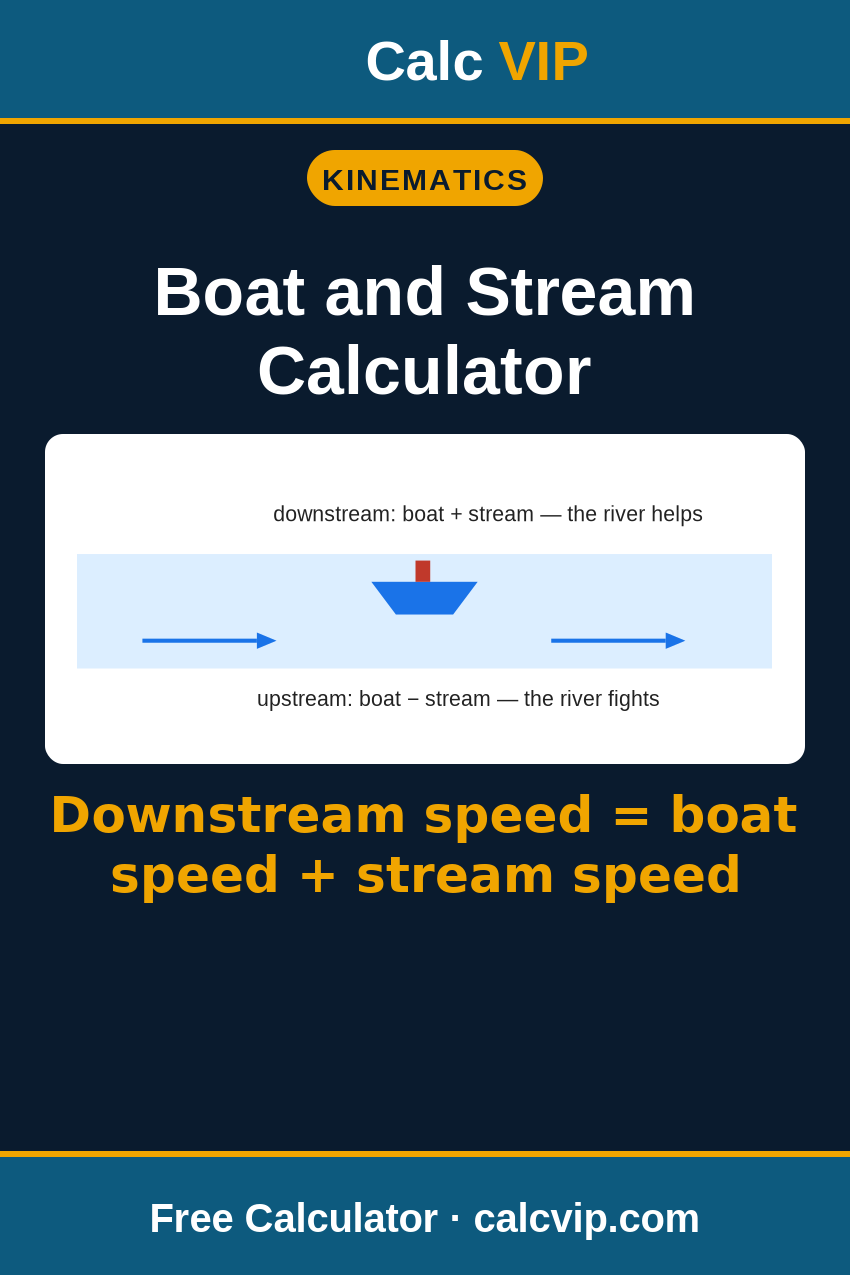
Downstream speed = boat speed + stream speed • Upstream speed = boat speed − stream speed • Reverse: boat = (downstream + upstream) ÷ 2 and stream = (downstream − upstream) ÷ 2
The formulas are velocity addition in one dimension: velocities along the same line add when they point together and subtract when they oppose. The reverse pair is the same two equations solved backwards — add them and the stream cancels, giving twice the boat speed; subtract them and the boat cancels, giving twice the stream speed. Journey times then follow from time = distance ÷ speed, using the downstream speed with the current and the upstream speed against it. A consequence worth memorising: a round trip on the river always averages (b² − s²) ÷ b, which is less than the still-water speed b — the current always costs more time upstream than it repays downstream, because the slow leg lasts longer.
| Symbol | Meaning | Units |
|---|---|---|
| b | boat speed in still water (through the water) | km/h |
| s | stream speed (the current, over the ground) | km/h |
| D | downstream speed, b + s (over the ground) | km/h |
| U | upstream speed, b − s (over the ground) | km/h |
Two speeds for one boat: through the water, over the ground
Every boat carries two speeds at once, and confusing them is the source of nearly all river-problem errors. The speed through the water is what the hull, engine and a trailing log measure — it is the boat's own, earned by its machinery. The speed over the ground is what a GPS reports and what decides arrival times — it belongs jointly to the boat and the river. A ferry captain lives in both worlds simultaneously: the timetable is written in ground speed, the fuel bill in water speed, and the difference between them is the river's mood that day. Tidal rivers sharpen the point: the "stream" reverses twice a day, so the same engine setting produces a downstream bonus in the morning and an upstream penalty in the afternoon, and prudent schedules are written around the tide tables for exactly this reason.
The distinction is also the thin end of a very large wedge. Velocities only add this simply because the speeds are tiny compared with light; the general rule — velocities measured in different frames combine by addition — is Galilean relativity, the framework Newton built mechanics on and Einstein later revised. The river problem is that grand theory at walking pace: the bank is one frame, the water another, and the boat's motion is the translation between them.
How to use
- Choose the mode: "Boat + stream" if you know the still-water speed and the current; "Downstream + upstream" if a problem gives you the two journey speeds and asks what they imply.
- Enter the two speeds in km/h. In the first mode the stream may be zero (a lake); in the second, downstream must exceed upstream.
- Click "Calculate" to see the downstream and upstream speeds, or the recovered boat and stream speeds.
- For journey times, divide the distance by the appropriate speed — downstream speed with the current, upstream speed against it.
- If the upstream answer comes out zero or negative, the current wins: the boat cannot make way against that stream at that engine setting.
Worked examples
Example 1 — the classic pair. A boat travels at 10 km/h in still water and the stream flows at 3 km/h. Downstream speed = 10 + 3 = 13 km/h; upstream speed = 10 − 3 = 7 km/h. Running it backwards: still-water speed = (13 + 7) ÷ 2 = 10 km/h and stream speed = (13 − 7) ÷ 2 = 3 km/h — the same values, as expected.
Example 2 — a there-and-back trip. The same boat travels 26 km downstream and returns. Downstream: 26 ÷ 13 = 2 hours. Upstream: 26 ÷ 7 = 3.71 hours. The 52 km round trip takes 5.71 hours, an average of 9.1 km/h — below the still-water 10 km/h, exactly as the formula (b² − s²) ÷ b = (100 − 9) ÷ 10 = 9.1 predicts. The river is never a fair trade.
Example 3 — recovering the hidden speeds. A launch is timed at 18 km/h downstream and 12 km/h upstream. Boat speed = (18 + 12) ÷ 2 = 15 km/h; stream speed = (18 − 12) ÷ 2 = 3 km/h. Two stopwatch readings have separated the vessel from the river.
Example 4 — a swimmer. A swimmer manages 4 km/h in still water in a river flowing at 1.5 km/h: downstream 5.5 km/h, upstream 2.5 km/h. An 11 km stretch takes 11 ÷ 5.5 = 2 hours down and 11 ÷ 2.5 = 4.4 hours back — the upstream leg more than doubles, a ratio every open-water swimmer respects.
Example 5 — a ferry leg. A ferry with the Example 1 speeds crosses a 39 km reach: downstream 39 ÷ 13 = 3 hours; upstream 39 ÷ 7 = 5.57 hours. The timetable cannot be symmetric, and the operator who prints one anyway will be apologising by lunchtime.
Example 6 — when the river wins. A small boat capable of 8 km/h meets a flood current of 10 km/h: upstream speed = 8 − 10 = −2 km/h. The negative sign is information, not an error: at full power the boat still loses ground at 2 km/h. The calculator flags exactly this case — the only honest answers are a bigger engine, a tow, or waiting for the river to fall.
Boats and streams in real life
Ferry timetables. River and estuary ferries publish different crossing times by direction and by tide, because their ground speeds genuinely differ. The asymmetry in Example 5 is printed, in disguise, in every honest river timetable in the world.
Flight planning. Replace water with air and the page becomes aviation: a 200 km/h aircraft in a 30 km/h wind has groundspeeds of 230 km/h downwind and 170 km/h upwind, and the round trip averages below 200 — the reason westbound and eastbound flight times differ on the same route.
Measuring a river. Hydrologists run the recovery mode in earnest: time a float or a boat over a marked reach both ways, and the half-difference estimates the current — a low-tech flow measurement still used to sanity-check gauging stations.
Rowing and kayaking strategy. Racers hug the bank upstream (where the current is weakest) and ride the centre downstream (where it is strongest) — an applied reading of this page: the stream speed s is not one number but a profile across the river, and the art is choosing which s to accept.
Search and rescue. A drifting object moves at the stream speed alone; a powered vessel searching for it must work in ground speeds. Rescue coordinators plot both frames — the drift frame and the search frame — which is this calculator's two modes drawn on a chart.
Exam and aptitude tests. Boat-and-stream questions persist because they test whether a candidate can hold two frames in mind at once and reverse a pair of equations cleanly. The recovery mode — average and half-difference — is the whole trick, and it is learnable in one sitting.
Crossing the river: when the stream pushes sideways
Everything so far runs along the river; crossing it adds a second dimension and a classic strategy. Aim straight across and the current carries you downstream while you cross — you land below your target. To land exactly opposite, aim upstream at an angle whose sideways component cancels the stream: sin θ = s ÷ b, which for b = 10 and s = 3 gives θ = 17.46° upstream of straight-across. The price is crossing speed: only √(b² − s²) = √91 = 9.54 km/h of your effort points across, the rest is spent fighting the drift. If the stream is faster than the boat, the cancellation is impossible — sin θ would exceed 1 — and some downstream landing is unavoidable: the same "river wins" condition as Example 6, wearing a second dimension.
There is a genuine choice here, and ferrymen have made it for centuries. Aiming straight across is the fastest crossing — all of your speed works across the river — but you land downstream and must walk or motor back: crossing a 500 m river at b = 10 km/h takes 0.05 h (3 minutes) and delivers you 3 × 0.05 = 0.15 km, a full 150 m, below your target. Aiming upstream at the cancellation angle lands you exactly opposite but stretches the crossing by the factor b ÷ √(b² − s²) — about 5% longer in this example. Which is "correct" depends on what waits on the far bank: a landing stage demands the angled strategy; an open beach forgives the drift. The mathematics does not choose — it prices both options and lets the purpose decide.
Travelators, escalators and treadmills: the river indoors
The boat-and-stream structure follows you off the water. Walking on an airport travelator, your ground speed is your walking speed plus the belt's — downstream, in river language — and walking back against it is the upstream case, which is why the return stroll along a moving walkway feels so oddly expensive. An escalator carrying a stationary passenger is a stream with no boat: the passenger's ground speed is the stream's alone. A swimmer on a treadmill pool, a cyclist on a rolling road, an aircraft on a conveyor — each is the same two-frame addition. The indoor versions even reproduce the subtlety of Example 2: walk a travelator to the end and walk back beside it, and your average speed for the round trip is below your normal walking speed, because the slow leg — unaided, on the return — lasts longer than the assisted leg. The river's unfairness turns out to be a general law of moving media: help is brief, hindrance is long, and the average keeps the receipts in every medium ever devised.
Quick reference: a 12 km/h boat in strengthening currents
| Stream speed | Downstream | Upstream |
|---|---|---|
| 0 km/h (lake) | 12 km/h | 12 km/h |
| 1 km/h | 13 km/h | 11 km/h |
| 2 km/h | 14 km/h | 10 km/h |
| 3 km/h | 15 km/h | 9 km/h |
| 4 km/h | 16 km/h | 8 km/h |
| 5 km/h | 17 km/h | 7 km/h |
| 6 km/h (half the boat) | 18 km/h | 6 km/h |
Read the upstream column as a countdown: every km/h the river gains is a km/h the boat loses, and at a stream equal to the boat's own speed the column reaches zero — upstream travel ends, whatever the timetable or the ticket says.
Common mistakes
- Adding the stream both ways. The current helps only downstream. Upstream it subtracts — the single sign error that sinks most attempts at these problems.
- Using the still-water speed for journey times. Arrival times are governed by ground speed. Timing an upstream leg at the boat's still-water speed promises an arrival the river will not permit.
- Averaging wrongly in the recovery mode. Boat speed is the average of downstream and upstream; stream speed is half the difference. Swapping the two operations produces a "stream" faster than the boat and other nonsense.
- Expecting the round trip to average the still-water speed. It averages (b² − s²) ÷ b, always less. Planning a return journey at the still-water speed underestimates the total time.
- Treating a negative upstream speed as an error. It is a physical verdict: the vessel is being carried backwards. The correct response is operational — more power, a tow, or waiting — not a recalculation.
FAQ
What if the stream is faster than the boat?
Then the upstream speed would be zero or negative — the boat cannot make progress against the current and is carried backwards.
How do I find the time for a river trip?
Time = distance ÷ speed, using the downstream speed for the trip with the current and the upstream speed for the trip against it.
Does this apply to planes and wind too?
Yes. Replace boat speed with airspeed and stream speed with wind speed: tailwind adds, headwind subtracts, exactly like the river.
Why is the boat speed the average of the two journey speeds?
Because the stream adds itself once and subtracts itself once: downstream + upstream = (b + s) + (b − s) = 2b. Averaging cancels the river exactly, leaving the boat. It is the same cancellation that makes the recovery mode work.
What if the stream speed is not constant?
Then use an average stream speed for estimates, or split the journey into reaches and apply the formulas reach by reach. Real rivers run faster mid-channel and slower at the banks, which is why racers choose their line as described above.
How do tides change the problem?
A tidal stream reverses direction and varies in strength through the day, so "downstream" swaps ends. Skippers time departures to ride a fair tide both ways where the geography allows — using this page's arithmetic with a tide table as the stream input.
Can the stream speed be found from one journey only?
Not from speed alone — one journey gives one equation with two unknowns. You need either the return journey (the recovery mode) or an independent measurement of the boat's still-water speed.
Does the formula work in m/s or knots?
Yes — any consistent unit works, because the operations are pure addition and subtraction. Mariners traditionally work in knots for both boat and stream, and the answers emerge in knots unchanged.
What is a "log" speed versus GPS speed on a real boat?
The log (a small paddlewheel or pressure sensor) measures speed through the water — the boat speed b. The GPS measures speed over the ground — b ± s. The difference between the two instruments' readings, watched over a leg, is a live measurement of the stream.
Why do exam questions love the round trip?
Because it punishes the reflex of averaging 13 and 7 to get the journey average. The true round-trip average (9.1 km/h in Example 2) is the harmonic mean of the leg speeds — the slow leg lasts longer, and the average keeps the receipts. It is the same lesson the round-trip average speed calculator teaches on the road, transplanted to water.