 Calc
Centripetal Acceleration Calculator – a = v²/r and a = ω²r
 Created by Sarah Mitchell · Physics Editor · Motion & Measurement · Last updated: November 2026
Use this free Centripetal Acceleration Calculator for an object moving in a circle. Enter the speed and radius, or the angular velocity and radius, and get the acceleration directed towards the centre of the circle.
Take a car around a bend at a perfectly steady 30 km/h. The speedometer never moves — yet the car is accelerating. That sounds like a contradiction until you remember that velocity includes direction. Going round the bend, the direction of travel changes continuously, so the velocity changes continuously, and any change of velocity is an acceleration. For circular motion that acceleration points, at every instant, straight at the centre of the circle. "Centripetal" simply means centre-seeking.
You can feel it as a passenger. As the car turns, your body seems to be flung outwards — but what is really happening is that your body tries to keep going straight (as Newton's first law says it should) while the car turns underneath you. The seat, the door and the seatbelt push you inwards, giving you the same centripetal acceleration as the car.
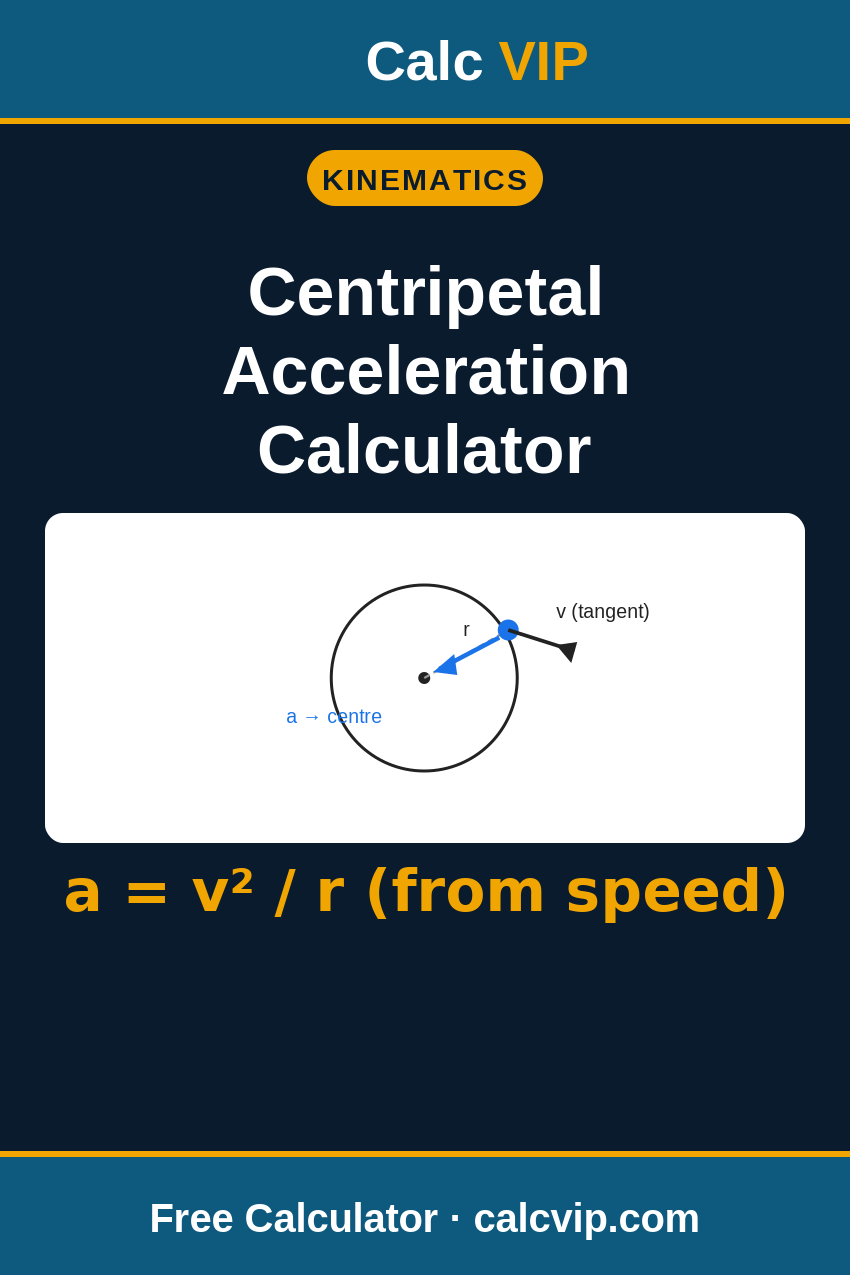
Nothing about the speed needs to change. A satellite in a circular orbit, a ball whirled on a string, a cyclist leaning into a corner — all are accelerating towards a centre the whole time, which is why a steady force towards that centre is always needed to keep them on the circle.
Formulas
a = v² / r (from speed) • a = ω²r (from angular velocity) — the acceleration always points towards the centre of the circle.
The two formulas are the same statement in different clothes, because v = ωr: substituting gives ω²r = (v/r)² × r = v²/r. Use whichever pair of values you happen to know — the calculator offers both modes and they always agree.
The shape of the formula carries two lessons worth memorising. Because the speed is squared, doubling your speed quadruples the acceleration — cornering forces grow frighteningly fast. And because the radius is on the bottom, halving the radius doubles the acceleration: tight bends are demanding even at modest speeds. Together they explain the universal driving advice — slow down before the bend, especially a tight one.
| Symbol | Meaning | Units |
|---|---|---|
| a | centripetal acceleration (towards the centre) | m/s² |
| v | speed around the circle | m/s |
| r | radius of the circle | metres (m) |
| ω | angular velocity, ω = v/r | rad/s |
Where the acceleration comes from
Centripetal acceleration is not produced by a special "centripetal force". It is produced by ordinary forces doing a particular job. For a car on a bend, friction between tyres and road pushes the car towards the centre. For a ball on a string, tension in the string does it. For the Moon, gravity does it. In each case Newton's second law sets the size of the job: the inward force must equal m × v²/r.
If the available force falls short, the object cannot hold the circle. Cut the string and the ball flies off along the tangent — the straight line it was following at that instant. Hit ice on a bend and, with friction gone, the car does the same thing: straight on, whatever the steering wheel says.
How to use
- Choose whether you know the speed (m/s) or the angular velocity (rad/s).
- Enter the radius of the circular path in metres.
- Click "Calculate Centripetal Acceleration" to get the result in m/s², also shown as a multiple of g.
Worked examples
Example 1 — a car on a tight bend. A car goes around a bend of radius 5 m at 10 m/s. a = v² ÷ r = 100 ÷ 5 = 20 m/s², about 2.04 × g. (Check with the other formula: ω = v/r = 2 rad/s, so a = ω²r = 4 × 5 = 20 m/s² — the same answer.)
Example 2 — the Moon orbiting Earth. The Moon travels at about 1022 m/s on an orbit of radius 3.844 × 10⁸ m. a = 1022² ÷ 3.844 × 10⁸ = 1,044,484 ÷ 384,400,000 ≈ 0.00272 m/s². Tiny compared with g — yet this gentle, constant inward acceleration is exactly Earth's gravity at the Moon's distance, and it is enough to keep the Moon falling around us forever instead of drifting away.
Example 3 — a roundabout. A car circles a roundabout of radius 30 m at 15 m/s (54 km/h). a = 15² ÷ 30 = 225 ÷ 30 = 7.5 m/s², about 0.76 × g. Passengers will definitely feel that — it is close to the limit of what comfortable road tyres and suspension are asked to do in normal driving.
Example 4 — a fairground carousel. A carousel of radius 5 m completes a turn every 10 s, so its riders travel at v = 2π × 5 ÷ 10 ≈ 3.14 m/s. Their centripetal acceleration is a = v² ÷ r = 9.87 ÷ 5 ≈ 1.97 m/s² — about a fifth of g, a gentle lean's worth, which is exactly why carousels are the ride grandparents are volunteered for.
Example 5 — the hammer throw. A hammer circles at 25 m/s on a wire giving a radius of about 2 m just before release. a = v² ÷ r = 625 ÷ 2 = 312.5 m/s², about 31.9 × g. The athlete's grip and shoulders must supply the matching inward force on a 7.26 kg hammer — over 2200 N — which is why hammer throwers are built like oak doors.
Example 6 — the space station. The ISS travels at about 7660 m/s on an orbit of radius 6.77 × 10⁶ m. a = 7660² ÷ 6.77 × 10⁶ = 58,675,600 ÷ 6,770,000 ≈ 8.67 m/s² — nearly 0.9 × g. Orbit is not the absence of gravity; it is gravity, at almost full strength, employed entirely as centripetal acceleration.
Centripetal acceleration in real life
Space stations. The International Space Station travels at about 7660 m/s on an orbit of radius roughly 6.77 × 10⁶ m, giving a centripetal acceleration of about 8.67 m/s² — nearly 0.9 × g. Gravity up there is almost as strong as on the ground. Astronauts float not because gravity is absent, but because the station and everything in it are falling towards Earth together, continuously, in a circle.
Washing machines and centrifuges. A spin drum of radius 0.25 m turning at 1200 rpm has ω = 125.66 rad/s, so the clothes at the rim experience a = ω²r ≈ 15,790 × 0.25 ≈ 3,950 m/s² — about 400 × g. The drum wall supplies the inward force on the clothes; the water, free to escape through the holes, leaves along the tangent. That is the whole secret of spin drying.
Banked tracks and roads. On a steeply banked velodrome or a banked motorway curve, the surface itself tilts, so part of the normal force from the road points towards the centre of the turn. The circle can then be held faster, with less reliance on friction — which is why racing circuits and velodromes are built like bowls.
Formula 1 cornering. A grand-prix car at 50 m/s (180 km/h) through a bend of radius 100 m needs a = 2500 ÷ 100 = 25 m/s², about 2.55 × g, supplied by tyres and aerodynamic downforce pressing the car into the road. Drivers train their neck muscles for exactly this sideways load, lap after lap.
Aeroplane turns. An airliner banks so that a component of its lift becomes the centripetal force. Passengers feel slightly heavier rather than sideways-pushed, because the acceleration arrives through the seat, aligned with the cabin floor — the same trick banked roads play, performed in an empty sky.
From acceleration to force: the pull you can feel
Multiply the acceleration by the mass and you have the inward force doing the turning, F = mv²/r. Take a 1000 kg car around a bend of radius 50 m at 10 m/s: the acceleration is 100 ÷ 50 = 2 m/s², so the tyres must supply 1000 × 2 = 2000 N of sideways friction. Demand more than the road can give — by entering faster, since the force grows with v² — and no steering input can hold the line. This is the calculation behind every "max speed" plate on a motorway slip road, and behind racing drivers' obsession with grippy tyres: the tyre's grip is a budget of force, and the bend spends it.
Artificial gravity: spinning space stations
Run the idea in reverse and centripetal acceleration becomes a tool. Astronauts on a long voyage suffer without gravity, so rotating station designs give the crew a floor pressed against the rim of a spinning wheel: the rim's centripetal acceleration, aimed at the hub, is felt by the crew as gravity aimed at the rim. For a station of radius 100 m to reproduce Earth's gravity, ω = √(9.81 ÷ 100) ≈ 0.313 rad/s — one full turn every 20 seconds or so, stately enough to avoid most motion sickness. Halve the radius to 50 m and the station must spin noticeably faster, ω ≈ 0.44 rad/s (a turn every 14 seconds), because a = ω²r demands more spin from a smaller wheel. The same equation that describes a car on a bend sizes the space stations of the future.
How much can a person take?
Because the calculator reports the answer as a multiple of g, it doubles as a guide to human tolerance. Everyday life stays below 1 g of centripetal acceleration: a brisk roundabout is about 0.3–0.5 g. Roller coasters briefly reach 4–5 g in tight loops and turns — thrilling precisely because it is far outside daily experience, and safe because it lasts a second or two. Trained fighter pilots, wearing anti-g suits that keep blood from draining from the brain, can sustain about 9 g in a hard turn; untrained people black out around 5 g sustained, because the heart cannot pump blood uphill against the effective gravity. The same v²/r law that governs a playground roundabout sets the design limits of aircraft, centrifuge training machines and fairground rides alike.
Designing the bank: how engineers choose the angle
A banked bend is designed so that at one chosen speed, no friction is needed at all: the road's tilt provides the centripetal acceleration through the normal force alone. The design condition is tanθ = v² ÷ (r × g). For a bend of radius 50 m designed for 20 m/s, tanθ = 400 ÷ (50 × 9.81) = 0.816, so θ ≈ 39.2° — a dramatically steep banking, of the kind seen on velodromes and test tracks. Ordinary roads use a few degrees of camber because their design speeds and radii are gentler, and they let friction handle the difference.
The formula also explains the velodrome's theatre: at 39° a stationary cyclist simply slides down the banking, yet at design speed the same slope feels like flat ground, with the track's push arriving squarely through the wheels. Banking does not remove the centripetal acceleration — the rider still needs v²/r towards the centre — it re-aims the surface so the acceleration feels like ordinary gravity, only tilted.
Quick reference: centripetal accelerations from moons to hammers
One formula spans twelve orders of magnitude in this table. The pattern to notice is the trade: huge circles tolerate huge speeds at tiny accelerations (the Moon), while small circles make even human-scale speeds violent (the hammer).
| Circular motion | a |
|---|---|
| Moon orbiting Earth | ≈ 0.00272 m/s² |
| you, standing on the equator | ≈ 0.034 m/s² |
| car on a roundabout (Ex. 3) | 7.5 m/s² |
| ISS in orbit (Ex. 6) | ≈ 8.67 m/s² |
| Formula 1 car at 180 km/h (r = 100 m) | 25 m/s² |
| hammer throw just before release (Ex. 5) | 312.5 m/s² |
When the string breaks: motion after the centre lets go
Centripetal acceleration exists only while the inward force does. Cut the hammer thrower's wire at the instant of Example 5 and the 312.5 m/s² vanishes in that instant — the hammer does not fly outward, as intuition suggests, but departs along the tangent, in the direction it was already moving, at its full 25 m/s. Everything that follows is ordinary projectile motion under gravity alone. The thrower's skill is timing the release so that this tangent points down the field's centre line.
The same geometry governs the unpleasant cases. A car that loses grip on a bend does not slide away from the centre along a radius; it continues along the tangent its velocity had at the moment friction gave up — which is why run-off areas and barriers are placed where tangents point, not where radii do. And a satellite whose gravity were magically switched off would not drift away from Earth radially; it would sail off along its orbit's tangent into the dark, at 7660 m/s, in a straight line forever.
A playground roundabout makes the scale tangible: a platform of radius 2 m turning once every 4 seconds carries its riders at v = 2π × 2 ÷ 4 ≈ 3.14 m/s, and the required centripetal acceleration is 3.14² ÷ 2 ≈ 4.93 m/s² — about half of g, quite enough to make a small rider hold on with both hands and lean inwards like a tiny racing driver.
Common mistakes
- "Constant speed means no acceleration." The most common misconception in circular motion. Direction is part of velocity, so turning is accelerating, even at a perfectly steady speed.
- Believing in a "centrifugal force" that throws you outwards. In the usual (non-rotating) frame there is no outward force — only your body's tendency to go straight while the vehicle turns inwards under you.
- Using the diameter instead of the radius. The formulas need r, the distance to the centre — half the diameter. Using the full width of the circle halves the answer.
- Pointing the acceleration along the motion. The velocity is tangential, but the centripetal acceleration is always perpendicular to it, aimed at the centre. If it pointed along the motion, the object would speed up instead of turning.
- Using the circumference or diameter as r. The r in v²/r is the radius — half the diameter, and certainly not the distance travelled in one lap. A circle of diameter 30 m has r = 15 m, and using 30 halves the true acceleration.
FAQ
Why does circular motion need acceleration if the speed is constant?
Because the direction keeps changing, and velocity includes direction. This change of direction is the centripetal acceleration, pointing to the centre.
What provides the centripetal acceleration?
A real force: friction for a car on a bend, tension for a ball on a string, or gravity for the Moon orbiting Earth.
What happens if the radius gets smaller?
At the same speed, the acceleration increases — a = v²/r — which is why tight bends must be taken slowly.
Is centrifugal force real?
Not in the ordinary frame of reference — there is no outward force on a turning object. "Centrifugal" is the name given to the outward sensation you feel because your body wants to travel straight while being pushed inwards. Engineers sometimes use it as a bookkeeping device in rotating frames, but the real, measurable acceleration is the inward one.
Does the mass of the object change the centripetal acceleration?
No. The acceleration a = v²/r depends only on speed and radius. Mass matters for the force needed (F = mv²/r): a heavier object on the same circle needs proportionally more inward force.
Why don't satellites fall to the ground?
They are falling — constantly. A satellite falls towards Earth with its centripetal acceleration, but its tangential speed carries it sideways fast enough that the ground curves away beneath it. It falls around the Earth instead of into it.
What is the centripetal acceleration at the equator due to Earth's spin?
With ω = 7.27 × 10⁻⁵ rad/s and r = 6.37 × 10⁶ m, a = ω²r ≈ 0.034 m/s² — only about 0.3% of g, but enough to make you very slightly lighter at the equator than at the poles.
Can centripetal acceleration ever change the speed?
Not by itself. It acts at right angles to the motion, so it steers without speeding up or slowing down. If the speed also changes — a car accelerating out of a bend — a second, tangential acceleration is present alongside the centripetal one.
Why is the Moon's centripetal acceleration equal to gravity at its distance?
Because gravity is the force providing it. Newton's insight was that the Moon's inward acceleration (0.00272 m/s²) matches Earth's surface gravity diluted by the inverse square of the distance — the same pull, 60 Earth-radii away, shrunk by 60² = 3600.
How much centripetal acceleration can a road car produce?
On dry tarmac, tyres can sustain roughly 8–10 m/s² sideways before sliding — about 0.8–1 g. That is why Example 3's roundabout figure of 7.5 m/s² already feels dramatic: ordinary cars live most of their lives below 3 m/s².