 Calc
Equivalent Dose Calculator – Sievert from Gray & Weighting Factor
 Created by Anna Kowalski · Physics Editor · Heat & Atoms · Last updated: November 2026
Use this free Equivalent Dose Calculator to convert an absorbed dose in gray into the biologically weighted dose in sievert. Different radiations do different amounts of damage for the same absorbed energy, so each type carries a radiation weighting factor wR.
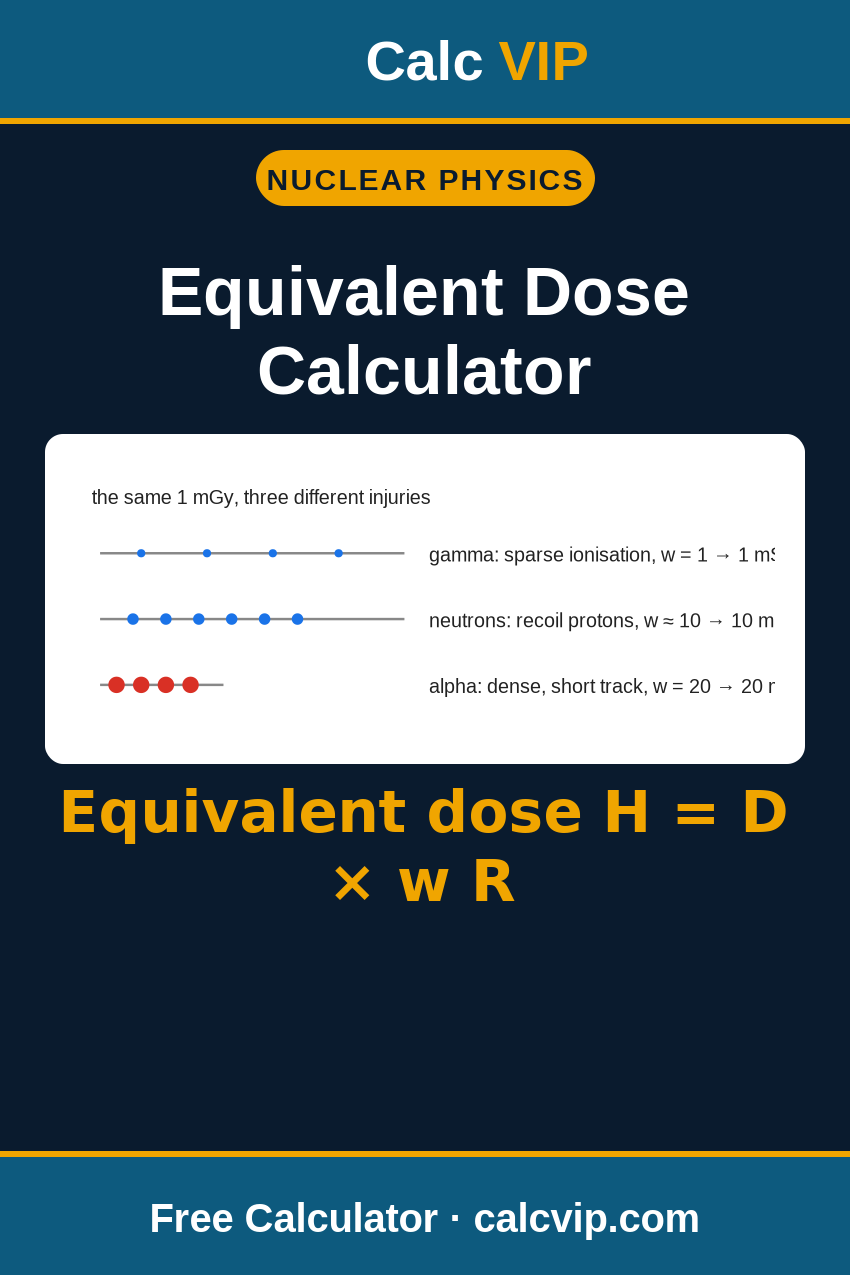
The gray, for all its physical honesty, has a blind spot: it counts joules, not damage. A kilogram of tissue that absorbs 0.001 J of gamma rays and a kilogram that absorbs 0.001 J of alpha particles have received the same absorbed dose — but they have not received the same injury. Alpha particles are massive, highly charged and slow; they tear through only a few dozen cells, dumping every ionisation into that short track, creating dense clusters of molecular wreckage that the cell's repair machinery handles badly. Gamma rays spread the same energy thinly over a long path. Equivalent dose exists to correct for this: it multiplies the absorbed dose by a radiation weighting factor, wR, that encodes how damaging each radiation type is per gray. The result, in sievert, is the first dose quantity that speaks the language of biological risk.
The weighting factors are deliberately coarse, because they summarise a great deal of radiobiology in single numbers. Photons (gamma rays and X-rays) and electrons (beta particles) are the reference radiation: wR = 1, so for them sievert and gray are numerically equal. Protons carry wR = 2. Neutrons sit in an energy-dependent band, roughly 5 to 20. Alpha particles — and heavy ions and fission fragments — take the maximum, wR = 20. These are not measured constants of nature like the speed of light; they are expert judgements, set by the International Commission on Radiological Protection (ICRP) from decades of experiments on cells, animals and, soberingly, human exposure data.
Almost every radiation number you will ever meet in the news, in a hospital or on a worker's dose record is in sievert — usually millisievert (mSv), because whole sieverts are large. Average natural background gives 2–3 mSv a year; a chest X-ray about 0.02 mSv of effective dose; the occupational limit is 20 mSv a year. This calculator performs the conversion that produces those numbers from the physicist's gray, and understanding it is the key to reading any radiation headline with a cool head.
Formula
Equivalent dose H = D × wR • D in gray (Gy), H in sievert (Sv), wR dimensionless.
For a mixture of radiations the equivalent doses simply add: H = Σ Di × wR,i over each radiation type i — a tissue rarely receives just one kind. The conversions: 1 Sv = 1,000 mSv = 100 rem, so 1 rem = 0.01 Sv = 10 mSv, and 1 mSv = 0.1 rem. The formula rearranges to D = H / wR if you have a sievert figure and want the underlying absorbed dose. One subtlety matters: H is defined for a specific tissue or organ — "the equivalent dose to the lung" — because different organs may absorb different gray values. Averaging those organ doses with tissue weighting factors produces the next quantity up, effective dose, described below. This calculator handles the radiation weighting step for one tissue at a time; use it once per radiation type and add the results for mixed fields.
| Symbol | Meaning | Units |
|---|---|---|
| H | equivalent dose — absorbed dose weighted for radiation type | sievert (Sv); also mSv, rem |
| D | absorbed dose in the tissue | gray (Gy) |
| wR | radiation weighting factor for the radiation type | dimensionless (1, 2, 5–20, 20) |
Why track density decides the weighting
The physics behind wR is the linear energy transfer (LET) of the particle — how many keV it deposits per micrometre of track. A gamma ray's secondary electrons are light and fast, ionising sparsely: a few ionisations per micrometre, isolated single-strand DNA breaks that enzymes repair routinely. An alpha particle, carrying two units of charge and nearly 7,300 times an electron's mass, ploughs through tissue depositing around a hundred times more energy per micrometre. The result is clustered damage: multiple breaks and base lesions within a few nanometres of DNA, a configuration repair machinery often cannot fix faithfully. Per gray — per joule per kilogram — the alpha dose puts far more of its ionisations into these irreparable clusters, and the factor of 20 is the ICRP's summary of that difference.
Neutrons are the subtle case. They are uncharged, so they ionise nothing directly; instead they knock protons out of hydrogen nuclei in tissue, and those recoil protons are themselves densely ionising. How much damage follows depends on how much energy each neutron hands to its proton, which is why the neutron weighting factor is a curve, not a number: about 5 for very slow and very fast neutrons, rising to a peak of about 20 near 1 MeV where the recoil protons are most destructive, and settling near 10 as a textbook average — the value this calculator's neutron preset uses. Whenever a neutron dose matters professionally, the energy spectrum has to be known; the single number here is a first estimate, honestly labelled.
How to use
- Enter the absorbed dose D in gray for the tissue of interest. If you only have deposited energy and mass, get D first from the Absorbed Dose Calculator.
- Choose the radiation type from the dropdown — the weighting factor fills in automatically (gamma/beta 1, neutrons 10, alpha 20) — or pick "Custom weighting factor" and type a wR of your own, for example for protons (2) or a specific neutron energy.
- Click "Calculate Equivalent Dose" to see H in sievert and millisievert, plus the older rem unit.
- For a mixed radiation field, repeat once per radiation type and add the sievert results — equivalent doses add; absorbed doses of different types should not be averaged before weighting.
Worked examples
Example 1 — alpha particles, the reference case. Tissue absorbs 0.001 Gy (1 mGy) of alpha radiation, wR = 20.
H = 0.001 × 20 = 0.02 Sv = 20 mSv = 2 rem. The same 1 mGy of gamma rays would give only 1 mSv — alpha particles count twenty times more, which is why inhaled alpha emitters like radon progeny dominate natural background risk despite tiny absorbed doses.
Example 2 — gamma rays, where gray meets sievert. A worker's whole body absorbs 0.002 Gy of gamma radiation during a year of incidents.
H = 0.002 × 1 = 0.002 Sv = 2 mSv (0.2 rem) — comparable to a year of natural background, and a tenth of the occupational annual limit. For photons, the conversion is a formality; the weighting factor of 1 leaves the number untouched.
Example 3 — neutrons at the textbook average. Tissue near a neutron source absorbs 0.0005 Gy (0.5 mGy) of neutrons, wR = 10.
H = 0.0005 × 10 = 0.005 Sv = 5 mSv. Half a milligray of neutrons outweighs 2 mGy of gamma rays — the reason neutron fields around reactors and accelerators are monitored with special care.
Example 4 — a mixed field, added properly. In one procedure a tissue receives 1 mGy of gamma and 0.1 mGy of alpha contamination.
H = (0.001 × 1) + (0.0001 × 20) = 0.001 + 0.002 = 0.003 Sv = 3 mSv. Note the alpha contribution: a tenth of the absorbed dose, but twice the equivalent dose. Adding the grays first (1.1 mGy) and weighting once would have buried this completely.
Example 5 — checking a worker against the limit. A radiographer's annual record shows 0.8 mGy of gamma and 0.05 mGy of alpha (from a contamination incident).
H = 0.8 + (0.05 × 20) = 0.8 + 1.0 = 1.8 mSv — just 9% of the 20 mSv occupational annual limit, with the small alpha term contributing more than the gamma despite being 16 times smaller in gray.
Example 6 — skin dose, beta versus alpha. Skin absorbs 5 mGy. As beta radiation (wR = 1): H = 5 mSv. Had the same 5 mGy arrived as alpha particles: H = 5 × 20 = 100 mSv — except that external alphas cannot penetrate the dead outer skin layer at all, a reminder that weighting factors apply to dose actually absorbed in living tissue.
Equivalent dose in real life
Radiation workers' dose records. Every classified worker's official record is kept in millisievert — the dosimetry service converts the badge's absorbed-dose reading using the radiation types of that workplace. Careers in nuclear power, radiography and medicine are managed against the 20 mSv/year limit in these units.
Radon and the home. The largest single contributor to most people's dose is radon gas: its alpha-emitting decay products lodge in the lung and deliver roughly 1.2 mSv a year — about half of the average 2.4 mSv total background — from an absorbed dose in gray that would look trivial, multiplied by wR = 20.
Aircrew cosmic radiation. At cruising altitude the cosmic-ray field is a mixture of gamma rays, neutrons and protons. A long-haul crew member accumulates roughly 2–5 mSv a year from it; a single 8-hour flight at a typical dose rate of ~4 µSv/h gives about 32 µSv. Airlines roster crew with these sievert totals in mind.
Nuclear medicine and radiotherapy support. Staff preparing radiopharmaceuticals handle beta and gamma emitters daily; their finger and whole-body doses, tracked in mSv, decide glove-box design, syringe shields and rotation schedules.
Emergency response. After reactor accidents, authorities set intervention levels — sheltering, evacuation, food restrictions — in millisievert of projected dose. The sievert is the currency in which public protection decisions are denominated.
Space mission planning. Astronaut dose budgets are set in sievert because the space radiation field is rich in heavy ions with the maximum weighting. A Mars mission's total is estimated at around 1 Sv — the dominant health risk of the voyage, and a direct product of H = D × wR applied to exotic radiations.
From equivalent dose to effective dose
Equivalent dose is specific to one tissue. But risk is not: a sievert delivered to the thyroid does not carry the same lifetime cancer risk as a sievert to the lung or the whole body. The final step in the protection system multiplies each organ's equivalent dose by a tissue weighting factor wT — lung 0.12, red bone marrow 0.12, thyroid 0.04, skin 0.01, among others — and sums over all organs to give the effective dose, also in sievert. Example: an equivalent dose of 10 mSv to the lung contributes 10 × 0.12 = 1.2 mSv of effective dose, while the same 10 mSv to the thyroid contributes only 10 × 0.04 = 0.4 mSv. Effective dose is the number compared against public and occupational limits, because it represents whole-body risk on a single scale. This calculator stops one step earlier, at the tissue level — the step where the radiation physics ends and the anatomy begins.
Quick reference: doses in sievert
| Exposure | Dose |
|---|---|
| eating one banana (potassium-40) | ≈ 0.0001 mSv |
| chest X-ray (effective dose) | ≈ 0.02 mSv |
| transatlantic flight | ≈ 0.03–0.1 mSv |
| natural background, per year | ≈ 2–3 mSv |
| public limit, artificial sources, per year | 1 mSv |
| occupational limit, per year (averaged) | 20 mSv |
| acute whole-body dose causing sickness | ≈ 1,000 mSv (1 Sv) |
Every figure in the table passed through this page's multiplication on its way from a physicist's measurement to a protection quantity — the weighting factor is where radiation stops being only physics and becomes biology.
A short history of the sievert
The unit honours Rolf Sievert, the Swedish physicist who built radiation measurement into a science in the early twentieth century — the ionisation chambers he designed were, for decades, simply called Sievert chambers. The sievert itself was adopted internationally in the late 1970s, replacing the rem ("roentgen equivalent man"), which survives in the conversion 1 Sv = 100 rem and in older American records. The weighting-factor system has been revised as radiobiology improved: the ICRP's 1991 recommendations introduced the modern wR table, and its 2007 revision refined the neutron curve into the smooth energy-dependent function sketched above. The numbers on this page are judgements that evolve with evidence — one more reason the gray underneath them, a pure measurement, must always be recorded too.
Common mistakes
- Treating gray and sievert as interchangeable. For gamma rays they coincide numerically, which breeds the habit; for alpha particles the sievert is twenty times the gray. Always ask which quantity a number is before comparing it with a limit.
- Adding grays of different radiations, then weighting once. Mixed fields must be weighted component by component and added in sievert, as in Example 4. A single average wR applied to the total can badly understate the dose.
- Using one fixed neutron weighting factor. wR for neutrons runs from ~5 to ~20 with energy. The value 10 is a textbook average for estimates, not a constant of nature; serious neutron dosimetry uses the actual spectrum.
- Getting the rem conversion backwards. 1 Sv = 100 rem, so rem figures are bigger numbers: 20 mSv is 2 rem, not 0.2. A factor-of-100 error in either direction destroys a dose assessment.
- Comparing an organ's equivalent dose with whole-body limits. Limits are set in effective dose. A thyroid equivalent dose of 20 mSv is not a breach of the 20 mSv limit — its effective contribution is 20 × 0.04 = 0.8 mSv.
FAQ
Why do alpha particles have a weighting factor of 20?
Alpha particles are heavy and slow, so they dump all their energy in a very short track, producing dense clusters of ionisation that cells struggle to repair. Per gray absorbed, the biological damage is about 20 times that of gamma rays.
What is a safe equivalent dose?
Average natural background gives about 2–3 mSv per year. Occupational limits for radiation workers are typically 20 mSv per year averaged over five years; the public limit from artificial sources is 1 mSv per year.
Is the weighting factor for neutrons always 10?
No — it depends on the neutron energy, ranging from about 5 for very fast or very slow neutrons up to 20 near 1 MeV. The value 10 used here is a common textbook average.
What is the difference between equivalent dose and effective dose?
Equivalent dose weights the absorbed dose for radiation type, tissue by tissue. Effective dose goes one step further, weighting each tissue's equivalent dose by that tissue's sensitivity (wT) and summing over the body, giving one whole-body risk number. Both are measured in sievert.
Why is the weighting factor for protons only 2?
Protons are charged and ionise more densely than electrons, but far less densely than alpha particles — a proton carries one unit of charge rather than two and is much lighter. The ICRP's judgement from the radiobiology data places it just above the photon/electron reference, at wR = 2.
Can equivalent dose be measured directly?
Not exactly — no instrument reads sievert. Dosimeters measure absorbed dose (or related quantities like air kerma), and the sievert is computed using the known radiation types present. It is a protection quantity: defined for managing risk, calculated rather than metered.
How do I convert rem to sievert?
Divide by 100: 1 rem = 0.01 Sv = 10 mSv. Older American records in rem convert directly — 2 rem is 20 mSv, a full occupational year at the limit.
Does a bigger weighting factor mean the radiation is more penetrating?
Almost the opposite. Alpha particles, with the highest wR, are the least penetrating — stopped by paper or dead skin. Weighting measures damage per gray absorbed in living tissue, not range. Alpha emitters are dangerous mainly when inhaled or ingested, where no skin barrier protects the tissue.
Why did scientists not just measure risk directly in gray?
Because the same gray demonstrably produces different injury rates for different radiations — experiments with alpha sources showed roughly twenty times the cell killing per gray of gamma rays. A quantity that ignores that would mislead every protection decision built on it.
Is the sievert used for radiotherapy?
No — radiotherapy prescriptions stay in gray. Treatment aims at a physical absorbed dose in the tumour; weighting factors are protection tools for healthy tissue and workers, not therapy tools. You will see Gy on a treatment plan and Sv on a staff dose record, and the distinction is deliberate.