 Calc
Altitude Pressure Calculator – Barometric Formula P(h)
 Created by Elena Petrova · Physics Editor · Fluids & Rotation · Last updated: November 2026
Use this free Altitude Pressure Calculator to find the atmospheric pressure at any height above sea level, using the standard barometric formula. Air gets thinner as you climb, so the pressure falls quickly at first and then more gently.
The air has weight — about 1.2 kg in every cubic metre at sea level — and the atmosphere is an ocean of it some tens of kilometres deep, with all of us living at the bottom. The pressure at any height is the weight of the air still overhead, and that is why pressure falls as you climb: there is literally less sky above you. The fall is swift at first — half the atmosphere's mass lies below 5.5 km, so by the height of a respectable Alpine summit half the pressure is gone — and then ever gentler, because the remaining air is itself thinner: each successive kilometre removes a smaller share of a smaller total.
The barometric formula on this page captures that behaviour in one line: P = P₀ × (1 − 2.25577×10⁻⁵ × h)^5.25588. Its odd-looking constants hide two physical facts. The exponent, just over 5, comes from the way air cools as it rises (the standard atmosphere assumes temperature falls 6.5 °C per kilometre), and the small coefficient converts metres of height into the fraction of the atmosphere left behind. The result is the International Standard Atmosphere's pressure — the reference profile against which altimeters are calibrated, aircraft performance is quoted, and weather stations reduce their readings to sea level so that maps can be drawn.
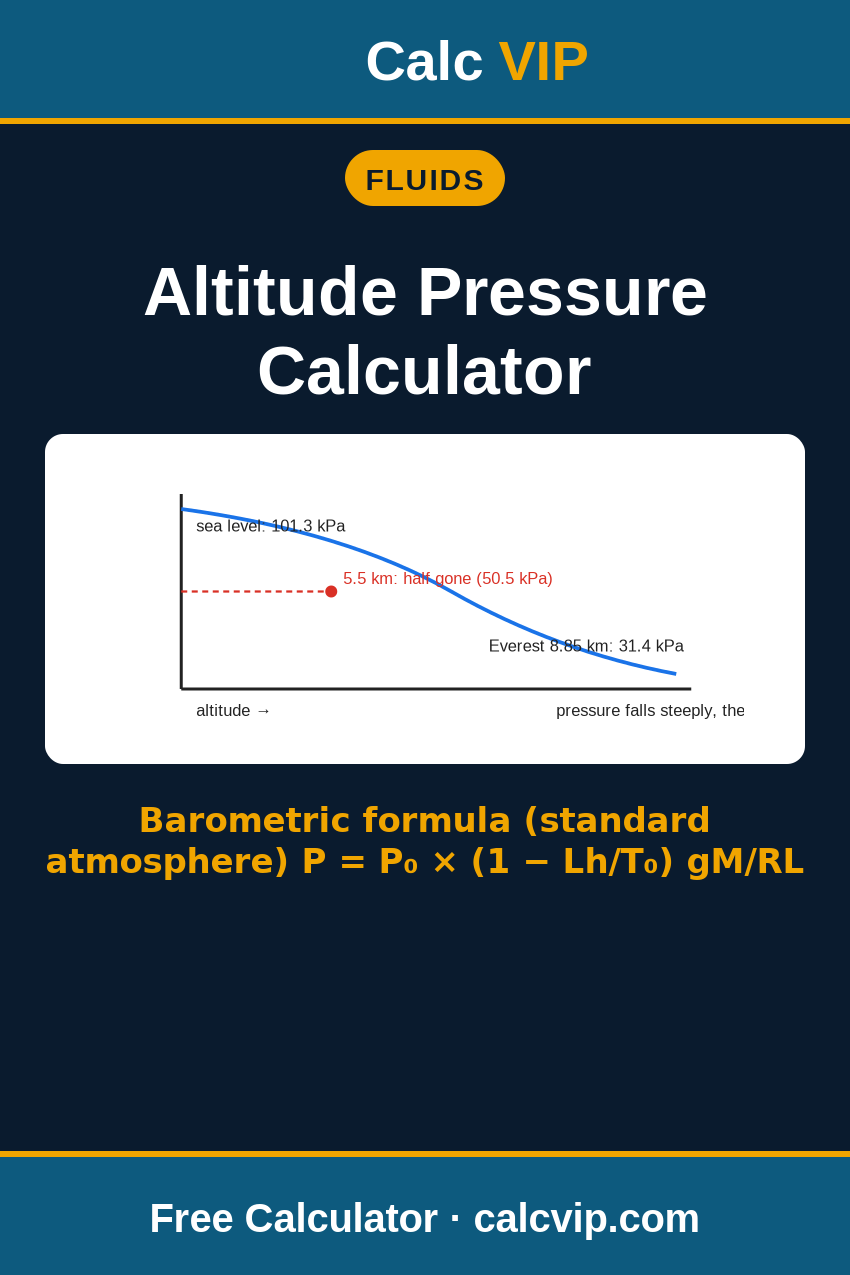
This calculator evaluates the formula for any altitude up to about 11,000 m — the whole troposphere, containing every mountain, every city and nearly every flight — entered in metres or feet. It returns the pressure in kilopascals and atmospheres, and as a percentage of the sea-level value: the single most intuitive way to feel what a height means, whether you are planning a trek, setting an altimeter, or working out why the cake recipe misbehaved in the mountains.
Formula
Barometric formula (standard atmosphere) P = P₀ × (1 − Lh/T₀)gM/RL, evaluated with the standard constants as P = 101,325 × (1 − 2.25577×10⁻⁵ × h)5.25588 • P in pascals (Pa), h in metres (m), P₀ = 101,325 Pa
Every symbol earns its place. The term 2.25577×10⁻⁵ per metre is the temperature lapse rate (6.5 °C per kilometre) divided by the sea-level temperature (288.15 K): as air cools with height it also densifies less quickly, and the formula tracks both effects at once. The exponent 5.25588 combines gravity, the molar mass of air and the gas constant with that same lapse rate. Two honest limits: the formula models the standard atmosphere — a defined average — so real pressure at a height on a real day differs by a percent or two with the weather; and it is built for the troposphere, up to about 11,000 m, above which the temperature profile changes character and a different formula takes over. This calculator converts feet to metres for you (1 ft = 0.3048 m exactly) and reports kPa, atm and the percentage of sea-level pressure.
| Symbol | Meaning | Units / value |
|---|---|---|
| P | air pressure at altitude h | Pa (calculator reports kPa) |
| P₀ | standard sea-level pressure | 101,325 Pa |
| h | altitude above sea level | m (calculator also takes feet) |
| 2.25577×10⁻⁵ | lapse rate ÷ sea-level temperature | per metre |
| 5.25588 | exponent from g, air's molar mass, R and the lapse rate | — |
An exponential in disguise: the scale height
Buried inside the barometric formula is the atmosphere's favourite number: the scale height, about 8.4 km — the height over which pressure falls by a factor of e (2.718) if temperature stayed constant. Real air cools as it rises, so the true profile is the power law on this page rather than a pure exponential, but the intuition survives intact: pressure does not fall by a fixed amount per kilometre, it falls by a fixed fraction. Near sea level the toll is about 12 Pa per metre — roughly 1 kPa per 85 m, the rule altimeter-setters use — but at 5000 m the same metre costs half as much, because there is half as much air left to remove. This is why the first kilometre of a mountain road makes ears pop while the fifth passes almost unnoticed, and why "half the atmosphere below 5.5 km" and "three-quarters below 11 km" are the same fact stated twice.
The fraction view also explains altitude's physiology. What lungs and blood actually care about is the partial pressure of oxygen — 20.9% of the total. At 3000 m the total pressure is 70.1 kPa, so oxygen's share is about 14.7 kPa, equivalent to breathing 14.5% oxygen at sea level. At Everest's 31.4 kPa, oxygen's partial pressure is about 6.6 kPa — a third of normal — which no amount of fitness can negotiate away; acclimatisation raises red-cell counts and breathing rates, but the partial pressure is set by this formula and does not bargain. Aircraft cabins are the engineered answer: the fuselage holds the pressure at the equivalent of roughly 2400 m (about 75 kPa) while the aircraft cruises at 11,000 m in air of 22.6 kPa, and the difference — some 53 kPa across the skin — is what the structure is built to carry, flight after flight.
How to use
- Enter the altitude above sea level.
- Choose the unit: metres (pre-selected) or feet — aviation altitudes in feet convert automatically at 0.3048 m per foot.
- Click "Calculate Pressure".
- Read the pressure in kPa and atm, plus the percentage of sea-level pressure — the most intuitive measure of how much air is left.
- Stay below about 11,000 m: above the tropopause the standard atmosphere changes its temperature behaviour and this formula hands over to a different one (the calculator will tell you if the height is out of range).
Worked examples
Example 1 — one kilometre up. At an altitude of 1000 m: P = 101,325 × (1 − 2.25577×10⁻⁵ × 1000)5.25588 = 101,325 × (0.97744)5.25588 ≈ 89.87 kPa ≈ 0.89 atm — about 88.7% of the sea-level pressure. That is why aircraft cabins and high-altitude cities feel noticeably "thinner" air.
Example 2 — a high city: Denver, 1609 m. P ≈ 83.43 kPa, about 82% of sea level. Water there boils at roughly 94.6 °C (the boiling point falls about 1 °C per 300 m), so eggs take longer, cakes rise differently, and visiting athletes feel the missing 18% of oxygen in the first training session — the "mile-high" effect is this example wearing a nickname.
Example 3 — a trekking altitude: 3000 m. P ≈ 70.11 kPa ≈ 0.69 atm — 69.2% of sea level. This is the height of many ski resorts and the threshold above which altitude sickness becomes common in unacclimatised visitors; the oxygen partial pressure is down to about 14.7 kPa, and the body's answer — faster breathing, faster pulse — is measurable within hours.
Example 4 — the halfway sky: 5500 m. P ≈ 50.51 kPa — 49.85%, essentially half an atmosphere. Everest Base Camp sits near this height, and climbers spend weeks here and at Camp 2 persuading their blood to carry more oxygen, because above this line the human body can no longer fully acclimatise; it can only visit.
Example 5 — the summit of Everest, 8848 m. P ≈ 31.44 kPa ≈ 0.31 atm — 31% of sea level, as the manifest of every expedition records. Each breath delivers about a third of the sea-level oxygen; the few who summit without bottled oxygen do so at the absolute edge of human physiology, in the briefest of weather windows.
Example 6 — cruising altitude, 10,000 ft and 11,000 m. An airliner climbing through 10,000 ft (3048 m) passes P ≈ 69.68 kPa. At its cruising height of 11,000 m, the outside pressure is ≈ 22.63 kPa — 22.3% of sea level, at the very top of this formula's range — while the cabin is held near 75 kPa. The 53 kPa difference, pressing outward on every square metre of fuselage, is the quiet structural fact of every flight you have ever taken.
Altitude pressure in real life
Altimeters and aviation. An aircraft altimeter is a barometer with a height scale: it measures the outside pressure and reads it through this formula. Because real weather moves the pressure around, pilots dial in the local sea-level pressure (QNH) so the instrument reads true altitude — the daily ritual that keeps aircraft separated in a sky whose pressure map changes hourly.
Weather forecasting. Stations report pressure "reduced to sea level" using the barometric relationship, stripping out each station's altitude so the map shows weather, not geography. Without the correction, every mountain town would sit in a permanent fake low-pressure zone.
Mountaineering and medicine. Acclimatisation schedules, oxygen planning and the diagnosis of altitude illness all key off the pressure profile: above about 2500 m the falling oxygen partial pressure starts to matter, and the "death zone" above 8000 m — where pressure is under about 35 kPa — is defined by it outright.
Cooking at altitude. Boiling point follows pressure: about 95 °C at 1600 m, 90 °C at 3000 m, and roughly 70 °C on Everest's summit — where a "boiled" egg cannot cook through and tea is a lukewarm negotiation. Pressure cookers exist largely to give the pressure back.
Engines and aircraft performance. Engines breathe air by volume but burn it by mass: at 3000 m, with density down by a third, a naturally aspirated engine loses roughly a third of its power, runways must be longer, and helicopters meet a ceiling where the thin air can no longer support them — all of it the pressure formula translated into machinery.
Everyday packages and ears. Crisp packets puff up on mountain roads and in cargo holds because the air sealed inside them at low altitude is now the higher pressure; ears pop in lifts and aircraft for the same reason in miniature — a few hundred pascals of difference, equalising through a swallowed yawn.
Density altitude: the height the air "feels like"
Pilots keep a second, slyer altitude in their calculations. What wings, propellers and lungs respond to is not pressure alone but air density — and density depends on temperature as well as pressure. On a hot day, warm expanded air at a 2000 m airfield can be as thin as standard air at 3000 m; the field's density altitude is 3000 m, and aircraft taking off there need the longer runway, the reduced load and the gentler climb that 3000 m demands, whatever the map says. Accidents have been written in the gap between the two numbers: high, hot and heavy is the fatal combination. The barometric formula gives the standard day's answer — the pressure an average atmosphere would have at your height — and density altitude is the correction reality applies when the day is not standard. It is the standing reminder that this page's profile is a model of the air, an excellent one, and that the air itself always has the last word.
Quick reference: standard pressure by altitude
| Altitude | Pressure | % of sea level | Landmark |
|---|---|---|---|
| 0 m | 101.32 kPa | 100% | sea level |
| 500 m | 95.46 kPa | 94.2% | hill country |
| 1000 m | 89.87 kPa | 88.7% | Example 1 |
| 2000 m | 79.50 kPa | 78.5% | high plateau cities |
| 3000 m | 70.11 kPa | 69.2% | ski resorts |
| 4000 m | 61.64 kPa | 60.8% | La Paz heights |
| 5000 m | 54.02 kPa | 53.3% | highest permanent settlements |
| 8848 m | 31.44 kPa | 31.0% | Everest summit |
| 11,000 m | 22.63 kPa | 22.3% | airliner cruising height |
Memorise three anchors — 90 kPa at 1 km, half pressure at 5.5 km, a third at Everest — and you can place any mountain, city or flight on the curve to within a few percent, in your head, forever.
Common mistakes
- Expecting a linear fall. Pressure does not lose a fixed 12 kPa per kilometre all the way up — if it did, it would hit zero at 8.4 km, with Everest in vacuum. It loses a fixed fraction per step, which is why there is still 22.6 kPa at 11 km.
- Confusing pressure altitude with true altitude. On a stormy day the pressure at a fixed height is lower than standard, so a barometric altimeter over-reads — it thinks it is higher than it is. The formula gives the standard day; the weather adds its own correction.
- Using the formula above the troposphere. Beyond about 11 km the temperature stops falling and the constants change. The calculator refuses rather than extrapolates — respect the refusal.
- Mixing feet and metres. Aviation speaks feet, science speaks metres, and the factor is 0.3048 — a 10,000 ft altitude entered as 10,000 m lands you above Everest in near-vacuum. The unit selector exists for this.
- Forgetting that boiling, engines and lungs follow the pressure. The number is not trivia: every 300 m costs about a degree of boiling point and a measurable slice of engine power and blood oxygen. Altitude problems are pressure problems in costume.
FAQ
What is the pressure on top of Mount Everest?
At 8,848 m the formula gives roughly 31 kPa — only about one-third of the sea-level pressure. Climbers breathe so little oxygen per breath that most use bottled oxygen near the summit.
Why do my ears pop in a plane or a lift?
As the altitude changes, the outside pressure changes faster than the air trapped in your middle ear can equalise. Swallowing or yawning opens the passage that balances it — the "pop".
How high does this formula work?
It is designed for the troposphere, up to about 11,000 m — which covers every mountain and most airliner cruising altitudes. Higher layers of the atmosphere follow different formulas.
At what height is the pressure exactly half?
About 5,480 m — call it 5.5 km. The calculation runs both ways: half-pressure height is where (1 − 2.25577×10⁻⁵ h)^5.25588 = 0.5. It is a coincidence worth enjoying that this is also roughly the height of Everest Base Camp, where climbers pause to rebuild their blood for the thinner half of the sky.
Why is my altimeter wrong on some days?
Because it measures pressure and infers height through the standard formula, while the real atmosphere's pressure at your height shifts with the weather — by the equivalent of a few hundred metres between a deep low and a strong high. Pilots correct for it with the local QNH setting; hikers recalibrate at known summit markers.
What pressure do airliner passengers actually experience?
The cabin is pressurised to the equivalent of about 2000–2400 m — roughly 75–80 kPa — while the aircraft cruises where the outside pressure is 20–25 kPa. Newer aircraft with composite fuselages hold a lower cabin altitude (near 1800 m), which passengers feel as less fatigue and fewer ear complaints.
Does pressure ever reach zero?
Not at any finite height in this model — the atmosphere thins exponentially and fades into space rather than ending at a lid. By 100 km (the Kármán line, the conventional edge of space) the pressure is about 0.03 Pa, a few ten-millionths of sea level, but it is not zero; traces of atmosphere persist for hundreds of kilometres more.
How does altitude affect boiling water?
Water boils when its vapour pressure equals the air pressure, and lower pressure means a lower boiling point: about 1 °C less per 300 m of altitude. At 3000 m water boils near 90 °C; on Everest's summit, near 70 °C — too cool to cook an egg properly, which is a pressure problem masquerading as a culinary one.
Why do athletes train at altitude?
The lower oxygen partial pressure (about 15 kPa at 3000 m against 21 kPa at sea level) prompts the body to produce more red blood cells. Returning to sea level with that extra carrying capacity — "live high, train low" is the refined version — can improve endurance performance for some weeks, until the extra cells retire.
What is the pressure inside the International Space Station?
Deliberately sea-level normal: about 101 kPa of breathable air, maintained against the vacuum outside by the station's structure and life-support. Astronauts live at the bottom of an artificial atmosphere while orbiting in none — the pressure difference across the hull is the full one atmosphere this page starts from.