 Calc
Barometer Calculator – Mercury Column Height to Pressure (mmHg, Pa, kPa, atm)
 Created by Elena Petrova · Physics Editor · Fluids & Rotation · Last updated: November 2026
Use this free Barometer Calculator to convert between the height of a mercury column and the pressure it balances. A barometer works because atmospheric pressure supports a column of mercury — read the height in mmHg and get the pressure in Pa, kPa and atm, or work backwards from a pressure to the column height.
For three and a half centuries, the weather was read off a column of mercury in a glass tube. The instrument is disarmingly simple — a tube sealed at the top, emptied of air, standing in a dish of mercury — and the physics is a single balance: the atmosphere presses on the dish, the mercury climbs the tube until the weight of the column pressing back down exactly matches. Read the height and you have weighed the air itself. This calculator converts in both directions, between column height in millimetres and pressure in pascals, kilopascals and atmospheres, using the same ρgh balance the instrument embodies.
The numbers anchor everyday life more than most people realise. Standard atmospheric pressure — the 760 mm of the textbook — is not measured from nature but defined into the unit system: the torr is exactly 1/760 of an atmosphere, and the standard atmosphere itself is fixed at 101,325 Pa. Yet real air wanders around that anchor constantly, sliding to 740 mm inside a deep storm system and rising to 780 mm under a settled anticyclone. Those ±20 mm of mercury, converted here into ±2.7 kPa, are the pressure changes your ears pop for, that weather forecasters map as isobars, and that altimeters turn into altitude.
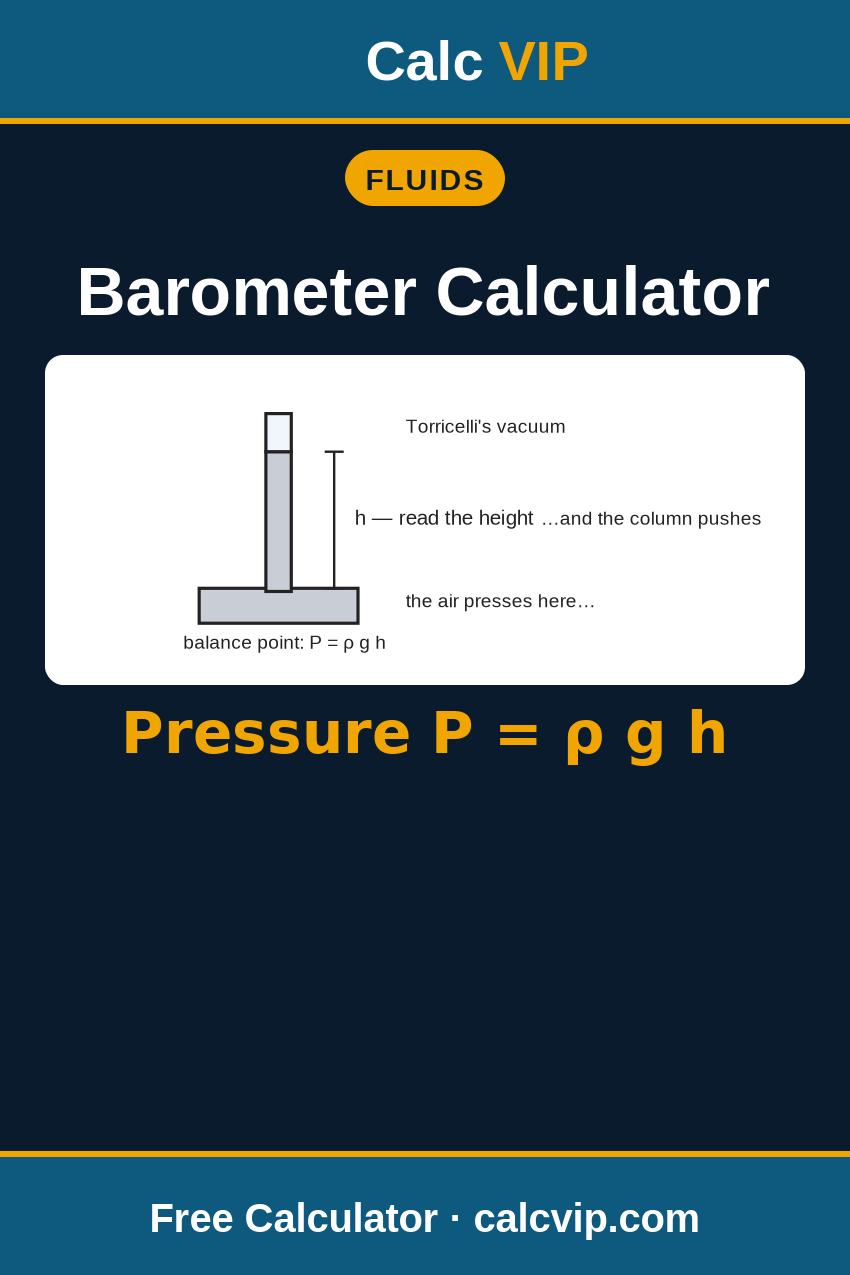
Mercury earns its place through density: at 13,595.1 kg/m³ it packs the atmosphere's push into a column 760 mm tall that fits on a wall. Water, 13.6 times lighter, would need a tube over ten metres tall — a barometer you would read from a staircase. This calculator uses mercury's density at 0 °C and g = 9.81 m/s², the conventions of the classic instrument; the small print of temperature corrections, which mattered to Victorian meteorologists reading to a tenth of a millimetre, is taken up in the depth section below.
Formula
Pressure P = ρ g h • ρ = 13,595.1 kg/m³ for mercury, g = 9.81 m/s², h in metres; rearranged, h = P / (ρ g)
This is the hydrostatic equation — the same ρgh that gives pressure at any depth in any fluid — applied to the one column whose top is a vacuum. Because the space above the mercury holds (almost) no pressure, the column's base pressure equals the full atmospheric pressure outside, and h becomes a direct reading of it. The product ρg for mercury is 133,367.9 Pa per metre, or 133.37 Pa per millimetre: each millimetre of column is worth about 133 Pa, a conversion worth memorising — multiply mmHg by 0.1333 to get kPa. This calculator converts height to Pa, kPa and atm, and pressure (in Pa, kPa or atm) back to millimetres.
| Symbol | Meaning | Units |
|---|---|---|
| P | atmospheric (absolute) pressure | Pa, kPa, atm |
| ρ | mercury density at 0 °C | 13,595.1 kg/m³ |
| h | column height above the reservoir level | mm (mmHg), m in the formula |
| g | gravitational acceleration | 9.81 m/s² |
Torricelli's insight: the sea of air
The barometer was born in 1643 from a puzzle about pumps: why could a suction pump never lift water more than about ten metres? Evangelista Torricelli, Galileo's successor, reasoned that the pump does not pull water up at all — the atmosphere pushes it up, and the atmosphere's push has a limit, because we live at the bottom of what he called a sea of air, some tens of kilometres deep, pressing down with its accumulated weight. His test replaced water with mercury, thirteen-odd times denser: if the air-sea theory was right, the column should stand at about one-thirteenth of ten metres. It stood at 760 mm, and fell and rose with the weather exactly as a sea's pressure should. The "empty" space at the top of the tube — the Torricellian vacuum — scandalised a philosophy that insisted nature abhors emptiness; within a few years Pascal had carried a barometer up a mountain and watched the column fall with altitude, proving the sea of air gets shallower as you climb through it.
That mountain experiment is the barometer's second career: because pressure falls predictably with height — roughly 1 mm of mercury for every 11 metres climbed in the lower atmosphere — the instrument doubles as an altimeter. Every aircraft altimeter is an aneroid barometer wearing a height scale, and every hiker's watch that reports altitude is solving h = P/(ρg) for the sky instead of for mercury.
How to use
- Choose the mode: column height → pressure, or pressure → column height.
- For height mode, enter the mercury column in millimetres as read from the reservoir level to the top of the meniscus.
- For pressure mode, enter the pressure and pick its unit — Pa, kPa or atm.
- Click "Calculate" to see the conversion instantly: pressure in Pa, kPa and atm, or the column height in mm and cm.
Worked examples
Example 1 — the standard column. A barometer reads 760 mm.
P = 13,595.1 × 9.81 × 0.760 = 101,360 Pa ≈ 101.36 kPa ≈ 1.00 atm. (The tiny excess over the defined 101,325 Pa is the difference between ρgh with these constants and the torr's definition — a 0.03% reminder that the mmHg and the torr are cousins, not twins.)
Example 2 — an approaching storm. The column has fallen to 740 mm: P = 13,595.1 × 9.81 × 0.740 = 98,692 Pa ≈ 98.69 kPa ≈ 0.974 atm. Twenty millimetres of fall is 2.67 kPa of missing air — a deep Atlantic low on the doorstep, and the classic barometer-tap of the worried sailor.
Example 3 — a settled anticyclone. Under strong high pressure the column reaches 780 mm: P = 104,027 Pa ≈ 104.03 kPa ≈ 1.027 atm. The full swing of ordinary weather, storm to calm, is barely ±3% of the atmosphere's weight — yet it moves oceans of air.
Example 4 — on the mountain. At a high pass the barometer reads 620 mm: P = 13,595.1 × 9.81 × 0.620 = 82,688 Pa ≈ 82.69 kPa ≈ 0.816 atm. Roughly a fifth of the sea of air is below you — the thin air that makes climbers gasp and engines lose power, measured by the same tube Torricelli built.
Example 5 — pressure back to height. A forecast gives 98 kPa. h = 98,000 ÷ (13,595.1 × 9.81) = 0.7348 m = 734.8 mm. Working the equation backwards is how an altimeter's setting is computed: enter the known sea-level pressure, and the instrument can translate its own reading into height.
Example 6 — the water barometer that never was. With water (1,000 kg/m³) instead of mercury, standard pressure needs h = 101,325 ÷ (1,000 × 9.81) = 10.33 m of column — three storeys of glassware, and the reason the pump-makers' ten-metre limit and Torricelli's insight are the same number wearing two hats.
The barometer in real life
Weather forecasting. The barometer's tendency — rising, falling, steady — remains a forecaster's first instrument: a fall of 1–2 mm in three hours warns of wind; a steep rise promises clearing. Ships still log pressure every watch, and the global network of barometers draws the isobar maps behind every forecast.
Aviation altimetry. Pilots set the local pressure (QNH) into the altimeter so it reads height above sea level; a 1 mm error in that setting is about 11 m of phantom altitude — which is why controllers broadcast the setting to the hectopascal and crews read it back.
Medicine. Blood pressure is still quoted in mmHg worldwide — 120/80 is a column of mercury in disguise — because the first sphygmomanometers literally balanced the artery against one. The unit survives its instrument by a century and counting.
Laboratory vacuum work. Vacuum gauges report in torr and mbar, both children of this column: the torr from the barometer's unit, the millibar as 100 Pa. A "good" laboratory vacuum of 10−3 torr is a column shrunk to a hundred-thousandth of a millimetre.
Altitude and hiking. Barometric altimeters in watches and phones track climbs and descents to the metre — and drift with the weather, because the instrument cannot tell a genuine climb from an arriving low. Recalibrating at known heights is the hiker's version of the pilot's QNH ritual.
Industrial pressure standards. Deadweight testers and mercury columns long served as the primary standards against which other gauges were calibrated; national laboratories kept barometers reading to 0.01 mm as the court of appeal for pressure.
The fine print: temperature, gravity and capillarity
Precision barometry corrects three small effects, and knowing them explains the instrument's brass scale and careful siting. Temperature expands the mercury (lowering its density, so a warm column reads high) and expands the scale itself; observatories corrected every reading to 0 °C, worth about 0.13 mm per degree at 760 mm. Gravity varies with latitude and altitude — a column in Quito, near the equator and 2,850 m up, stands measurably differently from one in Helsinki at the same pressure; standard readings are reduced to g = 9.80665 m/s². Finally, mercury's meniscus is depressed slightly by surface tension in narrow tubes (capillary depression), a correction depending on the bore. Each effect is a fraction of a millimetre — invisible to weather-watching, decisive for the calibration laboratory, and the reason this calculator's constants (0 °C density, g = 9.81) are stated openly rather than hidden.
Quick reference: column heights and pressures
| Column | Pressure | Meaning |
|---|---|---|
| 620 mm | 82.69 kPa · 0.816 atm | high mountain pass |
| 700 mm | 93.36 kPa · 0.921 atm | exceptional low / high town |
| 740 mm | 98.69 kPa · 0.974 atm | storm approaching |
| 750 mm | 100.03 kPa · 0.987 atm | changeable |
| 760 mm | 101.36 kPa · 1.00 atm | the standard column |
| 780 mm | 104.03 kPa · 1.027 atm | settled anticyclone |
Commit the middle row to memory — 760 mm, 101.3 kPa, 1 atm — and the rest of the table can be estimated by the 0.1333 kPa-per-millimetre rule to within a percent.
A practical reading habit completes the table: what matters for weather is rarely the height itself but its movement over three hours. Barometers traditionally mark the dial Rain — Change — Fair — Set Fair across the 740–780 mm range, a rough translation of this table into expectations; the instrument's real forecast skill lies in the trend arrow, not in any single number.
From one column to the whole sky: the barometric formula
The barometer's ρgh works because mercury's density is constant along its short column. Air refuses that convenience: it is compressible, so its density falls as pressure falls, and the sky's pressure profile becomes an exponential rather than a straight line. Climb 5.5 km and the pressure halves (about 50 kPa, a column near 380 mm); climb another 5.5 km and it halves again. Meteorologists compress this into the barometric formula, P = P₀ × e−h/H, with a scale height H of roughly 8.4 km for the lower atmosphere — the height over which pressure falls by a factor of e. The formula is this page's equation integrated through a fluid whose density is proportional to its own pressure, and it explains both the altimeter's non-linear scale and why Everest's summit, at 8.85 km, offers barely a third of sea-level pressure: e−8.85/8.4 ≈ 0.35. Torricelli's sea of air turns out to be an ocean with an exponential shoreline — shallow very quickly, yet never quite ending, thinning past the Kármán line into space itself.
The same exponential governs the barometer's daily drama in reverse. A storm's 20 mm fall means the column of air overhead has genuinely lost mass — air has flowed away aloft faster than surface winds replace it — and the winds that follow are the atmosphere rebalancing its books. When forecasters say pressure is "falling rapidly", they are reporting the sea of air draining; when it rises, the sea is filling. No instrument in the history of science has extracted so much understanding from so simple a balance.
Common mistakes
- Reading to the reservoir's surface instead of its level change. As the column rises, the reservoir level falls slightly; precision instruments (Fortin barometers) adjust the reservoir to a fixed zero point before reading. Domestic instruments hide the correction in their scale.
- Using water's density for a mercury column. ρgh is fluid-specific: 760 mm of water is only about 7.5 kPa. The 13,595.1 kg/m³ in this calculator is mercury's — change the fluid and the whole conversion changes.
- Confusing gauge and absolute pressure. A barometer reads absolute pressure — from vacuum. A tyre gauge reads from atmospheric. Feeding a barometric value into a gauge-pressure problem double-counts the atmosphere.
- Treating mmHg and torr as exactly equal in precision work. They differ by about 0.00002% — nothing for weather, but the distinction is real, and Example 1's 101.36 vs 101.325 kPa shows the related rounding honestly.
- Expecting the column to read altitude directly. Height mode and altitude are linked through the weather: the same summit reads different pressures on different days. Altimeters must be set with the day's sea-level pressure first.
FAQ
What is the difference between mmHg and torr?
They are practically identical: 1 torr is defined as exactly 1/760 of an atmosphere, and 1 mmHg is the pressure of a 1 mm mercury column. They differ by less than 0.00002%.
Why does the column fall before a storm?
Storms are low-pressure systems. Lower atmospheric pressure supports a shorter mercury column, so a falling barometer is a classic sign of approaching bad weather.
Why mercury and not water?
Mercury is 13.6 times denser than water, so the column is 760 mm instead of about 10.3 m. Mercury also has a very low vapour pressure, keeping the vacuum at the top nearly perfect.
What does an aneroid barometer do differently?
It replaces the column with a small evacuated metal capsule that flexes as pressure changes, driving a needle by levers (or, in a barograph, a pen on a rotating drum). No liquid, no ρgh — but it is calibrated against mercury columns, and this calculator's conversions still describe what it measures.
Why does pressure fall with altitude?
Because there is less air above you pressing down. The fall is steepest near the ground — about 1 mmHg per 11 m — and gentler higher up, as the remaining air thins; half the atmosphere's mass lies below 5.5 km.
What is the highest and lowest pressure ever recorded?
Sea-level records stand near 1,084 hPa (a Siberian anticyclone, equivalent to about 813 mm) and 870 hPa inside a Pacific typhoon (about 653 mm) — the full historical swing of the column is roughly 160 mm of mercury.
How do I convert mmHg to hPa, the forecaster's unit?
Multiply by 1.3332: 760 mmHg = 1,013.25 hPa by definition of the standard atmosphere. Equivalently, kPa from this calculator × 10 = hPa.
Why is the top of the tube a vacuum and not air?
Any trapped gas would press down on the column and corrupt the reading, varying with temperature. Torricelli's tube is filled with mercury and inverted without admitting air, so the space holds only mercury vapour — a pressure so small it can be ignored at this precision.
Can I build a barometer with oil or alcohol?
Yes, and the column grows as the density falls: an oil of 800 kg/m³ would stand about 12.9 m tall at standard pressure. Such instruments exist as curiosities and as sensitive manometers — a long, light column magnifies small pressure changes — but mercury's compactness won the practical contest centuries ago.
Is mercury still used in barometers today?
Rarely — toxicity rules have retired it from schools and most observatories in favour of aneroid and electronic sensors. The unit it created, however, is immortal: every blood-pressure reading and vacuum specification still speaks mmHg. Surviving mercury instruments are now mostly museum pieces and calibration standards, handled with the care their contents demand.