Calc
Bubble Pressure Calculator – Laplace Pressure of Bubbles & Droplets
 Created by Elena Petrova · Physics Editor · Fluids & Rotation · Last updated: November 2026
Use this free Bubble Pressure Calculator to find the extra pressure inside a soap bubble or a liquid droplet caused by surface tension. Choose the mode, enter the surface tension and the radius — the calculator applies Laplace's law.
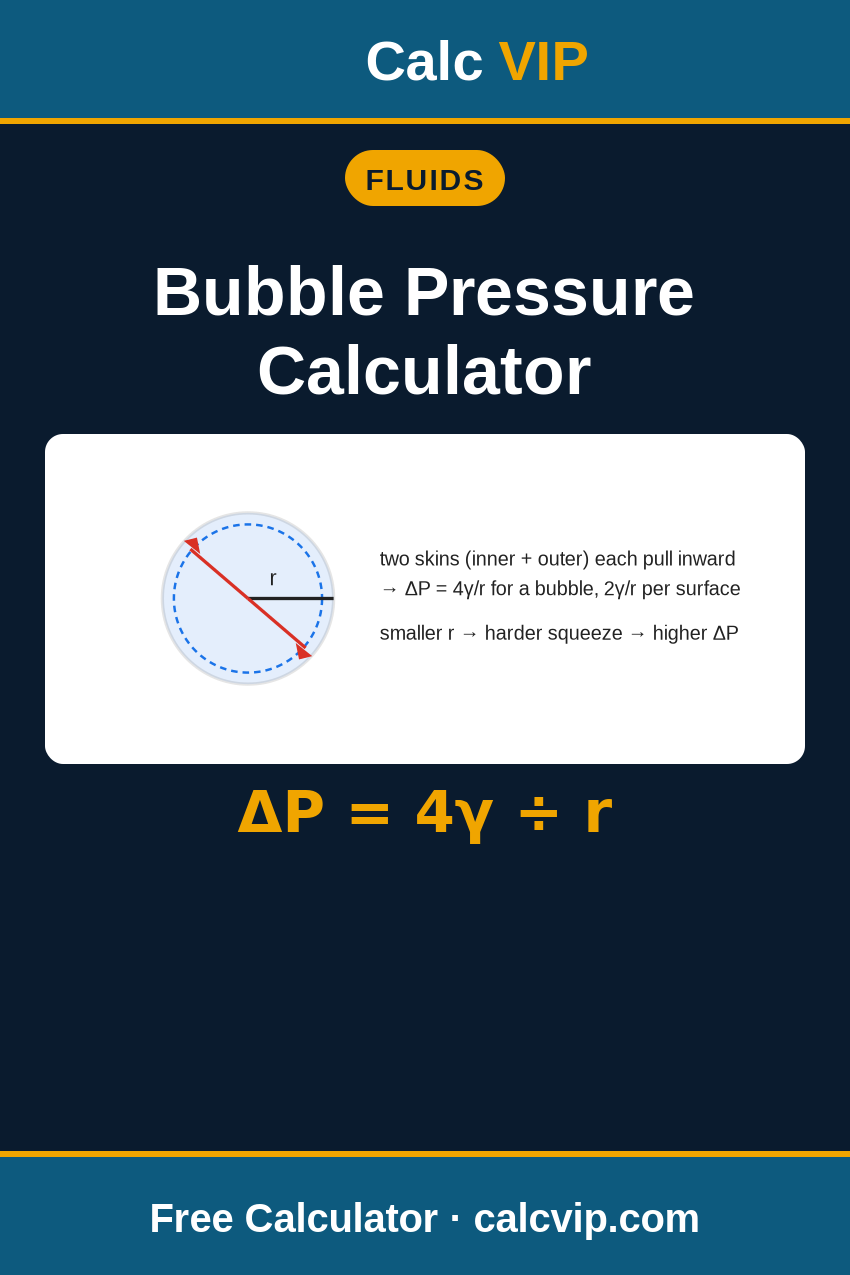
Every bubble is a tiny pressure vessel. The liquid film that forms its skin is under tension, constantly trying to shrink, and that squeeze raises the pressure of the air trapped inside above the pressure outside. The smaller the bubble, the tighter the squeeze: the excess pressure follows Laplace's law, ΔP = 4γ/r for a soap bubble and ΔP = 2γ/r for a droplet, growing without limit as the radius shrinks. This calculator applies both forms — pick the mode, enter the surface tension γ and the radius (in millimetres, as bubbles are actually measured), and it returns the excess pressure in pascals.
The numbers are small for the bubbles you blow in a garden — a centimetre soap bubble holds just 12 Pa of excess pressure, a thousandth of an atmosphere — but the 1/r law turns savage at small scales. Shrink a water droplet to a hundredth of a millimetre and its internal excess pressure reaches 14,560 Pa; inside the micron-scale droplets of a fog or an inhaler, surface tension is not a correction but the dominant force, deciding whether droplets merge, evaporate or survive. The same law governs the air sacs of your lungs, the foam on a wave and the ink droplets in a printer.
The factor of two between the two modes is the page's neatest piece of physics. A droplet has one surface; a soap bubble is a film with two — an inner and an outer skin — and each skin squeezes. Count the surfaces and you have the formula: ΔP = 2γ/r per surface. Behind that simplicity sits a general law (Young–Laplace) that prices any curved surface in any fluid, from the meniscus in a capillary tube to the surface of a star.
Formula
Laplace pressure — soap bubble: ΔP = 4γ ÷ r • droplet: ΔP = 2γ ÷ r • ΔP in pascals (Pa), γ in N/m, r in metres inside the formula
The general Young–Laplace law says ΔP = γ × (1/R₁ + 1/R₂) for a single surface curved with radii R₁ and R₂; for a sphere both radii equal r, giving 2γ/r, and a soap film's second surface doubles it to 4γ/r. The rearrangements: r = 4γ ÷ ΔP (bubble) finds the size a given pressure difference can sustain — the form that predicts which droplets survive in a spray — and γ = ΔP × r ÷ 4 turns a pressure measurement into a surface-tension measurement, which is exactly how the maximum-bubble-pressure tensiometer in a chemistry lab works: blow bubbles through a capillary at a measured peak pressure and γ falls out. Note the calculator takes the radius in millimetres and converts; in the formula itself r must be in metres.
| Symbol | Meaning | Units |
|---|---|---|
| ΔP | excess pressure inside minus outside | Pa |
| γ | surface tension of the liquid (film) | N/m |
| r | radius of bubble or droplet | mm (entered), m in formula |
| 2 or 4 | number of surfaces × 2γ/r each: droplet 2, bubble 4 | — |
Why the small bubble loses: Laplace's paradox
Connect two soap bubbles of different sizes with a tube and intuition says the big one, holding more air, should push into the small one until they match. The opposite happens. The small bubble has the higher internal pressure (ΔP ∝ 1/r), so air flows from small to large: the small bubble collapses into the big one, which grows. The demonstration is startling every time, and it is pure Laplace — the pressure ranking of bubbles is the reverse of their size ranking. The same instability shapes foams: in any foam, gas diffuses through the films from small bubbles (high pressure) to large ones (low pressure), so foams coarsen with time — big bubbles eat little ones — which is why a beer head or a shaving foam left standing turns coarse and collapses.
Your lungs face the same paradox at the scale of the alveoli, the ~0.1 mm air sacs where oxygen enters the blood. Modelled as tiny bubbles, the smaller alveoli should empty into the larger and the lung should collapse into a few big sacs. It does not, because the alveoli are lined with surfactant, a substance that lowers γ as the sac shrinks — cutting the pressure rise exactly where Laplace's law would cause it, and equalising the sacs. Premature babies born before surfactant production begins struggle with precisely this physics, and the treatment — surfactant replacement — is applied Laplace's law.
How to use
- Choose the mode: "Soap bubble" for a film with two surfaces (ΔP = 4γ/r), or "Liquid droplet" for a drop in air or another fluid (ΔP = 2γ/r).
- Enter the surface tension γ in N/m — soap solution ≈ 0.03, pure water ≈ 0.0728, most oils 0.03–0.035.
- Enter the radius in millimetres — half the diameter; a typical blown bubble is 10–50 mm, a raindrop 1–3 mm, mist 0.01 mm.
- Click "Calculate Excess Pressure" to see ΔP in pascals, the amount by which the inside pressure exceeds the outside.
Worked examples
Example 1 — the garden bubble. A soap bubble of radius r = 10 mm (0.01 m) blown from a soap solution with γ = 0.03 N/m.
ΔP = 4 × 0.03 ÷ 0.01 = 12 Pa. Only a gentle excess pressure inflates a centimetre bubble — but halve the radius and the pressure doubles.
Example 2 — a water droplet. A droplet of radius 1 mm with γ = 0.0728 N/m (droplet mode): ΔP = 2 × 0.0728 ÷ 0.001 = 145.6 Pa. Twelve times the big soap bubble's excess, from a droplet a tenth its size in a liquid with 2.4 times its surface tension.
Example 3 — a mist droplet. The same water at radius 0.01 mm: ΔP = 2 × 0.0728 ÷ 0.00001 = 14,560 Pa — over 14% of an atmosphere, inside a droplet you cannot see individually. This pressure raises the droplet's vapour pressure and drives the evaporation physics of clouds and sprays.
Example 4 — a big lazy bubble. A soap bubble of radius 50 mm, γ = 0.03: ΔP = 4 × 0.03 ÷ 0.05 = 2.4 Pa. Giant bubbles are barely pressurised at all — which is why they wobble, drift and deform so freely, and why bubble artists work at sizes where Laplace's squeeze fades away.
Example 5 — an alveolus, with and without surfactant. Model a lung air sac as a single-surface sphere of radius 0.1 mm. With a plain watery lining (γ = 0.025 N/m): ΔP = 2 × 0.025 ÷ 0.0001 = 500 Pa. With surfactant at low volume (γ ≈ 0.005): ΔP = 2 × 0.005 ÷ 0.0001 = 100 Pa. The fivefold cut in γ is the difference between a lung that inflates evenly and one whose small sacs collapse into its large ones.
Example 6 — a raindrop. A raindrop of radius 2 mm, γ = 0.0728: ΔP = 2 × 0.0728 ÷ 0.002 = 72.8 Pa. Modest — but as the drop falls and flattens, aerodynamic pressure competes with this Laplace pressure, and drops larger than about 4–5 mm across are torn apart by the contest, which is why raindrops have a maximum size.
Bubble pressure in real life
Lungs and medicine. Alveolar stability, surfactant therapy for premature infants, and the design of ventilator pressures all run on Laplace's law; the pressures in Example 5 are the pressures neonatologists manage.
Foams and their decay. Beer heads, firefighting foams, shaving cream and mineral flotation froths all coarsen by Laplace-driven gas transfer from small bubbles to large. Foam stabilisers are chemicals that slow exactly this traffic.
Inkjet and spray technology. A printer's nozzle must overcome the Laplace pressure of its own tiny droplets to eject them, and agricultural and paint sprays are engineered around the droplet sizes — hence internal pressures — that drift and coat correctly.
Clouds and aerosols. A pure-water droplet small enough has so high an internal pressure that its surface evaporates faster than vapour can condense — the Kelvin effect — which is why cloud droplets form on dust nuclei instead of from pure vapour, and why fine mists evaporate while coarse sprays survive.
Measuring surface tension. The maximum bubble pressure method blows bubbles through a capillary into the liquid and reads the peak pressure; with r known, γ = ΔP × r ÷ 4 turns this calculator inside out into a standard laboratory tensiometer.
Boiling and cavitation. A vapour bubble inside hot liquid must hold its Laplace excess against the liquid; the superheat needed to nucleate boiling, and the violence of cavitation collapse, both start from ΔP = 2γ/r evaluated at microscopic radii.
One law, many surfaces: Young–Laplace everywhere
The bubble formula is the spherical case of a general truth: any curved interface between fluids carries a pressure jump ΔP = γ(1/R₁ + 1/R₂), with the two principal radii of curvature. A cylindrical jet of liquid has one curved direction and one straight one, so its excess is γ/r — half the droplet's — which is why a thin stream of water from a tap necks and breaks into droplets: the cylinders are unstable, the spheres are not. A saddle-shaped surface, curved up one way and down the other, can have near-zero net jump — the geometry of the films in a foam's Plateau borders. And the meniscus in a capillary tube is Laplace's law again, producing the capillary rise h = 2γ/(ρgr) — for water in a 0.1 mm-radius tube, a rise of about 0.148 m, measurable on a bench. Learn the bubble and you have quietly learned all of these.
Quick reference: excess pressure by size (water droplet, γ = 0.0728 N/m)
| Radius | Droplet ΔP = 2γ/r | Everyday object |
|---|---|---|
| 2 mm | 72.8 Pa | a raindrop |
| 1 mm | 145.6 Pa | a coarse spray drop |
| 0.1 mm | 1,456 Pa | fine drizzle |
| 0.05 mm | 2,912 Pa | mist |
| 0.01 mm | 14,560 Pa | fog / inhaler aerosol |
Each tenfold shrink multiplies the pressure tenfold. By the bottom row, surface tension is generating pressures comparable to a metre of water head — inside droplets that drift like smoke.
Why kettles sing before they boil: nucleation and the critical radius
Laplace's law also explains why boiling is hard to start. A newborn vapour bubble inside hot water must pay its own excess pressure: at radius r the vapour inside must exceed the surrounding pressure by 2γ/r, but the vapour pressure is fixed by the temperature. There is therefore a critical radius, r* = 2γ ÷ (Pvapour − Pliquid): bubbles smaller than r* are crushed by their own surface tension and collapse; only a fluctuation or a scratch-born pocket bigger than r* can grow. Put numbers to it at 105 °C, where water's vapour pressure is about 120,790 Pa — an excess of 19,465 Pa over atmospheric — and γ has fallen to 0.0589 N/m: r* = 2 × 0.0589 ÷ 19,465 ≈ 0.000006 m — six micrometres. That is why perfectly clean water in a smooth vessel can be superheated past 100 °C without boiling, then erupt when a spoon offers it ready-made pockets larger than r* — and why kettle elements are deliberately rough. The same threshold, run in a diver's tissues, is where decompression bubbles begin.
A note on soap: why the film's γ is not water's
Everything in the examples turns on γ, and soap's whole job is to change it. Pure water's surface tension, 0.0728 N/m, is too high for stable, easily blown films; soap molecules crowd the surface and cut γ to roughly 0.03 N/m, which by Laplace's law cuts the excess pressure of every bubble by the same factor of about 2.4. A small demonstration ties the page together: a bubble of radius 5 mm blown from a stronger solution with γ = 0.025 N/m holds ΔP = 4 × 0.025 ÷ 0.005 = 20 Pa — stiffer than Example 4's big bubble (2.4 Pa) despite the gentler liquid, because its radius is ten times smaller. Radius and surface tension fight in every bubble; the formula is the referee, and it is why bubble mixture recipes (soap, glycerin for film life, sugar for elasticity) are really recipes for tuning γ and the film it prices.
Common mistakes
- Using the diameter instead of the radius. The formula wants r. Feeding it the diameter halves the computed pressure — the commonest bubble error, because bubbles are usually described by their width.
- Picking the wrong mode. A soap bubble is 4γ/r; a droplet is 2γ/r. An air bubble inside water is a droplet-type case (one surface), despite being called a bubble — count surfaces, not names.
- Entering γ for the wrong liquid. Soap solution (0.03) and pure water (0.0728) differ by a factor of 2.4. The whole point of soap is that it lowers γ; using water's value for a soap film erases the soap.
- Expecting big bubbles to be the pressurised ones. It is exactly backwards: ΔP ∝ 1/r. The small bubble is the hard one, which is why connected bubbles trade air small-to-large.
- Forgetting the radius unit. The calculator takes millimetres. If you measured in micrometres (an aerosol's 10 µm is 0.01 mm), convert first — a µm-for-mm slip understates the pressure a thousandfold.
FAQ
Why does a bubble use 4γ/r but a droplet only 2γ/r?
A soap bubble is a thin film with an inner and an outer surface, and both surfaces pull inwards. A droplet has just one surface, so the squeezing effect — and the excess pressure — is half as big.
What happens when two bubbles of different sizes are connected?
The smaller bubble has the higher internal pressure, so air flows from the small bubble into the big one: the small bubble shrinks and the big one grows — the opposite of what most people expect.
How big is the effect for a tiny water droplet?
For a droplet of radius 1 mm with γ = 0.0728 N/m, ΔP = 2 × 0.0728 ÷ 0.001 = 145.6 Pa. For a 0.01 mm mist droplet it is 100 times larger — which is why fine sprays behave so differently from rain.
Is the pressure inside a bubble enough to matter when blowing one?
For a child's bubble, no — 12 Pa is a whisper of breath. But the first moment of blowing, when the film is a tiny cap on the wand, demands the highest pressure of the whole process; once the bubble grows past a few millimetres, Laplace's law relaxes and blowing gets easier. You can feel the law in that first puff.
What is the surface tension of common liquids?
Water 0.0728 N/m at room temperature, soap solutions about 0.03, olive oil about 0.032, ethanol about 0.022, mercury an exceptional 0.465. Temperature lowers γ — hot water's surface tension is measurably less than cold water's.
Why don't the lungs' air sacs collapse into each other?
Surfactant. It coats the alveoli and reduces γ as a sac shrinks, cancelling the 1/r pressure rise that would otherwise empty small sacs into large ones. Without it — as in premature infants — breathing is a fight against Laplace's law.
What is an antibubble?
A droplet wrapped in a thin air film, submerged in liquid — the bubble turned inside out. It still obeys Laplace's law with its film's surfaces, and survives only seconds to minutes before the film drains and pops.
Does gravity flatten the pressure inside a real bubble?
Slightly: the film drains downward, so a real bubble is thicker at the bottom, and the internal air has its own tiny hydrostatic gradient. For bubbles under a few centimetres both effects are negligible beside 4γ/r; for the giant artist's bubbles they shape the wobble you see.
Why do foams coarsen over time?
Gas diffuses through the films from small bubbles (high ΔP) toward large ones (low ΔP). The small vanish, the large grow, the average size climbs and the foam weakens — Laplace's law acting as an unstoppable ageing process in every foam from cappuccino to firefighting.
Who was Laplace, and what is the full law?
Pierre-Simon Laplace, who with Thomas Young gave the general rule ΔP = γ(1/R₁ + 1/R₂) in the early 1800s. The bubble and droplet formulas on this page are its spherical special cases; the full version prices every curved surface in nature, from capillary menisci to the surface of a liquid jet.