 Calc
Buoyancy Solver Calculator – Submerged Volume & Percentage at Floating Equilibrium
 Created by Elena Petrova · Physics Editor · Fluids & Rotation · Last updated: November 2026
Use this free Buoyancy Solver Calculator to find how a floating object settles in equilibrium: how much of its volume sits below the surface and what percentage is submerged. A floating object displaces exactly its own weight of fluid, so the submerged fraction equals the ratio of the two densities.
Why does a block of wood settle with exactly half of itself underwater, while an iceberg hides nine-tenths of its bulk beneath the surface? Both answers come from a single ratio. A floating object is held up by the weight of the fluid it pushes aside, and it settles at the precise depth where that displaced weight equals its own. Divide the object's density by the fluid's density and you get the submerged fraction directly — no forces to resolve, no iteration. This calculator performs that short, beautiful piece of physics and reports the submerged volume, the percentage below the waterline, and the verdict that matters first: floats, or sinks.
The principle underneath is Archimedes', and it is worth stating in its strong form: the buoyant force on any object equals the weight of fluid it displaces, whether the object is floating politely at the surface, hanging from a crane half-submerged, or resting on the bottom. Floating is simply the special case where the object can find a waterline at which displaced weight and its own weight balance before it is fully covered. If even complete submersion cannot displace enough weight — because the object's average density exceeds the fluid's — no such waterline exists and the object sinks, as this solver will tell you plainly.
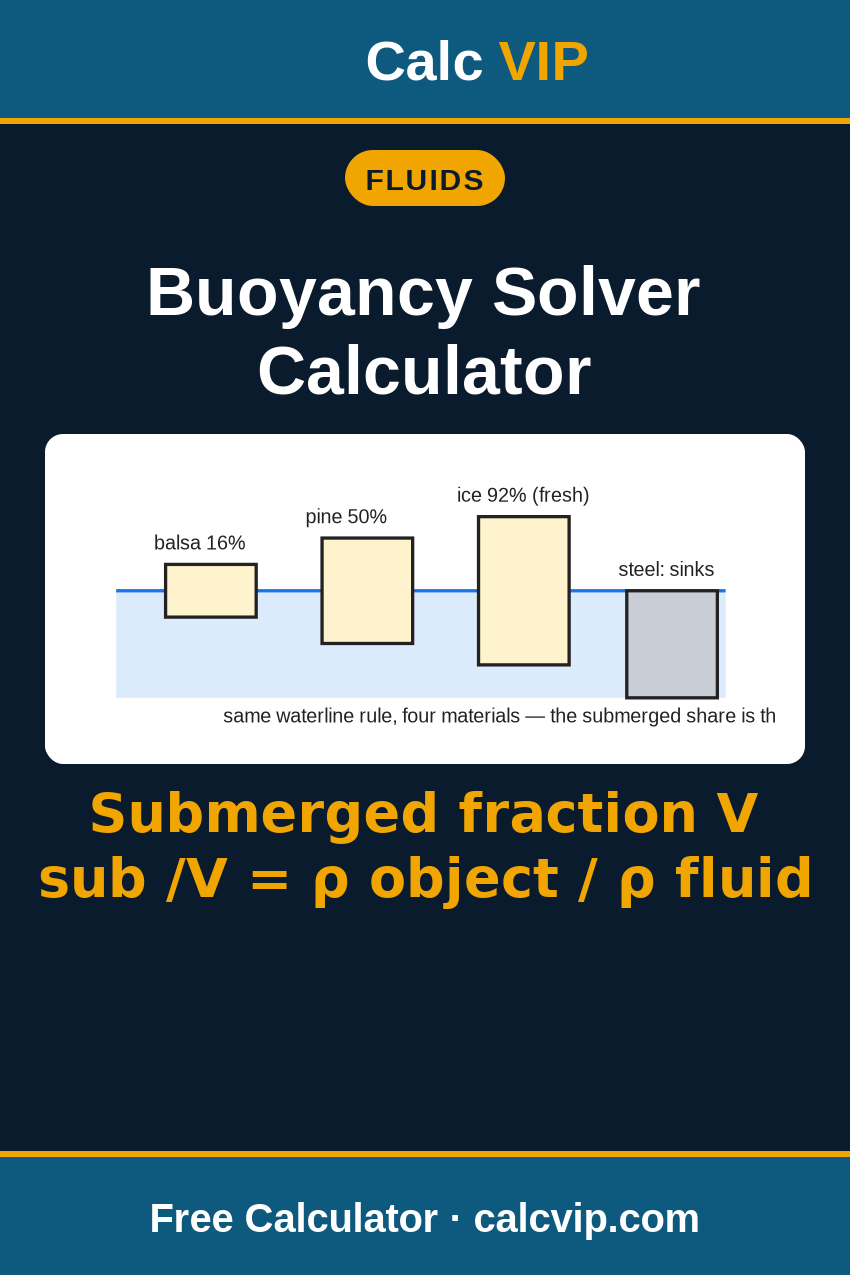
Two features of the result surprise nearly everyone the first time. First, the submerged percentage does not depend on the object's size or mass at all — only on the density ratio. A pine log and a pine matchstick float at the same fraction. Second, the percentage does not depend on the fluid's depth, the container's shape, or gravity itself: on the Moon the same block would float at the same waterline, merely settling more gently. What does change the answer is the pairing — the same oak block rides high in mercury, low in oil, and not at all in a fluid lighter than itself. Density ratio is destiny.
Formula
Submerged fraction Vsub/V = ρobject / ρfluid • densities in kg/m³; submerged volume Vsub = V × (ρobject/ρfluid), with total volume V = m / ρobject
The derivation is three lines long and worth owning. Weight: W = ρobject × V × g. Buoyancy at floating equilibrium: B = ρfluid × Vsub × g. Setting W = B, the g and the geometry cancel, leaving Vsub/V = ρobject/ρfluid. The formula rearranges to find a needed density instead: to float with exactly a fraction f submerged in a fluid of density ρfluid, an object (or a ship's hull averaged over its whole enclosed volume) must have average density f × ρfluid. That rearrangement is the naval architect's daily tool — a steel ship floats because its hull encloses so much air that the average density of steel-plus-air falls below water's.
| Symbol | Meaning | Units |
|---|---|---|
| Vsub/V | fraction of the object's volume below the surface | dimensionless (×100 for %) |
| ρobject | object's average density, mass ÷ total volume | kg/m³ |
| ρfluid | fluid density (fresh water 1,000; sea water 1,025) | kg/m³ |
| m, V | object's mass and total volume | kg, m³ |
Archimedes in one image: the displaced water carries the load
Picture the floating object lifted away and the hole it leaves in the water instantly freezing in shape. That hole — the displaced volume — is exactly the submerged part of the object. The water that would fill it has a weight, and while the object sat there, the surrounding water was pushing up with precisely that weight, no more and no less: the fluid cannot know whether the hole contains water, wood or a ship's hull; it pushes on the boundary the same way regardless. Floating is the negotiation in which the object sinks deeper, enlarging the hole, until the hole's water-weight matches its own. If the hole grows to the object's full volume and the match still fails, the negotiation ends — the object sinks, and Archimedes' force merely softens its fall.
This image also explains why the object's average density is what counts. A hollow steel ball and a solid wooden ball of the same size and mass float identically; the water reads only total weight against total enclosed volume. It is the loophole through which all steel shipping passes: a hull is a machine for enclosing air, arranging an average density of perhaps 300–500 kg/m³ for a loaded ship — comfortably floatable — out of a material that by itself sinks like a stone.
How to use
- Enter the object's mass in kilograms and its average density in kg/m³ (for a hollow object, use total mass ÷ total enclosed volume).
- Choose the fluid — fresh water, sea water or oil — or select Custom and type any fluid density.
- Click "Solve Floating Equilibrium" to see the object's volume, submerged volume, submerged percentage and the float/sink verdict.
- A reported ratio of 100% or more means the object sinks: it would need to displace more than its own volume to be supported.
Worked examples
Example 1 — the reference block. A block of mass 5 kg and density 500 kg/m³ in fresh water (1,000 kg/m³).
Total volume V = 5 ÷ 500 = 0.01 m³. Submerged fraction = 500 ÷ 1,000 = 0.5, so Vsub = 0.01 × 0.5 = 0.005 m³ and exactly 50% sits below the waterline.
Example 2 — the iceberg. Ice at 917 kg/m³ in sea water at 1,025 kg/m³: fraction = 917 ÷ 1,025 = 0.8946, so 89.46% is submerged and only 10.54% shows. A berg with 10,000 m³ of total volume hides 8,946 m³ below the surface — the arithmetic behind the most famous warning in navigation.
Example 3 — an oak plank. Oak at 720 kg/m³: a 2 kg plank has V = 2 ÷ 720 = 0.00278 m³, floats at 720 ÷ 1,000 = 72% submerged, displacing 0.002 m³ of water. The displaced mass is exactly 2 kg — as it must be: a floating object always displaces its own mass of fluid.
Example 4 — balsa, the champion floater. Balsa wood at 160 kg/m³ floats with only 160 ÷ 1,000 = 16% submerged — 84% of the block rides above the water. This is why balsa is the material of model aircraft and life-raft cores: no common solid keeps more of itself in the air.
Example 5 — when the solver says "sinks". Steel at 7,800 kg/m³ gives a ratio of 7.8 — the calculator reports that no floating equilibrium exists. Yet steel floats every day, because a ship is not solid steel: hull, decks and air spaces bring the average density of the whole vessel below 1,000 kg/m³, and it is the average that the formula judges.
Example 6 — same block, three fluids. The oak of Example 3 (720 kg/m³) in oil (800 kg/m³) floats at 720 ÷ 800 = 90% submerged — barely afloat, awash at the top. In sea water (1,025) it floats at 720 ÷ 1,025 = 70.24%. The block did not change; the pairing did. Swimmers discover the same effect: floating in the salty Dead Sea is effortless because the fluid side of the ratio has grown.
Buoyancy in real life
Ships and load lines. The Plimsoll marks painted on a hull are this formula made law: they show the waterline for fresh and salt water and for summer and winter, because a ship loaded to the mark in a freshwater port would float dangerously deeper in the less dense river than at sea.
Icebergs and sea ice. The 89% rule governs ice navigation, and it cuts both ways: melting sea ice does not raise sea level (it already displaces its meltwater's weight), while land ice sliding into the sea does — Archimedes adjudicates a climate argument.
Hydrometers. A hydrometer is a weighted float that sinks until it displaces its own weight; the submerged fraction of its stem reads the fluid's density directly — battery testers, antifreeze checkers and brewers' tools are this calculator turned into glass.
Submarines and divers. A submarine trims ballast tanks to make its average density exactly the water's, achieving neutral buoyancy — a submerged fraction of precisely 100% with neither floating nor sinking. Divers do the same with buoyancy compensators, litre by litre.
Hot-air balloons. The same physics in a gas: heated air inside the envelope is less dense than the cold air outside, and the "submerged fraction" logic becomes lift. The fluid is air, the object is a bubble of thinner air wearing a fabric skin.
Life jackets and rescue. A life jacket adds a large volume of foam at perhaps 100 kg/m³, dragging a person's average density below water's and — crucially — arranging for a safe fraction of the head to be part of the unsubmerged share.
Floating is not the whole story: stability
This solver finds where an object floats; it does not promise the object floats upright. Stability is a second question, governed by the metacentre — roughly, whether the buoyant push through the submerged part acts to right the object or to roll it further when it tilts. A wide, flat raft is stable because tilting submerges more volume on the low side, shifting the buoyant force to push that side back up. A narrow log is unstable and rolls until it finds a comfortable axis, which is why log-rolling is a sport. Ships manage stability by keeping heavy cargo low — lowering the centre of gravity — and by hull shapes whose submerged volume shifts decisively when heeled. Two objects with identical submerged fractions from this calculator can behave utterly differently in a seaway; equilibrium is necessary, stability is the engineering.
A homely demonstration: a tall, sealed bottle floats upright in a bath only while its base holds enough ballast; empty, the same bottle — same average density, same submerged fraction — tips onto its side and floats horizontally, because sideways is its stable attitude. The waterline percentage never changed. Whenever a floating design surprises its builder, the missing analysis is almost always stability, not buoyancy.
Quick reference: submerged share in fresh water
| Material (density) | Submerged |
|---|---|
| balsa (160 kg/m³) | 16% |
| pine (500 kg/m³) | 50% |
| oak (720 kg/m³) | 72% |
| ice (917 kg/m³) | 91.7% (89.5% in sea water) |
| human body, lungs full (≈985 kg/m³) | ≈ 98.5% — just the face above |
| steel (7,800 kg/m³) | sinks (ratio 7.8) |
The table reads as a design catalogue in reverse: choose the waterline you want, and the table tells you the average density you must build — with timber, foam, hollow spaces or cargo — to sit there.
Apparent weight: buoyancy when the object cannot float
Sinking objects still receive the full Archimedean push, and it shows up as lost weight. Hang an object from a scale and lower it into water: the reading falls by exactly the weight of the displaced fluid, even though the object sinks. The apparent weight is Wapp = (ρobject − ρfluid) × V × g. A 1 kg block of steel (V = 1/7,800 = 1.28 × 10⁻⁴ m³) displaces 0.128 kg of water, so in the tank it weighs as if it were 0.872 kg — a pull of about 8.55 N instead of 9.81 N. Divers' lift bags, salvage crews raising wrecks, and jewellers testing gold all trade on this difference: it depends on density alone, so weighing an object in air and again in water reveals its density without cutting or melting it.
That is, of course, the original Archimedes story — the crown of Syracuse, suspected of being part silver, betrayed by its displaced volume. The method remains a front-line forensic tool because density is hard to fake: plating, hollowing and alloying all move the average density, and the waterline — or the apparent weight — reports the truth. The same principle, run forwards by this calculator, is how engineers predict whether a sealed instrument housing, a pipeline section or a concrete caisson will float during installation, and how much ballast to add when it must not.
Common mistakes
- Using the material's density for a hollow object. The formula judges average density — total mass over total enclosed volume. A sealed empty drum of steel floats high; enter its mass and drum volume, not 7,800 kg/m³.
- Expecting mass to change the percentage. Double the block and both its weight and its displaced weight double together; the waterline fraction is unmoved. Only density changes it.
- Forgetting the fluid matters. Fresh, sea and oil differ by up to 25% in density; an object that floats in the sea can sink in a freshwater lake — the reason load lines carry separate marks.
- Confusing submerged volume with displaced mass. They are linked by the fluid's density: displaced mass = ρfluid × Vsub, and at equilibrium it equals the object's mass exactly — a good arithmetic check.
- Assuming floating means stable. Equilibrium says where it settles, not whether it stays upright. Tall, narrow objects can satisfy this solver perfectly and still capsize.
FAQ
Why does the object's mass not change the submerged percentage?
The percentage depends only on the density ratio. A bigger block of the same material floats at the same waterline fraction — it just displaces proportionally more water.
What happens if the object is denser than the fluid?
It cannot displace enough fluid to balance its weight, so it sinks. This calculator reports the ratio above 100% and tells you the object sinks.
Why do icebergs hide most of their bulk?
Ice has a density of about 917 kg/m³ versus 1,025 kg/m³ for sea water, so about 89% of an iceberg is submerged — the origin of the phrase "tip of the iceberg".
Why does a huge ship float while a small nail sinks?
Size is irrelevant; average density is everything. The nail is solid steel at 7,800 kg/m³. The ship's hull encloses vast air spaces, so ship-plus-air averages well below 1,000 kg/m³ — it floats for the same reason a sealed empty bottle does.
Does the depth of the water matter?
No. Buoyancy depends on the submerged volume and the fluid's density, not on how much more water lies below. A block floats at the same fraction in a bucket and in the ocean — provided it is not resting on the bottom.
What is neutral buoyancy?
The boundary case: average density exactly equal to the fluid's, ratio 1.00. The object hovers at any depth, neither rising nor sinking — the condition submarines and divers trim for, and the state of a fish with a tuned swim bladder.
Why do I float better in the sea than in a pool?
Sea water (1,025 kg/m³) is denser than fresh (1,000), so your submerged fraction falls by about 2.4% of your volume — a few extra litres of you ride above the surface, which your lungs notice immediately.
How much of an iceberg is really hidden?
About 89.5% in sea water — call it nine-tenths. In fresh water it would be 91.7%. The visible tip is roughly one-ninth of the berg, a ratio set entirely by ice's density of 917 kg/m³.
Can an object float in a gas?
Yes — the fluid in Archimedes' principle can be air. A helium balloon is an object whose average density (gas plus envelope) is below air's 1.2 kg/m³; its "submerged fraction" is 100% and the excess buoyancy becomes lift.
What happens to the waterline as a ship is loaded?
Adding cargo raises the ship's average density, so the submerged fraction — and the draft — increases in direct proportion. Doubling a light ship's displacement roughly doubles the submerged volume; the load line marks where legality and safety stop the process. Unloading reverses it symmetrically, which is why a ship in ballast, riding high with much of its hull exposed, behaves so differently in wind and waves from the same ship laden.