 Calc
Buoyancy Calculator – Archimedes Upthrust & Apparent Weight
 Created by Elena Petrova · Physics Editor · Fluids & Rotation · Last updated: November 2026
Use this free Buoyancy Calculator to find the upward force a fluid exerts on a submerged object, and how much the object appears to weigh while it is in the fluid. Enter the fluid density, the object's submerged volume and its mass.
Buoyancy is the upward push that every fluid gives to anything placed in it — the reason a beach ball fights to escape your hands underwater, why a loaded ship rides lower than an empty one, and how a hot-air balloon climbs through air exactly as a fish hovers in water. The push is not magic and it is not small: it equals, precisely, the weight of the fluid the object displaces. That statement is Archimedes' principle, over two thousand years old, and it is still the complete design rule behind every ship, submarine, life jacket and hydrometer ever built.
This calculator applies the principle in its working form. Give it the fluid's density, the volume of the object that sits below the surface, and the object's mass, and it returns three things: the buoyant force itself, the object's real weight, and its apparent weight in the fluid — the number a spring balance would actually read if you lowered the object in on a string. That third number is the one you feel in daily life: the rock that is a struggle to lift on the riverbank but one-handed easy while it is still in the river, the swimmer who weighs almost nothing in the pool.
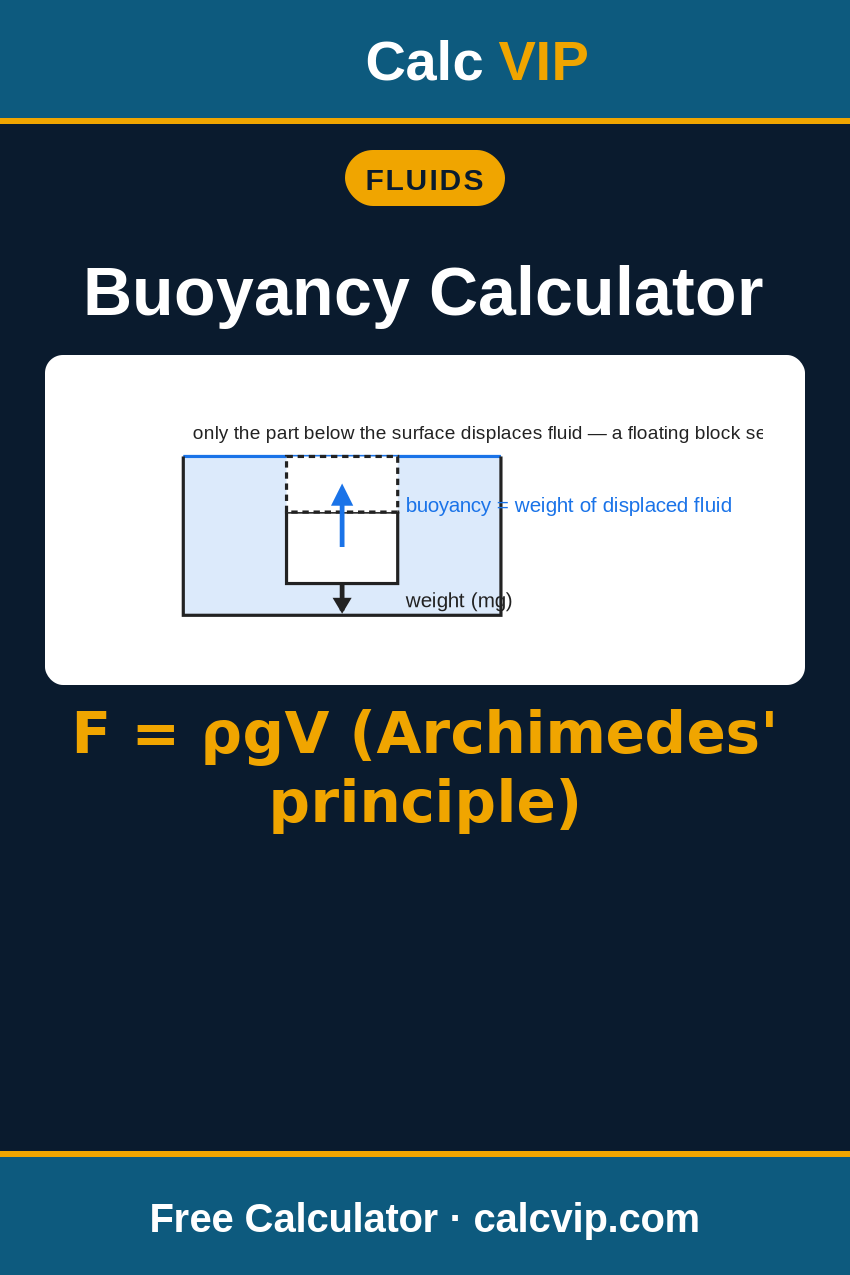
The verdict hidden inside those three numbers is the float-or-sink test. If the buoyant force at full submersion reaches the object's weight, the object can float — it will rise until only part of it is submerged and the displaced weight shrinks to match. If even the maximum buoyancy falls short of the weight, the object sinks, though it still lands on the bottom pressing down with only its reduced, apparent weight. Everything on this page — ships, icebergs, balloons, gold crowns — is those two sentences wearing different clothes.
Formula
Buoyant force = ρ × g × V → F = ρgV (Archimedes' principle)
Apparent weight = real weight − buoyant force → W′ = mg − ρgV
The two equations rearrange for design work: the volume needed to support a mass is V = m ÷ ρ (for a floating object, the submerged volume), and the density of an object that just barely floats fully submerged is ρobject = ρfluid — neutral buoyancy. One special case deserves memorising: for a floating object, the fraction submerged is simply ρobject ÷ ρfluid, which is why an iceberg (917 kg/m³ in 1,025 kg/m³ seawater) hides about 89% of itself below the waterline. Throughout, g = 9.81 m/s² and V is the submerged volume only.
| Symbol | Meaning | Units |
|---|---|---|
| F | buoyant force (upthrust) | newton (N) |
| ρ | density of the fluid | kg/m³ |
| V | submerged (displaced) volume | m³ |
| m | mass of the object | kg |
| W′ | apparent weight in the fluid | N |
Where the upward push actually comes from
Buoyancy is not a new force sprayed onto objects by water; it is hydrostatic pressure keeping its accounts. Pressure in a fluid grows with depth (P = ρgh), so the pressure pushing up on the bottom face of a submerged object is stronger than the pressure pushing down on its top face, simply because the bottom face is deeper. Add up the pressure over the whole surface of any shape you like and the sideways pushes cancel while the vertical ones leave exactly one survivor: an upward force equal to ρgV, the weight of the displaced fluid. Archimedes' principle is the pressure formula integrated over a body — which is why the two calculators sit so naturally side by side.
This origin explains buoyancy's quiet rules. It does not depend on depth for a fully submerged object in an incompressible fluid, because pushing the object deeper raises the pressure on its top and bottom faces by the same amount, leaving the difference untouched. It does not depend on the object's material, shape or colour — only on how much fluid is displaced. And it acts at the centre of the displaced volume (the centre of buoyancy), not at the object's centre of mass — the small print that decides whether a floating ship rights itself after a wave or rolls over, and why naval architects obsess over the relative positions of those two points.
How to use
- Pick a fluid from the list (water, seawater, petrol, olive oil) or choose "Custom density" and type the fluid density in kg/m³.
- Enter the submerged volume in cubic metres — only the part below the surface counts (1 litre = 0.001 m³; a partly floating object needs just its underwater volume).
- Enter the object's mass in kilograms.
- Click "Calculate Buoyancy" to see the buoyant force, the real weight, the apparent weight, and whether the object floats or sinks.
Worked examples
Example 1 — the sinking block. A 2 kg block with a volume of 0.001 m³ (1 litre) is held fully under water (ρ = 1000 kg/m³). Buoyant force = 1000 × 9.81 × 0.001 = 9.81 N. Real weight = 2 × 9.81 = 19.62 N. Apparent weight = 19.62 − 9.81 = 9.81 N — in the water the block feels like a 1 kg object, though it still sinks because its weight is bigger than the buoyancy.
Example 2 — how much of an iceberg hides. Ice has density 917 kg/m³; seawater 1,025 kg/m³. The submerged fraction is 917 ÷ 1,025 = 0.895 — about 89.5% of the berg is underwater. A berg standing 20 m above the waves continues roughly 170 m below them; "the tip of the iceberg" is a precise physical statement, not just a saying. In fresh water the fraction would be 917 ÷ 1000 = 91.7%.
Example 3 — why you float (barely). A 60 kg swimmer has a body volume of about 0.062 m³. Fully submerged, the buoyancy is 1000 × 9.81 × 0.062 = 608.2 N against a weight of 60 × 9.81 = 588.6 N — buoyancy wins, so the swimmer floats with 60 ÷ (1000 × 0.062) = 96.8% submerged and just 3.2% — roughly the face — above the surface. Empty lungs shrink the volume and the margin nearly vanishes, which is why floating is easier after a deep breath in.
Example 4 — a helium balloon's lift. Air is a fluid too (ρ ≈ 1.225 kg/m³). One cubic metre of helium displaces air weighing 1.225 × 9.81 = 12.02 N, while the helium itself (0.166 kg) weighs 1.63 N — net lift 10.39 N, enough to raise about 1.06 kg. A party balloon holds only about 0.014 m³, lifting roughly 15 g — which is why it takes a bunch of balloons to lift even a birthday card, and thousands to lift a person.
Example 5 — Archimedes and the gold crown. One kilogram of pure gold (density 19,300 kg/m³) occupies V = 1 ÷ 19,300 = 0.0000518 m³. In water its buoyancy is 1000 × 9.81 × 0.0000518 = 0.508 N, so it appears to weigh 9.81 − 0.51 = 9.30 N — it "feels like" 0.948 kg. A crown adulterated with lighter silver displaces more water per kilogram and loses more apparent weight: weighing an object in air and in water reveals its density, and its honesty, without damaging it.
Example 6 — what a ship really is. A ship of mass 10,000 tonnes (10,000,000 kg) floats when it displaces its own weight of seawater: V = m ÷ ρ = 10,000,000 ÷ 1,025 = 9,756 m³ of hull below the waterline. Loading cargo pushes the hull deeper until the displaced volume grows to match; the painted load lines on a ship's bow are this equation turned into law, with separate marks for fresh and salt water because ρ changes the answer.
Buoyancy in real life
Ship design and load lines. Every vessel is a buoyancy calculation with a hull wrapped around it. Designers choose the hull volume so that ρgV equals the fully loaded weight with freeboard to spare, and the Plimsoll marks on the side certify the result for waters of different densities — a ship loaded to the mark in a fresh-water river port floats higher once it reaches the denser sea.
Submarines and divers. A submarine hovers by trimming its average density to match the sea: ballast tanks flood to sink, blow air to rise. Scuba divers do the same with a buoyancy compensator vest and their own lungs, aiming for the neutral point where F = mg exactly — Example 3 with equipment on.
Life jackets and floatation. A life jacket is trapped low density: foam of about 100 kg/m³ needs only a few litres of volume to add a hundred newtons of buoyancy where the body needs it — at the chest, to keep an unconscious wearer's face up. The jacket works even though its wearer, per Example 3, is already almost buoyant; it supplies the last few percent, in the right place.
Hydrometers. A hydrometer is a weighted float that sinks until it displaces its own weight; in denser liquid it needs less submerged volume and rides higher. The scale on its stem reads the liquid's density directly — used for battery acid, brewing, antifreeze and milk, all from the floating-fraction rule ρobject/ρfluid.
Hot-air balloons and airships. Example 4 scaled up: heat the air inside an envelope until its average density falls below the cold air outside, and the displaced cold air's weight exceeds the craft's. The physics is identical to the iceberg's — only the fluid is a gas and the "waterline" is invisible.
Fish and swim bladders. Most bony fish carry an adjustable gas bladder, inflating or deflating it to hold neutral buoyancy at any depth without swimming effort. Sharks, lacking one, must swim continuously or sink slowly — two evolutionary answers to the same equation on this page.
Neutral buoyancy: the in-between state
Between floating and sinking sits the state every diver and submarine captain hunts for: apparent weight exactly zero, the object hanging in the fluid as if gravity had been switched off. It happens when the object's average density equals the fluid's — which is why it can be tuned. A Cartesian diver toy dives when you squeeze the bottle because the squeeze compresses its air bubble, shrinking V until ρgV loses to mg; release, and it climbs back. Space agencies train astronauts for spacewalks in giant pools for the same reason: a carefully ballasted suit in water is the closest Earth comes to weightlessness, buoyancy quietly cancelling gravity hour after hour.
Quick reference: fraction submerged in fresh water
| Material (density) | Fraction submerged | Verdict |
|---|---|---|
| cork (240 kg/m³) | 24% | floats high |
| pine wood (500 kg/m³) | 50% | floats half-in |
| oak (720 kg/m³) | 72% | floats low |
| ice (917 kg/m³) | 91.7% | floats awash |
| human body (≈ 985 kg/m³, lungs full) | ≈ 98% | just floats |
| steel, solid (7,800 kg/m³) | 100% — not enough | sinks (unless hollow) |
The table is the float test in one glance: compare densities. Below the fluid's density, the object floats with that fraction hidden; above it, no amount of wishing helps — unless, like the steel ship, the object is hollowed out until its average density drops below the line.
Stability: why floating things do not simply roll over
Floating is necessary but not sufficient — a floating object must also float upright, and stability is buoyancy's second act. When a vessel heels over, the submerged shape changes, so the centre of buoyancy (the centroid of the displaced volume, where F acts) shifts sideways. If it shifts far enough towards the low side, the buoyant force and the weight form a couple that rotates the vessel back upright: the vessel is stable. Naval architects track this with the metacentre — the point where the line of buoyancy crosses the centreline — and design so it stays above the centre of gravity with margin to spare. Loading a ship high raises its centre of gravity towards the metacentre and eats the margin, which is why containers are stacked under rules and why a top-heavy fishing boat can capsize in a beam sea while a ballasted yacht, its lead keel dragging the centre of gravity below the centre of buoyancy, can be knocked flat by a wave and roll serenely back up. The force on this page decides whether a thing floats; geometry decides whether it floats with dignity.
Common mistakes
- Using the whole volume of a floating object. V is the submerged part only. For a floating object that volume is unknown in advance — find it from the floating condition ρfluid × Vsub = m instead.
- Believing buoyancy grows with depth. For incompressible fluids and rigid objects it does not: the pressure difference between top and bottom faces is fixed by the object's height, not its depth. (A compressible object — a balloon taken deep — is the exception, because its V shrinks.)
- Confusing mass and weight. The calculator wants mass in kilograms and returns forces in newtons. "Feels like 1 kg" is shorthand for "apparent weight equals the weight of 1 kg" — keep the two ledgers separate.
- Forgetting the fluid matters as much as the object. The same block floats in mercury, hovers in brine and sinks in petrol. Always check which ρ the situation supplies before predicting anything.
- Thinking heavy things cannot float. Weight is irrelevant on its own; average density decides. A 100,000-tonne ship floats and a 10-gram solid steel bolt sinks — the bolt is denser than water, the ship is not.
FAQ
Why do huge steel ships float?
A ship's hull is mostly hollow, so its average density (steel + air inside) is less than water's. It displaces enough water for the buoyant force to equal its weight before it is fully submerged.
Does buoyancy depend on depth?
For a fully submerged object in an incompressible fluid, no — it depends only on the displaced volume and the fluid density, not on how deep the object is.
How do I convert litres to cubic metres?
Divide by 1000. For example, 2.5 litres = 0.0025 m³.
What is apparent weight, in plain words?
It is what a scale or spring balance reads while the object is in the fluid — the real weight minus the buoyant force. It is the heaviness you actually feel when you lift something underwater.
Can buoyancy act in gases?
Yes — air is a fluid. Balloons, airships and rising hot air all work by Archimedes' principle with ρ ≈ 1.225 kg/m³. The forces are small because air is about 800 times less dense than water, but over a balloon's volume they lift real loads (Example 4).
Why is floating in the Dead Sea so easy?
Its water is so salty that its density reaches about 1,240 kg/m³. The floating fraction ρbody/ρfluid drops, so more of you stays above the surface — bathers sit almost on top of the water, reading newspapers in the classic photographs.
Does the shape of the object matter?
Not for the size of the force — only the displaced volume counts. Shape matters enormously for stability, though: it decides where the centre of buoyancy sits and whether the object rights itself or capsizes.
What happens to buoyancy in an orbiting space station?
It vanishes. Buoyancy is gravity's pressure gradient at work; in free fall there is no "down" for the fluid to settle into, no pressure difference between an object's faces, and hot air does not rise — which is why flames in orbit are spherical and candles suffocate in their own exhaust.
How much weight does a swimmer "lose" in a pool?
Essentially all of it while floating: the apparent weight is zero, the pool carries the full mg through buoyancy. Standing on the bottom, your apparent weight falls as you wade deeper — about half your land weight waist-deep, and only about a tenth of it neck-deep — which is why pool-based physiotherapy can unload injured joints so gently.
Why did Archimedes shout "Eureka"?
Legend says the king's crown problem — is it pure gold or adulterated? — was solved in the bath, when he noticed the water his body displaced. Weighing the crown in air and water (Example 5) exposes its density without melting it down: the first recorded forensic measurement, and this calculator's party trick.