 Calc
Bernoulli's Equation Calculator – Pressure at a Second Point
 Created by Elena Petrova · Physics Editor · Fluids & Rotation · Last updated: November 2026
Use this free Bernoulli Calculator to find the pressure at a second point in a flowing fluid. Enter the pressure, speed and height at point 1, the speed and height at point 2, and the fluid density — the calculator applies Bernoulli's equation to find the pressure at point 2.
Bernoulli's equation is the great bookkeeping rule of flowing fluids. It says that along a streamline, a fluid carries three forms of mechanical energy — pressure energy, kinetic energy of motion, and gravitational height energy — and the total never changes: what one account gains, another must pay. Squeeze a fluid through a narrow throat and it speeds up; the kinetic account swells, so the pressure account must shrink to balance the books. Lift a fluid higher and the height account grows at the expense of pressure or speed. This calculator does that accounting between any two points of a flow.
The equation is named for Daniel Bernoulli, who published it in his Hydrodynamica of 1738, and it remains the first tool reached for in aerodynamics, plumbing, medicine and meteorology. It explains — at least to first approximation — why aeroplane wings lift, why a shower curtain creeps inwards, why fast rivers run shallow, and why the blood pressure in a narrowed artery drops in a way cardiologists must correct for. Wherever a fluid moves and you know what it is doing at one place, Bernoulli tells you what it must be doing at another.
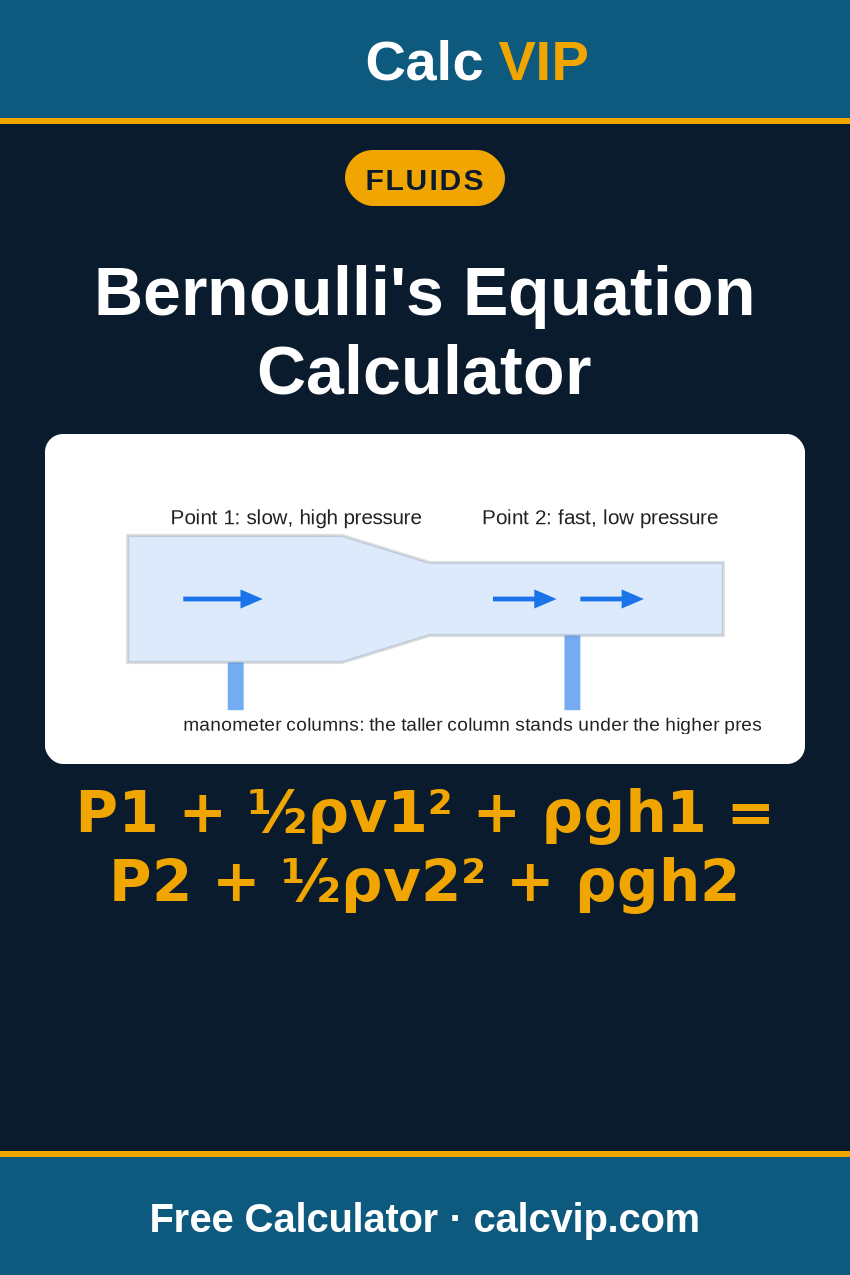
The calculator solves the equation for the unknown pressure at point 2. Give it the pressure, speed and height at point 1, the speed and height at point 2, and the fluid's density. In return you get P2 in pascals and kilopascals — plus a sanity warning if the answer comes out negative, which is nature's way of saying the flow you described cannot exist as a steady stream: something in it would cavitate, separate or choke first.
Formula
Bernoulli's equation: P1 + ½ρv1² + ρgh1 = P2 + ½ρv2² + ρgh2
Rearranged for the pressure at point 2: P2 = P1 + ½ρ(v1² − v2²) + ρg(h1 − h2). The equation rearranges just as readily for the other unknowns: v2 = √( v1² + 2(P1 − P2)/ρ + 2g(h1 − h2) ) if you know both pressures and want a speed — the form behind Torricelli's law for a draining tank — and h2 = h1 + (P1 − P2)/(ρg) + (v1² − v2²)/(2g) if you want a height. Each term is an energy per unit volume, measured in pascals: P is the pressure energy, ½ρv² the dynamic pressure, and ρgh the height energy. With g = 9.81 m/s², densities in kg/m³, speeds in m/s and heights in metres, every term lands in Pa and the books balance.
| Symbol | Meaning | Units |
|---|---|---|
| P | static pressure at the point | pascal (Pa) |
| ρ | density of the fluid | kg/m³ |
| v | flow speed at the point | m/s |
| h | height above a chosen reference level | m |
| ½ρv² | dynamic pressure — kinetic energy per unit volume | Pa |
Three energies, one constant — and the fine print
Read the equation as an energy ledger per cubic metre of fluid. A cubic metre of water moving at 10 m/s carries ½ × 1000 × 10² = 50,000 J of kinetic energy; raise that same cubic metre by one metre and it stores 9,810 J of height energy; hold it at 200 kPa and it carries 200,000 J of pressure energy, available to do work the moment it is released through a nozzle or turbine. Bernoulli's statement is that a fluid parcel trades between these three purses but never finds new money — provided nothing reaches in from outside. That proviso is the fine print, and it is strict: the flow must be steady (not pulsing or sloshing), incompressible (density constant — fine for liquids, approximate for slow air), frictionless along the path (no viscosity losses), and both points must lie on the same streamline, with no pump adding energy or turbine removing it in between.
Real engineers treat the equation as the ideal spine of a calculation and then add correction terms — a head-loss term for friction, a pump head where a machine intervenes. But the ideal version already captures the dominant effect in a startling range of life: it is why the pressure in the throat of a carburettor drops enough to suck fuel into the airstream, why a baseball's curveball drifts, and why standing too close to a passing express train feels like being pulled towards it — the air between you and the train speeds up, its pressure drops, and the still air behind you pushes you forward. The equation's authority comes from energy conservation itself, the least negotiable law in physics.
How to use
- Enter the pressure at point 1 in pascals (1 kPa = 1,000 Pa; atmospheric pressure is 101,325 Pa).
- Enter the fluid speeds at both points, in metres per second — if a pipe changes size, the Continuity Equation Calculator on this site finds the second speed from the two diameters.
- Enter the heights of both points above any fixed reference level (a bench top, the ground, sea level — only the difference matters).
- Enter the fluid density (water = 1000 kg/m³, air ≈ 1.225 kg/m³) and click "Calculate Pressure at Point 2".
Worked examples
Example 1 — the narrowing pipe. Water (ρ = 1000 kg/m³) flows through a pipe at the same height (h1 = h2 = 0). At point 1 the pressure is 200,000 Pa and the speed is 2 m/s. The pipe narrows so the speed at point 2 is 4 m/s. P2 = 200,000 + ½ × 1000 × (2² − 4²) = 200,000 + 500 × (−12) = 200,000 − 6,000 = 194,000 Pa = 194 kPa. The faster water has lower pressure.
Example 2 — water climbing to an upstairs tap. Same speed throughout (v1 = v2 = 3 m/s), but point 2 is 3 m higher: P2 = 150,000 + 0 + 1000 × 9.81 × (0 − 3) = 150,000 − 29,430 = 120,570 Pa. Height alone cost nearly 30 kPa — this is why top-floor taps run weaker and why water towers exist (the Hydrostatic Pressure Calculator prices the same climb from the other side).
Example 3 — a venturi meter. In the throat of a venturi, water accelerates from 1 m/s to 3 m/s with P1 = 120,000 Pa: P2 = 120,000 + 500 × (1 − 9) = 116,000 Pa. The 4,000 Pa dip, read on a manometer, reveals the flow rate — venturi meters measure flows in waterworks and industrial pipes using nothing but this pressure drop, with no moving parts in the stream.
Example 4 — lift on a wing. Air (ρ = 1.225 kg/m³) passes over a wing at 70 m/s and under it at 60 m/s at the same height: the pressure difference is ½ × 1.225 × (70² − 60²) = 0.6125 × 1,300 = 796 Pa, lower on top. Across a small aircraft's 16.2 m² of wing that is 796 × 16.2 ≈ 12,900 N of lift — enough to hold up about 1,315 kg of aeroplane. (The full story of lift also involves air being deflected downwards; Bernoulli supplies the pressure side of the account.)
Example 5 — Torricelli: the draining tank. A tank's surface (point 1) is 5 m above a tap (point 2), both at atmospheric pressure, and the surface barely moves (v1 ≈ 0). Bernoulli demands the height energy become kinetic: ½ρv2² = ρg × 5, so v2 = √(2 × 9.81 × 5) = 9.90 m/s — the speed a stone would reach falling the same 5 m. Efflux speed depends only on depth, a result Torricelli published in 1643, a century before Bernoulli explained why.
Example 6 — the shower curtain effect. Shower spray drags air along at perhaps 20 m/s while the bathroom air is still: ΔP = ½ × 1.225 × 20² = 245 Pa of pressure difference across the curtain — small, but acting over a square metre of flimsy plastic it is a push of 245 N spread out, more than enough to billow the curtain in against your legs. (Entrainment of air by the spray contributes too; Bernoulli names the pressure mechanism.)
Bernoulli's equation in real life
Aeroplane wings and spoilers. Example 4 is the working core of flight: pressure differences of under 1 kPa, integrated over enough wing, hold tonnes in the sky. Race cars run the equation in reverse — an upside-down wing (spoiler) creates a pressure difference that pins the car to the road at speed.
Carburettors and spray guns. Air rushing through a venturi throat drops in pressure and draws fuel, paint or perfume up a feed tube — the spray-gun version with water at 8 m/s against a near-still reservoir develops ½ × 1000 × (8² − 0.5²) ≈ 31,875 Pa of suction head to work with. Atomisers, sandblasters and laboratory water-jet pumps are all the same trick.
Blood pressure in narrowed arteries. Echocardiographers use a clinical form of Bernoulli, ΔP ≈ 4v² (with v in m/s and ΔP in mmHg), to estimate the pressure drop across a heart valve from the blood's speed alone. A jet at 4 m/s through a stenosed aortic valve means a 64 mmHg gradient — a diagnosis read straight off this equation.
Roofs in storms. Wind accelerating over a roof can drop the outside pressure by hundreds of pascals while the attic stays at full atmospheric pressure; the resulting lift, acting over tens of square metres, peels roofing off houses in hurricanes. Building codes in storm regions are, in part, Bernoulli countermeasures.
River rapids and shallows. Where a river narrows or shallows, continuity forces the water faster and Bernoulli drops its surface — kayakers read these dips and standing waves as the visible signature of the energy ledger shifting from pressure and height into speed.
Chimneys and ventilation. Wind blowing across a chimney top lowers the pressure there and draws smoke up — a Bernoulli assist to the buoyancy of hot gas. Traditional wind-catchers and modern passive-ventilation cowls harvest the same pressure difference to ventilate buildings without fans.
Dynamic pressure: the term that does the dramatic work
Of the three accounts, ½ρv² is the one that explodes, because it grows with the square of speed. For water, the dynamic pressure runs 500 Pa at 1 m/s, 2,000 Pa at 2 m/s, 12,500 Pa at 5 m/s and 50,000 Pa at 10 m/s — double the speed, quadruple the pressure available to appear or vanish. This is why high-pressure water jets cut steel, why a fire hose at full pressure can knock a person over, and why cavitation stalks fast propellers: where a blade's suction side accelerates water hard enough, Bernoulli drives the local pressure below water's vapour pressure, vapour bubbles form — and their violent collapse back in higher pressure pits and eats the metal. The same quadratic term, in air, is the "q" that aircraft engineers watch: it is the pressure available to lift wings, bend antennas and, at re-entry speeds, heat spacecraft.
Quick reference: dynamic pressure of water
| Speed | ½ρv² for water | Roughly equivalent to |
|---|---|---|
| 1 m/s | 500 Pa | 5 cm of water head |
| 2 m/s | 2,000 Pa | 20 cm of water head |
| 5 m/s | 12,500 Pa | 1.27 m of water head |
| 10 m/s | 50,000 Pa | 5.1 m of water head |
For air, divide the water figures by about 816 (the density ratio): the same 10 m/s breeze carries a dynamic pressure of only about 61 Pa — which is why wind loads are measured in pascals while water loads at the same speed are measured in kilopascals.
The pitot tube: Bernoulli turned into a speedometer
Every aircraft's airspeed indicator is Bernoulli's equation in a brass tube. A pitot tube faces into the airflow and measures the total pressure — static plus dynamic — while a separate port reads the static pressure. Their difference is the dynamic pressure ½ρv², so the speed follows at once: v = √(2 × ΔP ÷ ρ). At 70 m/s in sea-level air the difference is ½ × 1.225 × 70² = 3,001 Pa — a modest pressure, easily sensed, standing proxy for the aircraft's speed through the air. Pitot-static systems also feed altimeters and vertical-speed indicators, which is why their icing or blockage is treated so seriously in aviation: foul the ports and the aircraft's whole pressure-based picture of its motion goes wrong at once.
Common mistakes
- Joining points on different streamlines. The constant is the same along one streamline, not across the whole fluid. Comparing a point in the fast core of a jet with a point in the still air beside it misuses the equation — that error sits behind several popular "Bernoulli myths".
- Forgetting the height term. Dropping ρgh because "the pipe looks level" fails the moment the two points differ by metres of elevation — 3 m of water is nearly 30 kPa (Example 2), often larger than the speed effect.
- Applying it through a pump or turbine. Machines add or remove energy between the points, so the simple balance breaks. Add the machine's head explicitly, or place both points on the same side of it.
- Using it for thick, slow fluids over long paths. Honey in a long pipe loses most of its pressure to friction, which Bernoulli ignores. The equation suits water, fuels and air over short, clean paths — for viscous marathons, friction losses rule (see the Reynolds Number Calculator for when flow turns turbulent and losses climb).
- Mixing gauge and absolute pressures inconsistently. Either pressure scale works — the atmosphere cancels between the two sides — but only if both P1 and P2 use the same scale. One of each is the classic silent error.
FAQ
When does Bernoulli's equation not apply?
It assumes a steady, incompressible flow with no friction (viscosity) along one streamline. It works well for water and slow air flow, but not for very viscous fluids, pumps between the two points, or fast compressible gas flow.
How does Bernoulli explain aeroplane lift?
Air travels faster over the curved top of a wing than underneath, so the pressure above is lower. The higher pressure below pushes the wing up.
Can the pressure at point 2 be negative?
A negative result means the numbers you entered cannot happen in a real steady flow — for example the speed increase is too large for the starting pressure. In real pipes the flow would separate or cavitate instead.
What is a streamline?
The path a single fluid particle traces through the flow — the lines drawn in flow-visualisation photographs with dye or smoke. Bernoulli's constant is guaranteed along each one; neighbouring streamlines in a well-behaved flow usually share nearly the same constant, which is why the equation is so widely usable.
Why does pressure fall where speed rises — isn't faster fluid "pushing harder"?
It pushes harder forwards, against anything that stops it (that is the dynamic pressure a pitot tube reads), but its sideways push on the walls — the static pressure — falls, because energy spent on motion is energy no longer available as pressure. The ledger must balance.
What is the difference between static, dynamic and total pressure?
Static pressure P is what the fluid exerts on its container walls. Dynamic pressure ½ρv² is the extra pressure you would feel facing into the flow. Their sum (at the same height) is the total or stagnation pressure — what a pitot tube measures, and the constant in Bernoulli's equation.
Does Bernoulli work for blood flow?
Yes, approximately, and clinicians use it daily in the simplified form ΔP ≈ 4v² for valve jets (Example in the applications above). Blood is slightly non-Newtonian and flow pulsates, so the estimate is a guide, not gospel — but it is the standard first number in echocardiography.
How fast can water flow before Bernoulli fails through compressibility?
Water is so stiff that compressibility is essentially never the problem; friction and cavitation limit you first. For air, the incompressible version stays within about 5% up to roughly 100 m/s (Mach 0.3); beyond that, density changes must be carried through the calculation.
Why do two ships sailing side by side drift towards each other?
The water squeezed between their hulls speeds up, its pressure drops, and the higher pressure on their outer sides pushes them together — a genuine historical collision hazard, and a pure Bernoulli-plus-continuity effect.
Is Bernoulli's equation the same as conservation of energy?
It is conservation of energy, specialised to a steady flow of an incompressible, frictionless fluid. Each term is an energy per unit volume; the equation simply insists the sum is constant along a streamline. Where real flows lose energy to friction, the "lost" energy reappears as heat — the ledger still balances, in a warmer currency.