 Calc
Angle Converter – Degrees, Radians, Revolutions, Gradians & Arc Length
 Created by Sarah Mitchell · Physics Editor · Motion & Measurement · Last updated: November 2026
Use this free Angle Converter to convert an angle between degrees, radians, revolutions and gradians — the four units that show up across physics, maths and surveying. As a bonus, add a radius and the calculator also finds the arc length s = rθ swept out by the angle.
An angle is a fraction of a turn, and each of the four units on this page is a different culture's way of slicing the turn. Degrees divide it into 360 — a Babylonian inheritance, chosen in an age that liked numbers with many divisors. Revolutions refuse to divide it at all: one turn is one. Gradians divide it into 400, a decimal-age attempt to make the right angle a round 100. And radians do something subtler than all of them: they measure the angle by the arc it cuts, in units of the radius itself, so a full turn is 2π and the unit is not really a unit at all but a ratio of two lengths.
That last property is why physics belongs to the radian. Because a radian is arc ÷ radius — length divided by length — it is dimensionless, and formulas that would need ugly correction factors in degrees come out clean: arc length s = rθ, sector area ½r²θ, angular velocity ω = 2πf, and the small-angle approximations sin θ ≈ θ ≈ tan θ that optics and pendulum theory lean on. Every one of those formulas silently assumes radians. Degrees remain the language of the workshop, the cockpit and the map; radians are the language of the equations, and this converter is the interpreter between them.
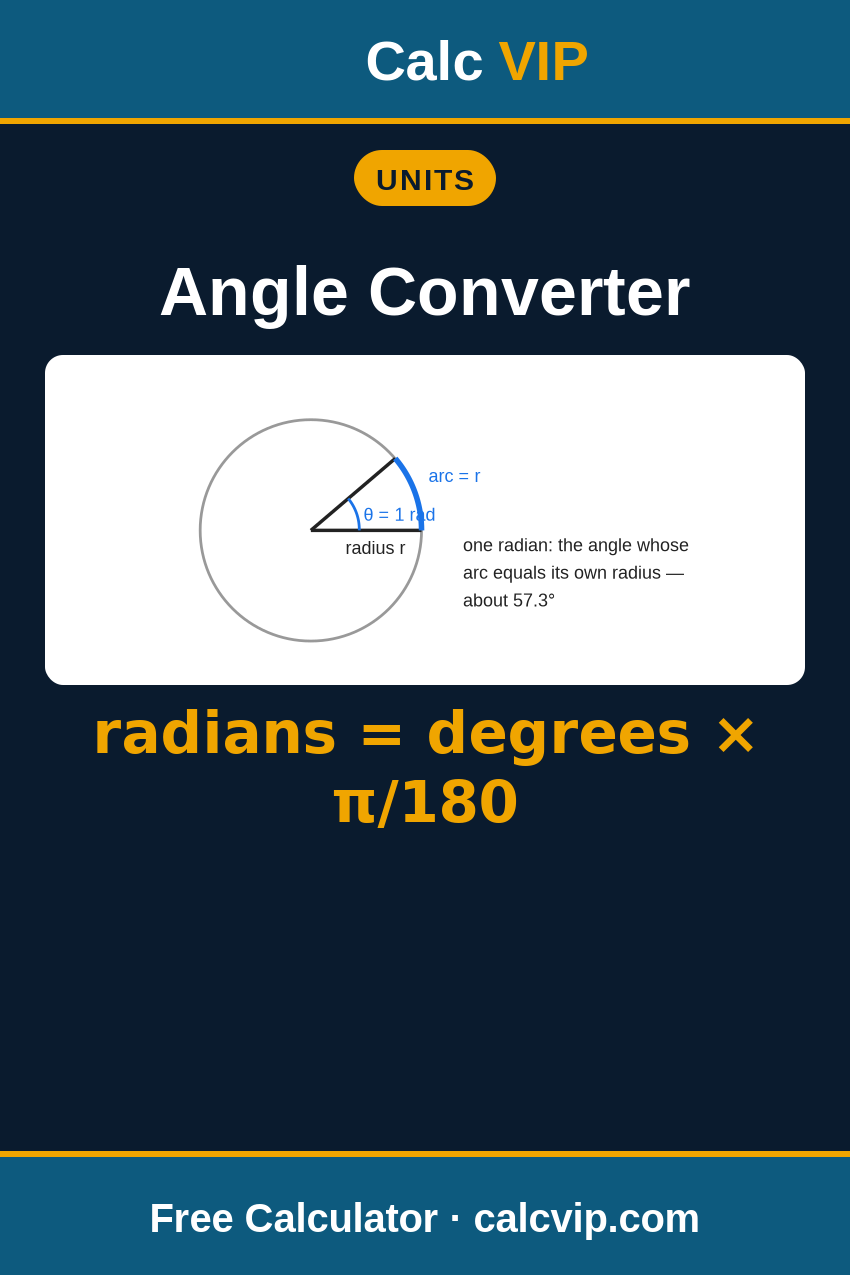
The arc-length bonus makes the radian's meaning tangible. Enter a radius alongside your angle and the calculator reports how far a point at that radius actually travels — the distance a valve cap moves as a wheel turns, the ground a swinging crane load covers, the length of crust between two lines of longitude. Angle conversions stop being abstract the moment an arc length is attached: 0.01 rad is a small angle in the abstract, but at a radius of 1 km it is 10 metres of ground.
Formula
radians = degrees × π/180, revolutions = radians / 2π, gradians = degrees × 10/9, and arc length s = rθ (with θ in radians)
The full set of bridges: degrees = radians × 180/π, radians = revolutions × 2π, degrees = gradians × 0.9, gradians = revolutions × 400. Two numbers do most of the work in practice — 1 rad = 57.2958° and 1° = 0.0174533 rad — and one habit prevents most errors: convert to radians before using any formula containing θ, because s = rθ, A = ½r²θ and sin θ ≈ θ are all false in degrees. The calculator's arc-length field enforces this for you by converting first, which is why its arc answers stay right whichever unit you typed.
| Symbol / unit | Meaning | One full turn |
|---|---|---|
| degree (°) | 1/360 of a turn; subdivides into 60 arcminutes, 3600 arcseconds | 360° |
| radian (rad) | angle whose arc equals the radius; θ = s/r | 2π ≈ 6.28319 rad |
| revolution (rev) | one complete turn; the unit of rotation counts and rpm | 1 rev |
| gradian (grad) | 1/400 of a turn; a right angle is exactly 100 grad | 400 grad |
| s, r | arc length and radius, in the same length unit | s = 2πr per turn |
Why radians make the mathematics simple
The small-angle approximation is the clearest exhibit. At θ = 5° — in radians, 0.0872665 — the sine of the angle is 0.0871557. Treating sin θ as θ itself errs by only 0.13%, and the error shrinks with the square of the angle: below 1° it is under 0.005%. In degrees the same trick is hopeless (sin 5° is 0.0872, not anything like 5), because the approximation is really a statement about arc versus chord, and only the radian measures the angle by the arc. Pendulum periods, diffraction patterns, and the bending of light all pass through this approximation; it is the working reason radians are non-negotiable in physics.
The same naturalness runs through calculus and rotation. The derivative of sin θ is cos θ only in radians — in degrees every derivative drags a factor of π/180 behind it. Angular velocity in rad/s multiplies by radius to give linear speed (v = rω) with no conversion factor, and a rotation frequency f in revolutions per second becomes ω = 2πf rad/s. Degrees survive for stating angles because 360 divides so obligingly (by 2, 3, 4, 5, 6, 8, 9, 10, 12…); radians rule for computing with them because the circle itself is built from π, not from 360.
The pendulum makes the stakes concrete. Its textbook period formula is derived using sin θ ≈ θ, so it is secretly a small-angle promise. At a swing of 5° the approximation errs by 0.13%, as computed above; at 10° (θ = 0.174533 rad, sin θ = 0.173648) the error has grown to about 0.51%, and the true period drifts measurably longer than the formula claims; by 30° the small-angle period is wrong by about 1.7% and clockmakers must correct for it (the "circular error" Huygens attacked with curved cheeks). Every degree of swing is purchased with approximation error, and the exchange rate is set by how far sin θ has wandered from θ — visible only when the angle is carried in radians.
Degrees, minutes and seconds: the navigator's subdivision
Degrees subdivide sexagesimally: 1° = 60 arcminutes (′) and 1′ = 60 arcseconds (″). Converting a decimal degree is a two-step pour: 12.7625° = 12° + 0.7625°, then 0.7625 × 60 = 45.75′, then 0.75 × 60 = 45″, giving 12°45′45″. The system survives where angles meet geography, because the Earth itself was the ruler: one arcminute of latitude is one nautical mile, exactly 1852 m, and one arcsecond of latitude is 1852 ÷ 60 ≈ 30.87 m — so a position quoted to the nearest arcsecond fixes a point on the Earth's surface to about the length of a bus. GPS coordinates in decimal degrees and chart coordinates in degrees-minutes-seconds describe the same points; converting between them is this page's arithmetic with 60s where the decimals would go.
The same subdivision prices the sky. The Earth's circumference of 40,075 km divided by 360 gives 111.32 km per degree at the equator — and therefore 1.855 km per arcminute and about 31 m per arcsecond of longitude there, shrinking with the cosine of latitude as the meridians converge. A satellite in low orbit crosses a degree of longitude in about 15 seconds; a ship's navigator correcting a sextant reading by one arcminute moves the fix by one nautical mile. Degrees feel coarse only until their subdivisions are priced in metres, which is why navigators kept the 60-based system that astronomers, with their arcsecond-defined parsec, never abandoned either.
How to use
- Enter the angle and choose the unit it is measured in.
- Optionally enter a radius to also get the arc length along that circle.
- Click "Convert Angle" to see the angle in all four units at once.
- If you plan to use the angle in a formula (s = rθ, sin θ ≈ θ, ω = 2πf), take the radians row — those formulas are false in every other unit.
Worked examples
Example 1 — the half turn. 180° = 3.14159 radians (exactly π) = 0.5 revolutions = 200 gradians. With a radius of 10, the arc length is s = 10 × π = 31.42 — half the circumference of a radius-10 circle, as a half turn should sweep.
Example 2 — the right angle. 90° = 1.5708 rad (π/2) = 0.25 rev = 100 grad. The gradian column shows off its design here: the surveyor's right angle is a round 100, the one conversion in this table that looks simpler than the degrees it replaces.
Example 3 — one radian in the other dialects. 1 rad = 57.2958° = 0.159155 rev = 63.662 grad. A radian is a big angle — nearly a sixth of a turn — which surprises people who meet it as a bare "1". Most angles in physics are small fractions of a radian.
Example 4 — an eighth of a turn with an arc. 45° = 0.785398 rad (π/4) = 0.125 rev = 50 grad. At a radius of 6, the arc is s = 6 × 0.785398 = 4.71239 — a point on a 6-unit wheel moves about 4.71 units when the wheel turns an eighth of a revolution.
Example 5 — three quarters round. 270° = 4.71239 rad (3π/2) = 0.75 rev = 300 grad. All four units scale together; the conversion factors never care how large the angle is, and angles beyond one turn (a motor's 720°, say) convert just as directly.
Example 6 — a small angle, a long arc. 5° = 0.0872665 rad. At a radius of 100 m the arc is s = 100 × 0.0872665 = 8.72665 m. Surveyors and snipers both live on this example: small angles at long radii are distances in disguise, and the radian is the exchange rate.
Angle conversion in real life
Time zones and the turning Earth. The Earth completes 360° in 24 hours — 15° per hour, 0.261799 rad per hour. Time zones are angle conversions worn as geography: each hour of time difference is 15° of longitude, and the radian figure is the Earth's angular velocity itself, ω.
Clocks. A minute hand sweeps 360° per hour — 6° per minute — while the hour hand creeps at 360° per 12 hours, 0.5° per minute. Telling the angle between the hands at a given time is a standard puzzle built entirely from these two rates and this page's conversions.
Engines and motors. A crankshaft at 3000 rpm turns at 3000 revolutions per minute = 50 rev/s, so ω = 2π × 50 = 314.159 rad/s. Every formula for rotating machinery — power = τω, centripetal acceleration = rω² — needs that radian figure, not the rpm on the dashboard.
Camera lenses. Field of view is quoted in degrees (a "wide" lens sees 84°), but the optics that project the image are computed in radians. The small-angle relation between angle and sensor position is what lens designers actually solve.
Surveying. European survey instruments may read in gradians (gon), where a right angle is 100 and slopes convert decimally. A boundary angle of 63.662 grad is exactly the 1 radian of Example 3 — the two systems meet more often than either admits.
Astronomy. The sky is measured in degrees, arcminutes and arcseconds for position (the Moon spans about 0.5°), but every dynamical calculation — orbits, rotations, precession — is carried out in radians. Converting between the observer's degrees and the calculator's radians is the daily bread of the field.
Arc length and sector area: the radian at work
Two formulas repay the radian's dimensionlessness every time they are used. Arc length, s = rθ, turns Example 1's geometry into arithmetic: r = 10, θ = π gives s = 31.4159, the semicircle. Sector area, A = ½ r²θ, is its twin: the same radius and angle give A = ½ × 100 × π = 157.08 square units — exactly half the circle's πr², as a half-turn sector must be. Try to write either formula in degrees and each acquires a π/180 barnacle; in radians they are nothing but the definitions restated. A machinist laying out a bolt circle, a pizza cut into honest slices, a radar sweep painting a sector of sky — all are these two lines of algebra, and all of them begin by converting the angle on this page.
Quick reference: the angles everyone meets
| Degrees | Radians | Revolutions | Gradians |
|---|---|---|---|
| 0° | 0 | 0 | 0 |
| 30° | 0.523599 (π/6) | 0.0833333 | 33.3333 |
| 45° | 0.785398 (π/4) | 0.125 | 50 |
| 60° | 1.0472 (π/3) | 0.166667 | 66.6667 |
| 90° | 1.5708 (π/2) | 0.25 | 100 |
| 180° | 3.14159 (π) | 0.5 | 200 |
| 270° | 4.71239 (3π/2) | 0.75 | 300 |
| 360° | 6.28319 (2π) | 1 | 400 |
Notice the fractions hiding in the radians column: every standard angle is a simple slice of π. That is no coincidence — it is the radian telling you, again, that it measures the circle in the circle's own terms. Keep this table and you hold every conversion on the page: each row is one angle wearing its four names at once.
Common mistakes
- Using s = rθ with θ in degrees. At 180° and r = 10 the true arc is 31.42; the degree-fed formula gives 1800. Convert to radians first — the calculator does it internally, hand work must do it explicitly.
- Calculator in the wrong mode. sin(30) is 0.5 in degree mode and −0.988 in radian mode. Before any trigonometry, confirm the mode indicator; this page's inputs are degrees unless you select otherwise.
- Confusing gradians with gradient. A gradian is an angle (400 per turn). A gradient is a slope (rise over run, or a percentage on road signs). The words differ by two letters and by an entire subject.
- Treating rpm as an angle. Revolutions per minute is a rate. The angle turned is rate × time, and the angular velocity for formulas is rpm × 2π/60 in rad/s — 3000 rpm is 314.159 rad/s, not 3000 of anything angular.
- Rejecting angles over 360° or under 0°. Both are legitimate: 720° is two full turns (a spinning shaft does this every cycle), and −90° is the same direction as 270°. Convert them like any other values; add or subtract 360° only if a 0–360 answer is required.
FAQ
Why do physicists prefer radians?
Because the nicest formulas only work in radians: arc length s = rθ, angular velocity relations, and the small-angle approximations sin θ ≈ θ all assume radians. Degrees are for humans; radians are for equations.
What is a gradian?
A gradian (or gon) divides a right angle into 100 parts, so a full turn is 400 gradians. It was designed for surveying and still appears on some European instruments and calculators.
How many radians are in a full circle?
Exactly 2π ≈ 6.28319 radians — the circumference of a unit circle. Half a circle is π radians = 180°.
How many degrees is one radian?
180/π = 57.2958°. It is a large angle — about a sixth of a turn — because the radian is defined by laying the radius along the circumference, and only 2π ≈ 6.28 radii fit around a circle.
Can an angle be negative, or bigger than 360°?
Yes to both. Negative angles turn clockwise instead of anticlockwise (−90° points the same way as 270°), and angles over 360° count multiple turns — a motor shaft passes 360° every revolution. This converter handles both without complaint.
What are arcminutes and arcseconds?
The degree's subdivisions: 1° = 60 arcminutes (60′) and 1′ = 60 arcseconds (60″), so a full turn holds 1,296,000 arcseconds. They survive in astronomy and navigation because the angles there are tiny — the parsec itself is defined through one arcsecond of parallax.
What is a mil?
A military unit: 6400 mils to a full turn (NATO standard), designed so that 1 mil at 1000 m spans about 1 m of arc — the small-angle approximation turned into a rangefinding tool. It is not in this converter, but it converts like the others: mils × 360/6400 gives degrees.
Why 360 degrees in a circle?
A Babylonian inheritance, probably tied to their 360-day ideal year and their base-60 arithmetic. The number is also brilliantly divisible — by every integer from 2 to 10 except 7 — which is why it outlasted decimal rivals like the gradian in everyday use.
Does the arc length formula work in degrees if I adjust it?
Yes, with the correction factor: s = rθ × π/180 when θ is in degrees. But that factor is exactly the degree-to-radian conversion, so adjusting the formula is converting the angle — there is no escaping the radian, only hiding it.
How do I convert rpm to radians per second?
Multiply by 2π and divide by 60: ω = rpm × 0.104720. So 3000 rpm = 314.159 rad/s, and a lazy 60 rpm (one turn per second) is 6.28319 rad/s. The reverse conversion divides by 0.104720.