 Calc
Pressure Converter – Pascals, Bar, Atmospheres, mmHg, Torr & psi
 Created by Sarah Mitchell · Physics Editor · Motion & Measurement · Last updated: November 2026
Use this free Pressure Converter to convert a pressure between pascals, kilopascals, megapascals, bar, atmospheres, millimetres of mercury (mmHg), torr and pounds per square inch (psi). Enter a value once and see it in every unit at the same time.
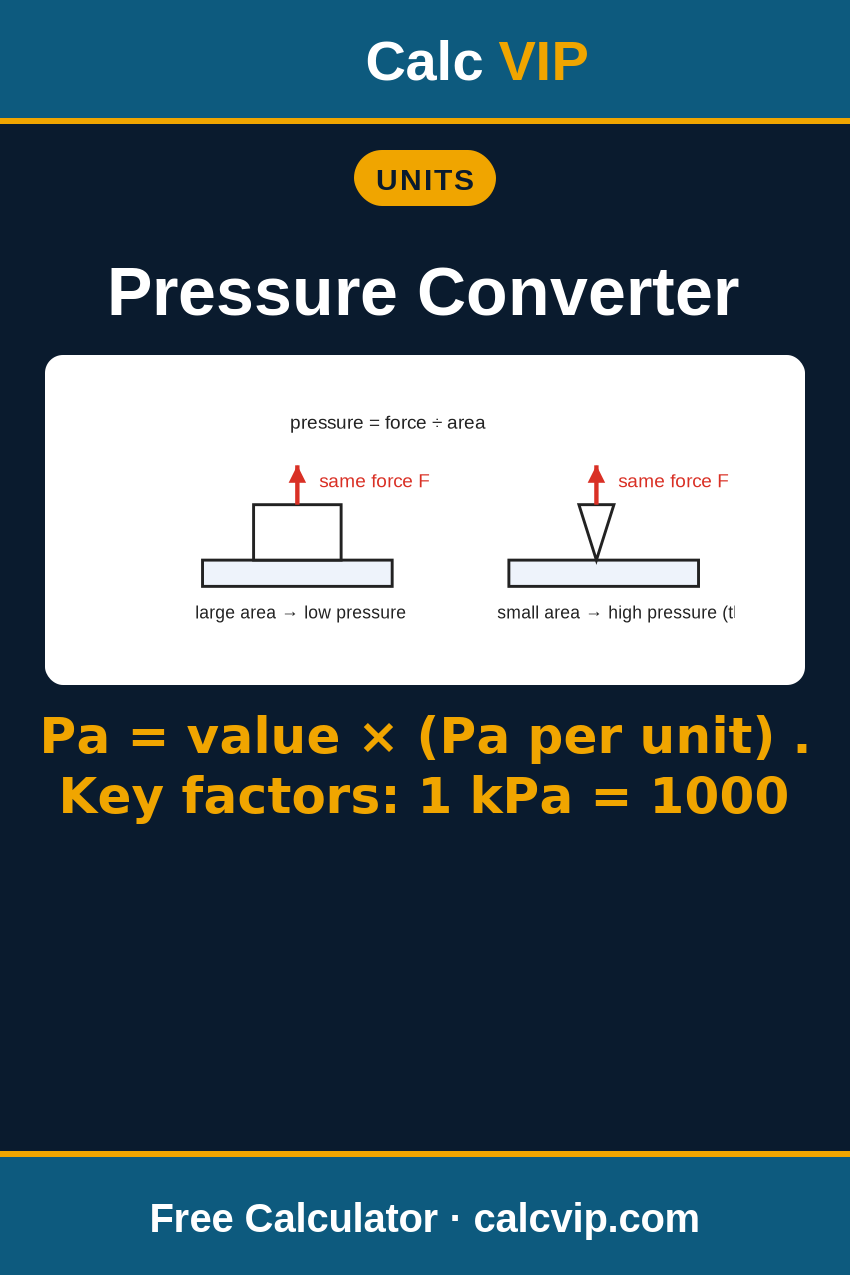
Pressure is force with the area taken into account: the same push spread over a square metre is a whisper, concentrated on a pinhead it pierces steel. Formally, pressure = force ÷ area, and that division is why its units are such a crowd. Every community that measures pressure kept the unit that suited its instruments: physicists the pascal, weather forecasters the bar and its thousandth, doctors the height of a mercury column, American engineers the pound per square inch. One atmosphere of air pressure — the reference condition of everyday life — is the Rosetta stone that ties all eight dialects together.
The conversion method is the same hub pattern as every converter in this set: each unit carries an exact value in pascals, and any conversion is a multiplication into pascals followed by a division out. The pascal itself is a derived SI unit, one newton per square metre — a small unit, as anyone who has seen a weather map in pascals knows (101,325 of them for ordinary air). Hence the working prefixes: kilopascals for tyres and weather in much of the world, megapascals for hydraulics and materials testing, where pressures run to hundreds of atmospheres.
Two of the units deserve a warning label, because they are defined through a physical substance rather than pure numbers. A millimetre of mercury is the pressure that supports a mercury column 1 mm high — it depends on mercury's density and on gravity, and its conventional value is 133.322 Pa. The torr is cleaner: exactly 1/760 of an atmosphere, 133.322368… Pa. The two agree to five decimal places, which is why medicine and vacuum science use them interchangeably — and why this converter, which keeps both definitions distinct, shows 760 for each at one atmosphere.
Formula
Every unit is first converted to pascals, then out to the target unit: value in Pa = value × (Pa per unit). Key factors: 1 kPa = 1000 Pa, 1 bar = 100,000 Pa, 1 atm = 101,325 Pa, 1 mmHg = 133.322 Pa, 1 psi = 6894.76 Pa.
In one step: value in unit B = value in unit A × (Pa per A) ÷ (Pa per B). Three anchor conversions are worth memorising because they recur constantly: 1 atm = 1.01325 bar (so bar and atm differ by only 1.3%, near enough for weather, not for engineering), 1 bar = 14.5038 psi, and 1 psi = 6.89476 kPa. And one structural warning belongs with the formula: these conversions translate units, not kinds. They will happily convert a gauge pressure into pascals, but the result is still a gauge pressure — see the depth section before comparing it with an absolute value from a textbook.
| Unit | Pascals per unit | Where it rules |
|---|---|---|
| pascal (Pa) | 1 | the SI unit; acoustics, vacuum science |
| kilopascal (kPa) | 1000 | tyres, meteorology (as hPa × 10) |
| megapascal (MPa) | 1,000,000 | hydraulics, material strength |
| bar | 100,000 | European engineering, diving, weather |
| atmosphere (atm) | 101,325 (exact) | chemistry, diving, reference conditions |
| millimetre of mercury (mmHg) | 133.322 | medicine — blood pressure |
| torr | 101325/760 = 133.322368… | vacuum technology |
| pound per square inch (psi) | 6894.76 | US engineering, tyres, plumbing |
Gauge pressure versus absolute pressure
Most gauges do not measure pressure from zero; they measure it from the surrounding air. A tyre gauge reads the excess over atmospheric pressure — the gauge pressure — because that excess is what holds the tyre's shape. The absolute pressure inside is gauge + atmosphere. This converter translates units faithfully, but it cannot know which kind you typed, and confusing the two is the most consequential error in practical pressure work: it is worth a whole atmosphere, 101.325 kPa, on every reading.
The worked example writes itself. A tyre at 32 psi gauge holds an absolute pressure of 32 + 14.6959 = 46.7 psi absolute, which is 46.7 ÷ 14.6959 = 3.18 atm — or, in SI, 220.632 kPa gauge on top of 101.325 kPa of air, totalling 321.957 kPa absolute. Blood pressure is also a gauge measurement (120 mmHg above the air around you), while chemistry's gas-law calculations demand absolute pressure throughout. Before converting, ask what zero your number was measured from; the units are the easy part.
A third kind completes the set: differential pressure, the difference between two points in one system, quoted in the same units but meaning neither gauge nor absolute. A filter gauge reading 0.5 bar (50 kPa) is saying the downstream side sits 50 kPa below the upstream side, whatever either is in absolute terms; flow meters, clean-room monitors and aircraft pitot tubes all report differentials. The converter translates a differential's units exactly as it translates any pressure — but comparing a differential figure with a gauge or absolute one, even in matching units, is comparing unlike quantities, and the mismatch survives every conversion.
How to use
- Enter the pressure and choose the unit it is measured in.
- Click "Convert Pressure".
- The same pressure is shown in all eight units at once — handy when a gauge, a textbook and a data sheet all use different units.
- Before comparing with another value, confirm both are the same kind — gauge or absolute. The conversion preserves the kind; it does not correct it.
Worked examples
Example 1 — one atmosphere, eight ways. 1 atmosphere = 101,325 Pa = 101.325 kPa = 0.101325 MPa = 1.01325 bar = 760 mmHg = 760 torr = 14.6959 psi. This single row is the most useful in pressure work: it is the conversion hub of everyday life, and every other example on this page can be checked against it.
Example 2 — a car tyre. 32 psi = 32 × 6894.76 = 220,632 Pa = 220.632 kPa = 2.20632 bar = 2.17747 atm. (That atm figure is the absolute multiple of atmospheric pressure only if the 32 psi were absolute; as a gauge reading the absolute pressure is 3.18 atm, as the depth section explains.)
Example 3 — blood pressure. A systolic reading of 120 mmHg = 120 × 133.322 = 15,998.7 Pa ≈ 16.0 kPa = 0.157895 atm = 2.32041 psi. The diastolic 80 mmHg is 10.6658 kPa. Medicine keeps mmHg because the numbers are conveniently human-sized and because two centuries of clinical records are written in them.
Example 4 — ten metres underwater. Water pressure grows by ρgh: at 10 m depth in fresh water, 1000 × 9.81 × 10 = 98,100 Pa of extra (gauge) pressure = 98.1 kPa = 0.981 bar = 0.968172 atm. Divers round this to "one more atmosphere every 10 metres" — the total at 10 m is about 2 atm absolute, half water, half air.
Example 5 — the top of Everest. Air pressure at the summit is roughly 33.7 kPa: = 0.332593 atm = 252.771 mmHg = 4.88777 psi. One third of sea-level pressure means one third of the oxygen per breath — the entire physiology of high-altitude climbing in a single conversion.
Example 6 — a hydraulic press. 25 MPa = 250 bar = 246.731 atm = 3625.94 psi = 187,515 mmHg. Industrial hydraulics live at hundreds of bar, which is why their gauges are marked in bar or MPa and why a tyre's 2.2 bar is, by factory standards, barely a breath.
Pressure conversion in real life
Tyres on two continents. The same car wants 32 psi in Ohio and 220 kPa (or 2.2 bar) in Oslo. Example 2 is the conversion; running a European car on "32" read as bar, or an American one on "2.2" read as psi, is how tyres get dangerously over- or under-inflated at borders and in imported vehicles.
Weather maps. Forecasters plot pressure in hectopascals (hPa), which are millibars by another name: standard sea-level pressure is 1013.25 hPa. A deep storm low of 960 hPa is 96 kPa; the isobars on the map are this page's numbers drawn as contour lines.
Medicine. Blood pressure in mmHg, ventilator pressures in cmH₂O or mbar, oxygen cylinders in bar or psi — a hospital corridor contains four pressure dialects, and staff convert between them as a routine safety skill.
Diving. Depth gauges read in metres or bar of added pressure (Example 4's rule), tank contents in bar (a full scuba cylinder is about 200 bar = 20 MPa), and decompression tables in a mixture of all of them. The 10-metres-per-atmosphere rule is the diver's version of this converter.
Cooking under pressure. A pressure cooker works at roughly 1 atm of gauge pressure — about 15 psi above the air — raising water's boiling point to around 120 °C. The "15 psi" on an American recipe and the "1 bar" on a European cooker are the same instruction.
Espresso. The famous "9 bars" of espresso extraction is 900 kPa = 130.53 psi of pump pressure at the coffee puck. Cafés quote bar because the Italian industry standardised on it; the conversion shows it is about nine atmospheres squeezing the water through.
How deep is the bottom of the ocean?
Example 4's rule — ρgh, about one atmosphere per 10 metres of water — scales all the way down. The floor of the Mariana Trench lies about 10,900 m below the surface, so the pressure there is roughly 10,900 ÷ 10 ≈ 1,090 atmospheres: about 108.6 MPa, or 1086 bar. At that pressure a litre of surface air would be crushed to less than a millilitre, and the few vehicles that have visited carry hulls engineered like the hydraulics of Example 6 run in reverse. Pressure conversion stops being clerical down there; it is the difference between a sphere that holds and one that does not. The same formula, pointed up instead of down, explains Everest (Example 5): air is just a much thinner fluid, so its ρgh accumulates an atmosphere over kilometres rather than metres.
Suction and hydraulics: pressure differences do the work
Most useful pressure is a difference. A vacuum cleaner does not pull air in; its fan lowers the internal pressure by roughly 20 kPa and the atmosphere — all 101.325 kPa of it — pushes air and dust in to fill the gap. The same physics sets the strength of a suction cup: a cup of diameter 10 cm has area π × 0.05² = 0.00785 m², so even a perfect vacuum inside could hold at most 101,325 × 0.00785 ≈ 796 N against the air outside — the weight of an 81 kg person, from a disc of rubber. Real cups manage a fraction of that, but the ceiling is set by this page's anchor number, 1 atm, and nothing else.
Hydraulics runs the difference the other way, through Pascal's principle: pressure applied to an enclosed fluid is transmitted equally everywhere, so a small force on a small piston becomes a large force on a large one, in proportion to the areas. Push with 50 N on a 2 cm² piston and you create 50 ÷ 0.0002 = 250,000 Pa = 250 kPa; apply that pressure to a 40 cm² piston and it lifts with 250,000 × 0.004 = 1000 N — a twenty-fold multiplication bought with a twenty-fold loss of travel distance, energy conserved throughout. Car brakes, jacks and excavator arms are this paragraph with seals and steel, and every pressure in the system is quoted in the bar and MPa of Example 6.
Quick reference: pressures you already know
| Situation | Pressure | In other units |
|---|---|---|
| standard atmosphere | 101.325 kPa | 1 atm = 760 mmHg = 14.6959 psi |
| healthy blood pressure (systolic) | 120 mmHg | ≈ 16.0 kPa (gauge) |
| car tyre (typical) | 32 psi | 220.632 kPa = 2.20632 bar (gauge) |
| espresso extraction | 9 bar | 900 kPa = 130.53 psi |
| full scuba cylinder | 200 bar | 20 MPa = 197.38 atm |
| Mariana Trench floor | ≈ 1086 bar | ≈ 108.6 MPa ≈ 1072 atm |
The scuba row checks itself against Example 1: 200 bar ÷ 1.01325 bar per atm = 197.38 atm. Any row of this table can be regenerated from any other with this page's factors — which is the real test of a converter, and of your understanding of it.
Common mistakes
- Mixing gauge and absolute pressure. A tyre's 32 psi is gauge; a gas-law problem's pressure is absolute. They differ by 14.6959 psi (one atmosphere) — convert units only after settling which kind you hold.
- Confusing pressure with force. 100 N on a square metre is 100 Pa; on a square centimetre it is 1 MPa — ten thousand times more pressure from the same force. The area is not a detail; it is half the definition.
- Treating bar and atm as identical. They differ by 1.325% (1 atm = 1.01325 bar). Irrelevant for weather, unacceptable for calibrating instruments or filling dive cylinders.
- Reading blood pressure as absolute. 120 mmHg is measured above atmospheric pressure. The absolute pressure in your arteries at systole is about 120 + 760 = 880 mmHg — the gauge figure is the medically meaningful one because it is the excess the heart generates.
- Forgetting that mmHg depends on a definition. The conventional mmHg (133.322 Pa) and the torr (101325/760 Pa) differ in the fifth decimal place. For every practical purpose they are equal — but a conversion claiming more precision than that is borrowing accuracy it does not have.
FAQ
Are mmHg and torr the same?
Almost. A torr is defined as exactly 1/760 of an atmosphere, while a millimetre of mercury depends on the density of mercury and gravity. They differ by less than 0.00002%, so in practice both read 760 at one atmosphere.
Which unit do physicists use?
The pascal (Pa) is the SI unit, and kilopascals or megapascals for larger pressures. Bar and atm survive in engineering and weather work, psi in the US, and mmHg in medicine (blood pressure).
What is standard atmospheric pressure?
Exactly 101,325 Pa by definition — the pressure of the air at sea level on an average day. That is the 1 atm used in the worked example.
What is a hectopascal on a weather map?
1 hPa = 100 Pa, and it equals the older millibar exactly. Standard sea-level pressure is 1013.25 hPa. Meteorology adopted it because sea-level readings land in a tidy 950–1050 range and the unit needs no conversion from the bar family.
What is an inch of mercury (inHg)?
The US aviation and weather unit: the pressure supporting one inch of mercury. One atmosphere is 29.921 inHg (760 mm ÷ 25.4 mm per inch). Altimeter settings in the US are issued in inHg; most of the world uses hPa for the same job.
Can pressure be negative?
Absolute pressure cannot — zero is a perfect vacuum. Gauge pressure can: a gauge reading of −20 kPa means 20 kPa below the surrounding air, as inside a vacuum cleaner's hose. If a conversion gives a negative absolute pressure, a gauge value has slipped in somewhere.
Why does pressure fall with altitude?
Pressure at any height is the weight of the fluid still above you. Air thins quickly: near sea level the pressure drops by roughly 1 hPa (100 Pa) for every 8 metres climbed, which is why an altimeter is fundamentally a barometer — and why Everest's summit holds only a third of an atmosphere.
Is a vacuum a pressure of zero?
A perfect vacuum is 0 Pa absolute — and is never quite achieved. Laboratory "high vacuum" is around 10⁻⁷ Pa, and interplanetary space manages a few atoms per cubic centimetre, a pressure of roughly 10⁻¹⁴ Pa. Vacuum technology measures these depths in torr or millibar, both convertible on this page.
Why do my ears pop in a lift or a plane?
Because the air pressure around you changes faster than the air trapped in your middle ear can equalise through the Eustachian tube. A cruising airliner holds its cabin at the equivalent of roughly 75 kPa — about three quarters of sea-level atmospheric pressure — the pop is your ear converting itself back to ambient.
How do I convert pressure units for an area other than square inches or square metres?
The units on this page are already force-per-area bundles, so no extra work is needed — psi is pounds per square inch. Only if you start from a raw force and area must you divide first (P = F/A, in consistent units) and convert the resulting pressure afterwards.