 Calc
Viscosity Converter – Pa·s, cP, Poise, m²/s, cSt & Stokes
 Created by Sarah Mitchell · Physics Editor · Motion & Measurement · Last updated: November 2026
Use this free Viscosity Converter for both kinds of viscosity. The first section converts dynamic viscosity between pascal-seconds (Pa·s), centipoise (cP) and poise (P); the second converts kinematic viscosity between m²/s, centistokes (cSt) and stokes (St).
Dynamic viscosity (η)
Kinematic viscosity (ν)
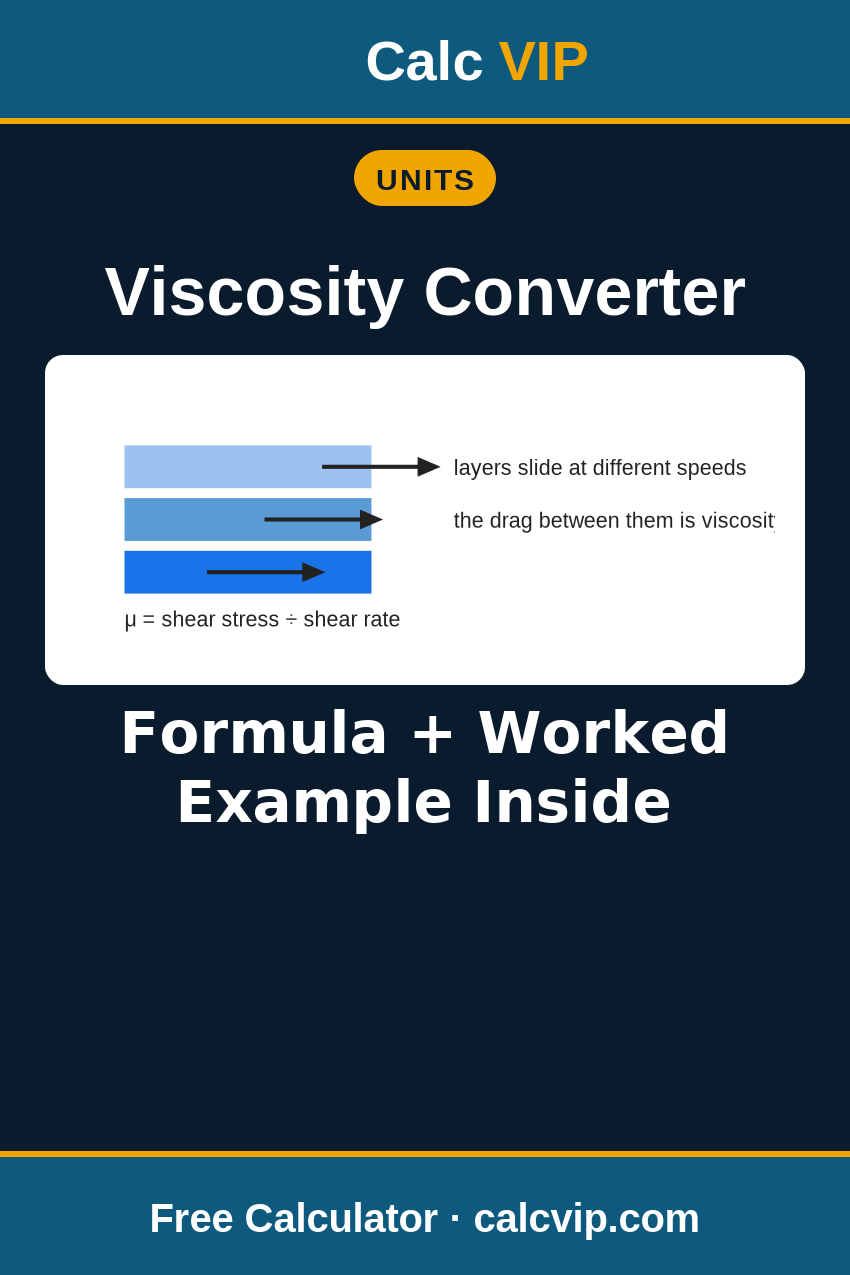
Viscosity is a fluid's internal friction — the resistance that makes honey crawl and water splash, that lets engine oil cling to a cylinder wall and lets blood cells slip through capillaries. It comes in two distinct flavours that are constantly confused. Dynamic viscosity (μ) measures the force needed to slide one layer of fluid over another; it belongs to pumps, bearings and pipelines. Kinematic viscosity (ν) divides that by the fluid's density, and measures how fast the fluid itself spreads under gravity; it belongs to oil grades, fuel specs and anything that flows through an orifice. Each flavour has its own family of units — pascal-seconds, poise and centipoise for dynamic; square metres per second, stokes and centistokes for kinematic — and this converter handles both families, separately, in one place.
The unit zoo exists because viscosity was measured long before it was standardised. The poise honours Poiseuille, the French physician who studied blood flow in the 1840s; the stokes honours Stokes, of Stokes' law fame. Industry then shrank both by a hundred to get practical numbers: water is an awkward 0.01 poise but a comfortable 1 centipoise, and its kinematic viscosity is almost exactly 1 centistoke — two coincidences that made the centi- units the working language of oil datasheets, paint shops and hydraulics catalogues worldwide. SI units (Pa·s and m²/s) rule research papers; the older units rule the workshop. Converting between them is a daily task, not a historical curiosity.
The single most important warning on this page: you cannot convert between the dynamic and kinematic families without the density. The bridge is ν = μ ÷ ρ. For water (ρ ≈ 1,000 kg/m³) the two numbers nearly coincide — 1 cP ↔ 1 cSt — which is exactly why people wrongly assume they coincide everywhere. For a light oil of density 870 kg/m³ they differ by 13 percent; for glycerol (1,260 kg/m³) by 26 percent; for air they differ by a factor of more than 800. This converter keeps the families apart on purpose, and the examples below show the density bridge used honestly.
Formula
Within the dynamic family, everything hangs off the pascal-second:
1 Pa·s = 1,000 cP = 10 P • 1 P = 0.1 Pa·s = 100 cP • 1 cP = 0.001 Pa·s
Within the kinematic family, everything hangs off the square metre per second:
1 m²/s = 1,000,000 cSt = 10,000 St • 1 St = 10−4 m²/s = 100 cSt • 1 cSt = 10−6 m²/s = 1 mm²/s
And the bridge between the families is density: ν = μ ÷ ρ, equivalently μ = ν × ρ. With ν in cSt and ρ in g/cm³, the product comes out directly in cP — the oil industry's favourite shortcut, used in Example 4 below. This calculator converts inside each family; crossing between families always needs the density step done explicitly, so no silent error can creep in.
| Symbol / unit | Meaning | Relation |
|---|---|---|
| μ (Pa·s, P, cP) | dynamic (absolute) viscosity — resistance to shearing | 1 Pa·s = 10 P = 1,000 cP |
| ν (m²/s, St, cSt) | kinematic viscosity — dynamic viscosity per unit density | 1 m²/s = 10,000 St = 10⁶ cSt |
| ρ | density — the bridge between the two families | ν = μ ÷ ρ |
| 1 cSt | also written 1 mm²/s — the modern datasheet form | = 10−6 m²/s |
Two viscosities, two different questions
Ask "how hard must I push this fluid through a pipe?" and you need dynamic viscosity: the pressure drop in laminar flow is directly proportional to μ, whatever the fluid weighs. Ask instead "how fast will this fluid drain, spread or splash?" and you need kinematic viscosity, because gravity is doing the pushing and gravity's push per unit mass is the same for everything — what differs is the friction per unit mass, which is exactly μ/ρ. The distinction is visible in a famous comparison: air's dynamic viscosity (0.0181 cP) is about 55 times smaller than water's (1 cP), so air feels thin and effortless. But air's kinematic viscosity (15.1 cSt) is about 15 times larger than water's (1 cSt), because air is 830 times less dense. Aerodynamicists therefore work in ν — it is why Reynolds numbers for aircraft and for ships live in comparable ranges despite the utterly different fluids.
Temperature rules both quantities, and brutally. Water falls from 1.79 cP at 0 °C to 0.28 cP at 100 °C; engine oils are graded by their kinematic viscosity at 40 °C and 100 °C precisely because a single cold figure would be meaningless; honey that will not pour in winter flows in summer. Every viscosity figure silently carries a temperature, and a conversion is only valid at the temperature the original figure was measured at. Datasheets that omit the temperature are not being concise — they are being useless.
How to use
- Decide which family your figure belongs to: Pa·s, poise or centipoise go in the dynamic section; m²/s, stokes or centistokes go in the kinematic section.
- Enter the value and select its unit. You may fill one section or both — each converts independently.
- Click "Convert Viscosity" to see the value in every unit of its family.
- To cross between families, use ν = μ ÷ ρ with the fluid's density at the same temperature — never copy a cP figure into a cSt slot unless the density is 1,000 kg/m³.
Worked examples
Example 1 — the reference conversions. Convert 1 Pa·s and 1 × 10⁻⁵ m²/s.
1 Pa·s = 1,000 cP = 10 P. And 1 × 10⁻⁵ m²/s = 10 cSt = 0.1 St. These two anchor every estimate: a pascal-second is a thick fluid (glycerol territory), while 10 cSt is a light oil.
Example 2 — water, the calibration fluid. At 20 °C water has μ ≈ 1 cP and ν ≈ 1.004 cSt.
1 cP = 0.001 Pa·s = 0.01 P; 1.004 cSt = 1.004 × 10⁻⁶ m²/s ≈ 0.01 St. The near-equality of the two "1"s is the density coincidence (ρ ≈ 1,000 kg/m³) that makes water the reference for both scales.
Example 3 — honey. Honey pours at roughly 10,000 cP.
10,000 cP = 10 Pa·s = 100 P — ten thousand times water's dynamic viscosity, which your breakfast spoon already knew. (Honey's exact figure swings wildly with temperature and water content; treat it as an order of magnitude.)
Example 4 — engine oil across the bridge. A 10W-40 oil is graded at 100 cSt at 40 °C, density 870 kg/m³.
Kinematic: 100 cSt = 1 × 10⁻⁴ m²/s = 1 St. Dynamic via the bridge: μ = ν × ρ = 100 cSt × 0.87 g/cm³ = 87 cP = 0.087 Pa·s. The pump designer needs the 87; the grade on the bottle is the 100.
Example 5 — air, the great counterexample. At room conditions μ = 1.81 × 10⁻⁵ Pa·s and ν = 1.51 × 10⁻⁵ m²/s.
Dynamic: 1.81 × 10⁻⁵ Pa·s = 0.0181 cP — fifty-five times thinner than water. Kinematic: 1.51 × 10⁻⁵ m²/s = 15.1 cSt — fifteen times thicker than water. Both statements are true; they answer different questions.
Example 6 — glycerol. Pure glycerol at 20 °C has μ ≈ 1,410 cP, density 1,260 kg/m³.
1,410 cP = 1.41 Pa·s = 14.1 P. Kinematic: ν = μ ÷ ρ = 1.41 ÷ 1,260 = 1.119 × 10⁻³ m²/s = 1,119 cSt — noticeably less than the dynamic figure, because glycerol is denser than water.
Viscosity conversion in real life
Choosing engine oil. The "40" in 10W-40 is a kinematic-viscosity band measured in cSt at 100 °C; the "10W" is a cold-cranking performance. Converting a datasheet's cSt into the Pa·s a bearing calculation wants — via the density bridge — is routine engine-design work.
Hydraulics. Hydraulic oils are sold by ISO viscosity grades that are simply kinematic viscosities in cSt at 40 °C: ISO VG 46 is 46 cSt. A pump specified in one country's catalogue (St or mm²/s) must be matched to oil bought in another's — conversion errors cavitate pumps.
Paint and coatings. Paint shops measure flow-cup times and convert them to kinematic viscosity to decide whether a paint will spray, sag or orange-peel. A few cSt either way is the difference between a mirror finish and a respray.
Food production. Syrups, chocolate and sauces are pumped, filled and coated by viscosity. Chocolate at working temperature sits near 10,000 cP territory; filling machines are timed around figures converted between the plant's cP instruments and the designer's Pa·s models.
Medicine and blood. Whole blood runs about 3–4 cP — three to four times water — and its viscosity rises with haematocrit, which is why it features in cardiovascular risk discussions. Poiseuille's original viscosity work was driven by exactly this fluid.
Printing inks and adhesives. Ink is specified in centipoise at press temperature; too low and it mists, too high and it will not transfer. Adhesive datasheets cross between P, cP and Pa·s depending on the manufacturer's country — the converter is the translation layer.
Saybolt, Redwood and other ghosts
Older catalogues — especially American petroleum and British engineering ones — quote viscosity in seconds: Saybolt Universal Seconds (SUS), Redwood seconds, or Engler degrees. These are not viscosities at all but times: how long a fixed volume takes to drain through a standard orifice in a standard cup at a standard temperature. They survive because generations of oil charts were printed in them. The conversion to centistokes is empirical rather than exact — for SUS above about 100, ν (cSt) ≈ 0.226 × SUS − 195 ÷ SUS is the standard approximation — and it only works because draining time is governed by kinematic viscosity (gravity does the draining). If you meet a Saybolt figure, convert it to cSt first, then use this page's kinematic family. Treating the seconds as if they were centistokes directly is a classic and expensive error.
Quick reference: familiar fluids
| Fluid (≈20 °C) | Dynamic μ | Kinematic ν |
|---|---|---|
| air | 0.0181 cP | 15.1 cSt |
| water | 1 cP | 1 cSt |
| olive oil | ≈ 56 cP | ≈ 61 cSt |
| engine oil (40 °C) | ≈ 87 cP | 100 cSt |
| glycerol | 1,410 cP | 1,119 cSt |
| honey | ≈ 10,000 cP | ≈ 7,000 cSt |
Read the air row and the water row side by side whenever the two families blur: dynamic says air is 55 times thinner, kinematic says air is 15 times thicker, and both are right.
How viscosity is actually measured
Three classical instruments cover most of the numbers you will ever convert. The capillary viscometer (Ostwald or Ubbelohde) times a fixed volume draining through a fine tube under gravity — it measures kinematic viscosity directly, which is why oil labs report cSt. The falling-ball viscometer times a steel ball sinking through the fluid and inverts Stokes' law: a 1 mm radius steel ball (density 7,800 kg/m³) in glycerol (1,260 kg/m³, μ = 1.41 Pa·s) sinks at v = 2r²g(ρball − ρfluid) ÷ 9μ = 0.0101 m/s — about a centimetre per second, slow enough to time with a stopwatch and a ruler, which is the entire charm of the method. The rotational viscometer spins a spindle in the fluid and measures the drag torque — note the full circle back to torque — giving dynamic viscosity in cP or Pa·s at a controlled shear rate, which is why paint, food and pharmaceutical labs favour it. Every figure on a datasheet began as one of these three timings or torques; the conversions on this page simply translate the result into the units your own calculation speaks.
Why datasheets quote two temperatures
Serious datasheets quote viscosity at two temperatures because one number cannot describe a fluid whose thickness may change tenfold across its working range. Engine oils are quoted at 40 °C and 100 °C so that the viscosity index — a score for how little the oil thins as it heats — can be computed; a high index (150 or more) means an oil that stays usefully thick in a hot engine yet still flows at a frozen start, while a low index warns of an oil that turns to treacle in winter and water in summer. The same logic appears wherever fluids work across seasons: hydraulic oil for an excavator in a desert and the same machine in a Scandinavian winter are chosen from the two-temperature figures, not from a single flattering one. When you convert a viscosity, it stays married to its measurement temperature — 100 cSt at 40 °C and 100 cSt at 100 °C describe completely different oils, and the converter's answer inherits whichever temperature the original figure carried.
Common mistakes
- Converting cP straight into cSt. Only valid when the density is 1,000 kg/m³. For oils, glycerol, syrups and gases the density bridge ν = μ ÷ ρ is compulsory, and skipping it costs 10–800 percent.
- Ignoring temperature. A viscosity without a temperature is half a fact. Oil that is 100 cSt at 40 °C may be 15 cSt at 100 °C and 1,000 cSt at 0 °C — conversions inherit the temperature of the original measurement.
- Mixing poise and centipoise. The factor is 100, not 10: 1 P = 100 cP, while 1 Pa·s = 10 P = 1,000 cP. Slipping one zero is the most common arithmetic error in the whole topic.
- Treating Saybolt seconds as centistokes. Efflux-cup seconds are times, not viscosities; they need their own empirical conversion to cSt before this page's factors apply.
- Assuming Newtonian behaviour. Ketchup, blood, paint and most slurries change viscosity with shear rate (they are non-Newtonian), so a single converted figure describes them only at the shear rate it was measured at.
FAQ
What is the difference between dynamic and kinematic viscosity?
Dynamic viscosity η measures a fluid's resistance to being sheared — how much force is needed to slide its layers. Kinematic viscosity ν is η divided by density, so it describes how fast the fluid itself flows under gravity. Thick honey has high η; mercury has low η but, being dense, a surprisingly low ν.
Why is 1 cP famous?
Because water at 20 °C has a dynamic viscosity of almost exactly 1 cP (1.002 cP), the centipoise became the everyday unit for thin liquids. Engine oils are typically tens to hundreds of cP.
Can I convert between dynamic and kinematic viscosity here?
Only with the density: ν = η/ρ. For example, an oil with η = 0.05 Pa·s and ρ = 900 kg/m³ has ν = 5.56 × 10⁻⁵ m²/s = 55.6 cSt. Convert each quantity within its own section above.
What is the difference between dynamic and kinematic viscosity?
Dynamic viscosity μ is the fluid's resistance to being sheared — a force-based property. Kinematic viscosity ν = μ ÷ ρ is that resistance per unit density — it governs how the fluid moves under gravity. Pumps care about μ; draining, spraying and oil grades care about ν.
Why is water exactly 1 cP and 1 cSt?
Nearly exactly, and only near 20 °C: its dynamic viscosity is 1.002 cP and, because its density is almost exactly 1 g/cm³, the kinematic value lands at almost exactly 1 cSt too. The units were effectively built around water.
How many centistokes are in a stokes?
100. And a centistoke is identical to 1 mm²/s, which is how modern datasheets usually write it: 46 cSt and 46 mm²/s are the same oil.
Can I convert centipoise to centistokes?
Only with the density: ν (cSt) = μ (cP) ÷ ρ (g/cm³). For an oil of density 0.87, 87 cP becomes 100 cSt. Without a density, the honest answer is that the conversion does not exist.
Which viscosity does engine oil use?
Kinematic, in cSt (mm²/s), measured at 40 °C and 100 °C. The SAE grade bands and ISO VG grades are both kinematic scales.
Why does viscosity fall when a fluid is heated?
In liquids, viscosity is molecular attraction resisting layers sliding past each other; heat shakes molecules loose, so the resistance falls — steeply. In gases the opposite happens (faster molecules exchange more momentum between layers), so air's viscosity actually rises slightly with temperature.
What is the most viscous everyday material?
Pitch — the black residue that looks like a solid — flows at around 10⁸ times water's viscosity. The famous pitch-drop experiment has produced about one drop per decade since 1927, and it is still running.