 Calc
Torque Converter – N·m, lbf·ft, kgf·m & lbf·in
 Created by Sarah Mitchell · Physics Editor · Motion & Measurement · Last updated: November 2026
Use this free Torque Converter to change torque values between the units used in physics, engineering and the workshop. Enter a value in newton metres (N·m), pound-feet (lbf·ft), kilogram-force metres (kgf·m) or pound-inches (lbf·in) and see all four units at once.
Torque is the twisting effect of a force — the quantity that decides whether a bolt clamps tight, whether an engine pulls a trailer up a hill, and whether a cyclist's legs can turn the pedals against a gradient. It is measured as a force multiplied by the length of the lever it acts through, which is why its units are always a force unit married to a distance unit: newtons times metres in the metric world, pounds times feet (or inches) in the imperial one, and kilogram-force times metres in the older engineering tradition that much of Asia and Europe still prints on workshop charts. The physics is identical everywhere; only the labels change, and this converter translates between the four labels you will actually meet.
The need for translation is not academic. A Japanese or European car manual specifies wheel-nut torque in newton metres; an American manual for the same job quotes pound-feet; a torque wrench bought online may be scaled in either, or in kilogram-force metres if it came from an older workshop. Set a wrench by the number alone, ignoring the unit, and you can under-tighten a wheel nut by a quarter or snap a small bolt clean in two — the conversion factors are close enough to 1 to look harmless and far enough from 1 to do real damage. Converting first, and converting correctly, is a genuine safety step.
One subtlety is worth fixing before any numbers: a pound-foot of torque is not a foot-pound of energy, even though the words and the arithmetic look the same. Torque is a vector — a twist about an axis — while energy is a scalar, a capacity to do work. Engineers keep the two apart by writing torque as lbf·ft and energy as ft·lbf, a small typographic courtesy this page follows. When you convert torque you are never converting energy, and a figure borrowed from an energy table has no business on a torque wrench.
Formula
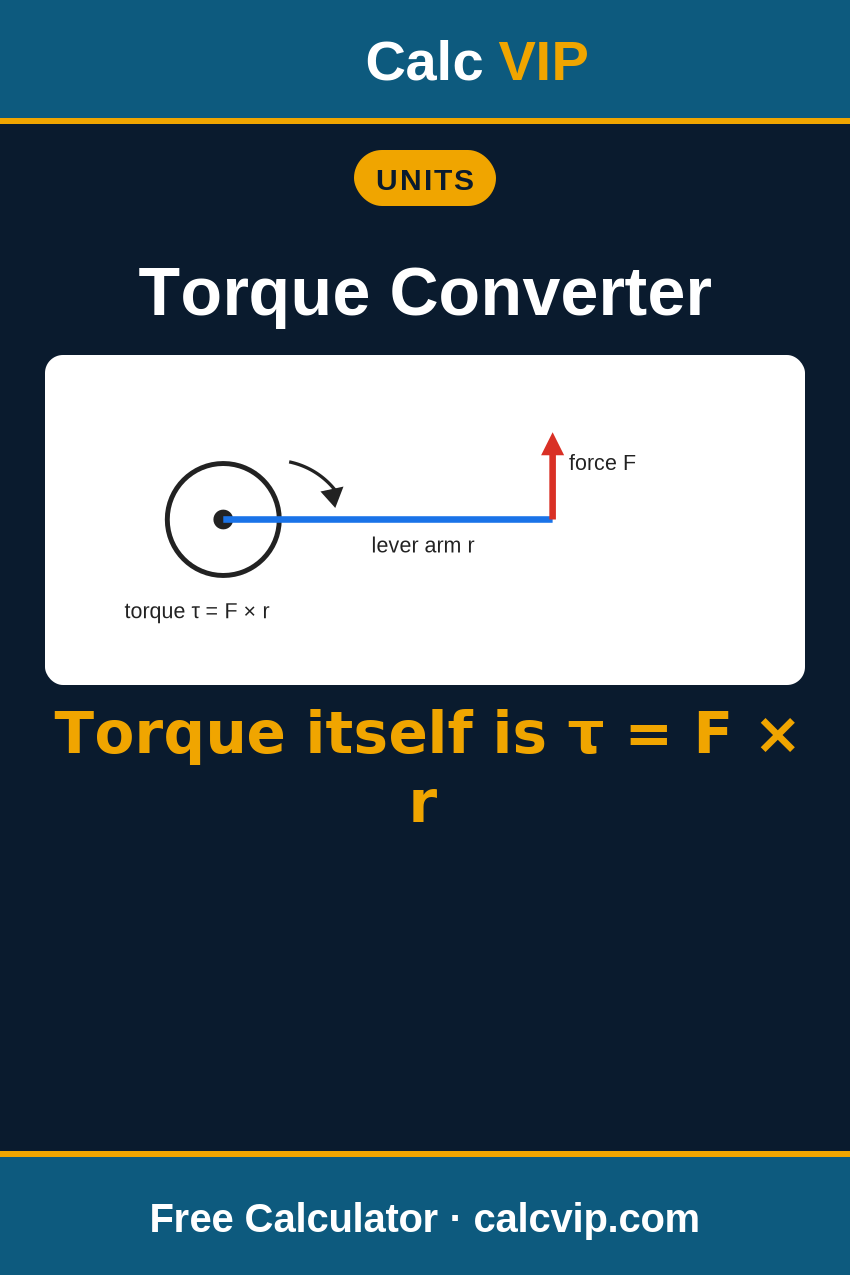
Torque itself is τ = F × r — force times lever arm, with the force applied at right angles to the arm. Converting between units only needs the exact definitions of the pound and the kilogram-force:
1 lbf·ft = 1.35582 N·m • 1 kgf·m = 9.80665 N·m • 1 lbf·in = 0.112985 N·m
Read the other way: 1 N·m = 0.73756 lbf·ft = 0.10197 kgf·m = 8.85075 lbf·in. The kilogram-force factors hide the familiar 9.80665 — standard gravity — because a kilogram-force is the weight of one kilogram in Earth's gravity, so converting kgf·m to N·m is really multiplying a weight by a length. The pound-inch is exactly one twelfth of a pound-foot, which is why its factor is the pound-foot factor divided by 12. This calculator converts any of the four units into all four at once, so you never have to chain conversions and accumulate rounding errors.
| Unit | Meaning | In N·m |
|---|---|---|
| N·m | newton metre — the SI unit of torque | 1 |
| lbf·ft | pound-foot — US automotive and engineering | 1.35582 |
| kgf·m | kilogram-force metre — older workshop charts | 9.80665 |
| lbf·in | pound-inch — small fasteners, electronics, bicycles | 0.112985 |
Why four units survive for one quantity
Torque units are a fossil record of engineering history. The newton metre arrived with the SI system and dominates modern manuals, research and European industry. The pound-foot survives because the American automotive and aerospace industries built a century of specifications, tooling and mechanic intuition around it — an engine advertised at "295 lb-ft" is speaking to buyers who feel that number. The kilogram-force metre belongs to the era when engineers thought in weights rather than masses: a kilogram-force is simply how hard one kilogram pulls in gravity, so a kgf·m torque is the twist of a kilogram hanging on a metre lever — intuitive in a workshop, awkward in physics. The pound-inch exists for scale: small fasteners need torques of a few newton metres, which are clumsy fractions of a pound-foot but comfortable whole numbers of pound-inches.
None of the four is going away soon, so fluency matters more than loyalty. The practical skill is recognising which unit a document is using before trusting its numbers — check the manual's unit line, check the wrench's scale, and convert with a tool rather than from memory. The factors 1.356 and 0.738 are easy to swap by accident, and swapping them turns a correct setting into one that is wrong by a factor of 1.84.
How to use
- Enter the torque value exactly as printed in your manual, chart or specification.
- Select the unit that value is expressed in — newton metres, pound-feet, kilogram-force metres or pound-inches.
- Click "Convert Torque" to see the same torque in all four units at once.
- Set your torque wrench (or check your specification) using the row that matches your tool's scale — never by copying the bare number across units.
Worked examples
Example 1 — the reference conversion. Convert 100 N·m into every other unit.
100 ÷ 1.35582 = 73.76 lbf·ft; 100 ÷ 9.80665 = 10.20 kgf·m; 100 ÷ 0.112985 = 885.07 lbf·in. One hundred newton metres is a typical wheel-nut specification for a family car, which is why these three numbers are worth recognising on sight.
Example 2 — a truck's wheel nuts. A workshop manual asks for 250 N·m.
250 ÷ 1.35582 = 184.39 lbf·ft; 250 ÷ 9.80665 = 25.49 kgf·m; 250 ÷ 0.112985 = 2,212.69 lbf·in. A mechanic whose wrench reads pound-feet sets 184 — setting 250 instead would over-tighten by 36 percent.
Example 3 — an American manual. A US specification gives 90 lbf·ft for a cylinder-head bolt sequence.
90 × 1.35582 = 122.02 N·m, and 122.02 ÷ 9.80665 = 12.44 kgf·m. In pound-inches it is simply 90 × 12 = 1,080 lbf·in.
Example 4 — an old chart in kgf·m. A vintage motorcycle manual specifies 25 kgf·m for a main bearing cap.
25 × 9.80665 = 245.17 N·m; 245.17 ÷ 1.35582 = 180.83 lbf·ft. Kilogram-force values always look deceptively small — the factor of nearly ten is the trap.
Example 5 — an engine's advertised torque. A car is advertised with 400 N·m of torque.
400 ÷ 1.35582 = 295.02 lbf·ft — the figure the same car wears in American brochures; 400 ÷ 9.80665 = 40.79 kgf·m; 400 ÷ 0.112985 = 3,540.30 lbf·in. Same engine, three marketing departments.
Example 6 — a delicate fastener. A bicycle stem bolt is rated at 60 lbf·in.
60 × 0.112985 = 6.78 N·m — just 5 lbf·ft. This is why small work is specified in pound-inches: "6.78" invites a decimal slip on a big wrench, while "60 lbf·in" sits comfortably in the middle of a small wrench's scale.
Torque conversion in real life
Wheel nuts and road safety. Under-torqued wheels can work loose; over-torqued ones warp brake discs and stretch studs. Cars typically want 100–140 N·m (74–103 lbf·ft), and the conversion is the difference between a safe wheel and a dangerous one when the manual and the wrench disagree in units.
Engine building. Cylinder heads, main bearings and con-rods are tightened in staged sequences to precise torques — often finished with an angle turn after a torque threshold. Builders constantly cross between US and metric literature, and a swapped factor scraps an engine.
Bicycles and carbon fibre. Carbon handlebars and seatposts crush at torques a steel-era mechanic would consider finger-tight — 4–6 N·m, usually printed in N·m while older inch-pound wrenches read lbf·in (35–53 lbf·in). The converter lives on the workbench for exactly this.
Engines, marketing and dyno sheets. Power figures travel the world, but torque is quoted in N·m in Europe and lbf·ft in America. Converting 400 N·m to 295 lbf·ft lets you compare two reviews of the same car without being misled by the bigger-looking number.
Industrial bolting. Flanged pipe joints, wind-turbine towers and structural steel all specify bolt preload through torque, with hydraulic wrenches scaled in either system. A wind-turbine bolt at 2,000 N·m is 1,475 lbf·ft — a conversion done once, checked twice, and written on the job sheet.
Everyday DIY. Spark plugs (typically 20–30 N·m), oil drain plugs and furniture cam-locks all carry torque guidance now. Owning the conversion means the wrench you already have fits the manual you just downloaded, whichever side of the Atlantic wrote it.
The 4 percent trap: torque, preload and friction
Converting units is only the first accuracy problem in tightening a bolt. What a joint actually needs is preload — the clamping force stretching the bolt — and torque is only an indirect way of producing it, because most of the applied torque is eaten by friction under the bolt head and in the threads. The workshop rule of thumb, T = K × F × d, hides a friction factor K that swings from about 0.11 for oiled threads to 0.20 or more for dry, rusty ones. The same 100 N·m can therefore produce preloads differing by nearly a factor of two depending on lubrication — a far bigger uncertainty than any unit conversion. This is why critical joints specify lubrication state alongside torque, and why the most critical of all (cylinder heads, con-rods) finish with an angle-of-turn method that stretches the bolt by a measured amount, bypassing friction almost entirely. Convert carefully, by all means — but know that the number on the wrench is the beginning of the story, not the end.
Quick reference: common torques in all four units
| N·m | lbf·ft | kgf·m | lbf·in |
|---|---|---|---|
| 1 | 0.74 | 0.10 | 8.85 |
| 5 | 3.69 | 0.51 | 44.25 |
| 10 | 7.38 | 1.02 | 88.51 |
| 25 | 18.44 | 2.55 | 221.27 |
| 50 | 36.88 | 5.10 | 442.54 |
| 100 | 73.76 | 10.20 | 885.07 |
| 200 | 147.51 | 20.39 | 1,770.15 |
| 500 | 368.78 | 50.99 | 4,425.37 |
Notice the pattern worth memorising: pound-feet are roughly three quarters of the newton-metre figure, kilogram-force metres roughly a tenth, and pound-inches roughly nine times it. Those three approximations catch most unit errors before a wrench is ever picked up.
From torque to power: why the same engine wears two numbers
Torque becomes power the moment the shaft turns: P = τ × ω, with ω the angular velocity in radians per second. Take the 400 N·m engine of Example 5. At 3,000 rpm the crankshaft spins at ω = 3,000 × 2π ÷ 60 = 314.16 rad/s, so P = 400 × 314.16 = 125,664 W ≈ 125.7 kW. Hold the same torque to 5,000 rpm (ω = 523.6 rad/s) and the power climbs to 209.4 kW — which is why engines chase revs, and why a torque figure without an rpm is only half a specification. The conversion runs through every rotating machine on Earth: a cyclist producing a modest 30 N·m at a cadence of 90 rpm (ω = 9.42 rad/s) is delivering 30 × 9.42 ≈ 283 W, world-class territory sustained over an hour. Electric motors invert the petrol pattern, delivering maximum torque from zero rpm — which is why their brochures quote N·m so proudly, and why this converter keeps being opened by people comparing an EV's launch with a diesel's tow rating. Whenever two torque figures are compared, ask at what speed each is made; the converter translates the units, but the rpm supplies the meaning.
How good is the number on the wrench?
A click-type torque wrench is typically accurate to about ±4 percent of its set value across the middle of its range — provided it is stored unwound (set back to its lowest mark), never dropped, and recalibrated on schedule. Professionals also exercise a click wrench with a few test clicks before trusting it on a real joint, and pull smoothly rather than jerking, because the mechanism registers the peak torque reached, not an average. That built-in tolerance is precisely why the unit conversion must be exact: a 4 percent tool error is an acceptable engineering margin, but a 36 percent unit error stacked on top of it is a failed joint. Beam wrenches trade the click for a bending pointer — cruder, but nearly impossible to knock out of calibration — while electronic wrenches read to ±1–2 percent and beep at the target, at a price that buys a drawer of click wrenches. Whichever type you own, its scale is printed in at least one of this page's four units; the conversion is what marries the tool in your hand to the manual on the bench.
Common mistakes
- Copying the number without converting. Setting 100 on a lbf·ft wrench when the manual said 100 N·m over-tightens by 36 percent — enough to stretch wheel studs or strip alloy threads.
- Swapping the factor direction. Multiplying by 1.356 when you should divide (or using 0.738 the wrong way) produces an answer wrong by a factor of 1.84. Sanity-check: the lbf·ft number must always be smaller than the N·m number.
- Confusing torque with energy. A joule is also a newton metre, and a foot-pound is an energy unit — but neither belongs on a torque wrench. Torque and energy share dimensions, not meaning.
- Treating kgf as kg. The kilogram-force metre is built on a force — the weight of a kilogram — which is why its factor is 9.80665, not 1. Dropping the gravity factor shrinks the torque tenfold.
- Using a big wrench at the bottom of its scale. Torque wrenches are accurate in the middle of their range, not at the extremes. A 6.78 N·m bicycle bolt belongs on a small lbf·in wrench, not at the first click of a 200 N·m wrench.
FAQ
Is a newton metre of torque the same as a joule?
They have the same dimensions, but they are different quantities: a joule is energy (force × distance moved along the force), while torque is force × perpendicular lever arm and does no work by itself. By convention torque is written N·m and energy is written J.
Why do car manuals give both N·m and lbf·ft?
Metric workshops set torque wrenches in N·m, while many US tools are marked in lbf·ft (or lbf·in for small fasteners). Converting correctly matters — an over-tightened bolt can snap, and an under-tightened wheel nut can work loose.
What is a kgf·m?
One kilogram-force metre is the torque produced by a 1 kg weight hanging at the end of a 1 m horizontal arm. It is still printed on some older Asian and European tools; 1 kgf·m = 9.80665 N·m exactly, because it is built on standard gravity.
How do I convert N·m to lbf·ft in my head?
Multiply by three quarters, then add a small correction — or simply multiply by 0.74. For 120 N·m: 120 × 0.74 = 88.8, close to the exact 88.51 lbf·ft. For the reverse, divide by 0.74 (or multiply by 1.36).
Why does my torque wrench have two scales?
Most wrenches are printed with N·m on one side and lbf·ft (or lbf·in) on the other, because manuals come in both systems. Always read the scale that matches your specification — the two scales reach the same click at very different numbers.
Is a newton metre of torque the same as a joule?
Dimensionally yes, physically no. A joule is energy — force through a distance along the force's direction. A newton metre of torque is force times a lever arm at right angles to the force. Physicists keep them conceptually separate, and so should your wrench settings.
What torque do car wheel nuts need?
Typically 100–140 N·m (74–103 lbf·ft) for passenger cars, more for trucks and SUVs — but always use the figure in the vehicle's own manual, and re-check it after 50–100 km of driving, as workshops advise.
Why are small fasteners specified in lbf·in?
Because their torques are tiny fractions of a pound-foot. 60 lbf·in is only 5 lbf·ft — an awkward, error-prone setting on a foot-pound wrench, but a comfortable mid-scale reading on an inch-pound one.
Does converting change the tightening?
No — the physical twist is identical; only its label changes. 100 N·m, 73.76 lbf·ft, 10.20 kgf·m and 885.07 lbf·in are the same clamp, the same stretch, the same joint. Conversion errors change the tightening; conversions never do.
What is a kilogram-force?
The force with which Earth gravity pulls on one kilogram: exactly 9.80665 N by definition. It survives in older engineering (kgf·m torques, kgf/cm² pressures) long after the SI system replaced it with the newton.