 Calc
Length Converter – Metres, Miles, Feet, AU, Light-Years & Parsecs
 Created by Sarah Mitchell · Physics Editor · Motion & Measurement · Last updated: November 2026
Use this free Length Converter for physics to convert a length between metres, kilometres, centimetres, millimetres, miles, feet, inches — and the astronomy units astronomers actually use: astronomical units (AU), light-years and parsecs. Enter a value once and see it in every unit at the same time.
Length is the quantity physics measures more than any other, and it is also the quantity humanity has invented the most units for. A physicist's lengths run from the width of an atom to the distance across the observable universe — some 27 orders of magnitude — and no single unit can be spoken comfortably at both ends. So we keep a ladder of them: millimetres for the bench, metres and kilometres for the landscape, miles and feet where history demands them, and a trio of giants — AU, light-year, parsec — for the spaces between stars. This converter holds the whole ladder at once.
Every conversion on this page travels through the metre. That is not a limitation but the definition of how unit conversion works safely: each unit has an exact, agreed value in metres, so any unit can reach any other by converting in to metres and back out. Chaining direct factors (miles to feet to inches to…) invites rounding at every step; the hub method rounds once, at the end. It is also how the calculator can show all ten units simultaneously from a single entry — ten short trips from the same hub.
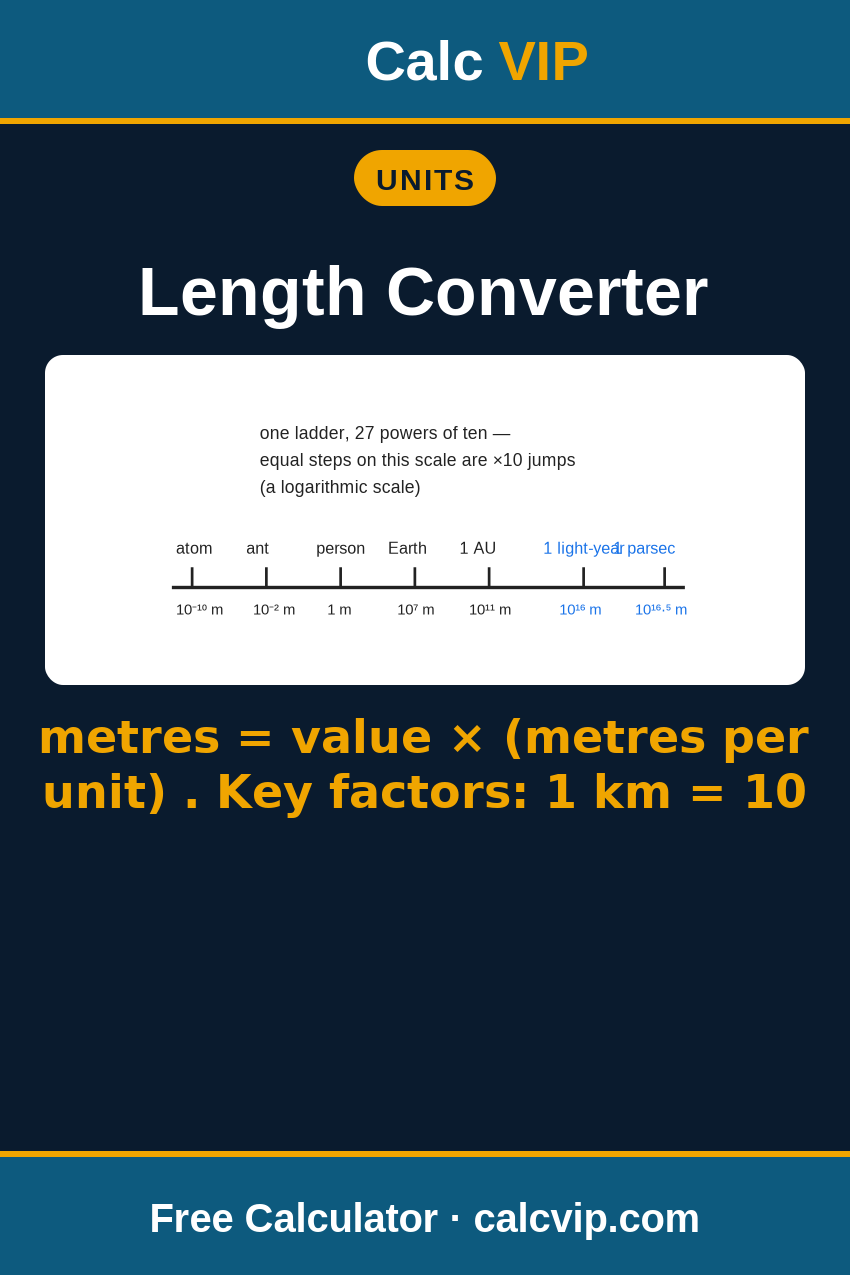
The factors themselves are no longer measurements but definitions. The inch is exactly 0.0254 m by international agreement (1959); the foot is exactly 0.3048 m; the mile is exactly 1609.344 m. The astronomical unit is exactly 149,597,870,700 m by a 2012 decision of the International Astronomical Union. Even the light-year and parsec are built from exact ingredients — the speed of light and the AU. When this page converts, it is not estimating; it is restating one exact quantity in ten exact dialects.
Formula
Every unit is first converted to metres, then out to the target unit: value in metres = value × (metres per unit). Key factors: 1 km = 1000 m, 1 mile = 1609.344 m, 1 ft = 0.3048 m, 1 AU = 1.495978707×10¹¹ m, 1 light-year = 9.4607×10¹⁵ m, 1 parsec = 3.0857×10¹⁶ m.
Written as a single step, value in unit B = value in unit A × (metres per A) ÷ (metres per B) — the hub formula this calculator applies ten times per conversion. Two habits keep hand conversions honest. First, convert with the exact factors, not the pub approximations (a mile is not 1.6 km when the answer matters; it is 1.609344 km). Second, sanity-check the direction of travel: converting to a bigger unit must make the number smaller. A kilometre figure that grows when expressed in miles has been multiplied where it should have been divided.
| Unit | Metres per unit (exact) | Where it rules |
|---|---|---|
| millimetre (mm) | 0.001 | engineering drawings, rainfall |
| centimetre (cm) | 0.01 | everyday metric measuring |
| inch (in) | 0.0254 | screens, tyres, US hardware |
| foot (ft) | 0.3048 | aviation altitude, US building |
| metre (m) | 1 | the SI base unit — science everywhere |
| kilometre (km) | 1000 | roads and geography in most of the world |
| mile (mi) | 1609.344 | roads in the US and UK |
| astronomical unit (AU) | 1.495978707×10¹¹ | distances inside solar systems |
| light-year (ly) | 9.4607×10¹⁵ | stars and galaxies, public astronomy |
| parsec (pc) | 3.0857×10¹⁶ | professional astronomy |
The units astronomers actually use
Each giant unit exists because a measurement technique made it natural. The AU is the Earth's own yardstick: once astronomers knew the shape of the solar system from Kepler's laws, every planetary distance was known in AU long before anyone knew the AU in metres — the ratios came first, the absolute scale centuries later. The light-year is the distance light covers in one year at 299,792,458 m/s; it doubles as a clock, since light arriving from 4 light-years away left 4 years ago, and astronomy's public language has adopted it for exactly that poetry.
The parsec is the professional's unit because it falls straight out of the oldest distance measurement in astronomy: parallax. As the Earth crosses its orbit, a nearby star appears to shift against distant stars by a tiny angle. One parsec is the distance at which the Earth–Sun separation (1 AU) subtends an angle of exactly one arcsecond — "parallax of one arcsecond", hence parsec. In metres it is 3.0857×10¹⁶ m, which is 206,265 AU, or 3.26 light-years. A star's distance in parsecs is simply 1 ÷ (its parallax in arcseconds), so the unit is the measurement wearing no disguise at all.
A scale model makes the emptiness honest. Shrink the AU to 10 metres — a garden path — and the Sun becomes a 9.3 cm grapefruit at one end of it (its true diameter, 1.3927×10⁶ km, scales by 10 ÷ 1.496×10⁸). The Earth is a 0.85 mm grain 10 m away, the Moon a speck a quarter of a millimetre wide orbiting about 2.6 cm from the grain, and Pluto a pinhead some 395 m down the road at 39.5 AU. The nearest star, at 1.30 parsecs, sits 268,553 × 10 m away on this scale — about 2,690 km, in another country. Every unit on this page exists because some audience needed that emptiness expressed in numbers it could hold.
How to use
- Enter the length and choose the unit it is measured in.
- Click "Convert Length".
- The same length is shown in all ten units at once — copy whichever one your problem needs.
- Check the direction of the change: numbers shrink as units grow. If your value in AU is larger than your value in metres, a factor has been applied upside down.
Worked examples
Example 1 — one kilometre, ten ways. 1 kilometre = 1000 m = 100,000 cm = 1,000,000 mm = 0.621371 miles = 3280.84 feet = 39,370.1 inches = 6.68459×10⁻⁹ AU = 1.057×10⁻¹³ light-years = 3.24078×10⁻¹⁴ parsecs. The astronomical entries are the lesson: a kilometre is a rounding error in interstellar accounting, which is why those units exist.
Example 2 — a marathon. The marathon distance, 42.195 km, converts to 42,195 m and to 42,195 ÷ 1609.344 = 26.2188 miles — the famous "26.2 miles". Runners in metric and imperial countries are training for the same race; only the split times on their watches are bilingual.
Example 3 — the distance to the Moon. The Moon orbits about 384,400 km away: 3.844×10⁸ m, 238,855 miles, and 3.844×10⁸ ÷ 1.495978707×10¹¹ = 0.00257 AU. The Moon is four-hundredths of one percent of the way to the Sun's distance — the solar system is emptier than any diagram in a textbook can honestly show.
Example 4 — one light-year in full. 1 ly = 9.46073×10¹⁵ m = 9.46073×10¹² km = 5.87863×10¹² miles = 63,241.1 AU = 0.306601 parsecs. Light needs a year to cross it; the fastest human spacecraft, at roughly 17 km/s, would need about 17,600 years. (Check: 9.46073×10¹² km ÷ 17 km/s ≈ 5.57×10¹¹ s ≈ 17,600 years.)
Example 5 — a person's height. 1.75 m = 5.74147 feet = 68.8976 inches = 175 cm. In feet-and-inches notation that is 5 ft 8.9 in — note that 0.74147 of a foot is 8.9 inches, not 7.4: decimal feet and feet-plus-inches are different notations, and confusing them is a classic conversion accident.
Example 6 — the nearest star. Proxima Centauri lies 4.2465 light-years away: in parsecs, 4.2465 × 0.306601 = 1.30198 pc; in kilometres, 4.2465 × 9.46073×10¹² = 4.0175×10¹³ km; in AU, 268,553 AU. Its measured parallax is about 0.768 arcseconds, and 1 ÷ 0.768 = 1.302 pc — the parsec figure falls straight out of the observation, exactly as the unit was designed to do.
Length conversion in real life
Roads and travel. Crossing from continental Europe to Britain or the US flips every sign and speedometer between kilometres and miles. The 0.621371 factor of Example 1 is the one travellers actually use, and misjudging it misjudges fuel stops and arrival times by nearly 40%.
Aviation. Altitude is quoted in feet almost everywhere on Earth — a rare imperial stronghold — while visibility is often in metres or kilometres and runway lengths in metres. Pilots convert constantly, and the exactness of 1 ft = 0.3048 m is a safety feature, not pedantry.
Screens, tyres and tools. A 55-inch television, a 17-inch wheel, a 1/2-inch wrench: the inch survives wherever an industry standardised early. Converting to millimetres (× 25.4) is the first step in comparing such hardware with metric specifications.
Space missions. Mission reports mix units by audience: kilometres for engineers, AU for trajectory summaries ("the probe is 162 AU from the Sun"), light-time for communications. The conversion discipline of this page is what keeps a spacecraft's position unambiguous across all three tellings.
Building and land. Surveyors in imperial countries record in feet; architects elsewhere draw in millimetres. A single misplaced factor of 0.3048 in a shared drawing is a wall in the wrong place — the construction industry's version of the unit errors that have famously destroyed spacecraft.
Reading astronomy news. "A galaxy 13 billion light-years away", "an exoplanet at 4.2 parsecs" — converting between the journalists' unit and the scientists' unit (divide or multiply by 3.26) lets you compare stories and spot when two reports describe the same object in different dialects.
The metre, defined by light itself
Since 1983 the metre has been defined as the distance light travels in vacuum in 1/299,792,458 of a second — which fixes the speed of light at exactly 299,792,458 m/s and turns every length measurement, deep down, into a timing measurement. The definition makes the light-year an exact quantity (one Julian year of 365.25 days at that exact speed) and gives this page a graceful by-product: divide any distance by c and you get the time light needs to cross it. Sunlight's journey to Earth: 1.495978707×10¹¹ ÷ 299,792,458 = 499 seconds — 8 minutes 19 seconds. Moonlight: 3.844×10⁸ ÷ 299,792,458 = 1.28 seconds. Astronomers quote "light travel time" so routinely that for deep-space probes it replaces distance altogether: a signal 22 light-hours out is at a perfectly definite place, whatever unit you measure it in.
Your phone uses the same physics every time it fixes your position. GPS satellites orbit about 20,200 km overhead, so their timing signals take 20,200,000 ÷ 299,792,458 ≈ 0.067 seconds to arrive — and the receiver locates itself by comparing those arrival times, converting nanoseconds into metres at exactly c. A timing error of one microsecond is a position error of 300 m, which is why the light-defined metre is not an abstraction but the working foundation of navigation.
Below the millimetre: the small end of the ladder
The converter's ladder stops at the millimetre, but the metric system continues down in the same powers of ten, and physics lives there. The micrometre (µm, 10⁻⁶ m) measures cells and fibres: a human hair is about 70 µm thick, a red blood cell about 8 µm across. The nanometre (nm, 10⁻⁹ m) measures light itself — red light's wavelength is about 650 nm = 6.5×10⁻⁷ m — and the transistors of modern chips, whose features are a handful of nanometres wide. The ångström (Å, 10⁻¹⁰ m, not an SI unit but beloved of chemists) matches atoms: a hydrogen atom is about 1 Å across, so atomic spacings in crystals are quoted in ångströms the way star distances are quoted in parsecs — each field keeps the unit its objects are round numbers in. All of them convert through the same hub rule as this page's ten units; only the exponents change. One step further down, the femtometre (10⁻¹⁵ m, nicknamed the fermi) is the scale of the atomic nucleus itself — a proton is about 0.84 fm across.
Quick reference: familiar lengths
| Object or journey | In metres | In another handy unit |
|---|---|---|
| height of Mount Everest | 8,849 m | 5.50 miles |
| football pitch length | 105 m | 114.83 yards |
| Earth's circumference | 4.0075×10⁷ m | 24,901.5 miles = 0.0002679 AU |
| Earth to Moon | 3.844×10⁸ m | 0.00257 AU |
| Earth to Sun | 1.496×10¹¹ m | 1 AU = 8.32 light-minutes |
| Sun to nearest star | 4.0175×10¹⁶ m | 4.2465 ly = 1.30198 pc |
The Everest figure hides a nice check: 8,849 m ÷ 1609.344 = 5.4986 miles, and the pitch conversion uses the yard (0.9144 m exactly), a unit this converter omits but which obeys the same hub rule. Every length in the table is one multiplication away from any unit on this page.
Common mistakes
- Using the length factor for areas and volumes. Conversion factors must be squared and cubed along with the unit: 1 m² = (1 ÷ 0.3048)² = 10.7639 ft², not 3.28084 ft². Forgetting this is the single most expensive conversion error in engineering.
- Reading a light-year as a time. It is a distance — the distance light travels in a year. "10 light-years away" and "the light left 10 years ago" are the same fact stated twice, but the unit itself measures metres, 9.4607×10¹⁵ of them.
- Confusing the mile with the nautical mile. The nautical mile is 1852 m exactly (one arcminute of the Earth's circumference) and belongs to navigation. This converter's mile is the statute mile, 1609.344 m — 15% shorter.
- Misreading decimal feet as feet and inches. 5.74147 ft is 5 ft 8.9 in, not 5 ft 7.4 in. Convert the fractional part separately: 0.74147 ft × 12 = 8.9 in.
- Assuming a parsec is smaller than a light-year. It is larger: 1 pc = 3.26 ly. Distances quoted in parsecs always sound smaller than the same distances in light-years, which trips up many a comparison between news reports.
FAQ
What is an astronomical unit?
One AU is the average distance from the Earth to the Sun, exactly 149,597,870,700 metres. Planetary distances are much easier to state in AU than in kilometres.
Which is bigger, a light-year or a parsec?
A parsec. One parsec ≈ 3.26 light-years ≈ 3.086×10¹⁶ m. Parsecs are the unit professional astronomers use for distances to stars and galaxies.
Why do the AU and light-year results use ×10 notation?
Everyday lengths are tiny compared with astronomical units, so the values are very small decimals. The calculator switches to scientific notation automatically so nothing is lost to rounding.
How many feet are in a metre?
1 ÷ 0.3048 = 3.28084 feet. The reverse, one foot, is exactly 0.3048 m by definition — the metre figure is the one that must be computed.
How do I convert square metres to square feet?
Square the length factor: 1 m² = (3.28084)² = 10.7639 ft². Never use the plain length factor on an area or volume; the exponent belongs to the conversion too.
What is a nautical mile, and is it included?
It is not in this converter. A nautical mile is exactly 1852 m — one arcminute of latitude — used at sea and in the air because it ties directly to charts. It is about 15% longer than the statute mile (1609.344 m).
Why do astronomers quote exoplanet distances in parsecs but news stories use light-years?
Parsecs come straight from parallax measurements (distance in pc = 1 ÷ parallax in arcseconds), so catalogues use them. Light-years carry the travel-time meaning the public finds intuitive. Multiply parsecs by 3.26 to translate.
How far does light travel in one second?
Exactly 299,792,458 m by definition — about 7.5 times around the Earth's equator (circumference 4.0075×10⁷ m). This "one light-second" is itself a working unit for the Earth–Moon system: the Moon is 1.28 light-seconds away.
Is the AU exactly the Earth–Sun distance?
It was originally defined from that distance, but since 2012 the AU is simply a defined constant — exactly 149,597,870,700 m — while the Earth's actual orbit varies slightly around it (roughly ±0.016 AU over a year, since the orbit is an ellipse). The unit stayed fixed; the planet did not have to.
What unit do astronomers use for galaxies?
Kiloparsecs and megaparsecs (kpc, Mpc) — thousands and millions of parsecs. The Andromeda galaxy is about 0.78 Mpc away (roughly 2.5 million light-years). They are just the parsec with metric prefixes, and convert through the same factor on this page.