 Calc
Mass Converter – Kilograms, Pounds, Ounces, Tonnes & Atomic Mass Units
 Created by Sarah Mitchell · Physics Editor · Motion & Measurement · Last updated: November 2026
Use this free Mass Converter for physics to convert a mass between kilograms, grams, milligrams, tonnes, pounds and ounces — plus the atomic mass unit (u) used for atoms and molecules. Enter a value once and see it in every unit at the same time.
Mass is the most conservative quantity in everyday physics: unlike weight, it does not change when you carry it to the Moon, the top of a mountain or the deck of a ship. What changes, endlessly, is the unit people insist on quoting it in. A pharmacist works in milligrams, a cook in grams and ounces, a truck driver in tonnes, a chemist in atomic mass units — and a physicist, sooner or later, has to translate between all of them. This converter holds seven of those dialects at once, from the tonne down to the mass of a single atom.
As with every safe conversion, all roads pass through one hub: here, the kilogram. Each unit on this page has an exact agreed value in kilograms, so a conversion in any direction is one multiplication into the hub and one division out of it, with rounding applied once at the end. The metric family (milligram, gram, kilogram, tonne) is decimal — pure powers of ten, related by sliding a decimal point. The imperial pair (pound, ounce) and the atomic unit are the interesting cases: their kilogram values are long decimals, fixed by international definition rather than by measurement.
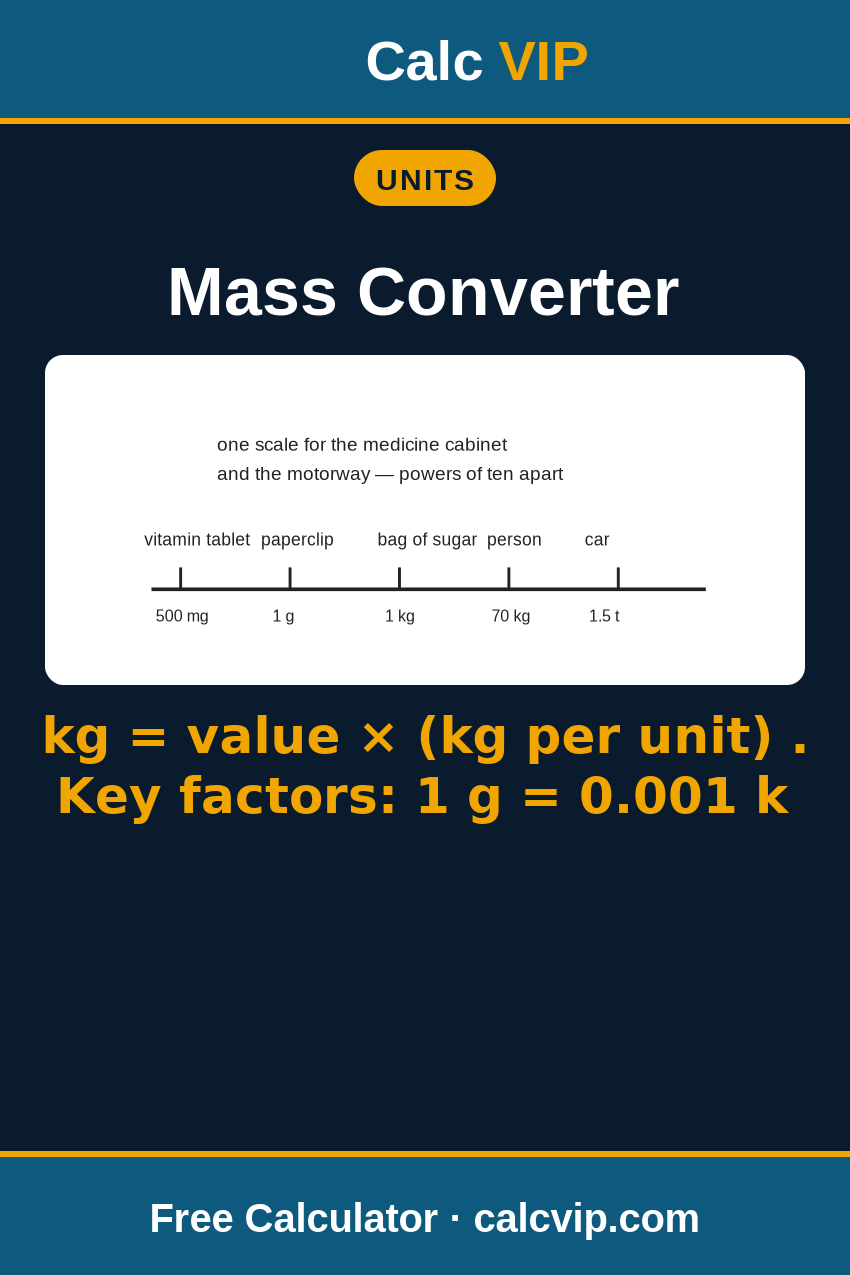
Those definitions are worth a glance, because they are exact. The pound has been defined as exactly 0.45359237 kg since 1959 — the imperial system is, legally, a translation of the metric one. The ounce is exactly one sixteenth of that pound. The atomic mass unit is defined as one twelfth of the mass of a carbon-12 atom, 1.66053906660×10⁻²⁷ kg, a number that must be measured (it is not exact) but is known to extraordinary precision. When this page converts 1 kg into 6.02214×10²⁶ u, it is counting, in effect, how many atomic-scale units make up a bag of sugar.
Formula
Every unit is first converted to kilograms, then out to the target unit: value in kg = value × (kg per unit). Key factors: 1 g = 0.001 kg, 1 tonne = 1000 kg, 1 lb = 0.45359237 kg, 1 oz = 0.028349523125 kg, 1 u = 1.66053906660×10⁻²⁷ kg.
As a single step: value in unit B = value in unit A × (kg per A) ÷ (kg per B). Within the metric family this collapses to moving a decimal point — kilograms to grams multiplies by 1000, grams to milligrams by another 1000 — which is why laboratory errors so often hide in factors of a thousand. Crossing to pounds or atomic units uses the long exact factors above; a useful mental shortcut is 1 kg ≈ 2.2 lb (the exact figure is 2.20462), good to about half a percent, and 1 lb ≈ 0.454 kg for the return trip.
| Unit | Kilograms per unit | Where it rules |
|---|---|---|
| atomic mass unit (u) | 1.66053906660×10⁻²⁷ | atoms, molecules, particles |
| milligram (mg) | 0.000001 | medicine doses, laboratory work |
| gram (g) | 0.001 | cooking, chemistry |
| ounce (oz) | 0.028349523125 | US cooking and post |
| pound (lb) | 0.45359237 | body mass and goods in the US/UK |
| kilogram (kg) | 1 | the SI base unit |
| tonne (t) | 1000 | vehicles, freight, industry |
The kilogram, redefined by a constant of nature
For 130 years the kilogram was a physical object: a cylinder of platinum-iridium kept in a vault near Paris, whose mass was the kilogram by decree. The arrangement had an obvious flaw — the cylinder and its copies appeared to drift apart by about 50 micrograms over a century, and nobody could say which of them was changing. In 2019 the definition was replaced: the kilogram is now fixed by assigning the Planck constant the exact value 6.62607015×10⁻³⁴ joule-seconds, so any laboratory with the right equipment (a Kibble balance, which weighs mass against electromagnetic force) can realise a kilogram from first principles, anywhere, forever.
The redefinition quietly changed the status of the atomic mass unit's kilogram value on this page. The mass of a carbon-12 atom is a fact of nature that must be measured against the kilogram, so 1 u = 1.66053906660×10⁻²⁷ kg carries experimental uncertainty in its last digits — unlike the pound, which is exact by legal definition. It is a pleasing inversion: the human-invented unit is the exact one, and the atom's own unit is the one we must keep measuring. In practice the new kilogram is realised by Kibble balances in a handful of national laboratories, which means mass metrology has quietly become a branch of electrical measurement.
How to use
- Enter the mass and choose the unit it is measured in.
- Click "Convert Mass".
- The same mass is shown in all seven units at once — from tonnes down to atomic mass units.
- Mind the powers of ten: the gram, milligram and u rows differ by factors of a thousand and more, so read the unit label, not just the digits.
Worked examples
Example 1 — one kilogram, seven ways. 1 kilogram = 1000 g = 1,000,000 mg = 0.001 tonnes = 2.20462 lb = 35.274 oz = 6.02214×10²⁶ u. The last figure startles everyone the first time: a single kilogram contains about 6×10²⁶ atomic mass units — Avogadro-scale counting hidden inside a bag of sugar.
Example 2 — a person's mass. 70 kg = 70,000 g = 154.324 lb = 2469.18 oz = 0.07 t. The pounds figure is the one printed on gym equipment in the US; the exact conversion is why 70 kg is 154.3 lb and not the rounder 154 lb of the ×2.2 shortcut (which gives 154.0, close but visibly off at this size).
Example 3 — a family car. 1.5 tonnes = 1500 kg = 3306.93 lb. Vehicle specifications cross the Atlantic constantly, and the tonne-to-pound conversion is where brochure figures quietly change: the same car is "1.5 t" in Berlin and "3,307 lb" in Detroit.
Example 4 — a water molecule. A water molecule, H₂O, has a mass of about 18.015 u. In kilograms: 18.015 × 1.66053906660×10⁻²⁷ = 2.99146×10⁻²⁶ kg. No balance on Earth can weigh one molecule; the figure comes from dividing the mass of a counted number of them — which is precisely what the mole concept organises (see the depth section below).
Example 5 — a medicine dose. A 500 mg tablet = 0.5 g = 0.0005 kg = 0.017637 oz. Doses live in milligrams because the gram is too coarse: misreading 500 mg as 500 g is a factor-of-1000 error, which is why prescriptions print the unit in full and why this converter keeps the mg row visible.
Example 6 — the defining atom. A carbon-12 atom has a mass of exactly 12 u by definition: 12 × 1.66053906660×10⁻²⁷ = 1.99265×10⁻²⁶ kg. Every atomic mass in chemistry is measured against this atom — oxygen at 15.999 u, iron at 55.845 u — and this page's u factor is what ties that relative scale to the kilogram.
Mass conversion in real life
Medicine and dosing. Drug doses are prescribed in milligrams (and micrograms for the potent ones) while patients think in grams of body mass per kilogram of dose. Converting cleanly between mg, g and kg is a literal safety skill, rehearsed by every nurse and pharmacist.
Airline baggage. Allowances are posted in kilograms by most of the world's airlines and in pounds by US carriers: the common 23 kg bag is 50.7 lb — just over the US 50 lb limit, a conversion with real fees attached to getting it wrong.
Cooking across the Atlantic. American recipes measure butter in ounces and sticks; European ones in grams. 4 oz of butter = 113.4 g — and since 1 oz = 28.3495 g exactly, the conversion is reliable enough for any recipe ever written.
Fitness and body mass. Scales, BMI charts and gym plates swap between kg and lb by region. A 20 kg Olympic barbell plate is 44.09 lb — close to, but not, the 45 lb plate of an American gym, a 2% difference lifters genuinely argue about.
Freight and vehicles. Truck limits, shipping containers and payload ratings are set in tonnes or kilograms in most of the world and in pounds in the US. Example 3's factor (×2204.62 per tonne) is the one logistics software applies millions of times a day.
Chemistry and the mole. A molecule's mass in u and a mole of it in grams are the same number — 18.015 u per water molecule, 18.015 g per mole of water. The atomic unit on this page is the bridge between the atomic scale and the laboratory scale, explored further below.
The mole bridge: why the atomic unit matches the gram
The atomic mass unit looks arbitrary in kilograms — 1.66053906660×10⁻²⁷ — but it was chosen with a destination in mind. Avogadro's number, 6.022×10²³, is (very nearly) the number of atomic mass units in one gram. So a carbon-12 atom of 12 u, gathered 6.022×10²³ at a time into one mole, masses exactly 12 g; a water molecule of 18.015 u becomes 18.015 g per mole. Chemists therefore read atomic masses off the periodic table and weigh out grams on a balance, and the two scales meet without any conversion factor at all. The 6.02214×10²⁶ u in Example 1's kilogram is the same bridge seen from the other side: it is 1000 × Avogadro's number, the count of atomic units in a kilogram. (Since the 2019 redefinitions the match is no longer exact to all digits — the mole is now defined by fixing Avogadro's number itself — but it holds to better than one part in a billion, far beyond any balance.)
Glucose shows the bridge carrying real weight. A glucose molecule, C₆H₁₂O₆, masses 6 × 12.011 + 12 × 1.008 + 6 × 15.999 = 180.156 u, so a mole of glucose is 180.156 g. A 4.2 g teaspoon of sugar is therefore 4.2 ÷ 180.156 ≈ 0.0233 mol — about 1.4×10²² molecules, a number no one could reach by counting, arrived at by weighing. Every titration, every drug synthesis and every baking recipe that scales is this two-step: convert grams to moles with the mass in u, do the chemistry in moles, convert back.
The masses of the very large
The tonne column is where this converter hands over to astronomy, and the numbers repay a look. The Earth's mass is 5.972×10²⁴ kg = 5.972×10²¹ tonnes — a figure no one measures directly, but assembles from g, the Earth's radius and Newton's constant, then converts with this page's decimal shift. The Sun masses 1.989×10³⁰ kg, so large that astronomers simply adopt it as a unit (the solar mass) and quote other stars as multiples. In atomic units the Sun is 1.989×10³⁰ ÷ 1.66053906660×10⁻²⁷ ≈ 1.198×10⁵⁷ u — a count of its atoms, give or take, and a reminder that the u and the tonne are the same idea at opposite ends of creation: a unit sized to its objects.
The small end is just as extreme, and the converter's u factor is the bridge to it. An electron masses 9.109×10⁻³¹ kg, which in atomic units is 0.00054858 u — the electron is a rounding error in its own atom's budget. A hydrogen atom, one proton plus one electron, masses about 1.008 u ≈ 1.674×10⁻²⁷ kg. Between that 10⁻²⁷ kg atom and the 10³⁰ kg Sun lie 57 orders of magnitude, and every mass ever measured sits somewhere on the line between them — quoted, sensibly, in whichever of this page's units makes it a number a human can say.
Mass is not weight: the same 70 kg on three worlds
| Place | Surface gravity | Mass of the person | Weight (force) = m × g |
|---|---|---|---|
| Earth | 9.81 m/s² | 70 kg | 686.7 N |
| Moon | 1.62 m/s² | 70 kg | 113.4 N |
| Mars | 3.71 m/s² | 70 kg | 259.7 N |
The middle column never changes — that is the point of this converter. Bathroom scales complicate the story by measuring force and reporting it as mass, assuming Earth's gravity: the same person would "weigh 11.6 kg" on a Moon-based scale, a statement about the scale's assumption, not about the person. Every unit on this page is a mass unit; weight, in newtons, needs a gravity value as well.
Common mistakes
- Confusing mass with weight. Kilograms measure mass; newtons measure weight (force). A "weight" of 70 kg is mass in disguise, valid only where Earth's gravity is assumed — see the table above.
- Mixing up the tonne and the US ton. A tonne is exactly 1000 kg. A US (short) ton is 2000 lb = 907.185 kg — nearly 10% less. Freight documents that just say "tons" have caused real disputes.
- Using the wrong ounce. This page's ounce is the everyday avoirdupois ounce, 28.3495 g. Gold and silver are weighed in troy ounces of 31.1035 g — 10% heavier. Precious-metal prices quoted "per ounce" mean the troy one.
- Slipping by a thousand between mg, g and kg. Each step is ×1000, and the slip is invisible in the digits (0.5 could be grams or kilograms). Medicine's factor-of-ten errors are the notorious case; always state the unit with the number.
- Treating the pound as a force. In everyday use lb is a mass (this page's meaning). Engineering also uses the pound-force (lbf), the weight of one pound of mass under standard gravity — numerically equal on Earth, conceptually different, and a classic source of mixed-up calculations.
FAQ
What is an atomic mass unit?
One u (also written amu) is defined as 1/12 of the mass of a carbon-12 atom, about 1.66×10⁻²⁷ kg. It is the natural unit for the masses of atoms, molecules and particles.
Is mass the same as weight?
No. Mass (in kg) is the amount of matter and stays the same everywhere. Weight is a force — mass × gravity — measured in newtons. This converter handles mass units only.
Why is a tonne in a physics converter?
Large masses — vehicles, machinery, asteroids — are unwieldy in kilograms. One tonne is exactly 1000 kg, so converting is just a shift of the decimal point.
What is the quick way to convert kilograms to pounds in my head?
Multiply by 2.2 — it is accurate to about 0.2%: 70 kg → 154 lb against the exact 154.324 lb. For the reverse, divide by 2.2 (or multiply by 0.454). Use the calculator's exact factor, 2.20462, whenever the answer matters.
How many atomic mass units are in a proton?
About 1.00728 u — the proton's mass is 1.6726×10⁻²⁷ kg, and dividing by 1.66053906660×10⁻²⁷ kg/u gives 1.00728. The neutron is slightly heavier at 1.00866 u; the electron is a featherweight 0.00054858 u, which is why atomic masses are essentially the masses of their nuclei.
What is a stone?
A British unit of body mass: 1 stone = 14 lb = 6.35029 kg exactly. It is not in this converter, but it converts through the pound: a person of 11 stone is 154 lb = 69.85 kg.
What is a carat?
The gemstone unit: 1 carat = 200 mg exactly. A "1-carat" diamond masses 0.2 g — the carat survives because gem sizes are small and the unit is conveniently sized to them, just as the milligram serves medicine.
Does my mass change on the Moon?
No — your mass is 70 kg (or whatever it is) everywhere in the universe. Your weight drops to about a sixth (113.4 N instead of 686.7 N for 70 kg), because the Moon's gravity is weaker. A balance-beam scale would still read 70 kg on the Moon; a spring scale would not.
How many grams are in an ounce?
Exactly 28.349523125 g for the everyday (avoirdupois) ounce, since the ounce is defined as 1/16 of the exactly-defined pound. The troy ounce used for precious metals is different: 31.1035 g.
Why does 1 kg come out as 6.02214×10²⁶ u?
Because Avogadro's number of atomic mass units makes almost exactly one gram — so a kilogram, 1000 g, contains 1000 × 6.022×10²³ ≈ 6.02214×10²⁶ u. It is the mole bridge of the depth section, read off the converter's own output.