 Calc
Angular Momentum Solver Calculator – L = Iω Solve for L, I or ω
 Created by Elena Petrova · Physics Editor · Fluids & Rotation · Last updated: November 2026
Use this free Angular Momentum Solver Calculator to work with L = I × ω in any direction: find the angular momentum of a spinning object, the moment of inertia it must have, or the angular speed it needs to reach a target L.
Angular momentum is the rotational counterpart of ordinary momentum — a measure of how much turning motion an object has, and how stubbornly it keeps it. A spinning flywheel resists being stopped or tilted; a slowly turning merry-go-round barely resists at all. The quantity that captures this is L = I × ω: the moment of inertia I, which measures how the mass is spread around the axis, multiplied by the angular speed ω. Mass far from the axis counts for far more than mass near it, which is why I — not plain mass — is the right partner for ω.
Angular momentum earns its keep through one of physics' great conservation laws: in the absence of an external torque, L does not change. It cannot be created or destroyed inside a system, only traded between parts of it. This single rule explains the figure skater's accelerating spin, the stability of a thrown frisbee, the slow lengthening of Earth's day as the Moon steals spin, and the dizzying rotation of collapsed stars. Whenever something spinning changes its shape or its company, L = Iω with L held fixed is the equation that predicts what happens next.
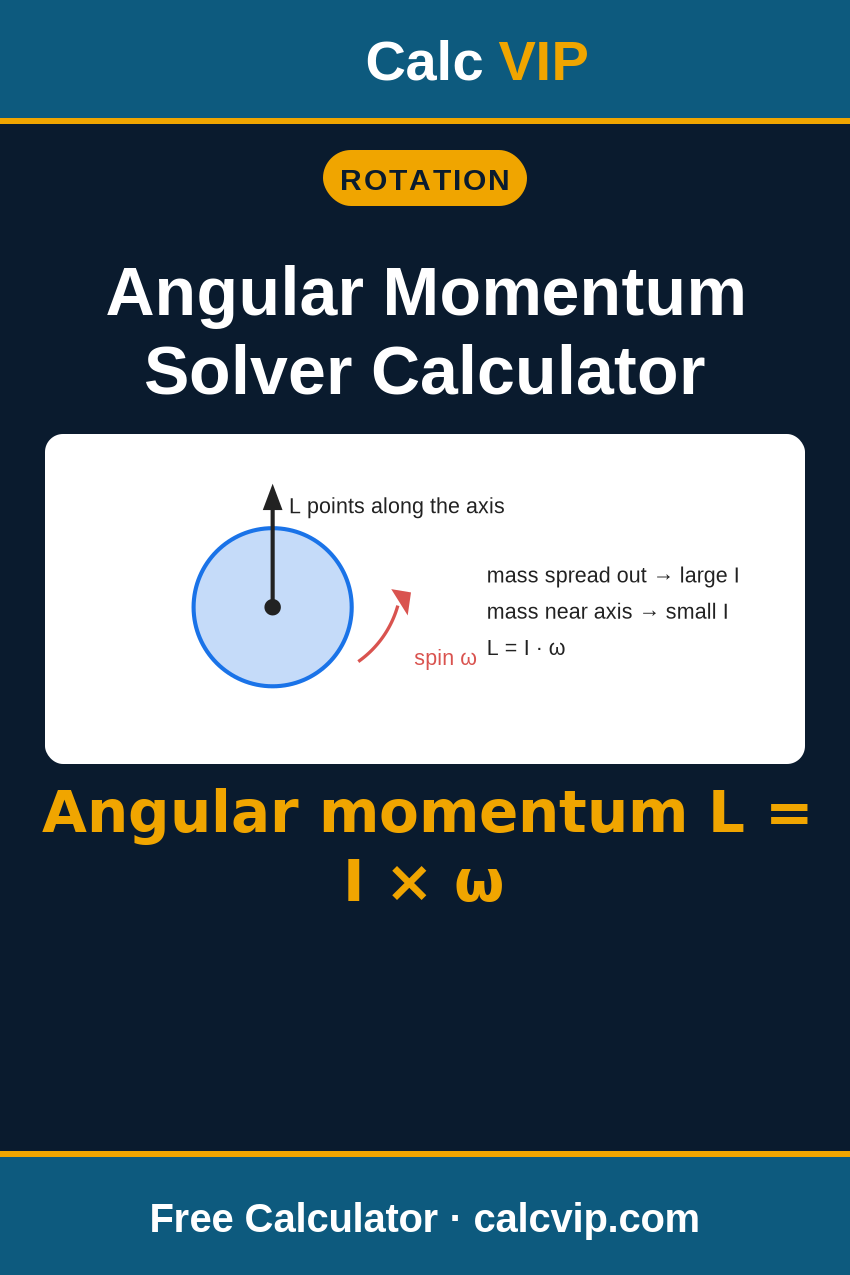
This solver rearranges the equation all three ways. Find L for a rotor whose I and ω you know; find the I a component must have to store a target L at a given speed (the reaction-wheel designer's question); or find the ω needed to reach a target L with the hardware you have. It also handles the particle form, L = m × v × r, through the same idea — a point mass circling at radius r has I = mr², so its L is mvr, as the examples show.
Formula
Angular momentum L = I × ω • L in kg·m²/s, I in kg·m², ω in rad/s
The rearrangements are I = L / ω and ω = L / I. For a single particle or a point mass on a string, I = m × r², so the same law appears as L = m × v × r (using v = ωr). Two companions complete the picture: the rotational kinetic energy KE = ½Iω² can be written as KE = L² / (2I) — the form that reveals why a skater's spin-up costs energy even though L is conserved — and the rate of change of angular momentum equals the applied torque, τ = dL/dt, the rotational Newton's second law. Conservation of L is simply the special case where that torque is zero.
| Symbol | Meaning | Units |
|---|---|---|
| L | angular momentum about the axis | kg·m²/s |
| I | moment of inertia about the same axis | kg·m² |
| ω | angular speed | rad/s |
| m, v, r | particle mass, speed, and distance from the axis (for L = mvr) | kg, m/s, m |
Conservation: the skater, the star and the Moon
Hold L fixed and the equation becomes a see-saw: whatever I loses, ω gains. A skater spinning with I = 3 kg·m² at ω = 4 rad/s carries L = 12 kg·m²/s; pulling her arms in to I = 1.2 kg·m² forces ω = 12 / 1.2 = 10 rad/s — two and a half times faster, with no push from the ice. The same see-saw, run over stellar timescales, spins a collapsing gas cloud from a stately turn into a pulsar flashing dozens of times per second: a star like the Sun (I ~ 10⁴⁷ kg·m² scale, ω ~ 3 × 10⁻⁶ rad/s) shrinking to a 10 km neutron star keeps its L while I falls by some ten orders of magnitude, so ω explodes by the same factor.
Earth and Moon trade L through the tides. The Moon's gravity drags on Earth's oceans, applying a small braking torque to Earth's spin; Earth's lost angular momentum reappears as orbital angular momentum of the Moon, which responds by drifting about 3.8 cm farther away each year while our day lengthens by roughly 2.3 milliseconds per century. Nothing is lost — the total L of the Earth–Moon system is (very nearly) conserved; it is merely being re-filed from "spin" to "orbit", at a rate this calculator's equation tallies exactly.
How to use
- Choose what you want to find from the drop-down menu — angular momentum, moment of inertia, or angular speed. Its input box disappears.
- Enter the other two values: I in kg·m², ω in rad/s (convert rpm with ω = rpm × 2π/60), L in kg·m²/s.
- Click "Calculate" to see the result with the working shown.
- For conservation problems, compute L once from the "before" state, then reuse that same L as the input for the "after" state — two runs of the calculator, one conserved quantity.
Worked examples
Example 1 — the flywheel. A flywheel has a moment of inertia of I = 4 kg·m² and spins at ω = 6 rad/s:
L = 4 × 6 = 24 kg·m²/s. Check the reverse: I = L / ω = 24 / 6 = 4 kg·m² ✓
Example 2 — the whole Earth. Earth's moment of inertia is about I = 8.04 × 10³⁷ kg·m² and it turns once per sidereal day, ω = 2π / 86,164 s = 7.2921 × 10⁻⁵ rad/s:
L = 8.04 × 10³⁷ × 7.2921 × 10⁻⁵ ≈ 5.86 × 10³³ kg·m²/s. This is the reservoir the Moon is slowly draining (see the concept section) — a number so large that the drain takes geological time to notice.
Example 3 — the skater's see-saw. A skater with arms out has I = 3 kg·m² and spins at ω = 4 rad/s, so L = 3 × 4 = 12 kg·m²/s. She pulls her arms in, dropping I to 1.2 kg·m²:
ω = L / I = 12 / 1.2 = 10 rad/s — about 1.6 revolutions per second, from a gentle 0.64 rev/s, with no external torque at all. Her kinetic energy, though, is not conserved: KE = L²/(2I) rises from 144/6 = 24 J to 144/2.4 = 60 J, and the extra 36 J is work her muscles did pulling the arms inward against the spin.
Example 4 — solving for I. A satellite reaction wheel must store L = 0.8 kg·m²/s while spinning at ω = 400 rad/s:
I = L / ω = 0.8 / 400 = 0.002 kg·m². A small, dense rim-heavy wheel meets this easily — which is the point: reaction wheels trade in L, and this division is their first sizing calculation.
Example 5 — solving for ω. A gyroscopic stabiliser with I = 25 kg·m² must hold L = 1000 kg·m²/s to steady a ship or camera platform:
ω = L / I = 1000 / 25 = 40 rad/s = 40 × 60 / 2π ≈ 381.9719 rpm — a stately spin for so large a wheel, and all the steadier for its size.
Example 6 — a particle on a string. A stone of m = 0.2 kg whirls at v = 3 m/s on a string of r = 0.8 m. Its I about the hand is mr² = 0.2 × 0.64 = 0.128 kg·m² and ω = v/r = 3.75 rad/s:
L = Iω = 0.128 × 3.75 = 0.48 kg·m²/s — the same as mvr = 0.2 × 3 × 0.8 = 0.48, as it must be. The particle form and the rigid-body form are one law, not two.
Angular momentum in real life
Diving and gymnastics. A diver leaves the board with a fixed L; tucking reduces I and the somersault speeds up, extending does the reverse to slow the rotation for entry. Every twist and somersault combination is planned in the currency of L = Iω with L frozen at take-off.
Spacecraft attitude control. Satellites cannot push against anything, so they steer by trading L with internal reaction wheels (Example 4): spin a wheel one way and the craft rotates the other, total L unchanged. When wheels saturate, magnetorquers dump the excess against Earth's magnetic field.
Bicycle and motorcycle wheels. A hoop-style wheel (m = 0.5 kg, r = 0.34 m, I = mr² = 0.0578 kg·m²) at 8 m/s road speed spins at ω = 23.5294 rad/s and carries L = 0.0578 × 23.5294 ≈ 1.36 kg·m²/s per wheel. That L resists tilting — part (though not all) of a bike's self-stability, and the reason a spun wheel held by its axle feels alive in your hands.
Helicopters. The main rotor's L is huge and the engine's torque on it must be answered: the tail rotor exists to provide the counter-torque, because the fuselage would otherwise spin the opposite way to conserve L. Twin-rotor designs cancel the problem internally with contra-rotating rotors.
Hard drives and gyroscopes. A spinning platter's L is why a running external hard drive resists being twisted — and why dropping one while it spins is so destructive. Gyroscope instruments from ship stabilisers (Example 5) to phone motion sensors are all, at heart, managed angular momentum.
Pulsars. A collapsed star spinning 30 times a second (ω = 188.4956 rad/s) with I ≈ 10³⁸ kg·m² carries L ≈ 1.9 × 10⁴⁰ kg·m²/s — the shrunken inheritance of its parent star's slow rotation, conserved through the most violent event in nature. The lighthouse-regular pulses are L = Iω keeping time.
Quick reference: moments of inertia of common shapes
| Shape (axis through centre unless stated) | I |
|---|---|
| Point mass at distance r | mr² |
| Thin hoop / bicycle rim, radius R | mR² |
| Solid disk or cylinder, radius R | ½mR² |
| Solid sphere, radius R | (2/5)mR² |
| Thin rod, length L, about its middle | (1/12)mL² |
| Thin rod, length L, about one end | (1/3)mL² |
Read the table as a ranking of how effectively mass resists spinning: the hoop, with every gram at full radius, tops the list at mR²; the sphere, with mass tucked close to the axis, manages only two-fifths of it. Multiply any of these by ω and you have the L this calculator solves for.
Shapes combine by addition: a wheel is a hoop (the tyre and rim) plus a disk (the hub and spokes, roughly), and its I is the sum of the parts, each taken about the same axis. Hollow shafts, stepped rotors and built-up flywheels all yield to the same bookkeeping — break the body into standard pieces, look each up, add. Where a piece sits off-axis, the parallel-axis term md² joins its own I, which is how bolt-on balance weights tune a rotor's total.
The energy twist: L conserved, KE not
Students are often unsettled that the skater's kinetic energy rises while "everything is conserved". The resolution is in the two formulas: L = Iω is conserved because no external torque acts, but KE = L²/(2I) is not a conserved quantity — it grows as I shrinks, from 24 J to 60 J in Example 3. The extra energy is real work, done by the skater's muscles pulling mass inward against its tendency to fly outward. The same bookkeeping, reversed, is why a tethered satellite that reels its tether in spins up using battery power, and why reaction wheels need motors, not just bearings: changing I or ω against the conservation law always has an energy bill, and something must pay it.
When L does change: torque is its rate of flow
Conservation is the special case; the general law is τ = dL/dt — angular momentum changes at exactly the rate the net external torque dictates, in the torque's direction. Apply a steady 5 N·m to a stationary wheel for 4 s and its L grows by 5 × 4 = 20 kg·m²/s, however the wheel is built; a wheel with I = 4 kg·m² then spins at ω = L/I = 5 rad/s, while one with I = 0.5 kg·m² reaches 40 rad/s on the same diet. This is the rotational Newton's second law, and it is the working form behind gyroscopes: gravity's torque on a tilted spinning top is perpendicular to L, so dL/dt points sideways, L's tip circles, and the axis precesses instead of falling — the subject of the gyroscope precession calculator in this same series. Read together, the two pages cover the whole life of L: this one tallies it, that one watches it turn.
Common mistakes
- Feeding in rpm or revolutions per second as ω. The formula wants rad/s. Entering 6 rev/s instead of 37.7 rad/s shrinks L by a factor of 2π. Convert first: ω = rpm × 2π/60, or rev/s × 2π.
- Assuming L is conserved when a torque is acting. Conservation needs zero external torque. A motor, a brake, friction in a bearing, or a hand touching the wheel all break it — then use τ = dL/dt instead and expect L to change at exactly the torque's rate.
- Using the wrong axis for I. I depends on the axis as much as on the object: a rod about its end has four times the I of the same rod about its middle ((1/3)mL² vs (1/12)mL²). L = Iω only works when I and ω share an axis.
- Confusing L with rotational KE. They share ingredients but differ: L = Iω (units kg·m²/s), KE = ½Iω² (joules). Doubling ω doubles L but quadruples KE — mixing the formulas scrambles both answers.
- Putting the diameter into mr²-style formulas. Every I formula takes the radius (or the length, for rods). A diameter slipped into a hoop's mR² overstates I — and therefore L — by a factor of four.
FAQ
What are the units of angular momentum?
kg·m²/s (kilogram metre squared per second), the rotational equivalent of linear momentum's kg·m/s.
Why do ice skaters spin faster when they pull their arms in?
With no external torque, L stays constant. Pulling the arms in reduces I, so ω must increase to keep L = Iω the same.
Is angular momentum a vector?
Yes — it points along the rotation axis, in the direction given by the right-hand rule (curl your fingers with the rotation; your thumb gives the direction of L).
What is the difference between angular and linear momentum?
Linear momentum p = mv measures straight-line motion and is conserved when no external force acts; angular momentum L = Iω measures turning and is conserved when no external torque acts. A system can have one without the other: a planet in a circular orbit has both, a spinning-in-place top has only L.
Can angular momentum be zero for a moving object?
Yes — about a chosen axis. A ball thrown straight at the axis has L = mvr with r (the perpendicular distance to the axis) equal to zero. L is always "about" some axis or point; change the reference and the value changes.
Why does a cat land on its feet if L is conserved?
The falling cat starts with L = 0 and must keep it at zero — so it rotates its front and rear halves in opposite senses, with different I values, netting a change of orientation with zero total L throughout. Conservation constrains the total, not each part.
How is angular momentum stored in a flywheel battery?
A flywheel battery stores energy (½Iω²), but its L = Iω is what the bearings and housing must withstand gyroscopically — which is why such units are often mounted in pairs spinning oppositely, so their L cancels while their energies add.
Does the Moon have angular momentum?
Enormously — mostly orbital: treating it as a particle, L = mvr ≈ 7.35 × 10²² × 1022 × 3.844 × 10⁸ ≈ 2.89 × 10³⁴ kg·m²/s, larger than Earth's spin L (Example 2). The tides are slowly transferring Earth's share into this orbital account.
What happens to L when a spinning object breaks apart?
The total is conserved (if no external torque acted): the fragments' angular momenta — spin plus orbital, summed as vectors — equal the original L. This is how astrophysicists reconstruct explosions and collisions they never saw.
Is Earth's angular momentum exactly constant?
Nearly, but not exactly: tidal friction transfers spin L to the Moon's orbit (lengthening the day ~2.3 ms per century), and melting ice caps redistribute mass, changing I and hence ω slightly. The conservation law holds for the whole Earth–Moon system; Earth alone is an open account.