 Calc
Conical Pendulum Calculator – Period, Tension, Radius and Speed
 Created by Elena Petrova · Physics Editor · Fluids & Rotation · Last updated: November 2026
Use this free Conical Pendulum Calculator to analyse a mass swinging in a horizontal circle on a string: find the period T = 2π√(L cosθ / g), the string tension, the circle radius and the speed — all from the string length, the angle and the mass.
Set a pendulum swinging in a circle instead of a line and it becomes a conical pendulum: the bob traces a horizontal circle while the string sweeps out the surface of a cone. It is one of the prettiest systems in mechanics, because everything about it is determined by geometry and gravity alone. The string tilts at angle θ to the vertical; the bob's circle has radius r = L sinθ; and the motion settles into a steady period T = 2π√(L cosθ/g) that depends — astonishingly — only on the vertical depth of the bob below the pivot, L cosθ, and not on the mass or the radius at all.
The physics is a two-way split of one force. The string's tension does double duty: its vertical component holds the bob up against gravity (Tension × cosθ = mg), and its horizontal component pulls the bob towards the circle's centre, supplying the centripetal force. Divide those two statements and the tension cancels into tanθ = v²/(gr) — the angle is the motion's own report of how fast it is going. Spin the bob faster and θ opens; the cone widens; the period shortens as the depth L cosθ shrinks. Every quantity the calculator returns is one of these interlocking facts.
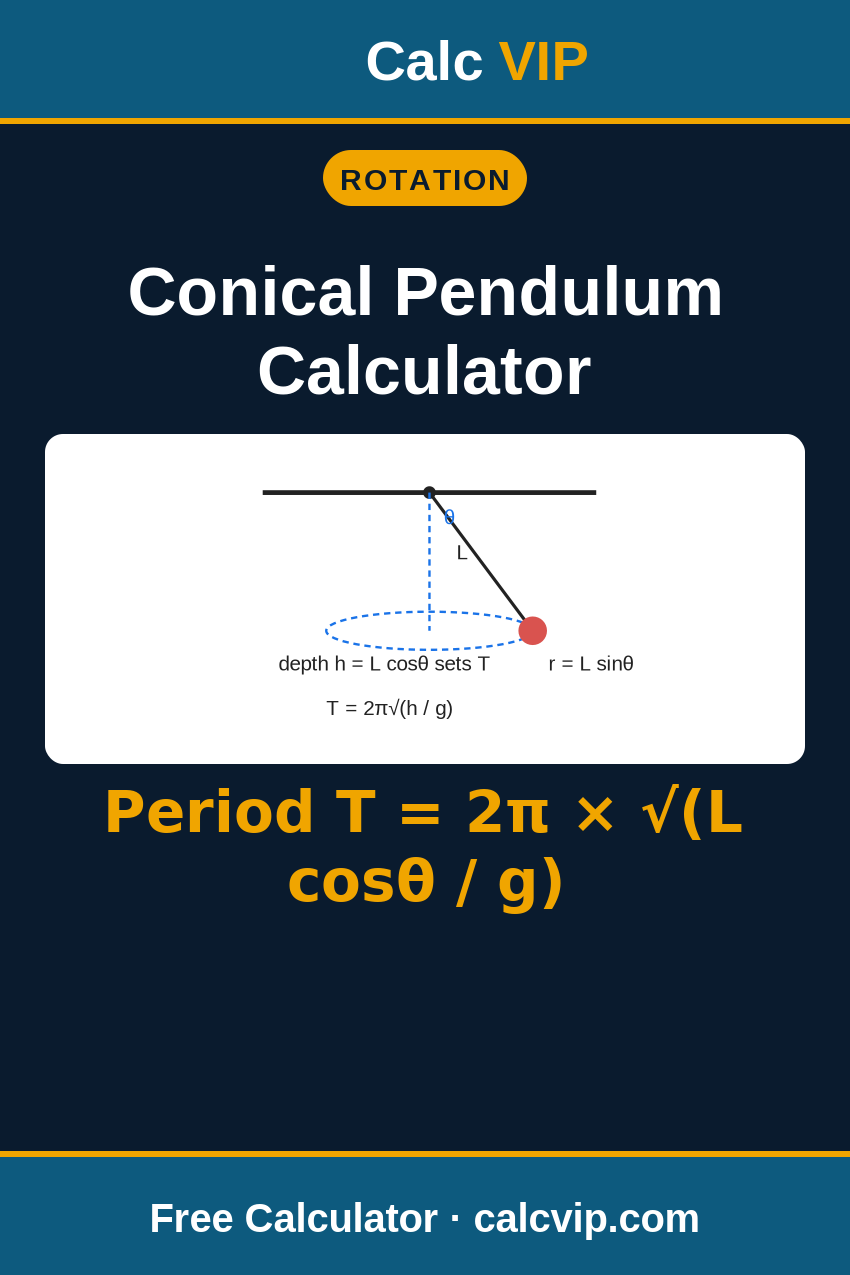
Conical pendulums are more than a textbook ornament. The Watt governor that regulated every steam engine is a conical pendulum whose height reads the engine's speed; fairground swing rides are conical pendulums carrying people; and the system remains a laboratory standard for measuring g, because its period depends on nothing but a length, an angle and gravity itself. Enter L, θ and m, and this calculator returns the period, tension, radius and speed with the working shown.
Formulas
Period T = 2π × √(L cosθ / g) • Tension = m × g / cosθ • circle radius r = L × sinθ • speed v = √(g × r × tanθ) • (g = 9.81 m/s²)
The derivation is short enough to keep. Vertically, nothing accelerates, so Tension × cosθ = mg, giving the tension formula at once. Horizontally, the tension's other component is the centripetal force: Tension × sinθ = mv²/r. Dividing the second by the first eliminates both Tension and m: tanθ = v²/(gr). The period then follows from T = 2πr/v with r = L sinθ — two lines of algebra later, T = 2π√(L cosθ/g). Note what the derivation promises: the period cannot involve m (it cancelled), and θ is measured from the vertical — the calculator's convention, and the one the formulas assume.
| Symbol | Meaning | Units |
|---|---|---|
| L | string length, pivot to bob | m |
| θ | angle of the string to the vertical | degrees (°) |
| m | mass of the bob | kg |
| h = L cosθ | vertical depth of the bob below the pivot | m |
| T | period of one revolution | s |
Only the depth matters: the h = L cosθ secret
Rewrite the period as T = 2π√(h/g), where h = L cosθ is the vertical distance from pivot to bob, and the conical pendulum reveals its kinship: it has exactly the period of an ordinary pendulum of length h. Two conical pendulums with different string lengths and different angles share a period whenever their bobs hang at the same depth. A long string flown wide and flat (L = 2 m at 60°, h = 1 m) ticks at precisely the rate of a short string flown steep (L = 1 m at 0°… which is just a hanging bob) — both give T = 2.0061 s. The cone's showy geometry collapses into a single vertical measurement.
This is the principle James Watt built into his governor. Two heavy balls on hinged arms spin with the engine shaft; as speed rises they fly outward, and their depth h obeys h = g/ω² — at ω = 10 rad/s, h = 9.81/100 = 0.0981 m; at ω = 20 rad/s, h = 0.0245 m. The height of the balls is therefore a direct, mechanical readout of ω, and Watt linked it to the throttle: rise too high (too fast) and the valve closes. The first automatic feedback controller in industry is this calculator's period formula, inverted and built in brass.
How to use
- Enter the string length L in metres, measured from the pivot to the bob's centre.
- Enter the angle θ in degrees — measured from the vertical, not from the horizontal. (If your angle is from the horizontal, subtract it from 90° first.)
- Enter the mass m in kg; it affects only the tension, never the period, radius or speed.
- Click "Calculate Conical Pendulum" to see the circle radius, period, tension and speed with the working shown.
Worked examples
Example 1 — the standard cone. A mass of m = 0.5 kg on a string of L = 1 m swings at θ = 30° to the vertical:
r = 1 × sin30° = 0.5 m
T = 2π × √(1 × cos30° / 9.81) = 2π × √0.0883 = 1.8669 s
Tension = 0.5 × 9.81 / cos30° = 5.6638 N • v = 1.6828 m/s — note the tension already exceeds the weight (4.905 N) by 15%, at a modest angle.
Example 2 — the fairground swing ride. A rider of m = 60 kg hangs from chains of L = 5 m that fly out to θ = 40°:
r = 5 × sin40° = 3.2139 m
T = 2π × √(5 × cos40° / 9.81) = 3.9261 s per revolution
Tension = 60 × 9.81 / cos40° = 768.3627 N • v = √(9.81 × 3.2139 × tan40°) = 5.1435 m/s. The chains carry 768 N — 1.31 times the rider's weight — which is why ride chains are rated with generous margins.
Example 3 — a gentle cone. A bob of m = 0.2 kg on L = 0.5 m at just θ = 10°:
r = 0.5 × sin10° = 0.0868 m
T = 2π × √(0.5 × cos10° / 9.81) = 1.4077 s • Tension = 1.9923 N • v = 0.3875 m/s. Compare the period with a simple pendulum of the same 0.5 m (1.4185 s): at small angles the cone is barely quicker, because cos10° ≈ 0.985 — the depth is nearly the full string.
Example 4 — a wide, fast cone. A bob of m = 1 kg on L = 2 m driven out to θ = 60°:
r = 2 × sin60° = 1.7321 m
T = 2π × √(2 × cos60° / 9.81) = 2.0061 s • Tension = 1 × 9.81 / cos60° = 19.62 N (exactly twice the weight) • v = 5.4249 m/s. The depth here is h = 2 × cos60° = 1 m — and the period equals a 1 m simple pendulum's, confirming the concept section's claim with the calculator's own numbers.
Example 5 — the governor ball. A Watt-governor ball of m = 0.15 kg on arms of L = 0.3 m flying at θ = 45°:
r = 0.3 × sin45° = 0.2121 m
T = 2π × √(0.3 × cos45° / 9.81) = 0.924 s, so ω = 2π/T = 6.80 rad/s • Tension = 2.081 N • v = 1.4426 m/s. The depth is h = 0.2121 m, and indeed g/ω² = 9.81/46.24 = 0.2121 m — the governor relation h = g/ω², checking itself.
Example 6 — measuring g with a cone. Time Example 1's pendulum: T = 1.8669 s at L = 1 m, θ = 30°. Solve the period formula for g:
g = 4π²L cosθ / T² = 39.4784 × 0.866 / 3.4852 = 9.81 m/s². A string, a protractor and a stopwatch have measured the Earth's gravity — the conical pendulum's party piece in every teaching laboratory, accurate to a percent with care.
Conical pendulums in real life
Fairground chair-o-planes. Example 2 is the ride outside every fair: chairs on chains, flying out to 30–45° at speed. The operator's speed control is really an angle control — θ reports v through tanθ = v²/(gr) — and the chain tension, mg/cosθ, is the number the safety case is built on.
Steam-engine governors. Watt's flyball governor (Example 5) held engine speed constant for a century of industry: balls rise with ω, the linkage throttles back, equilibrium returns. It is feedback control from 1788, and its transfer function is h = g/ω².
Tetherball and playground swings. A tetherball wrapping its pole is a conical pendulum with shrinking L — watch its period shorten as the string wraps, exactly as √(L cosθ) dictates. Swings pushed "around the world" enter the same regime briefly at the top of their travel.
Helicopter rotor coning. Rotor blades in flight cone upward at an angle set by the balance of lift and centrifugal effect — the engineer's very name for it is the coning angle, and the blade-root stresses follow the same component-splitting as the string's tension here.
Aircraft in a coordinated turn. A banked aircraft is a conical pendulum with wings: the lift vector tilts like the string, its vertical component supports the weight, its horizontal component turns the aircraft, and tanθ = v²/(gr) sizes the bank for a given turn — pilots compute load factor 1/cosθ exactly as this page computes tension over weight.
Laboratory measurement of g. Example 6's method — period, length, angle — remains a standard undergraduate experiment because every quantity is measurable with school equipment and the formula contains nothing else. Few experiments put a fundamental constant within reach of a protractor.
Quick reference: period vs angle for L = 1 m
| θ (from vertical) | Depth h = cosθ (m) | Period T (s) | Tension ÷ weight (1/cosθ) |
|---|---|---|---|
| 0° | 1 | 2.0061 | 1 |
| 15° | 0.9659 | 1.9716 | 1.0353 |
| 30° | 0.866 | 1.8669 | 1.1547 |
| 45° | 0.7071 | 1.6869 | 1.4142 |
| 60° | 0.5 | 1.4185 | 2 |
| 75° | 0.2588 | 1.0206 | 3.8637 |
Two trends pull opposite ways as the cone opens: the period falls gently (only as √cosθ), while the tension climbs steeply (as 1/cosθ, doubling by 60° and nearly quadrupling by 75°). Structures are sized by the second column's behaviour; clocks and governors by the first.
Why the bob's path stays a perfect horizontal circle
Nothing in the setup obviously forbids the bob from bobbing up and down or wobbling into an ellipse — yet the steady state is a level circle. The reason is that the two force components are self-correcting. If the bob drifts outward, θ grows, and the geometry rebalances at a larger radius with a higher speed; if it dips, the tension's vertical share grows beyond mg and lifts it back. The conical solution is an attractor: release the bob reasonably cleanly and small disturbances damp out (with a little help from air resistance) until the circle is clean. It is the same stability that lets the governor hold an engine at one speed and the swing ride carry forty riders in identical cones — each seat an independent pendulum, all agreeing on θ because all share L and ω.
The energy view: what it costs to open the cone
The formulas so far are forces and times, but energy tells the same story from a second direction — and catches errors the first view misses. Raising the bob from hanging straight down (θ = 0) to its circling height lifts it by L(1 − cosθ), costing mgL(1 − cosθ) of potential energy, while its motion holds ½mv² of kinetic energy. For Example 1 (m = 0.5 kg, L = 1 m, θ = 30°, v = 1.6828 m/s): the lift is 0.5 × 9.81 × 1 × (1 − 0.866) = 0.6572 J and the kinetic energy is ½ × 0.5 × 1.6828² = 0.708 J — a total of about 1.365 J that the hand or motor starting the motion must supply. Note the elegant split: with v² = gr tanθ and r = L sinθ, the kinetic energy works out to exactly (mgL/2) × sin²θ/cosθ, and the ratio of kinetic to potential energy is (1 + cosθ)/(2cosθ) — at 30°, 1.077, matching 0.708/0.6572. Spin-up is cheap at small angles and ruinous at large ones: by θ = 75° the kinetic share alone is nearly 2.4 times the potential, another face of the 1/cosθ climb that the tension already announced.
Common mistakes
- Measuring θ from the horizontal. Every formula here takes θ from the vertical. A string "30° above horizontal" is at 60° to the vertical — swapping the two interchanges sin and cos throughout and can halve or double the period and tension. The calculator refuses angles outside 0–90°, but it cannot know your reference.
- Using L where L cosθ belongs. The period is set by the depth h = L cosθ, not the string length. At θ = 60° the difference is a factor of √2 in T — the single most common conical-pendulum error in examinations.
- Expecting the tension to equal the weight. Tension is mg/cosθ, always more than mg once the cone opens (15% more at 30°, double at 60°). Strings, chains and ride hardware sized to "just the weight" are undersized by exactly this factor.
- Thinking a heavier bob swings slower. Mass cancels from the period, radius and speed — a 0.5 kg and a 5 kg bob on identical strings at identical angles share T to the digit. Mass appears only in the tension. If your period changed with mass, friction or air resistance has entered the experiment, not the formula.
- Timing the wrong period. T here is the time per revolution of the circle, not per back-and-forth swing. Time ten full circuits against a fixed background mark and divide by ten; timing a single pass of the bob invites large fractional errors.
FAQ
How is a conical pendulum different from an ordinary pendulum?
An ordinary pendulum swings back and forth in one plane; a conical pendulum's mass travels in a horizontal circle, with the string sweeping out a cone. Its period depends on L cosθ — the vertical depth of the mass below the pivot — not on L alone.
Why is the tension bigger than the weight?
Only the vertical component of tension (Tension × cosθ) balances mg, so the tension itself must be mg / cosθ, which is always larger than mg (except at θ = 0).
Can θ reach 90°?
No. As the mass spins faster θ grows, but cosθ never reaches zero for a real pendulum — the string can never become perfectly horizontal, because then nothing would balance the weight.
Does the period depend on the mass?
No — m cancels when the vertical and horizontal force equations are divided. Doubling the bob doubles the tension and leaves T, r and v untouched. This is the same mass-independence Galileo prized in the ordinary pendulum, one dimension further.
How fast must the bob go to hold a given angle?
v = √(g r tanθ), with r = L sinθ. For L = 1 m at 45°: r = 0.7071 m and v = √(9.81 × 0.7071 × 1) = 2.6333 m/s. The angle is a speedometer: measure θ and the speed is already determined.
What happens if I spin it faster and faster?
θ opens towards (but never reaches) 90°, r approaches L, the tension climbs as 1/cosθ, and the period falls towards zero as √(L cosθ). In practice the string's strength ends the experiment first — the tension column of the quick-reference table is the warning.
Is the conical pendulum's period ever equal to a simple pendulum's?
Yes — when the simple pendulum's length equals the depth h = L cosθ. Example 4's cone (L = 2 m, θ = 60°, h = 1 m) ticks at 2.0061 s, exactly a 1 m simple pendulum's period. At tiny angles the two are indistinguishable, since cosθ ≈ 1.
Why do all the seats on a swing ride fly at the same angle?
Because θ depends only on L and ω (through tanθ = v²/(gr) with v = ωr and r = L sinθ, giving cosθ = g/(Lω²)) — identical chains at the same rotation rate give identical cones, regardless of the rider's mass. Heavier riders load the chains more (tension) but do not change the geometry.
Can a conical pendulum measure gravity?
Yes — rearrange to g = 4π²L cosθ/T² (Example 6). With a metre string, a good protractor and twenty timed revolutions, school laboratories reach within a percent of 9.81 m/s². It is among the oldest precision measurements in the teaching canon.
What breaks the ideal motion in practice?
Air resistance (which slowly closes the cone unless energy is fed in), string mass and stretch (which make L and θ vary slightly), and an off-centre release (which adds a swinging component that takes time to damp). The ideal formulas describe the settled state these effects decay towards.