 Calc
Circular Motion Period Calculator – T = 2πr/v with Frequency and Angular Speed
 Created by Elena Petrova · Physics Editor · Fluids & Rotation · Last updated: November 2026
Use this free Circular Motion Period Calculator to find how long one full lap takes for anything moving in a circle: T = 2πr / v. It also gives the frequency and the angular speed ω from the same two inputs.
The period is the heartbeat of circular motion: the time for one complete lap. Everything that turns — planets, propeller tips, centrifuge samples, the hands of a clock — has one, and it is fixed by a disarmingly simple ratio: the circumference of the path, 2πr, divided by the speed along it. Double the speed and the lap takes half the time; double the radius at the same speed and it takes twice as long. From those two inputs the calculator also derives the frequency (laps per second) and the angular speed (radians swept per second), the three dialects in which turning is described.
Period, frequency and angular speed are not three facts but one fact in three costumes: f = 1/T and ω = 2π/T = v/r. Fluency in converting between them is the real skill this page teaches. Engineers quote rpm and mean ω; musicians and electricians quote hertz and mean f; astronomers quote years and mean T. Underneath every one of those numbers sits the same lap, and the same division of a circumference by a speed.
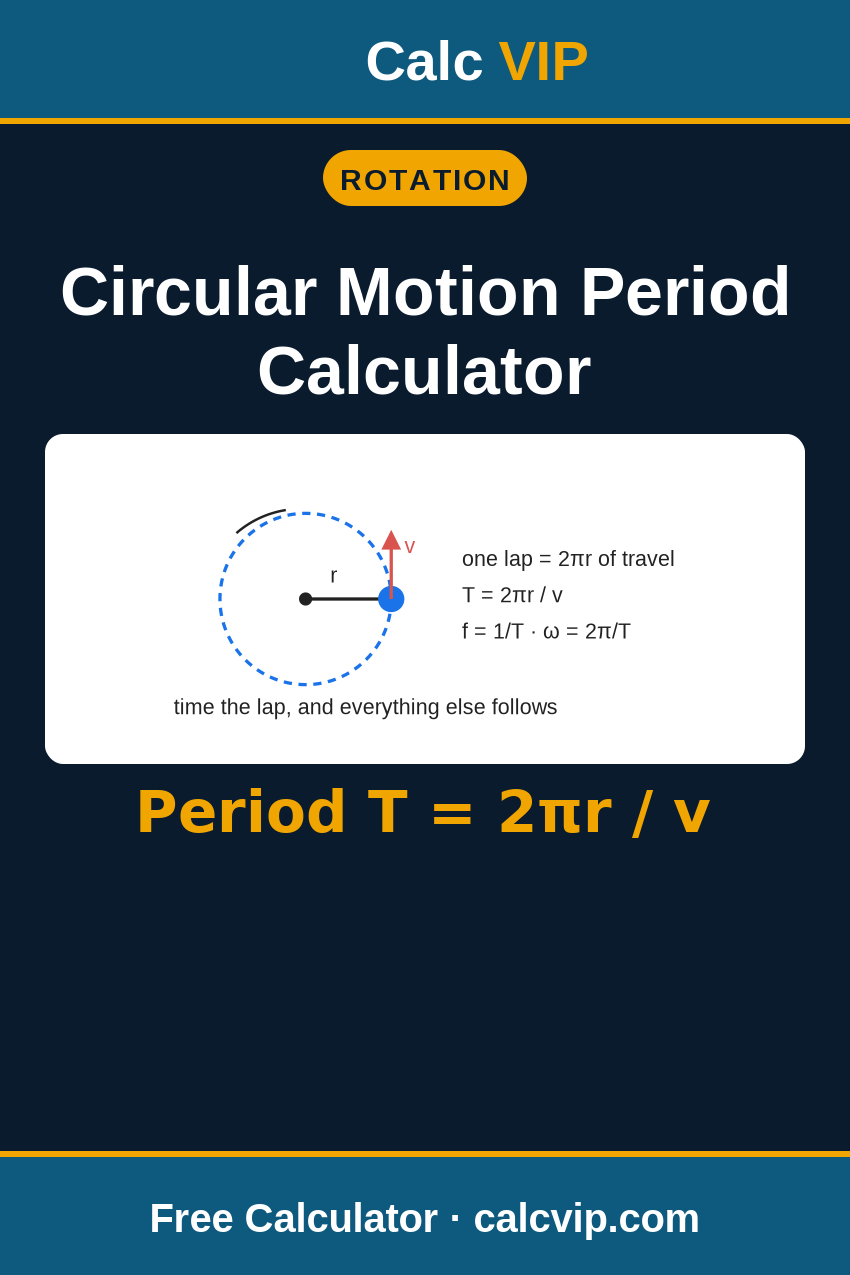
Notice what is absent from T = 2πr/v: the mass. A pebble and a planet on the same circle at the same speed share a period exactly. Mass enters only when you ask what force the lap requires — the centripetal question — not how long it takes. That separation makes the period the cleanest first measurement in any rotating system: time the lap, measure the radius, and the speed, frequency, angular speed and even the centripetal acceleration (a = v²/r, also reported) all follow without ever weighing anything.
Formulas
Period T = 2πr / v • frequency f = 1 / T • angular speed ω = v / r = 2π / T • centripetal acceleration a = v² / r • T in seconds, r in m, v in m/s, f in Hz, ω in rad/s
Two conversions glue this family to the workshop. If the turning is quoted in revolutions per minute, the period is simply T = 60 / rpm seconds — a 33⅓ rpm record has T = 1.8 s before any physics is done. And ω in terms of rpm is ω = rpm × 2π/60. Keep the three quantities straight by their units: seconds per lap (T), laps per second (f), radians per second (ω). The factor 2π lives between f and ω and nowhere else; most errors in this topic are that factor, lost or doubled.
| Symbol | Meaning | Units |
|---|---|---|
| T | period — time for one complete lap | seconds (s) |
| f | frequency — laps per second, f = 1/T | hertz (Hz) |
| ω | angular speed — angle swept per second | rad/s |
| r | radius of the circular path | m |
| v | speed along the path | m/s |
From laps to laws: where Kepler hides in T = 2πr/v
For an orbiting body, the speed is not free — gravity sets it. A circular orbit needs the centripetal requirement met by gravity, which fixes v = √(GM/r), and substituting into this page's formula gives T = 2πr / √(GM/r) = 2π√(r³/GM): Kepler's third law, T² ∝ r³, falling out of a circumference divided by a speed. The numbers in the examples obey it beautifully. The ISS (r = 6.771 × 10⁶ m, T = 5553.97 s) and the Moon (r = 3.844 × 10⁸ m, T = 27.35 days ≈ 2,363,265 s) circle the same Earth: their period ratio is 2,363,265 / 5553.97 ≈ 425.5, and their radius ratio raised to the 3/2 power is (56.77)^1.5 ≈ 427.7 — agreement to within the rounding of the input speeds. One division per orbit, and a law of planetary motion appears.
The same structure explains the architecture of satellite systems. Double an orbit's radius and its period grows by 2^1.5 ≈ 2.83; keep climbing until T reaches one sidereal day and you have found the geostationary ring at r ≈ 42,164 km from Earth's centre — the only circle whose period matches the planet's own turning, which is why the sky's television satellites hang motionless. All of it is this calculator, with gravity choosing v.
How to use
- Enter the radius of the circular path in metres — to the centre of the circle the object actually travels.
- Enter the steady speed in m/s (divide km/h by 3.6; if you know rpm instead, get v from v = ωr or use T = 60/rpm directly).
- Click "Calculate Period" to see the period, frequency, angular speed and centripetal acceleration.
- Cross-check with a stopwatch: time ten laps and divide by ten — the period is the most directly measurable quantity on this page, and agreement validates every other figure.
Worked examples
Example 1 — the stone on a string. A stone moves in a circle of radius r = 2 m at a steady v = 4 m/s:
T = 2π × 2 / 4 = 3.1416 s per lap
f = 1 / 3.1416 = 0.3183 Hz • ω = 4 / 2 = 2 rad/s • a = 4² / 2 = 8 m/s² — a lap every three seconds, leisurely enough to count aloud.
Example 2 — Earth's year. Earth orbits at r = 1.496 × 10¹¹ m with v = 29,780 m/s:
T = 2π × 1.496 × 10¹¹ / 29,780 = 31,563,617 s ≈ 3.1564 × 10⁷ s = 365.32 days. The calendar is this division, rounded by astronomy's finer corrections — and f = 3.1682 × 10⁻⁸ Hz is the slowest frequency you will ever use.
Example 3 — the space station. The ISS circles at r = 6.771 × 10⁶ m (about 400 km up) at v = 7660 m/s:
T = 2π × 6.771 × 10⁶ / 7660 = 5553.97 s ≈ 92.57 minutes — sixteen sunrises a day for the crew, with ω = 0.0011313 rad/s and a = 8.6657 m/s² (the 0.88 g that gravity still provides up there).
Example 4 — the merry-go-round. A roundabout of radius r = 3 m carries its riders at v = 1.5 m/s:
T = 2π × 3 / 1.5 = 12.5664 s, f = 0.0796 Hz, ω = 0.5 rad/s, a = 0.75 m/s². Twelve and a half seconds per turn is the stately pace playground equipment is regulated to — the period is the safety specification, stated in seconds.
Example 5 — the vinyl record. An LP's edge sits at r = 0.15 m; at 33⅓ rpm the surface speed there is v = ωr = 3.4907 × 0.15 = 0.5236 m/s:
T = 2π × 0.15 / 0.5236 = 1.8 s exactly (as T = 60/33⅓ promises), f = 0.5556 Hz. The stylus reads a groove whose features pass at this stately lap rate — audio encoded as wiggles in a 1.8-second circle.
Example 6 — the ceiling-fan tip. A fan blade tip at r = 0.6 m moves at v = 12 m/s:
T = 2π × 0.6 / 12 = 0.3142 s, f = 3.1831 Hz, ω = 20 rad/s, and a = 12² / 0.6 = 240 m/s² — the tip is being wrenched around at 24 g, which is why blade fastenings are engineered, not merely screwed.
Periods in real life
Clocks. The second, minute and hour hands have periods of 60 s, 3600 s and 43,200 s by construction — the original period standards from which the second itself was defined. Every other period in this list is measured against descendants of those turning hands.
Satellite planning. Example 3's 92.57 minutes is the heartbeat of low Earth orbit: ground stations plan contacts, cameras plan exposures, and crews plan sleep around it. Raise the orbit until the period becomes 23 h 56 min and the satellite parks over one longitude — the geostationary trick from the concept section.
Turntables and hard drives. Vinyl at 1.8 s per revolution, a hard-drive platter at 7200 rpm (T = 60/7200 = 0.00833 s): the period sets how long the reading head waits for its data to come around — the "rotational latency" of storage specifications is half this period, on average.
Cyclotrons. In a classic cyclotron, a charged particle's period in the magnetic field is independent of its speed and radius (T = 2πm/qB) — the beautiful exception that lets a fixed-frequency alternating voltage keep kicking the particle every lap. The calculator's formula shows why it works: as r grows, v grows in proportion, and the ratio 2πr/v stands still.
Washing machines. A spin cycle at 1200 rpm has T = 0.05 s; the drum's period, through a = v²/r, becomes the several-hundred-g extraction force that wrings the clothes. The dial's "rpm" is this page's period wearing a disguise: T = 60/rpm.
Fairground regulation. Ride inspectors measure periods with stopwatches because T, with r, fixes v and therefore a — the quantities passengers' bodies actually feel (Example 4). A ride that laps too fast for its radius fails its inspection on this arithmetic alone.
Quick reference: familiar periods
| Circling thing | Period T | Frequency f |
|---|---|---|
| Clock second hand | 60 s | 0.0167 Hz |
| Vinyl LP (33⅓ rpm) | 1.8 s | 0.5556 Hz |
| Ceiling-fan tip (Example 6) | 0.3142 s | 3.1831 Hz |
| ISS orbit | 5553.97 s (92.57 min) | 0.00018 Hz |
| Moon's orbit | 27.35 days (≈ 2.3633 × 10⁶ s) | 4.23 × 10⁻⁷ Hz |
| Earth's orbit | 3.1564 × 10⁷ s (365.32 days) | 3.1682 × 10⁻⁸ Hz |
Read the table top to bottom and you read turning itself slowing down by ten orders of magnitude — yet every row is the same computation, a circumference divided by a speed. There are not many formulas in physics that serve a wristwatch and a planet without modification; this is one.
Frequency, angular frequency, and the 2π that separates them
The commonest confusion in the whole topic is between f and ω. Frequency counts whole laps per second; angular speed counts radians per second; one lap contains 2π radians, so ω = 2πf, always and exactly. A motor "at 50 Hz" in an electrical sense rotates its field at ω = 314.1593 rad/s; a sound wave at 50 Hz has T = 0.02 s but no ω in the circular-motion sense at all (its "ω" in wave theory is the same 2πf by analogy). The calculator reports both f and ω for every input — compare them in any example (0.3183 Hz against 2 rad/s in Example 1) and the factor 6.2832 stares back. Internalise that one ratio and an entire category of textbook errors becomes impossible.
When the lap is not steady: elliptical orbits and the meaning of "the" period
Everything above assumes a constant speed, and nature often declines to provide one. A planet on an elliptical orbit hurries near the Sun and dawdles far from it, so the instantaneous lap time 2πr/v — with r itself changing — is different at every point of the journey. Yet the orbit still has a perfectly definite period: the time to return to the same point, measurable to the second for Mercury or a comet. Kepler's third law survives the generalisation intact, with the semi-major axis a playing the radius's role: T² ∝ a³. Halley's comet, with a period of about 75–76 years and an orbit stretched from inside Venus's path to beyond Neptune's, obeys the same law as the ISS — the average is lawful even when the moment-to-moment motion is not.
The practical lesson cuts both ways. For genuinely circular, steady motion — motors, records, centrifuges, roundabouts — this calculator's T is the whole truth, and a stopwatch will confirm it to three figures. For anything elliptical, pulsed or speeding up, treat the computed figure as the average lap time and say so: it remains the right number for counting laps per hour, scheduling observations and comparing orbits, but it will not tell you where on the lap the object is at a given instant. Period is a property of the whole circuit, not of any point on it.
Common mistakes
- Using the area instead of the circumference. The lap length is 2πr, not πr². The area formula answers "how much disk", not "how far around" — a slip that inflates T by a factor of r/2 and survives unnoticed in large-radius problems.
- Reciprocating the wrong pair. f = 1/T, but ω = 2π/T, not 1/T. Dropping the 2π makes every angular speed 6.28 times too small and poisons downstream torque and power calculations (P = τω) built on it.
- Expecting mass to matter. T = 2πr/v has no mass term: the heavy and light object share a period. If your answer changes when the mass changes, you have solved a force problem by accident — the force question belongs to the centripetal solver, not here.
- Timing from diameter. A "4 m roundabout" is 4 m across; its riders travel at r = 2 m. Feeding the diameter into 2πr doubles the circumference and the period alike.
- Assuming the period is constant when the speed is not. The formula presumes steady v. On an elliptical orbit or a slowing turntable, the instantaneous period 2πr/v changes around the lap and with time; quote it as an average, or not at all.
FAQ
What is the difference between period and frequency?
The period T is the time for one complete lap (seconds per lap); the frequency f is how many laps happen each second (Hz). They are reciprocals: f = 1/T.
Does the period depend on the object's mass?
No. T = 2πr/v contains only the radius and the speed — a heavy and a light object with the same r and v have the same period (though the force needed to hold them in the circle differs).
How does this apply to planets?
A planet's orbital period follows the same idea: T = 2πr/v. Earth, with r ≈ 1.5 × 10¹¹ m and v ≈ 29,800 m/s, takes about 3.16 × 10⁷ s — one year.
How do I get the period from rpm?
Divide 60 by the rpm: T = 60/rpm seconds. A 1200 rpm spin cycle has T = 0.05 s; a 45 rpm record has T = 1.3333 s. It is this calculator's formula with the circumference traded for the rotation count.
Why is ω = 2π/T and not just 1/T?
Because ω counts radians, not laps. One lap sweeps 2π radians, so the radians-per-second figure is 2π times the laps-per-second figure. The calculator shows both so the factor is visible rather than memorised.
Can the period be measured more accurately than it can be calculated?
Usually, yes — time 100 laps with a stopwatch and divide, and your T is good to a fraction of a percent, limited by your reaction time spread over 100 laps. This is why period (and frequency) measurements anchor precision physics: atomic clocks are, at heart, lap counters.
What period does a geostationary satellite have?
Exactly one sidereal day: 86,164 s (23 h 56 min 4 s) — the time Earth takes to turn once relative to the stars. Matching that period is what pins the satellite over one longitude; its radius, about 42,164 km from Earth's centre, is then forced by Kepler's law.
Does a shorter string always mean a shorter period for a whirled stone?
At the same speed, yes: T = 2πr/v shrinks with r. But if the same angular speed is kept instead, T = 2π/ω does not change at all — the stone simply moves slower on the smaller circle. Always ask which quantity is being held fixed.
How does the period relate to centripetal acceleration?
Eliminate v between T = 2πr/v and a = v²/r and you get a = 4π²r/T² — acceleration from a ruler and a stopwatch alone. This is the form used to measure g with a conical pendulum and to weigh planets from their moons' periods.
What is the period of Earth's own rotation?
Relative to the stars, 86,164 s (the sidereal day); relative to the Sun, 86,400 s (the solar day) — the 236 s difference accumulates because Earth advances along its orbit while it turns, needing one extra degree of rotation to bring the Sun back to noon. Two laps, two references, two periods.