 Calc
Flywheel Energy Calculator – Stored Energy from Inertia & RPM
 Created by Elena Petrova · Physics Editor · Fluids & Rotation · Last updated: November 2026
Use this free Flywheel Energy Calculator to find the energy stored in a spinning flywheel from its moment of inertia and its speed in rpm, using E = ½Iω². Enter I in kg·m² and the speed in revolutions per minute.
A flywheel is a battery made of motion. Charge it by spinning it up, and it holds the energy as rotational kinetic energy; draw on it, and it pays the energy back as it slows. No chemistry, no charge leakage in the electrical sense, almost nothing to wear out but the bearings — the idea is older than the steam engine, and it is currently enjoying a second career storing energy for power grids, buses and racing cars. This calculator tells you how much energy a given wheel holds: enter its moment of inertia and its speed in rpm, and it converts the speed to rad/s and applies E = ½Iω², the rotational kinetic energy formula, on your behalf.
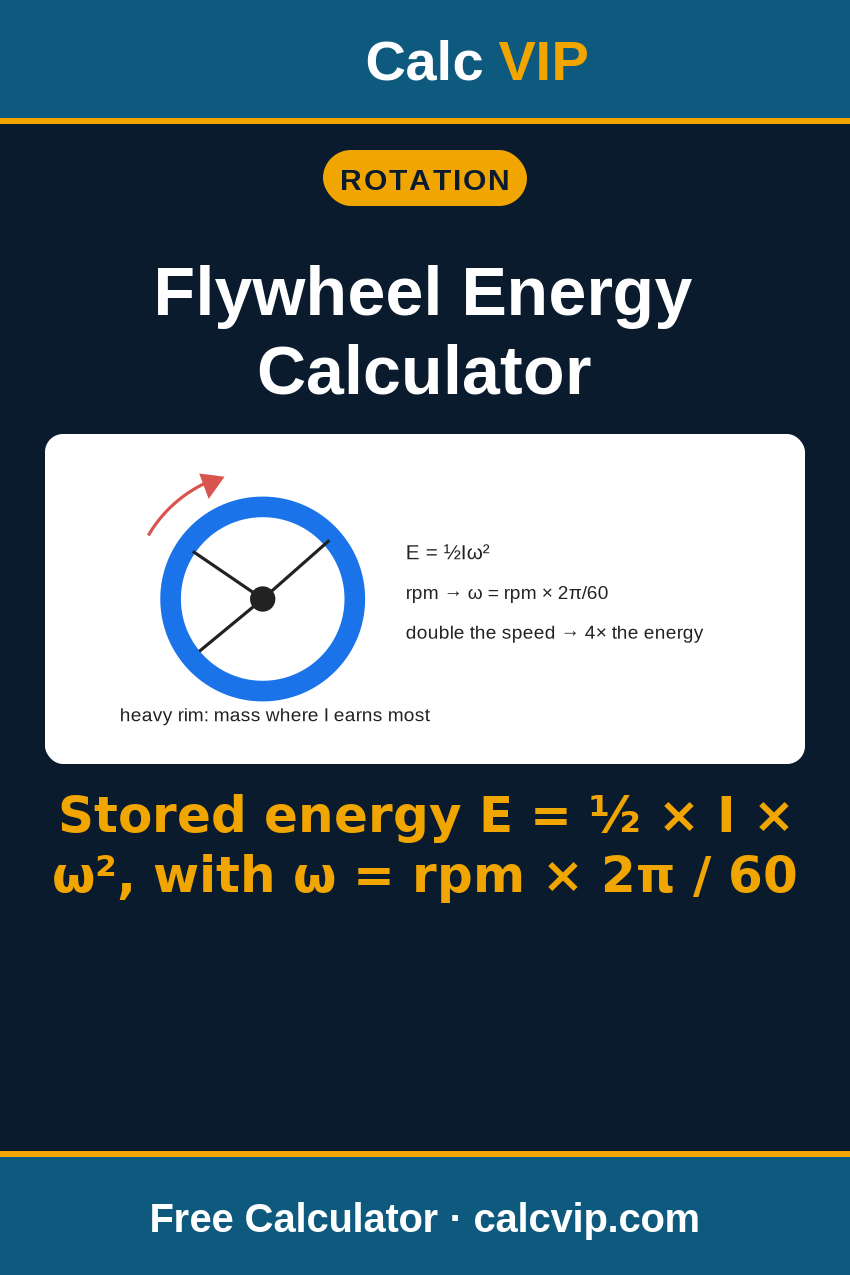
Two design truths are packed into that formula, and every flywheel ever built is a negotiation between them. The first is that stored energy grows in direct proportion to I, the moment of inertia — and I rewards mass placed far from the axle, squared. That is why flywheels are rims with ambitions: heavy rings on light spokes, putting every kilogram where it earns the most. The second truth is sharper: energy grows with the square of the speed. Double the rpm and the same wheel stores four times the energy. This is why modern flywheel stores do not look like mill wheels at all — they are small, impossibly fast rotors of carbon fibre spinning in vacuum chambers at tens of thousands of rpm, buying their capacity with speed rather than size.
The numbers span an almost comic range. The flywheel of a toy or a potter's wheel stores tens or hundreds of joules. An engine flywheel stores thousands. The worked examples below follow one honest mid-sized wheel — I = 5 kg·m² at 600 rpm, holding just under 10 kJ — and then scale up to a grid rotor holding over half a megajoule, enough to run a home for minutes. Along the way sits the flywheel's one great subtlety: you can never spend it all, because a wheel that has slowed to half speed has already given up three quarters of its energy. The usable fraction, not the headline total, is what engineers design around — and this page shows you how to work it out.
Formula
Stored energy E = ½ × I × ω², with ω = rpm × 2π / 60 • E in joules (J), I in kg·m², ω in rad/s
The formula rearranges for the two questions designers ask most: ω = √(2E/I) — the speed a wheel of known inertia must reach to bank a target energy — and I = 2E/ω² — the inertia a target energy demands at a chosen speed. The usable energy between two speeds is the difference of two totals: Eusable = ½I(ω₁² − ω₂²), the workhorse formula of flywheel engineering, used in Example 3 below. Unit discipline: the rpm-to-rad/s conversion is not optional decoration. Skipping it overstates the energy by a factor of (60/2π)² ≈ 91, the most expensive slip in this corner of physics. This calculator performs the conversion for you and reports joules; divide by 1,000 for kJ or by 3,600,000 for kWh.
| Symbol | Meaning | Units |
|---|---|---|
| E | energy stored in the spinning wheel | joules (J) |
| I | moment of inertia of the wheel | kg·m² |
| ω | angular velocity (= rpm × 2π/60) | rad/s |
| rpm | rotational speed | revolutions per minute |
Why the rim rules, and why speed beats size
Look inside I and the flywheel's shape explains itself. The moment of inertia sums each piece of mass times the square of its distance from the axle, Σmr². A kilogram at the rim of a half-metre wheel contributes 0.25 kg·m²; the same kilogram near the hub, at 5 cm, contributes 0.0025 — a hundred times less. So the rational flywheel puts nearly all of its mass in the rim and makes the rest as light as decency allows: the classic cast-iron mill wheel, the potter's kick wheel, and the carbon-fibre grid rotor are the same idea at three levels of technology. A ring of mass M and radius R achieves I = MR², double the ½MR² of a solid disk of the same mass and size — Example 4 puts the two side by side.
But the rim strategy has a ceiling: spin a wheel faster and the rim is pulled outward by its own motion, with stresses that grow as ω² — the same square that makes speed so attractive makes it dangerous. Every material has a rim speed it cannot survive, a few hundred metres per second for steel and around a thousand for carbon fibre wound the right way. That ceiling is why the technology forked. Slow flywheels (engines, presses, potter's wheels) are big, heavy and rim-loaded, turning at hundreds of rpm. Fast flywheels (energy stores, KERS) are small composite rotors in vacuum, on magnetic bearings, at tens of thousands of rpm — living near the stress ceiling because that is where the ω² bargain is richest.
How to use
- Enter the flywheel's moment of inertia I in kg·m². For a rim-style wheel use I ≈ MR²; for a solid disk, I = ½MR²; or measure it with the torque-and-acceleration method described in this batch's torque calculator.
- Enter the rotational speed in rpm, exactly as a tachometer or nameplate reports it — the calculator converts to rad/s for you.
- Click "Calculate Stored Energy" to get the total stored energy in joules.
- For the usable energy, run the calculator again at the lowest speed the wheel may fall to, and subtract: the difference is what your load can actually spend.
Worked examples
Example 1 — the reference wheel. A flywheel with I = 5 kg·m² spinning at 600 rpm:
ω = 600 × 2π/60 = 62.8319 rad/s
E = ½ × 5 × 62.8319² = 9869.6044 J ≈ 9.87 kJ
That is roughly the energy needed to lift a 100 kg mass by 10 metres.
Example 2 — a small, fast rotor. A compact rotor with I = 0.8 kg·m² at 3,000 rpm:
ω = 3000 × 2π/60 = 314.1593 rad/s; E = ½ × 0.8 × 314.1593² = 39,478 J ≈ 39.5 kJ. One fifth of Example 1's inertia, five times its speed — and four times its stored energy. The square wins again.
Example 3 — the usable fraction. Example 1's wheel is allowed to slow from 600 rpm to 300 rpm while driving a load. At 300 rpm, ω = 31.4159 rad/s and E = ½ × 5 × 31.4159² = 2,467.4 J.
Usable energy = 9,869.6 − 2,467.4 = 7,402.2 J — exactly 75% of the total, surrendered while the wheel still turns at half speed. This is the arithmetic behind the FAQ's warning: a flywheel is a battery whose last quarter is practically locked away.
Example 4 — rim versus disk, same mass. Take 20 kg formed two ways at radius 0.5 m. As a rim (ring): I = MR² = 20 × 0.25 = 5 kg·m². As a solid disk: I = ½MR² = 2.5 kg·m². At 600 rpm the rim stores 9,869.6 J (Example 1's wheel) while the disk stores ½ × 2.5 × 62.8319² = 4,934.8 J — precisely half. Shape alone doubled the battery.
Example 5 — a grid-scale rotor. A utility flywheel with I = 100 kg·m² at 1,000 rpm:
ω = 104.7198 rad/s; E = ½ × 100 × 104.7198² = 548,311 J ≈ 548 kJ ≈ 0.152 kWh. Modest as energy, magnificent as power: released in five seconds it delivers about 110 kW, which is the entire point — flywheels sell speed of delivery, not bulk storage.
Example 6 — the potter's wheel. A kick wheel with I = 2 kg·m² turning at a gentle 120 rpm:
ω = 12.5664 rad/s; E = ½ × 2 × 12.5664² = 157.9 J. Small — but spent only against bearing friction and the drag of the potter's hands, it keeps the wheel turning smoothly for minutes between kicks.
Flywheels in real life
Grid stabilisation. Plants of containerised flywheels absorb and inject power in milliseconds to hold a grid's frequency steady — a job batteries do reluctantly and flywheels, with no chemistry to degrade, do for decades. Their nameplate figures come straight from E = ½Iω² and the usable-fraction rule.
UPS backup. Data centres use flywheel uninterruptible power supplies to bridge the seconds between a mains failure and the diesel generators starting. The wheel coasts down through its usable band delivering clean power — Example 3 with a payroll attached.
Hybrid buses and KERS. Braking a bus throws away megajoules as heat; a flywheel hybrid banks a useful share of it in a fast rotor and spends it pulling away again. Formula 1's flywheel KERS stored its harvest in a 5 kg rotor at up to 64,000 rpm — the ω² strategy taken to its limit.
Engines and presses. The oldest job: smoothing. An engine's flywheel carries the crank through the gaps between power strokes, and a punch press's wheel banks energy slowly from a small motor, then spends it in the single violent instant of the punch — power levelling in both directions.
Spacecraft. Reaction wheels are flywheels flown for their momentum rather than their energy: spin one up and the satellite counter-rotates. The same I and ω appear in the attitude equations — the energy ledger and the pointing ledger are the same book.
Ride smoothing in lifts and cranes. Rotating machinery that starts and stops all day uses flywheel effect (sometimes just the motor rotor's own inertia, quoted as GD² in old catalogues) to soften the jolts — the stored ½Iω² absorbs the mismatch between what the motor offers and what the load demands, second by second.
The usable-energy rule, properly
Example 3 deserves a section of its own, because it overturns the way most people first read this calculator. The headline number — total stored energy — is a vanity figure. A load driven by a flywheel usually needs a minimum speed to work at all: a generator must hold its voltage, a press its pace. Below that floor speed the wheel may still be turning, but it is no longer useful. The deliverable energy is therefore the difference between the totals at the top and floor speeds, ½I(ω₁² − ω₂²). Because of the squares, the top of the speed range is where the wealth is: the band from full speed down to half speed holds 75% of everything, the band from half to quarter holds under 19%, and the final crawl to rest holds barely 6%. Practical flywheel systems are specified by a speed ratio — commonly 2:1, banking on that generous top band — and this calculator, run twice, gives you both ends of the subtraction.
Battery engineers will recognise the shape of this problem: it is depth of discharge, in rotational dress. A battery, too, keeps a reserve it prefers not to spend, and its nameplate capacity is not its working capacity. The flywheel's version is kinder in one respect — the reserve costs nothing in lifespan. Draining a flywheel to its floor speed a hundred thousand times leaves it exactly as it was, where a battery pays for every deep cycle with a little of its life. When you compare storage technologies, compare like with like: usable band against usable band, cycle life against cycle life. Run honestly on those terms, the flywheel's modest totals buy a durability no chemical store has yet matched.
Quick reference: familiar flywheels
| Wheel | Typical I | Typical speed | Stored energy (order) |
|---|---|---|---|
| potter's kick wheel | 2 kg·m² | 120 rpm | ≈ 160 J |
| car engine flywheel | 0.15 kg·m² | 3,000 rpm | ≈ 7.4 kJ |
| this page's reference wheel | 5 kg·m² | 600 rpm | ≈ 9.87 kJ |
| grid rotor (Example 5) | 100 kg·m² | 1,000 rpm | ≈ 548 kJ |
| modern composite store | small, by design | 30,000+ rpm | megajoules |
The engine-flywheel row is worth a second look: at cruising speed a family car's flywheel quietly carries about seven kilojoules — comparable to this page's much larger reference wheel — purely because its rpm is five times higher. Speed, once again, is doing the heavy lifting.
Common mistakes
- Skipping the rpm conversion. E = ½Iω² needs ω in rad/s. Feeding rpm straight in overstates the energy by a factor of about 91. This calculator converts for you — but if you check by hand, ω = rpm × 2π/60 comes first, always.
- Designing with the total instead of the usable energy. The wheel cannot deliver its last joules without stopping entirely. Plan on the difference between full-speed and floor-speed totals — usually about 75% for a 2:1 speed band.
- Using the disk formula for a rim wheel (or the reverse). I = MR² versus ½MR² is a factor of two in the answer. Look at where the mass actually is before choosing the formula.
- Assuming a heavier wheel is always better. Beyond the stress ceiling of its material, added speed is forbidden and added rim mass is what bursts wheels. Capacity is bought inside a safety envelope, not by enthusiasm.
- Forgetting the wheel coasts down. A stored-energy figure is a snapshot. Friction and the load drain it continuously, so "how long will it run?" needs the power draw as well: time ≈ usable energy ÷ average power.
FAQ
Why do flywheels have heavy rims?
Mass far from the axle gives a much larger moment of inertia, and stored energy is proportional to I — so a rim-heavy wheel stores far more energy than a solid one of the same weight.
Where are flywheel energy stores used?
In UPS backup systems, grid stabilisers, hybrid buses and KERS in racing cars — anywhere energy must be stored and released again very quickly.
How much energy can I safely use from a flywheel?
Only part of the stored energy is usable: if the wheel slows to half speed, it gives up ¾ of its energy, because E depends on ω².
How do I find my flywheel's moment of inertia?
If it is a rim-style wheel, I ≈ MR² with R the rim's mean radius; if a solid disk, I = ½MR². For an irregular wheel, apply a known torque and measure the angular acceleration, then I = τ/α — the method of Example 6 in this batch's torque calculator. Manufacturers often quote I or GD² directly.
Why are modern energy flywheels kept in a vacuum?
At 30,000 rpm a rotor's surface moves at hundreds of metres per second, and air drag at such speeds is a serious brake and a source of heat. A vacuum removes the drag, and magnetic bearings remove contact friction — together they let a charged wheel hold most of its energy for hours.
How long can a flywheel hold its energy?
A traditional engine or press flywheel is meant to hold it for seconds. A modern storage rotor on magnetic bearings in vacuum loses only a few percent per hour. A simple open wheel on ordinary bearings may coast down in minutes — try Example 6's wheel: friction decides, and the formula gives the size of the account, not the leak rate.
Flywheel or battery — which stores more?
Per kilogram, a lithium battery stores far more energy than any flywheel. The flywheel wins on power (it can charge and discharge in seconds), on lifetime (hundreds of thousands of cycles with no chemistry to fade) and on knowing its state of charge exactly — just measure the speed. The two technologies are complements, not rivals.
What happens if a flywheel breaks?
All of E = ½Iω² is released at once, which is why large flywheels live in containment housings. Steel wheels can throw fragments; carbon-fibre rotors are designed to unravel into comparatively harmless fibres. The energy figure from this calculator is precisely the quantity the containment must be designed against.
Does the wheel's energy depend on which way it spins?
No. ω enters squared, so clockwise and anticlockwise store identical energy. Direction matters for machinery (threads, pumps and gyroscopic effects care), but the energy ledger does not.
Can a flywheel charge itself back up from the load?
That is exactly regenerative braking: the load — a braking bus, a descending crane hook — drives the wheel faster, banking its kinetic energy as a higher ω. The formula runs both ways because it is an account, not a one-way valve.