 Calc
Belt & Pulley Speed Calculator – Output RPM from Pulley Diameters
 Created by Elena Petrova · Physics Editor · Fluids & Rotation · Last updated: November 2026
Use this free Belt & Pulley Speed Calculator to find the output rpm of a belt drive from the two pulley diameters and the driver speed. Enter the driver pulley diameter, its rpm, and the driven pulley diameter — and get the output speed, the ratio and the belt speed.
A belt drive is a conversation between two pulleys held at a distance, and the belt itself is the messenger: whatever speed its surface travels at, both pulleys must agree to. That single fact writes the whole mathematics of this page. The driver pulley's surface moves at v = πD₁ × rpm₁/60; the belt carries that speed unchanged to the second pulley; so the output speed is fixed by the diameters alone — output rpm = input rpm × D₁/D₂. A small pulley driving a large one slows the output and strengthens it, exactly as a gear pair would, but smoothly, quietly, over metres of distance if needed, and with a built-in forgiveness gears cannot offer: overload it, and the belt slips instead of breaking teeth. This calculator returns the output rpm, the drive ratio and the belt speed itself.
The belt speed, often overlooked, is the third character in the story. It is the actual velocity of the power in transit — the quantity that decides how much power a given belt tension can carry (P = (T₁ − T₂) × v), how hot the belt runs, and whether the drive is in its efficient band at all. Too slow, and the required tension grows until bearings complain; too fast — beyond roughly 30 m/s for classic V-belts — and centrifugal effects lift the belt off the pulleys and grip evaporates. The worked examples keep a bench grinder's honest 7.54 m/s in view as the reference case, then push the speed both ways so you can see the trade.
Belt drives survive in a world of gears and direct drives because they solve problems the others cannot: they span distance cheaply, isolate vibration (the driven machine never feels the motor's judder through a steel path), run quietly, need no lubrication, and fail politely. From the line shafts of Victorian mills — one engine, a forest of belts — to the serpentine belt snaking around a modern car engine's accessories, the principle on this page has been in continuous service for two centuries. Enter your three numbers and it goes to work for you too.
Formula
Output speed = input rpm × D₁ / D₂ • Ratio = D₂ / D₁ • Belt speed v = π × D₁ × input rpm / 60 • D in the same unit for the ratio; D in metres for v in m/s
The formulas rest on the no-slip condition at each pulley: belt speed = surface speed, πD × rpm/60, at both ends, so D₁ × rpm₁ = D₂ × rpm₂ — the belt drive's analogue of the gear law N₁rpm₁ = N₂rpm₂, with diameters standing in for teeth. The set rearranges for design: to hit a target output, the driven pulley must be D₂ = D₁ × input rpm / target rpm; to choose a driver for a fixed driven pulley, D₁ = D₂ × target rpm / input rpm (Example 6). Torque follows the gear pattern too: slowing the output by the ratio D₂/D₁ multiplies the torque by the same factor, minus a few percent for belt losses. One caution is built into the units: the ratio is unit-free (any consistent unit works), but belt speed needs D in metres — a diameter left in centimetres makes v a hundred times too large.
| Symbol | Meaning | Units |
|---|---|---|
| D₁ | driver pulley diameter | cm (m for belt speed) |
| D₂ | driven pulley diameter | cm (m for belt speed) |
| rpm₁, rpm₂ | driver and driven speeds | rpm |
| v | belt speed (surface speed of both pulleys) | m/s |
| ratio | D₂/D₁ — input turns per output turn | — (written as ratio : 1) |
One belt speed, two pulleys: the idea that runs the page
It is worth pausing on the belt speed, because it is the physical quantity the whole drive negotiates around. A belt is (very nearly) inextensible: the metre of belt that leaves the driver each second must arrive at the driven pulley in the same second, or belt would pile up somewhere. So the surface speeds match — not approximately by design, but necessarily by accounting. The small pulley compensates for its size with rpm; the large pulley trades rpm for circumference; the belt neither knows nor cares. This is why the centre distance between the pulleys appears nowhere in the speed formulas: stretch the drive across a factory floor and the bookkeeping is unchanged, only the belt gets longer. Distance affects the belt's length, its wrap angles and its life — never its ratio.
The same accounting explains the belt drive's one act of mercy. A gear pair under shock load transmits the shock, tooth to tooth, until something chips. A belt under the same shock slips for an instant — the no-slip condition breaks briefly and sacrificially, the energy goes into a squeal and a whiff of heat, and the machinery survives. Engineers exploit this deliberately, sizing belt drives as mechanical fuses for augers, crushers and mower decks: the cheapest component in the drive is nominated to fail first, softly. The 1–2% speed loss the FAQ attributes to creep is the quiet, everyday version of the same compliance.
How to use
- Enter the driver pulley's diameter D₁ — the pulley on the motor or input shaft. The calculator's fields are labelled in centimetres; any consistent unit works for the ratio, but keep centimetres for the belt-speed figure to read correctly (it converts internally).
- Enter the driver's speed in rpm, from the motor nameplate or a tachometer.
- Enter the driven pulley's diameter D₂.
- Click "Calculate Output rpm" to get the output speed, the drive ratio and the belt speed. Expect the real output to sit 1–2% below the calculated figure under load, from belt creep — the FAQ explains.
Worked examples
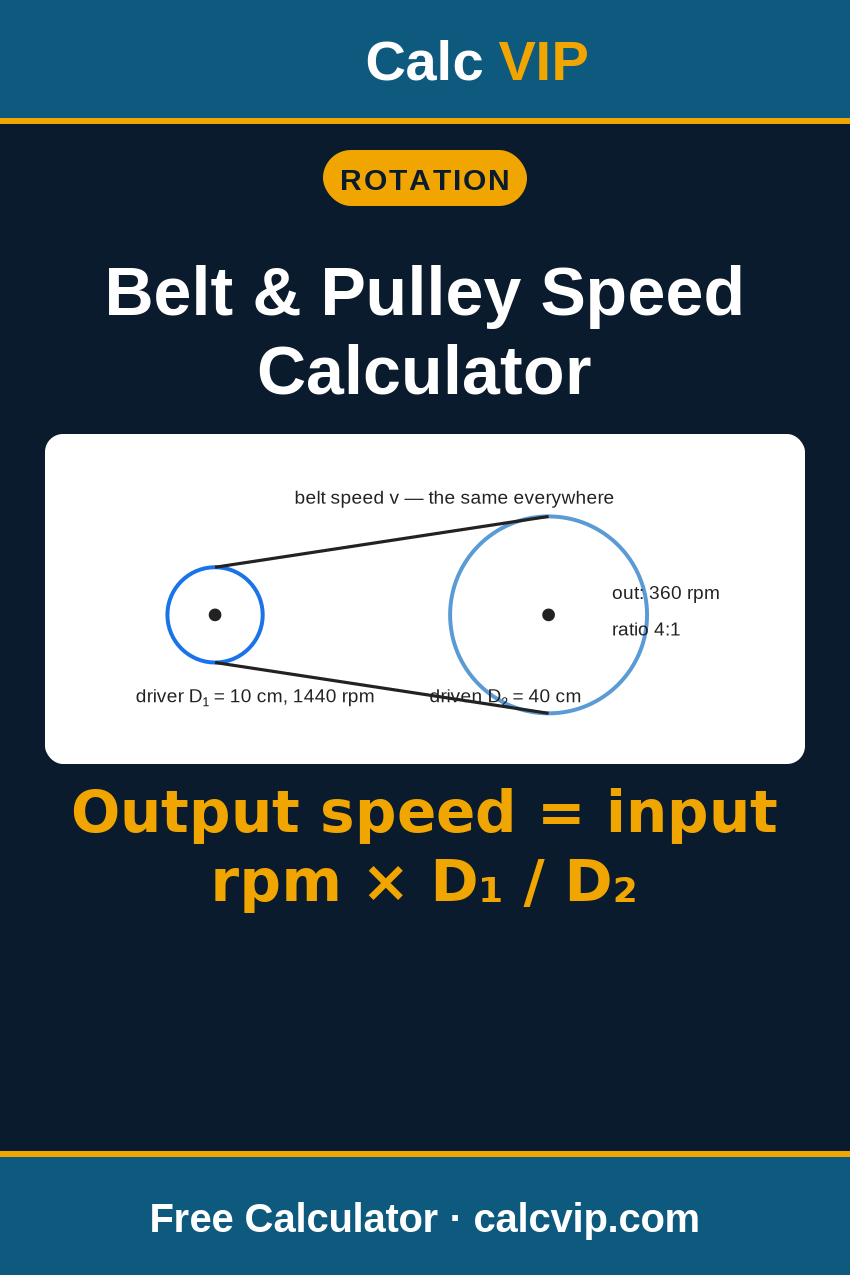
Example 1 — the bench drive. A motor pulley of D₁ = 10 cm at 1440 rpm drives a pulley of D₂ = 40 cm (typical bench-grinder / lathe setup):
Output speed = 1440 × 10/40 = 360 rpm
Belt speed = π × 0.10 m × 1440/60 = 7.5398 m/s
The big pulley turns four times slower — and delivers roughly four times the torque.
Example 2 — a speed increaser. Reverse the sizes: D₁ = 30 cm driving D₂ = 10 cm, input 600 rpm:
Output = 600 × 30/10 = 1,800 rpm; belt speed = π × 0.30 × 600/60 = 9.4248 m/s. This is the arrangement inside many a drill press's ancestor and every cream separator ever cranked — modest input, frantic output, torque traded away.
Example 3 — an air compressor. A motor at 2,800 rpm with D₁ = 8 cm drives a compressor pump with D₂ = 20 cm:
Output = 2800 × 8/20 = 1,120 rpm; belt speed = π × 0.08 × 2800/60 = 11.7286 m/s — comfortably inside the efficient band for a V-belt, which is no accident: the pulley sizes were chosen by someone running this page's numbers.
Example 4 — equal pulleys. D₁ = D₂ = 15 cm at 900 rpm: output = 900 × 15/15 = 900 rpm, ratio 1:1, belt speed = π × 0.15 × 15 = 7.0686 m/s. A 1:1 belt drive changes nothing about the speed — it exists to move power across a distance, or around a corner of the machine, which is a perfectly good reason.
Example 5 — the honest figure, with slip. Example 1's ideal output is 360 rpm. With a typical 2% loss to creep and slip under load, the shaft actually turns at 360 × 0.98 = 352.8 rpm. For a grinder, nobody cares; for a metering pump or a timing-sensitive process, that 7 rpm is exactly why toothed belts — which cannot creep — exist.
Example 6 — designing backwards. You need 500 rpm at a machine whose pulley is fixed at D₂ = 25 cm, from a 1,500 rpm motor. Required driver: D₁ = D₂ × target/input = 25 × 500/1500 = 8.33 cm. Choose the nearest stock pulley — 8 cm gives 480 rpm, 9 cm gives 540 rpm — and the ratio formula prices each compromise before you spend anything.
Belt drives in real life
The car's serpentine belt. One long belt, driven by the crankshaft pulley, snakes around the alternator, water pump, power-steering pump and air-conditioning compressor — each accessory's pulley diameter setting its speed by this page's ratio, all from a single driver. Its routing diagram, printed under every bonnet, is a belt-speed map.
Workshop machinery. The classic drill press and lathe use stepped pulleys — cones of three or four diameters facing opposite ways — giving a menu of ratios by moving one belt. Each step is an Example 1 with different diameters; machinists have selected speeds this way for a century and a half.
HVAC and fans. Most large air-handling fans are belt-driven precisely because the ratio is adjustable: swap a pulley, and the fan's rpm — and with it the airflow, which scales directly — is retuned without touching the motor. Commissioning engineers carry a box of pulleys and this formula.
Agricultural machinery. Threshers, augers and PTO-driven equipment live on belt drives because of the sacrificial slip described above: a jam in the machine slips the belt instead of snapping a shaft. The belt is the fuse, and it is replaced in minutes with hand tools.
CVT transmissions. A scooter's or snowmobile's continuously variable transmission is a belt drive whose pulleys change diameter on the move — squeezing the belt outward on one pulley and letting it sink on the other varies D₁/D₂ continuously, and with it the ratio. Every CVT is this calculator with its diameters in motion.
Timing belts. Where slip is forbidden — an engine's camshaft must stay in step with its crankshaft — the belt grows teeth and the pulleys grow grooves, and the drive becomes a gear pair in flexible form: ratio set by tooth counts, creep abolished, and the formulas of this batch's gear page take over.
Open belts, crossed belts and wrap: the fine print
Two routings exist. In an open belt drive the belt runs straight from pulley to pulley without crossing; both pulleys turn the same way, and the belt's two runs are parallel. In a crossed belt drive the belt is given a half-twist between the pulleys, forming an X; the driven pulley turns the opposite way, and — a small bonus — the wrap angle on each pulley grows, improving grip. The speed arithmetic is identical in both, because the belt-speed bookkeeping does not care about direction; the FAQ's first answer says as much. Wrap matters for a subtler reason: power capacity grows with the angle of contact on the smaller pulley, since more of its surface is gripped. Crossed belts, longer centre distances and idler pulleys that press the belt into a deeper wrap are all ways of buying wrap when a drive slips — geometry in service of friction, while the ratio minds its own business overhead.
Quick reference: what pulley pairs do
| Driver → Driven | Ratio | Output (from 1,440 rpm) | Character |
|---|---|---|---|
| 10 cm → 40 cm | 4:1 | 360 rpm | strong reducer (Example 1) |
| 10 cm → 20 cm | 2:1 | 720 rpm | gentle reducer |
| 15 cm → 15 cm | 1:1 | 1,440 rpm | distance carrier |
| 20 cm → 10 cm | 1:2 | 2,880 rpm | speed increaser |
| 30 cm → 10 cm | 1:3 | 4,320 rpm | strong increaser (Example 2's family) |
The table's symmetry is the whole subject in miniature: read it top-down and speed bleeds away into torque; read it bottom-up and torque is spent buying speed. The belt, indifferent, simply insists that both pulleys share its one travelling speed.
Common mistakes
- Inverting the diameter ratio. Output = input × D₁/D₂ — driver over driven. Swap them and a 4:1 reducer becomes a 1:4 increaser on paper, wrong by a factor of sixteen in speed. Anchor it physically: the bigger pulley always turns slower.
- Mixing centimetres and metres in the belt speed. The ratio forgives any unit; v = πD × rpm/60 does not. D must be in metres for m/s — Example 1's 0.10 m, not 10, is what produces the correct 7.5398 m/s.
- Promising the ideal rpm to a timed process. Creep and slip shave 1–2% under load (Example 5). For fans and grinders, irrelevant; for metering and timing, use a toothed belt or measure the shaft directly.
- Ignoring the belt-speed band. A correct ratio at a foolish belt speed is still a bad drive: below a few m/s the tension needed grows brutal, and beyond roughly 30 m/s a classic V-belt loses its grip to centrifugal lift. Check the calculator's v figure, not just its rpm.
- Measuring the pulley's outside flange instead of the pitch diameter. The belt rides in the groove, and its effective diameter is the pitch diameter where the belt's neutral line sits — slightly inside the visible rim. A millimetre or two of flattery here becomes a percent of phantom speed there.
FAQ
What is the difference between an open belt and a crossed belt?
With an open belt both pulleys rotate in the same direction. Crossing the belt makes the driven pulley rotate the opposite way — the speed formula is exactly the same.
Does the distance between the pulleys matter?
Not for the speed. Centre distance affects belt length and grip, but the rpm ratio depends only on the two diameters.
Why is the real output sometimes a little lower?
Belts can slip and stretch slightly (creep), typically losing 1–2% of speed under load. Toothed (timing) belts avoid this because the teeth lock into the pulleys.
How is a belt drive different from a gear drive, in numbers?
The ratio law is the same shape — output = input × (driver size)/(driven size) — with diameters in place of teeth. The differences are in behaviour: belts span distance, run quietly and slip protectively, but surrender 1–2% to creep; gears are exact and compact but rigid, noisy and unforgiving of shock.
What belt speed is best?
Classic V-belts are happiest around 20–25 m/s, work acceptably from about 5 m/s, and lose grip beyond roughly 30 m/s as centrifugal force lifts them from the grooves. Flat belts tolerate higher speeds; toothed belts are chosen for exactness rather than speed. The calculator's belt-speed output exists so you can check your drive against its band.
Can a belt drive increase torque?
Yes, exactly as gears do: reduce the speed by 4:1 (Example 1) and the output torque ideally quadruples, because power is conserved. In practice the belt's grip caps the multiplication — beyond a certain torque the belt simply slips, which is the drive declining the transaction rather than failing at it.
How do I calculate the belt length I need?
For an open drive, approximately L ≈ 2C + (π/2)(D₁ + D₂) + (D₂ − D₁)²/(4C), where C is the centre distance — the two straight runs, the two half-wraps, and a small correction for unequal pulleys. Speed never enters it; length is pure geometry, which is why it is not this calculator's job.
Why does my driven pulley turn the wrong way?
Because the belt is crossed, or an extra idler is in the path. Fit an open belt for same-direction rotation, cross it to reverse. The speeds from this calculator are unaffected — only the sense of rotation changes, as the first FAQ describes.
What does a slipping belt sound and look like?
A squeal at start-up or under sudden load, a glazed shiny surface on the belt's inner face, black dust near the pulleys, and an output speed sagging well beyond the honest 1–2%. Causes: low tension, worn grooves, oil contamination, or a load the drive was never sized for — in roughly that order of likelihood.
Do chains follow the same formula?
In spirit, yes — but count sprocket teeth instead of measuring diameters, and the creep term vanishes because the chain cannot stretch its way around a sprocket. Chain output = input × (driver teeth)/(driven teeth), exact like gears, at the price of noise, lubrication and wear.