 Calc
Centripetal Force Solver Calculator – F = mv²/r Solve for Force, Mass, Speed or Radius
 Created by Elena Petrova · Physics Editor · Fluids & Rotation · Last updated: November 2026
Use this free Centripetal Force Solver Calculator to rearrange F = m × v² / r any way you like: find the centripetal force, or solve for the mass, the speed or the radius of the circular path.
Anything that moves in a circle is accelerating towards the centre, and something must supply the force for that acceleration. That force — tension in a string, friction under tyres, gravity on a moon, the wall of a centrifuge tube — is called centripetal, and its size is fixed by one compact law: F = mv²/r. The law has a personality dominated by the square: double the speed and the required force quadruples. Nearly every surprise in circular motion — why fast corners are treacherous, why centrifuges are mighty, why the Moon needs 10²⁰ newtons to stay with us — is that square, working.
"Centripetal" names a job, not a substance. There is no centripetal ingredient added to a system; there is only the ordinary force (or combination of forces) that happens to point at the centre and does the turning. The equation is therefore a requirement: for a mass m to hold a circle of radius r at speed v, the inward forces must sum to mv²/r. Fall short and the circle widens or breaks; exceed it and the circle tightens. Engineering with circles — roads, rides, orbits, rotors — is the art of arranging for the requirement to be met exactly, with margin.
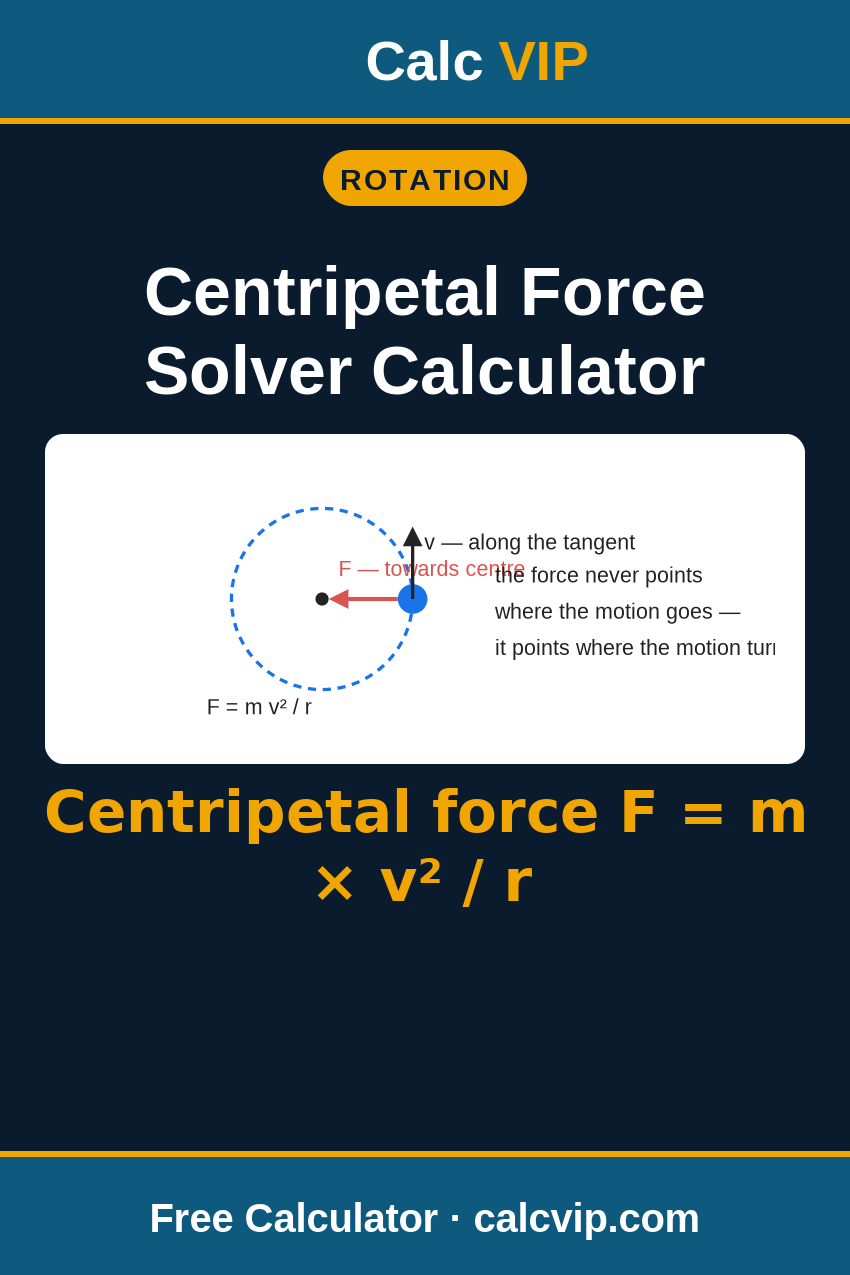
This solver rearranges the requirement in all four directions. Find the force a motion demands; or, given a force budget — the friction a tyre can muster, the tension a string can bear — solve for the mass it can hold, the speed it permits, or the radius it needs. The speed mode, v = √(Fr/m), is the safety engineer's favourite: it turns a grip limit into a maximum cornering speed in one square root.
Formulas
Centripetal force F = m × v² / r • F in newtons (N), m in kg, v in m/s, r in m
The four faces of the law: F = mv²/r, m = Fr/v², v = √(Fr/m), r = mv²/F. Behind them stands the centripetal acceleration a = v²/r, with F = ma in its familiar form — the force law and the acceleration law are one statement. Two unit habits keep the arithmetic honest: speeds quoted in km/h must be divided by 3.6 to become m/s before they are squared (a 10% speed error becomes a 21% force error after squaring), and r is always the radius of the path — half the diameter, measured to the centre of the circle the mass actually travels.
| Symbol | Meaning | Units |
|---|---|---|
| F | net inward (centripetal) force required | newtons (N) |
| m | mass of the circling object | kg |
| v | speed along the circle (tangential) | m/s |
| r | radius of the circular path | m |
| a | centripetal acceleration, a = v²/r | m/s² |
The v² law and why speed is unforgiving
Every term in F = mv²/r is linear except the speed, and the speed is squared. The consequences run through daily life. A car that takes a bend at 30 m/s needs four times the tyre friction of the same bend at 15 m/s — not twice. Road designers know the curve of accidents against speed is this square wearing a disguise. The same square, working for good, is the centrifuge: a laboratory rotor at 6000 rpm with r = 0.1 m moves its samples at v = 62.8319 m/s, and a = v²/r = 39,478.42 m/s² — about 4,024 times gravity — from a motor no bigger than a kettle's. Whenever circular motion astonishes, look for the square.
The radius works the opposite way and just as powerfully: halve r at fixed speed and the required force doubles. It is why the tightest corner on a road, not the fastest straight, sets the grip problem; why a satellite in low orbit (small r from Earth's centre, but enormous v) needs gravity's full strength; and why the solver's radius mode — r = mv²/F — answers the practical question "how wide must this turn be for the grip we have?"
How to use
- Choose what you want to find from the drop-down menu — force, mass, speed or radius. Its input box disappears.
- Enter the other three values: mass in kg, speed in m/s (divide km/h by 3.6), radius in metres, force in newtons.
- Click "Calculate" to see the missing value with the working shown.
- For "how fast dare I go" questions, use speed mode with F set to the maximum inward force available — tyre friction, string strength, or a passenger-comfort limit on a = v²/r.
Worked examples
Example 1 — the ball on a string. A ball of mass m = 2 kg whirls in a circle of radius r = 5 m at v = 10 m/s:
F = 2 × 10² / 5 = 200 / 5 = 40 N
Check the reverse: v = √(40 × 5 / 2) = √100 = 10 m/s ✓ — the string's tension must supply all 40 N, about the weight of a 4 kg mass.
Example 2 — a car cornering. A car of m = 1200 kg takes a bend of radius r = 50 m at v = 15 m/s (54 km/h):
F = 1200 × 15² / 50 = 1200 × 225 / 50 = 5,400 N of friction must act sideways. Try 30 m/s in the calculator and the demand leaps to 21,600 N — beyond most tyres on most roads, which is the v² law writing the accident statistics.
Example 3 — solving for the mass. A rotating ride's restraints and structure can supply F = 800 N of inward force at r = 10 m for a gondola moving at v = 20 m/s:
m = F × r / v² = 800 × 10 / 400 = 20 kg — the maximum mass (gondola share plus passenger share) that station of the ride may carry at that speed.
Example 4 — solving for the safe speed. A car's tyres can muster at most F = 2000 N of sideways friction per the axle loading in question; the car is m = 900 kg and the bend has r = 30 m:
v = √(F × r / m) = √(2000 × 30 / 900) = √66.67 = 8.165 m/s — about 29 km/h. Above that speed the required force exceeds the available friction and the car runs wide, whatever the steering wheel says.
Example 5 — the Moon's leash. The Moon (m = 7.35 × 10²² kg) circles at v = 1022 m/s with r = 3.844 × 10⁸ m:
F = 7.35 × 10²² × 1022² / 3.844 × 10⁸ ≈ 1.9971 × 10²⁰ N. That is gravity's inward pull on the Moon, and its acceleration is a gentle v²/r = 0.00272 m/s² — a huge force producing a tiny acceleration, because the mass is astronomical too.
Example 6 — the laboratory centrifuge. A sample of m = 0.01 kg rides at r = 0.1 m in a rotor at 6000 rpm, so v = ωr = 628.3185 × 0.1 = 62.8319 m/s:
F = 0.01 × 62.8319² / 0.1 = 394.7842 N on a 10-gram sample — an acceleration of 39,478.42 m/s² ≈ 4,024 g. This is how centrifuges persuade particles to settle in minutes that gravity would need days for.
Centripetal force in real life
Roads and banking. On a flat bend, friction alone must meet the mv²/r requirement (Examples 2 and 4). Banking the road tips the normal reaction inward, letting a component of the car's own weight help — the reason velodromes and motorway slip roads are tilted, and the reason ice, which deletes friction, makes even gentle bends into radius problems.
Orbits. For a satellite, gravity is the centripetal force and the equation sets the only possible speed for each radius: the ISS at r = 6.771 × 10⁶ m must travel at the speed giving a = v²/r = 8.6657 m/s² (0.88 g), which gravity at that height exactly provides. Slower, and the circle cannot close — the craft falls into an ellipse.
Washing machines and salad spinners. The drum's wall pushes the clothes inward with the required force; the water, reaching a hole where no wall exists, finds no inward force and leaves tangentially. Spin drying is centripetal bookkeeping with plumbing.
Roller coasters and stunt flying. At a loop's top the requirement is met by gravity plus the track's push; pilots and riders feel the difference between the supplied force and gravity as the "g-force". Designers use this solver's equation, plus the vertical-circle energy rules, to keep that difference inside human limits.
Centrifuges everywhere. From blood labs (Example 6) to uranium enrichment, the recipe is identical: small r, enormous ω, and the v² term doing in minutes what settling cannot. Industrial cream separators were the 19th century's version of the same insight.
The hammer throw and the sling. The athlete's arms and the wire must supply mv²/r for a 7.26 kg ball at over 25 m/s — several kilonewtons through the hands. Release removes the force entirely, and the ball obeys: straight line, tangent, exactly as Newton promised.
Quick reference: centripetal acceleration in g's
| Speed v (m/s) | Radius r (m) | a = v²/r (m/s²) | In g's |
|---|---|---|---|
| 10 | 10 | 10 | 1.02 |
| 20 | 20 | 20 | 2.04 |
| 30 | 50 | 18 | 1.83 |
| 15 | 30 | 7.5 | 0.76 |
| 62.8319 | 0.1 | 39,478.42 | 4,024 |
Humans tolerate sustained accelerations of a few g; roads are designed so ordinary driving stays well under 0.3 g sideways. The table's last row is the centrifuge's reminder that machinery plays by different limits entirely.
Free-body honesty: never draw "centripetal" as an extra arrow
The commonest diagram error in the whole topic is drawing the usual forces (tension, gravity, friction) and then adding a separate arrow labelled "centripetal force". That double-counts: the centripetal force is the inward sum of the real forces, not an addition to them. For the ball on a string, tension alone is the centripetal force. For the cornering car, friction alone is. For the Moon, gravity alone is. The equation F = mv²/r then reads as a balance to check — real inward forces on the left, requirement on the right — and this solver's job is to evaluate the right-hand side so you can compare it with what your real forces can supply. Keep the bookkeeping clean and circular-motion problems lose their reputation for trickery.
Banked curves: letting the road share the work
Tilt the surface and friction no longer works alone. On a bank angled at θ, the normal reaction — always perpendicular to the surface — leans inward, and its horizontal component helps supply mv²/r. At one special speed friction is not needed at all: the components balance when tanθ = v²/(r g). For a bend of r = 100 m banked for v = 20 m/s, tanθ = 400 / (100 × 9.81) = 0.4077, so θ ≈ 22.18° — the steep wall of a velodrome, arrived at from this page's equation plus one triangle. Slower vehicles slide down the bank (friction acts up-slope), faster ones climb it (friction acts down-slope), and the calculator's force figure is the total the two must jointly provide at any speed. Aircraft do the same in mid-air: a coordinated turn banks the lift vector so a component of lift becomes the centripetal force, and passengers feel only a slightly heavier seat.
Artificial gravity: the equation as a design tool
Run the law in design mode and it sizes rotating space stations. To fake Earth gravity at the rim of a station of radius r = 100 m, the rim's centripetal acceleration must equal g: ω = √(g/r) = √(9.81/100) = 0.3132 rad/s — one revolution every 20.06 s, a rim speed of 31.32 m/s. Halve the radius and the same gravity needs ω = 0.443 rad/s, but the difference in acceleration between a crew member's head and feet doubles — the comfort argument for large, slow stations over small, fast ones. Every rotating-habitat proposal is, at its core, this solver's acceleration form with a chosen g.
Common mistakes
- Squaring the speed in km/h. v must be in m/s before squaring. 54 km/h is 15 m/s; squaring "54" inflates the force by (3.6)² ≈ 13 times. Divide by 3.6 first — always.
- Using the diameter as r. The law takes the radius of the path. A "2 m wide" turntable's edge is at r = 1 m; feeding in 2 halves the true force demand and flatters every safety margin built on it.
- Inventing centrifugal force in an inertial frame. In the laboratory frame there is no outward force on the circling object — only the inward requirement and, if it fails, a tangential exit. "Centrifugal" belongs to the rotating frame's accounting; mixing frames mid-problem manufactures forces that do not exist.
- Expecting the force to depend on the direction of travel. Clockwise or anticlockwise, the requirement mv²/r is identical — v enters squared and r is a length. Direction matters for the vector's orientation, never for its size.
- Forgetting that several forces can share the job. At the top of a loop, gravity and the track's reaction add to meet the requirement; on a banked road, friction and the tilted reaction share it. Solving as if one force must do everything overstates the demand on each — the law constrains only the sum.
FAQ
What provides the centripetal force?
It is not a new force — it is the job done by tension, friction, gravity or a normal reaction, whichever acts towards the centre. A ball on a string is pulled in by tension; the Moon is pulled in by Earth's gravity.
What happens if the speed doubles?
The required force goes up by 2² = 4 times, because F depends on v². That is why sharp, fast cornering needs so much grip.
Is centripetal force the same as centrifugal force?
No. Centripetal force is the real inward force. "Centrifugal force" is the apparent outward push you feel in a rotating frame — it is not a real force acting on the object.
What happens when the required force is not available?
The object cannot hold the circle: it moves into a wider path (a car running wide) or leaves the circle entirely along the tangent (a released hammer throw). Nature does not negotiate the requirement — she simply changes the trajectory.
Does the centripetal force do any work?
No. It acts at right angles to the motion at every instant, so it changes the velocity's direction without changing its size — the speed, and hence the kinetic energy, stays constant in uniform circular motion. Work requires a force component along the displacement; there is none.
Why do pilots black out in tight turns?
Because a = v²/r in a fast, tight turn reaches 5–9 g, draining blood from the brain. The force the seat must supply is m × a — for an 80 kg pilot at 7 g, about 5,494 N. Training centrifuges reproduce exactly this with the solver's equation.
Can the centripetal force ever point outward?
By definition, no — "centripetal" means centre-seeking. If the net force on an object points outward, the object is not in circular motion about that centre at all. Outward net forces appear in spiralling-out trajectories, which are not circles.
How does this apply to electrons and atoms?
In the Bohr model, the Coulomb attraction plays the centripetal role: e²/(4πε₀r²) = mv²/r sets the allowed orbits. Real quantum mechanics replaces the picture, but the force-balance bookkeeping survives as the virial relations — the same equation, wearing a lab coat.
What radius should I use for a car on a roundabout?
The radius of the path the car's centre of mass actually follows — roughly the lane's radius, not the roundabout's kerb-to-kerb diameter. Measure to the middle of the car's circular path; using the full road width understates the force demand.
Is there a maximum possible centripetal force for a car?
Yes: friction's ceiling, roughly μ × m × g for the tyres on that surface. Set F to that ceiling in speed mode and the calculator returns the fastest survivable corner — about √(μgr) — the single most useful number in vehicle dynamics.