 Calc
Gear Ratio Calculator – Output RPM & Torque from Teeth Counts
 Created by Rachel Novak · Senior Editor · All Topics · Last updated: November 2026
Use this free Gear Ratio Calculator to find the output speed and output torque of a gear pair from the teeth counts of the driver and driven gears. Enter both teeth counts, the input speed in rpm and the input torque.
Gears are the negotiators of the mechanical world: they trade speed for torque, or torque for speed, at a rate fixed by their teeth. A small gear driving a large one slows the output down and multiplies its twisting force; a large gear driving a small one does the opposite. The exchange rate is the gear ratio — driven teeth divided by driver teeth — and it is one of the few perfectly honest numbers in engineering, set the day the gears are cut and unchangeable thereafter. This calculator applies it both ways at once: enter the two teeth counts, the input speed and the input torque, and it returns the ratio, the output rpm and the output torque, so you can see the trade you are making before you make it in metal.
The trade itself is forced by a conservation law wearing overalls: power. Ignoring friction, the power leaving a gear pair equals the power entering it, and power in rotation is torque × angular velocity, P = τω. If the teeth slow the output to a third of the input speed, the same power at a third of the speed demands three times the torque — the multiplication is not a bonus, it is arithmetic. Real gearboxes keep a few percent of the power as heat and noise, so real output torque falls slightly short of the ideal figure this calculator reports; treat its answers as the honest ceiling that good gears approach within a few percent.
Why trade at all? Because motors and loads rarely speak the same language. An electric motor is happiest spinning fast with modest torque; a cement mixer, a winch or a car's driven wheels want the opposite — slow, strong turning. The gearbox translates. Cars carry several ratios and swap them as gears; bicycles offer the rider twenty-odd ratios in the chainrings and sprockets; industrial drives stack pairs in compound trains to reach ratios of hundreds. Every one of those arrangements is this page's single pair, repeated or resized — the teeth counts decide, the calculator reports, and the machine obeys.
Formula
Gear ratio = N₂ / N₁ • Output speed = input rpm × N₁ / N₂ • Output torque = input torque × N₂ / N₁ • N in teeth, speeds in rpm, torques in N·m
The three formulas are one fact read three ways: at the mesh, the teeth passing per second must match, so N₁ × rpm₁ = N₂ × rpm₂, and everything else follows. The set rearranges for design: to hit a target output speed, the required ratio is N₂/N₁ = input rpm / target rpm, and any teeth counts with that quotient will do — 20:60, 15:45 and 30:90 are the same gearbox in different sizes. Power threads through all of it: P = τ × ω is conserved (minus losses), which is why speed and torque trade in exact reciprocals. For compound trains — two or more pairs in series — the total ratio is the product of the stage ratios, the trick behind Example 4's 12:1 from two modest pairs. This calculator handles the single pair; multiply stage results together for trains.
| Symbol | Meaning | Units |
|---|---|---|
| N₁ | teeth on the driver (input) gear | teeth (count) |
| N₂ | teeth on the driven (output) gear | teeth (count) |
| ratio | N₂/N₁ — turns of input per turn of output | — (written as ratio : 1) |
| rpm₁, rpm₂ | input and output speeds | rpm |
| τ₁, τ₂ | input and output torques | N·m |
Teeth are the ratio: why gears never slip their arithmetic
A belt drive approximates its ratio — the belt can creep and slip a percent or two. A gear pair cannot. The teeth mesh positively: every tooth of the driver that passes the contact point pushes exactly one tooth of the driven gear past it, so the counts per minute must satisfy N₁ × rpm₁ = N₂ × rpm₂ with the precision of bookkeeping. That is why clockmakers loved gears centuries before engineers did: a gear train is a mechanical fraction, dividing rotation by exact rational numbers, immune to load, weather and wear (until the teeth themselves fail). It is also why the ratio is conventionally quoted from teeth rather than diameters: two meshing gears share the same tooth size, so their diameters are proportional to their teeth counts, and the integers are easier to get exactly right than the millimetres.
The meshing has one more consequence that surprises newcomers: the output turns the opposite way. Each mesh flips the direction of rotation. A single pair reverses; a pair of pairs restores. Where the direction matters and the ratio must not change, designers slip an idler gear between the two — a gear that transmits the motion, flips the direction back, and, as Example 6 shows, leaves the ratio exactly where it was, because the idler's teeth cancel out of the arithmetic. Direction, in gearing, is a free choice; ratio is destiny.
How to use
- Count or look up the teeth on the driver gear — the one the power arrives on — and enter it as N₁.
- Enter the teeth on the driven gear as N₂. If N₂ > N₁ you are building a reducer (slower, stronger); if N₂ < N₁, a speed increaser.
- Enter the input speed in rpm and the input torque in N·m.
- Click "Calculate Output" for the ratio, the output rpm and the ideal output torque. For a real gearbox, shave a few percent off the torque for friction; the speed, being tooth-locked, stands as calculated.
Worked examples
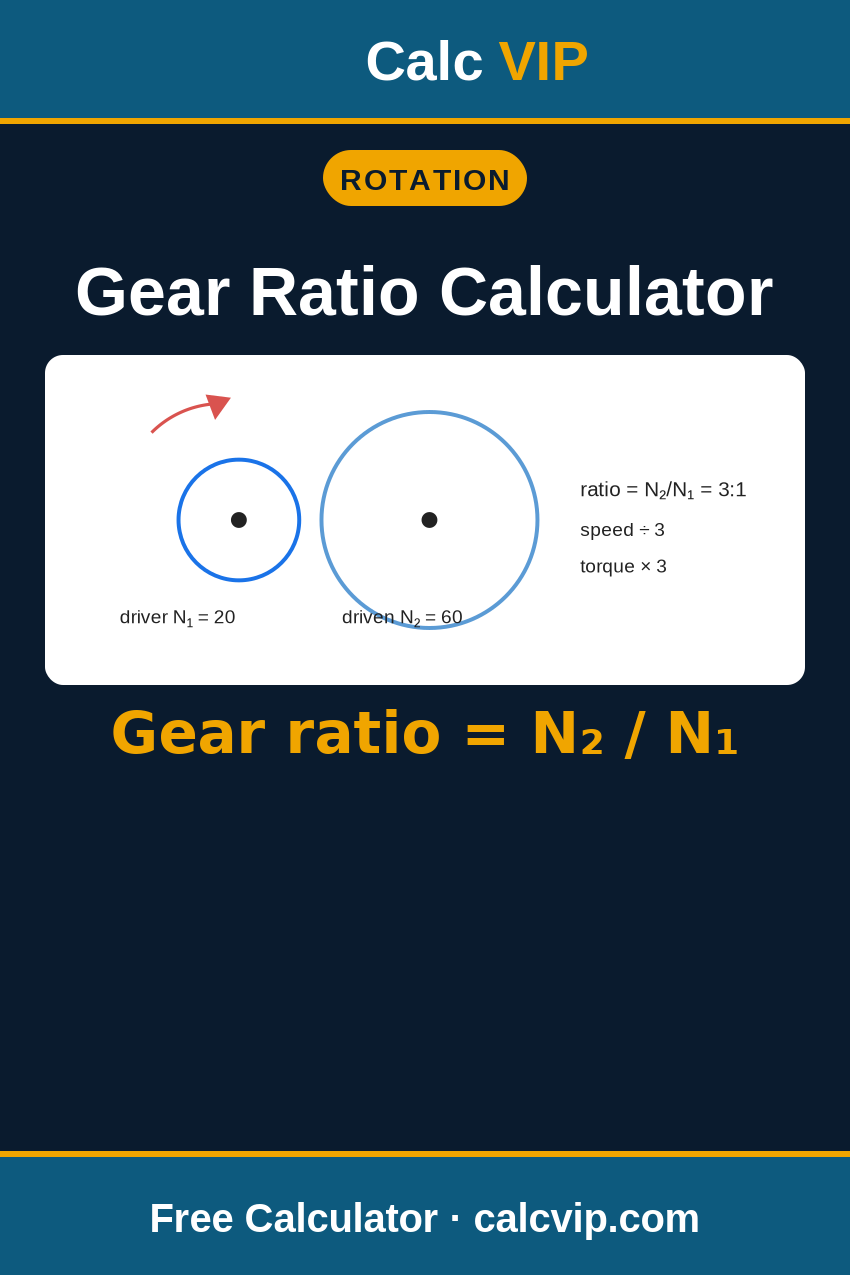
Example 1 — the classic reducer. A driver gear with 20 teeth turns a driven gear with 60 teeth. Input: 900 rpm and 10 N·m:
Gear ratio = 60 / 20 = 3 : 1
Output speed = 900 × 20/60 = 300 rpm
Output torque = 10 × 60/20 = 30 N·m — three times slower, three times stronger.
Example 2 — the same pair, run backwards. Feed the power into the 60-tooth gear instead: N₁ = 60, N₂ = 20, input 300 rpm and 5 N·m:
Ratio = 20/60 = 0.333:1; output speed = 300 × 60/20 = 900 rpm; output torque = 5 × 20/60 = 1.6667 N·m. Speed increasers are how centrifuges, drills and turbine accessories get their frantic rpm from sober motors — paid for, always, in torque.
Example 3 — a bicycle's top gear. Chainring 44 teeth, rear sprocket 11 teeth: ratio = 11/44 = 0.25:1. A rider pedalling at 80 rpm spins the rear wheel at 80 × 44/11 = 320 rpm, and the wheel's torque is a quarter of the crank torque. The same rider in the lowest gear (34 driving 34) gets ratio 1:1 — wheel torque equal to crank torque, for the hill that demands it.
Example 4 — a compound train. Two pairs in series: first 15 → 45 teeth (ratio 3:1), second 12 → 48 (ratio 4:1). Total ratio = 3 × 4 = 12:1. A 1,200 rpm motor emerges at 1200/12 = 100 rpm, and a 2 N·m input torque becomes 2 × 12 = 24 N·m. Compounding is how modest gears reach industrial ratios without any single gear becoming enormous.
Example 5 — a car's first gear, end to end. First gear contributes 3.6:1 and the final drive another 4.1:1 — total 3.6 × 4.1 = 14.76:1. At an engine speed of 3,000 rpm the wheels turn at 3000/14.76 ≈ 203 rpm, and the engine's 150 N·m arrives at the wheels (ideally) as 150 × 14.76 = 2,214 N·m — the multiplication that gets a tonne and a half of car moving from rest.
Example 6 — the idler that changes nothing. A 20-tooth driver turns a 30-tooth gear through a 40-tooth idler. Ratio = 30/20 = 1.5:1 — the idler's 40 teeth appear in neither the result nor, if you expand the two meshes, anywhere at all: (40/20) × (30/40) = 30/20. Input 600 rpm gives 400 rpm out, turning the same way as the input — the idler's only, and entire, job.
Gear ratios in real life
Car gearboxes. First gear is Example 5 — a deep reduction for launching. Top gear is often near 0.8:1, an overdrive that lets the engine loaf at motorway speed. The whole gearbox is a menu of this page's single calculation, and changing gear is choosing a different row of it.
Bicycles. The derailleur offers the rider a spread of ratios from about 1:1 to 0.25:1, trading leg torque against wheel speed as terrain changes. Riders think in exactly this calculator's terms: which ring, which sprocket, what cadence becomes what road speed.
Clockwork. A clock's hands are a gear-ratio manifesto: the minute hand must turn 12 times for each turn of the hour hand, and the train between them is a compound product of pairs multiplying to exactly 12:1 — Example 4 with three centuries of polish.
Wind turbines. The rotor turns at perhaps 15 rpm; the generator wants about 1,500. A compound gearbox with a ratio near 1:100 — a speed increaser on a heroic scale — bridges them, and its reliability in a nacelle a hundred metres up is one of wind energy's defining engineering battles.
Hand drills and kitchen mixers. The crank of an old hand drill drives a large gear that spins the chuck several times per turn — a speed increaser you can feel. A mixer's lowest setting is the opposite: reduction gearing that turns motor speed into the slow, unstoppable torque that kneads dough.
Electric vehicles. Most EVs carry a single fixed reduction, often near 8:1 or 9:1, because the motor's wide speed range makes a multi-gear box unnecessary. The ratio is chosen once, with this page's arithmetic, to balance launch torque against top speed — a decision the car lives with for life.
Power is conserved: the trade that cannot be cheated
Every gear calculation is haunted by a quantity this calculator does not ask for: power. P = τ × ω (with ω in rad/s) is the rate at which the shaft does work, and an ideal gear pair passes it through untouched — that is precisely why the torque multiplication mirrors the speed division. Example 1 makes the point numerically: the input carries 10 N·m at 900 rpm, ω = 94.25 rad/s, so P = 942.5 W; the output carries 30 N·m at 300 rpm, ω = 31.42 rad/s, so P = 942.5 W. Identical. Gears are currency exchanges, not mints: they change the denomination of mechanical power between speed and torque at a rate set by their teeth, taking only friction's small commission. Any design that appears to gain both speed and torque from a gear pair has made an arithmetic error — usually the one corrected in the Common mistakes below.
The commission compounds politely. A well-made spur or helical stage passes about 98% of its power; two stages pass 0.98² ≈ 96%; the four-stage trains inside industrial reducers still deliver around 92% — which is why their output torque, alone among this page's numbers, deserves a small haircut before you promise it to a load. Efficiency is also a diagnostic: a gearbox that runs hot is announcing that its commission has grown, through wear, misalignment or tired lubricant, and the missing power can be measured in the temperature of the casing. The ratio, being teeth, never drifts; the commission is where gearboxes keep their secrets.
Quick reference: ratios you already own
| Application | Typical ratio | Direction of trade |
|---|---|---|
| car first gear + final drive | ≈ 14.76:1 | torque for launching |
| car top gear (overdrive) + final drive | ≈ 3.3:1 | quiet, economical cruise |
| bicycle lowest gear | ≈ 1:1 | climbing torque |
| bicycle highest gear | ≈ 0.25:1 | speed on the flat |
| clock hour-to-minute train | 1:12 (product of stages) | exact timekeeping |
| wind turbine gearbox | ≈ 1:100 | speed for the generator |
The spread is the lesson: a single pair of gears comfortably covers ratios from about 0.2:1 to 6:1, and everything beyond that — the car's launch, the turbine's hundredfold step-up — is built by compounding pairs, exactly as Example 4 compounds two into 12:1.
Common mistakes
- Inverting the ratio. Ratio = N₂/N₁, driven over driver. Invert it and a 3:1 reducer becomes a 1:3 increaser on paper — the output speed wrong by ninefold. Anchor it with words: more driven teeth means slower and stronger.
- Gaining speed and torque together. Impossible — power is conserved. If a calculation shows both rising, a teeth count has been swapped. The product τ × ω may only stay level or, with friction, fall.
- Forgetting the direction flip. One mesh reverses the output's rotation. Designs that need the original direction add an idler or a second stage; discovering the flip at assembly is a rite of passage best skipped.
- Counting the idler into the ratio. An idler's teeth cancel: (Nidler/N₁) × (N₂/Nidler) = N₂/N₁. Including it once, unpaired, corrupts the ratio by exactly its factor.
- Expecting the ideal torque at the shaft. This calculator reports the lossless figure. Real meshes surrender roughly 1–3% per stage to friction, more for worm drives; a two-stage box delivering 95% of the ideal torque is a good box, not a broken promise.
FAQ
What does a 3:1 gear ratio mean?
The driver gear must turn 3 times for the driven gear to turn once. The output is 3 times slower but delivers about 3 times the torque.
How do I get more speed instead of more torque?
Swap the sizes: make the driver gear the bigger one. With 60 teeth driving 20 teeth, the output spins 3 times faster than the input, with one third of the torque.
Do real gears match these numbers exactly?
Almost — real gearboxes lose a few percent of power to friction and heat, so the real output torque is slightly less than the ideal value shown here.
Can I use gear diameters instead of teeth?
Yes — meshing gears share the same tooth size, so diameters are proportional to teeth counts and the ratio N₂/N₁ equals D₂/D₁. Teeth are preferred because they are exact integers; a measured diameter carries your ruler's error into the ratio.
What is a worm gear's ratio?
A worm is the extreme case of this page: the "driver's teeth" are the worm's thread starts — often just 1 — so a 40-tooth wheel gives 40:1 in a single stage. The price is friction: worm drives are the least efficient common gearing and often cannot be back-driven at all.
How do planetary gears fit in?
A planetary set packs a sun gear, planet gears and a ring gear into one housing and offers several ratios depending on which member is held still. Each configuration still obeys this page's law — output speed and torque trade by the effective teeth ratio — but the bookkeeping needs the ring's teeth counted too.
Why not always use one huge pair for a big ratio?
Geometry and strength: a 100:1 single pair needs a driven gear a hundred times the driver's tooth count — enormous, heavy, and its teeth at the mesh would carry loads they cannot survive. Compounding reaches the same ratio with modest gears, which is why real high-ratio boxes are trains, not pairs.
Does the gear ratio change the power?
No — ideally not at all, and in practice it reduces it slightly through friction. What changes is the form of the power: slower and stronger, or faster and weaker. If a specification seems to promise more power out than in, the specification is wrong.
What does "overdrive" mean?
Any overall ratio below 1:1 in the speed sense — the output turning faster than the engine — used for relaxed, economical cruising. In this calculator's terms it is a pair (or train) with effective N₂ < N₁, like Example 2's arrangement installed in a car's top gear.
How accurate is the output speed?
Exact, in a way few engineering numbers are. Because the teeth mesh positively, the average output rpm is the input rpm times N₁/N₂ to the precision of the input measurement itself. Only torque carries the few-percent uncertainty of friction.