 Calc
Annihilation Calculator – Particle & Antiparticle Energy Release
 Created by Yuki Tanaka · Physics Editor · Modern Physics · Last updated: November 2026
Use this free Annihilation Calculator to find out how much energy is released when a particle meets its antiparticle and both vanish into light. For the famous electron–positron case, all of the mass becomes two gamma-ray photons of 0.511 MeV each.
Annihilation is E = mc² with the gloves off. In fission and fusion, a fraction of a percent of the mass is converted; when a particle meets its antiparticle, all of it is — both particles cease to exist entirely, and their full rest energy, plus any kinetic energy they carried, leaves as radiation. It is the most complete conversion of matter into energy that physics allows, gram for gram roughly a thousand times more energetic than fission and a hundred million times more than burning. Every particle has an antiparticle twin with the same mass and opposite charge — electron and positron, proton and antiproton — and the universe keeps the two kinds apart mainly by scarcity: antimatter is rare, short-lived and precious, which is the only reason annihilation is a laboratory curiosity rather than a daily hazard.
The cleanest case, and the one this calculator is built around, is annihilation at rest. With no net momentum to dispose of, symmetry dictates the outcome completely: the energy emerges as two photons of exactly equal energy, fired in exactly opposite directions. Each photon carries one particle's rest energy, mc². That rigid geometry — two identical gamma rays on a single straight line — is not just elegant; it is useful. It is the signal that hospital PET scanners hunt for, the spectral line astronomers see glowing from the centre of our galaxy, and the cleanest experimental proof that mass and energy are one quantity wearing two units.
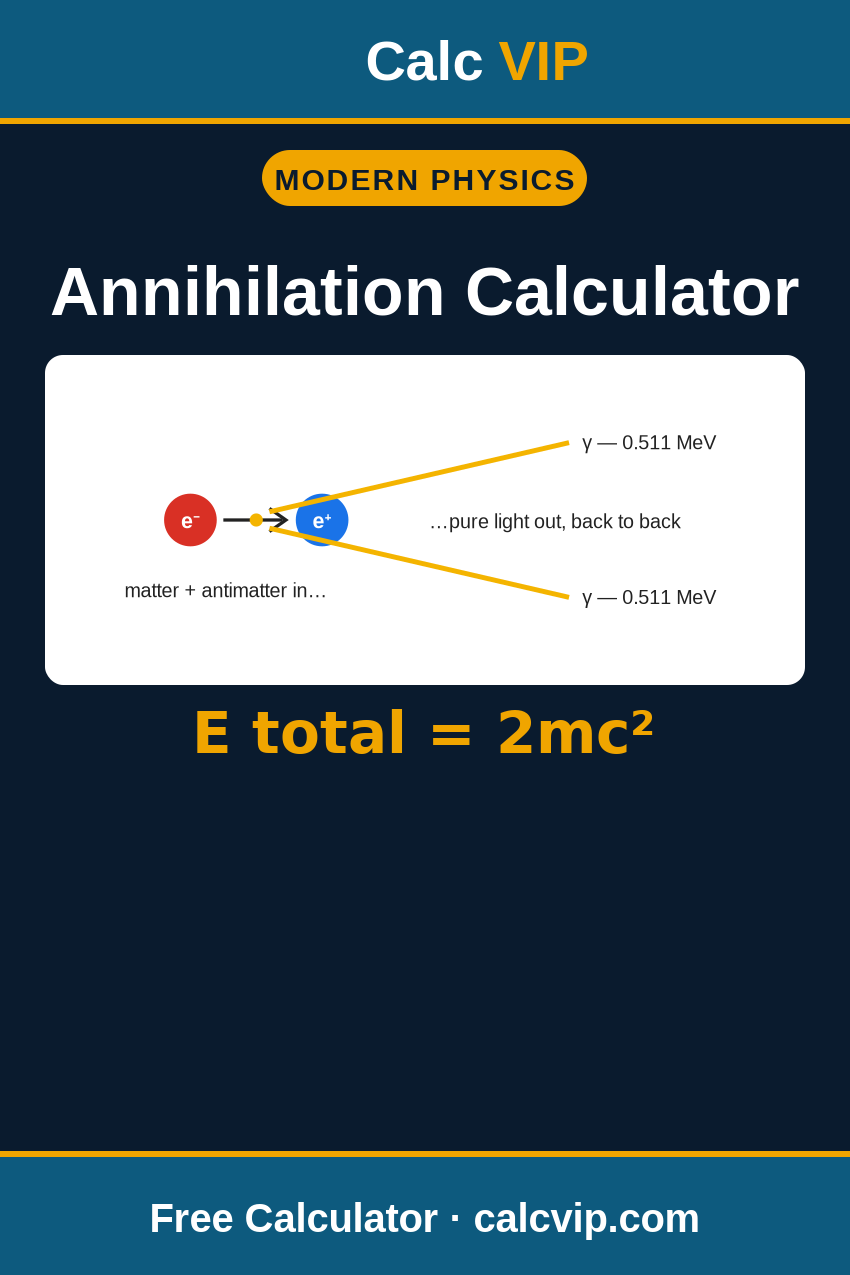
Real annihilations are often messier than the textbook picture, and this page will be honest about where the simple model holds and where nature elaborates. Heavy pairs like proton–antiproton usually shatter into intermediate particles (pions) that decay in cascades before the energy finally settles into photons and other products; the total energy, however, is always exactly 2mc² plus kinetic energy, and the two-photon figures this calculator returns are the exact answer for electron–positron pairs and the correct energy budget for every pair. Enter a pair — or any mass of your own — and the full budget is computed for you.
Formula
Etotal = 2mc² • for a pair at rest: two photons, each Ephoton = mc² • photon wavelength λ = hc / Ephoton • photon frequency f = Ephoton / h
The factor of two is the whole story: both particles contribute their rest energy, so the yield of an annihilation is always twice the rest energy of one member of the pair. The formula rearranges to answer the reverse questions. Given a photon energy, the particle mass it could have come from is m = E/c²; given a total release, each photon of a symmetric two-photon event carries half. Unit discipline is the only real hazard: work in MeV throughout (the electron's rest energy is 0.511 MeV, the proton's 938.28 MeV), convert to joules only at the end by multiplying by 1.602 × 10⁻¹³ J per MeV, and get wavelengths from λ = hc/E with hc = 1.988 × 10⁻²⁵ J·m. This calculator performs exactly that chain — for preset pairs it reads the rest energy directly; for a custom entry it converts your mass in u at 931.5 MeV per u first.
| Symbol | Meaning | Units |
|---|---|---|
| m | rest mass of ONE particle of the pair | kg, u, or MeV/c² |
| Etotal | total energy released, 2mc² (plus any kinetic energy) | MeV or J |
| Ephoton | energy of each photon in a two-photon event, = mc² | MeV or J |
| λ, f | photon wavelength and frequency, λ = hc/E, f = E/h | m (pm here), Hz |
| h, c | Planck's constant 6.626 × 10⁻³⁴ J·s; speed of light 3 × 10⁸ m/s | SI |
Why two photons, back to back: momentum runs the show
Energy conservation alone would permit a single photon carrying all 2mc². Momentum conservation forbids it. The pair at rest has total momentum zero; a single photon always carries momentum E/c in its direction of travel, so one photon would leave the momentum ledger unbalanced — an impossibility, not a detail. Two photons of equal energy flying in exactly opposite directions cancel each other's momentum while summing their energies, satisfying both laws at once. This is why the calculator's picture — twin gamma rays on one straight line — is forced by physics rather than chosen for tidiness, and why PET scanners can locate an annihilation by drawing a line between two detectors that fire simultaneously.
Relax the "at rest" condition and the geometry relaxes with it. If the positron arrives with kinetic energy, the pair's net momentum is no longer zero: the two photons still emerge, but their energies split unevenly and the angle between them opens slightly away from 180°, sharing out the extra energy and momentum between them. Push further, into the fleeting atom called positronium — an electron and positron orbiting each other before they annihilate — and a third possibility appears: the triplet state of positronium decays into three photons whose energies form a continuous spread totalling 1.022 MeV, while the singlet state gives the classic two. The calculator models the dominant, clean case; nature's footnotes all begin from it.
How to use
- Pick a particle–antiparticle pair from the list — electron–positron or proton–antiproton — or choose "Custom mass".
- For a preset pair, the box already shows the rest energy of ONE particle in MeV. For a custom entry, type the particle's mass in atomic mass units (u) instead, and it will be converted at 931.5 MeV per u.
- Click "Calculate Annihilation Energy" to see the total energy released in MeV and joules, each photon's energy, and the photon wavelength and frequency.
- Check the scale of your answer: electron pairs give 0.511 MeV photons (wavelength 2.428 pm); anything proton-scale gives photons near 938 MeV with femtometre wavelengths. A result far from the pair's known rest energy means the mass was typed in the wrong unit.
Worked examples
Example 1 — electron and positron at rest. An electron and a positron annihilate at rest:
Total energy = 2 × 0.511 = 1.022 MeV (= 1.637 × 10⁻¹³ J)
Each photon = 0.511 MeV
Photon wavelength = hc / E = 2.428 pm (a gamma ray)
Photon frequency = 1.235 × 10²⁰ Hz
These twin 511 keV photons flying in opposite directions are exactly what PET scanners detect in hospitals.
Example 2 — proton and antiproton. Scale the same arithmetic up to the proton's rest energy of 938.28 MeV:
Total energy = 2 × 938.28 = 1,876.56 MeV (1.877 GeV, = 3.006 × 10⁻¹⁰ J)
If all of it emerged as two photons, each would carry 938.28 MeV, with wavelength hc/E = 1.322 fm (0.001322 pm) and frequency 2.269 × 10²³ Hz. In practice a proton–antiproton pair usually annihilates into a spray of pions whose decays share the same 1,876.56 MeV budget — the total never changes, only the way it is divided.
Example 3 — a muon pair, entered as a custom mass. The muon's rest energy is 105.66 MeV, which as a custom entry is 105.66 ÷ 931.5 = 0.11343 u. The calculator returns:
Total energy = 2 × 105.66 = 211.32 MeV (= 3.385 × 10⁻¹¹ J)
Each photon = 105.66 MeV, wavelength = 11.74 fm, frequency = 2.555 × 10²² Hz.
Muons live only 2.2 microseconds, so muon–antimuon annihilation is a theorist's benchmark rather than a laboratory routine — but the arithmetic is identical for every pair.
Example 4 — neutron and antineutron. With a rest energy of 939.565 MeV, the heaviest common pair gives:
Total = 2 × 939.565 = 1,879.13 MeV (= 3.010 × 10⁻¹⁰ J); each photon-equivalent = 939.565 MeV at 1.321 fm and 2.272 × 10²³ Hz. Neutron and proton pairs sit within 0.14% of each other in yield — annihilation energetics care about mass alone, not about charge or structure.
Example 5 — one gram of antimatter. Take the FAQ's gram seriously and run the budget in SI: 1 g of antimatter meets 1 g of matter, total mass 0.002 kg.
E = mc² = 0.002 × (3 × 10⁸)² = 1.8 × 10¹⁴ J.
One tonne of TNT releases 4.184 × 10⁹ J, so the gram pair yields 1.8 × 10¹⁴ ÷ 4.184 × 10⁹ ≈ 43,000 tonnes of TNT — 43 kilotons, roughly three Hiroshima bombs, from two grams of fuel. This is why antimatter dominates science-fiction propulsion chapters and why its real-world production rate — nanograms per year, worldwide — keeps it there.
Example 6 — a single PET annihilation, in joules. Each 0.511 MeV photon carries 0.511 × 10⁶ × 1.602 × 10−19 = 8.186 × 10⁻¹⁴ J, so one annihilation deposits 1.637 × 10⁻¹³ J of gamma energy in the patient's surroundings. A PET tracer dose involves on the order of 10¹³ such annihilations over the scan — a total of a few joules of radiation energy, spread through the body, in exchange for a three-dimensional map of its metabolism. The feebleness of the single event and the power of counting trillions of them is the whole design philosophy of the scanner.
Annihilation in real life
PET scanning. A glucose tracer tagged with fluorine-18 (half-life 110 minutes) collects in metabolically active tissue; its positrons travel a millimetre or so, meet electrons, and annihilate. Two detectors registering 0.511 MeV photons at the same instant define a line through the event; millions of lines become an image of cancers, brain activity and heart damage that no X-ray can match.
The galaxy's 511 keV glow. The INTEGRAL satellite maps a bright spectral line at exactly 511 keV from the centre of the Milky Way — positrons from radioactive decay, pulsars and other sources annihilating in interstellar gas. The line's energy is this calculator's Example 1 written across the sky, and its total brightness tracks roughly 10⁴³ annihilations per second in the galactic bulge.
Materials science. Positron annihilation spectroscopy fires positrons into metals and semiconductors; the time each survives before annihilating, and the tiny Doppler shift of the 511 keV photons, reveal vacancy defects, voids and dislocations far too small for any microscope — quality control at the atomic scale.
Antimatter in the laboratory. CERN's Antiproton Decelerator makes antihydrogen atoms and traps them; the ALPHA-g experiment released them in 2023 and watched them fall down, confirming antimatter responds to gravity like matter. Every atom of that antihydrogen eventually annihilated on the trap walls in a flash of the photons computed here.
Lightning and cosmic rays. Thunderstorms accelerate electrons hard enough to produce positrons, detected as gamma flashes by satellites; cosmic-ray collisions in the upper atmosphere create positrons and antiprotons continuously. A small, natural antimatter economy operates above our heads at all times — annihilating, as here, at 0.511 MeV a pair.
Propulsion studies. NASA and university studies keep returning to annihilation because the numbers in Example 5 have no chemical rival: even beamed or catalysed versions, using antiprotons to trigger fusion, out-perform every conventional rocket chemistry by orders of magnitude. The obstacle is never the physics — it is making and storing the antimatter.
Annihilation in flight, and the positronium detour
The calculator assumes the pair meets at rest, which positrons in matter nearly do — they thermalise, shedding their kinetic energy in collisions within picoseconds, before annihilating. But a positron that annihilates in flight, still carrying, say, 0.511 MeV of kinetic energy, changes the output in two ways the conservation laws predict precisely: the total photon energy rises to 1.022 + 0.511 = 1.533 MeV, and the photons no longer split it equally or leave at exactly 180°, because their combined momentum must equal the positron's incoming momentum. Hospitals quietly rely on the at-rest case dominating; particle physicists deliberately stage in-flight annihilations to probe structure. Positronium adds the other footnote: about a quarter of thermalised pairs form the singlet state (two photons, lifetime 125 picoseconds) and three quarters the triplet state (three photons, 142 nanoseconds — a thousand times longer, and the basis of experimental "positronium imaging" that adds lifetime information to PET maps). Every variant conserves the same total: 2mc², plus whatever kinetic energy came in.
Quick reference: annihilation yields by pair
| Pair | Total energy | Each photon | Photon λ |
|---|---|---|---|
| electron – positron | 1.022 MeV | 0.511 MeV | 2.428 pm |
| muon – antimuon | 211.32 MeV | 105.66 MeV | 11.74 fm |
| pion – antipion | 279.14 MeV | 139.57 MeV | 8.89 fm |
| proton – antiproton | 1,876.56 MeV | 938.28 MeV | 1.322 fm |
| neutron – antineutron | 1,879.13 MeV | 939.565 MeV | 1.321 fm |
The pattern to carry away: the photon energy is the pair's calling card. Measure a gamma ray's energy and you have weighed the particle that died to make it — 0.511 MeV always means electrons, and any annihilation line is a mass measurement performed by the universe itself.
Common mistakes
- Forgetting the factor of two. The yield is 2mc², not mc² — both particles vanish. Halving the answer is the single most common error in student annihilation calculations, and it also halves the photon energy if applied in the wrong place: each photon is mc² precisely because the total is 2mc² split evenly.
- Assuming heavy pairs really give two photons. The two-photon outcome is essentially exact for electrons and positrons. Proton–antiproton annihilation overwhelmingly produces pions first, which decay through chains of further particles; the calculator's photons for heavy pairs are the energy-equivalent summary, not the typical event photograph.
- Mixing MeV and joules mid-calculation. 1.022 MeV is 1.637 × 10⁻¹³ J. Feeding MeV into λ = hc/E with SI constants (or vice versa) produces wavelengths off by thirteen orders of magnitude — check the unit at every step.
- Entering the pair's combined mass as a custom mass. The custom box wants the mass of ONE particle, in u. Entering both particles' mass doubles every output. For the muon, the correct custom entry is 0.11343 u, not 0.22686 u.
- Thinking annihilation violates conservation laws. It obeys all of them — energy, momentum, charge, lepton number. The particles' identities disappear, but every conserved quantity balances exactly, which is why the outputs are so rigidly predictable.
FAQ
Why are there always two photons, not one?
A single photon could not conserve both energy and momentum: the pair starts with zero total momentum, so the photons must leave in opposite directions with equal energies.
What is annihilation used for?
PET (positron emission tomography) scans inject a tracer that emits positrons; each positron annihilates with an electron in the body, and detectors use the back-to-back 0.511 MeV photons to build a 3D image.
How much energy is in 1 gram of antimatter?
Annihilating 1 g of antimatter with 1 g of matter releases 2mc² ≈ 1.8 × 10¹⁴ J — roughly the energy of a small nuclear weapon, from just 2 grams of fuel.
Can annihilation happen the other way round?
Yes — the reverse process is pair production: a photon of at least 1.022 MeV near a nucleus can materialise into an electron–positron pair. Annihilation and pair production are the same interaction read in opposite directions, and in hot, dense environments the two run in equilibrium.
Why don't the positrons in my body annihilate instantly?
They nearly do — a positron in tissue survives only a fraction of a nanosecond before meeting an electron. That brevity is a feature: the annihilation happens essentially where the tracer decayed, which is what makes PET images sharp.
Is antimatter dangerous in the quantities laboratories make?
No. All the antimatter ever produced at CERN amounts to nanograms. Even annihilating ten nanograms of it with ten nanograms of matter would release only about 1.8 × 10⁶ J — enough to run a light bulb for some hours, spread out as gamma rays. The danger exists only in science fiction's gram-scale stockpiles (Example 5).
What is positronium?
A short-lived "atom" of an electron and a positron orbiting their common centre. Its singlet state decays to two photons in 125 picoseconds; its triplet state to three photons in 142 nanoseconds. It is the lightest atom in nature and a precision laboratory for testing quantum electrodynamics.
Do antiprotons annihilate with the same photons as positrons?
The total energy is far larger (1,876.56 MeV against 1.022 MeV), and the energy usually emerges first as pions rather than a clean photon pair. When pions decay, photons of many energies appear — but the summed budget is still exactly the 2mc² this calculator reports.
Where does antimatter come from in nature?
Radioactive decays that emit positrons (potassium-40 in rocks — and bananas — among them), cosmic-ray collisions, pulsars, lightning, and the vicinity of black holes. The amounts are tiny and annihilate quickly, which is why the universe is matter-dominated in practice wherever we look.
Could annihilation power a spacecraft?
In principle it is the ultimate rocket fuel — Example 5's 43 kilotons from two grams is an energy density nothing else approaches. In practice, humanity produces antimatter in nanogram quantities at staggering cost and can store only minute amounts in magnetic traps. The physics is solved; the engineering and economics are not.