 Calc
Bohr Model Calculator – Shell Energy E = −13.6/n² eV & Orbit Radius
 Created by Yuki Tanaka · Physics Editor · Modern Physics · Last updated: November 2026
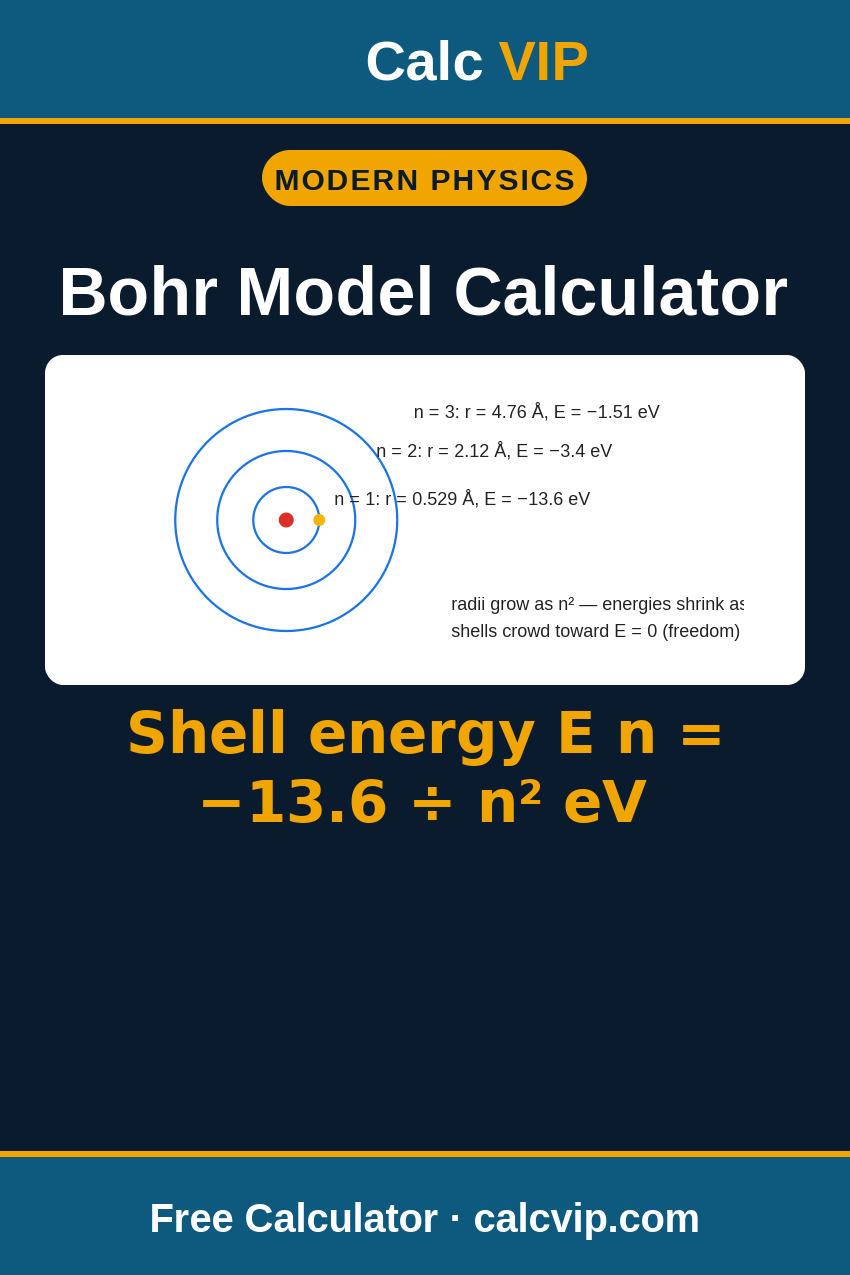
Use this free Bohr Model Calculator to find the energy and orbit radius of the electron in a hydrogen atom for any shell n. Energies follow En = −13.6 / n² eV and radii follow rn = 0.529 × n² Å.
In 1913 Niels Bohr proposed the first atom that actually worked: an electron circling a proton, but allowed only certain orbits — shells labelled n = 1, 2, 3, … — each with a fixed energy and radius. The rules were arbitrary (why those orbits? why doesn't the electron spiral in, radiating?), yet the numbers that fell out matched hydrogen's spectrum to astonishing precision. This calculator evaluates Bohr's two rules directly: the energy of shell n is En = −13.6/n² eV and its radius is rn = 0.529 × n² Å. Everything about hydrogen — its colours, its chemistry's starting point, the size of every atom built on the same plan — is latent in those two expressions.
The patterns repay a look. Energy rises toward zero as 1/n²: the shells crowd together as they approach freedom, at −13.6, −3.4, −1.51, −0.85 eV…, while radius grows as n², so the atom inflates quickly — the n = 10 shell has a radius of 52.9 Å, a hundred times the ground state's, enclosing a million times the volume. The negative energies are the signature of binding: zero is defined as an electron free and at rest, infinitely far away, so a trapped electron sits in an energy well, and the depth of the well at shell n — exactly |En| — is the ionisation energy from that shell.
Bohr's model is not the final truth — modern quantum mechanics replaces orbits with orbitals, clouds of probability — but it remains the fastest route to hydrogen's numbers and the conceptual scaffold on which the real theory was built. Its energy ladder predicts every hydrogen spectral line (the Rydberg formula is just the difference of two of its rungs), its ground-state radius sets the size scale of all atoms, and its failures are instructive: it cannot handle two-electron atoms, because electrons repel each other in ways its tidy circles ignore. Use it for hydrogen and hydrogen-like ions, and for the intuition it gives about every other atom.
Formula
Shell energy En = −13.6 ÷ n² eV • Orbit radius rn = 0.529 × n² Å • n = 1, 2, 3, …
The two rules are joined by a third, quieter one: the electron's speed falls as vn = 2.19 × 10⁶ ÷ n m/s, so the ground-state electron races around at about c/137 — fast, but slow enough that non-relativistic arithmetic is fine. For hydrogen-like ions (one electron around a nucleus of charge Z), both rules scale: En = −13.6 × Z² ÷ n² eV and rn = 0.529 × n² ÷ Z Å. The energy released or absorbed when an electron jumps between shells is the difference of the two shell energies, ΔE = 13.6 × (1/nlower² − 1/nupper²) eV, and that difference — converted by E = hc/λ — is the wavelength of the photon emitted or absorbed, the entire science of spectroscopy in one subtraction.
| Symbol | Meaning | Units |
|---|---|---|
| n | shell (principal quantum) number, 1, 2, 3, … | — |
| En | total energy of the electron in shell n | eV |
| rn | orbit radius of shell n | Å (1 Å = 10−10 m) |
| 13.6 eV | hydrogen's ground-state binding (ionisation) energy | eV |
| 0.529 Å | the Bohr radius, a₀ — ground-state orbit size | Å |
| Z | nuclear charge (1 for hydrogen, 2 for He+) | — |
Where the numbers 13.6 and 0.529 come from
Bohr did not fit these constants to experiment; he derived them. Demanding that the electron's angular momentum come in whole multiples of ħ (Planck's constant over 2π) — the "quantisation" guess — and balancing Coulomb attraction against centripetal acceleration gives the radius a₀ = 0.529 Å purely from e, me, ε₀ and h, and the energy 13.6 eV from the same ingredients. That a handful of universal constants should conspire to produce the exact size and binding energy of hydrogen, before any measurement was consulted, was the model's first miracle. The second came a decade later, when de Broglie showed the angular-momentum rule is equivalent to demanding the electron's matter wave fit a whole number of times around the orbit — 2πr = nλ — turning Bohr's postulate into a picture: allowed shells are standing waves.
The energy itself is a sum in disguise. In shell n the electron's kinetic energy is +13.6/n² eV and its potential energy −27.2/n² eV; the total, their sum, is the −13.6/n² this calculator reports. That two-to-one split (potential twice the kinetic, opposite in sign) is a general theorem for circular orbits, gravitational ones included — planets obey it too. It also explains ionisation bookkeeping: to free the electron you must supply the full |En|, after which the freed electron carries away any excess as kinetic energy.
How to use
- Enter the shell number n — a whole number, 1 for the ground state, 2, 3, 4… for excited states.
- Click "Calculate Energy & Radius" to see the shell's energy in eV, its radius in ångströms and nanometres, and the energy needed to ionise the atom from that shell.
- To find the light emitted in a jump, run the calculator for both shells and subtract the energies; then convert the difference to a wavelength with λ (nm) ≈ 1240.8 ÷ ΔE (eV).
- For hydrogen-like ions (He+, Li2+), multiply the energy by Z² and divide the radius by Z, as the formula section describes.
Worked examples
Example 1 — the third shell. For n = 3:
E3 = −13.6 ÷ 3² = −13.6 ÷ 9 = −1.511 eV, and r3 = 0.529 × 9 = 4.761 Å (0.476 nm). Ionising hydrogen from this shell takes just 1.511 eV — a photon of any wavelength shorter than 1240.8 ÷ 1.511 = 821 nm can do it, so even red light can ionise an atom already excited to n = 3.
Example 2 — the ground state. n = 1: E1 = −13.6 eV, r1 = 0.529 Å. This is the most important shell in the universe: hydrogen in its ground state is the raw material of stars, and 13.6 eV is the energy a photon needs to tear it apart — which is why starlight below 91.2 nm is called ionising radiation, and why the cosmos's history includes an era, reionisation, defined by photons of exactly this energy.
Example 3 — ionising from n = 2. E2 = −13.6 ÷ 4 = −3.4 eV, r2 = 0.529 × 4 = 2.116 Å. Ionisation from here costs 3.4 eV, a photon of λ = 1240.8 ÷ 3.4 = 364.9 nm or shorter. Astronomers know this threshold intimately: gas clouds glow and absorb around it, and the "Balmer break" at 364.6 nm in galaxy spectra is this same boundary seen through the Rydberg formula.
Example 4 — the red line of hydrogen. An electron falls from n = 3 to n = 2: ΔE = (−1.511) − (−3.4) = 1.889 eV, released as one photon of λ ≈ 1240.8 ÷ 1.889 ≈ 656 nm — the deep red H-alpha line. It is the most observed spectral line in astronomy, colouring nebulae red in every telescope photograph, and it is nothing but the difference of two numbers this calculator produces.
Example 5 — a hydrogen-like ion: He+. Helium with one electron has Z = 2, so En = −13.6 × 4 ÷ n²: its ground state is −54.4 eV at radius 0.529 ÷ 2 = 0.2645 Å, and its n = 2 shell sits at −13.6 eV — coincidentally exactly hydrogen's ground-state energy. Ionising He+ takes 54.4 eV, which is why doubly-ionised helium is found only near the hottest stars.
Example 6 — Rydberg atoms: n = 100. Push the calculator to n = 100: E = −13.6 ÷ 10,000 = −0.00136 eV and r = 0.529 × 10,000 = 5290 Å = 0.529 µm. The atom is now half a micrometre across — the size of a bacterium — bound by a thousandth of an electron-volt, fragile against the faintest fields. Laboratories create such Rydberg atoms deliberately; radio astronomers detect them in space, where electrons cascade down from shells near n = 1000.
The Bohr atom in real life
Every spectral line ever measured. The calculator's energy ladder is the master key to spectroscopy: neon signs, stellar atmospheres, distant galaxies — their light is decoded by matching observed wavelengths to differences of shell energies. Astronomy runs on this arithmetic.
The size of everything. The Bohr radius, 0.529 Å, sets the scale of all atoms (real atoms run 1–3 Å across) and therefore of molecules, crystals and ultimately materials. Chemistry's bond lengths are a few Bohr radii; nanotechnology is engineering at tens of them.
Hydrogen masers and atomic clocks. The ground state of hydrogen splits into two sub-levels separated by a tiny energy, and the transition between them — at 1420 MHz — drives hydrogen maser clocks and is the most famous frequency in radio astronomy, used to map the galaxy's hydrogen.
Semiconductor dopants. A phosphorus atom in silicon behaves like a giant hydrogen atom: its extra electron orbits at a Bohr radius stretched by the material's properties to about 2.5 nm, with binding near 0.045 eV. The same formulas, rescaled, design the dopants that make chips work.
Fusion and plasma physics. In the Sun's core and in tokamaks, hydrogen is ionised — electrons lifted past E = 0. Knowing the 13.6 eV cost, and the ladder below it, determines how plasmas radiate, cool and conduct.
Teaching quantum mechanics. The Bohr model remains the bridge every student crosses: it introduces quantised energy, photons as transitions, and the shell language (n = 1, 2, 3) that chemistry still uses daily, before the full wave theory replaces its orbits with orbitals.
Quick reference: hydrogen's first shells
| Shell n | Energy En | Radius rn | Electron speed |
|---|---|---|---|
| 1 | −13.6 eV | 0.529 Å | 2.19 × 10⁶ m/s |
| 2 | −3.4 eV | 2.116 Å | 1.095 × 10⁶ m/s |
| 3 | −1.511 eV | 4.761 Å | 7.30 × 10⁵ m/s |
| 4 | −0.85 eV | 8.464 Å | 5.48 × 10⁵ m/s |
| 5 | −0.544 eV | 13.225 Å | 4.38 × 10⁵ m/s |
| 6 | −0.378 eV | 19.044 Å | 3.65 × 10⁵ m/s |
| 10 | −0.136 eV | 52.9 Å | 2.19 × 10⁵ m/s |
Read the table diagonally and the model's whole character appears: as n doubles, energy quarters but radius quadruples — excited atoms are large, slow and loosely bound, which is why high shells are so easily disturbed by neighbouring atoms and fields.
Where the Bohr model stops
Knowing a model's limits is part of using it well. Bohr's atom fails, instructively, in four directions. It gives no reason for its own rules (quantum mechanics supplies them: the shells are the standing-wave states of the electron). It cannot compute multi-electron atoms, where electron–electron repulsion breaks the tidy 1/n² ladder — helium already defeats it. It predicts nothing about the intensity of spectral lines or the fine splitting of lines under magnification (spin and relativity add those). And it pictures the electron on a definite path, where the real ground state is a spherical cloud with zero angular momentum — nothing like a miniature solar system. Yet its energies for hydrogen are exact to the precision most work needs, because the deeper theory reproduces them. The Bohr model is best understood as quantum mechanics with the scaffolding still visible: wrong in picture, right in numbers, indispensable in intuition.
One more modern role deserves mention: Rydberg atoms — ordinary atoms excited to enormous n, named for the same man. At n = 100 the Bohr radius formula gives r = 100² × 0.529 Å = 0.53 µm, an atom the size of a bacterium, with its outer electron so loosely held (binding energy 13.6 ÷ 10,000 = 0.00136 eV) that stray electric fields tug it noticeably. Laboratories exploit exactly this fragility: Rydberg atoms serve as exquisitely sensitive electric-field sensors and as interacting qubits in one leading design of quantum computer, where the huge electron orbit lets neighbouring atoms feel each other's presence. The 1913 model's radius formula, applied at n = 100, still sizes the hardware.
Common mistakes
- Dropping the minus sign. En is negative for every bound shell. Reporting +1.511 eV for n = 3 describes a free electron with kinetic energy, not the shell — and it breaks every transition subtraction built on it.
- Squaring in the wrong place. Energy divides by n²; radius multiplies by n². Confusing the two gives an n = 3 atom that is simultaneously tighter and smaller — the classic first-week error.
- Applying 13.6 to every atom. The constant belongs to hydrogen alone. For He+ it is 13.6 × Z² = 54.4; for neutral multi-electron atoms the whole formula is only a rough guide.
- Confusing ångströms and nanometres. r1 = 0.529 Å = 0.0529 nm. A factor-of-ten slip here propagates into every size estimate downstream.
- Thinking the ionisation energy is En itself. Ionising from shell n costs |En| — the climb from the shell's negative energy up to zero — not 13.6 eV from every shell. From n = 2 it costs only 3.4 eV.
FAQ
Why is the energy negative?
Zero energy is defined as the electron being completely free and at rest. A bound electron has less energy than that, so its energy is negative — you must add energy to free it.
What is the ground state?
The n = 1 shell, with E = −13.6 eV and radius 0.529 Å. It is the lowest, most tightly bound state of hydrogen.
Does the Bohr model work for other atoms?
Exactly only for hydrogen and hydrogen-like ions (He⁺, Li²⁺), where the 13.6 becomes 13.6 × Z². For multi-electron atoms it is a useful first picture, but real quantum mechanics is needed.
How fast is the electron in the ground state?
About 2.19 × 10⁶ m/s — roughly c/137, or 0.73% of light speed. It completes an orbit in about 1.5 × 10⁻¹⁶ s, circling some 6.6 × 10¹⁵ times per second, which is why the atom behaves as a blur rather than a tiny planetary system.
What happens as n becomes infinite?
The energy tends to 0 and the radius to infinity: the electron is free. The crowded shells just below that limit are real, though — transitions among them produce the series limits of hydrogen's spectrum, and atoms excited to n of hundreds exist in interstellar space.
Why doesn't the electron fall into the nucleus?
In Bohr's model, by decree: only certain orbits are allowed. In the deeper theory, because confining the electron's wave to a smaller region would raise its kinetic energy more than the attraction gains — the uncertainty principle sets the ground-state size this calculator reports.
Is the Bohr radius the size of the hydrogen atom?
Effectively yes: 0.529 Å is where the electron's probability cloud peaks in the ground state, and atomic sizes quoted in chemistry (hydrogen's covalent radius ≈ 0.31 Å, van der Waals radius ≈ 1.2 Å) are all of this order — the Bohr radius is the yardstick.
Can an electron sit between shells?
No. The shells are the only allowed energies; an electron absorbs a photon only if the photon's energy exactly matches a gap between shells (or exceeds the ionisation energy). This all-or-nothing rule is what makes atomic spectra sharp lines rather than smears.
How does this calculator connect to the Rydberg formula?
They are the same physics in two arrangements. The Rydberg formula computes a transition's wavelength directly from the two shell numbers; this calculator gives the two energies whose difference is that photon. Run both for 3 → 2 and you will get the same red line by either road.
What is a Rydberg atom?
An atom excited to a very high shell — n of 50, 100 or more — where the Bohr formulas show it swollen to micrometre size and bound by milli-electron-volts. Such atoms interact enormously strongly with fields and each other, making them prized sensors in quantum-technology research.