 Calc
Bohr Orbit Speed Calculator – Electron Velocity & Energies by Shell
 Created by Yuki Tanaka · Physics Editor · Modern Physics · Last updated: November 2026
Use this free Bohr Orbit Speed Calculator to find how fast the electron moves in each Bohr orbit of hydrogen, together with its kinetic, potential and total energy. In the ground state the electron races around at about 2.19 million metres per second — roughly 0.73% of the speed of light.
In 1913 Niels Bohr proposed the audacious picture this calculator quantifies: the hydrogen atom as a miniature solar system, its single electron circling the proton in only certain permitted orbits, each labelled by a whole number n. Classical physics insisted such an atom should collapse in a flash of radiation within a fraction of a microsecond; Bohr simply postulated that the permitted orbits do not radiate, and that light appears only when the electron jumps between them. The reward for the audacity was the first theory ever to predict hydrogen's spectrum exactly — and, as a by-product, a precise speedometer for the electron in every shell, which is what this page computes.
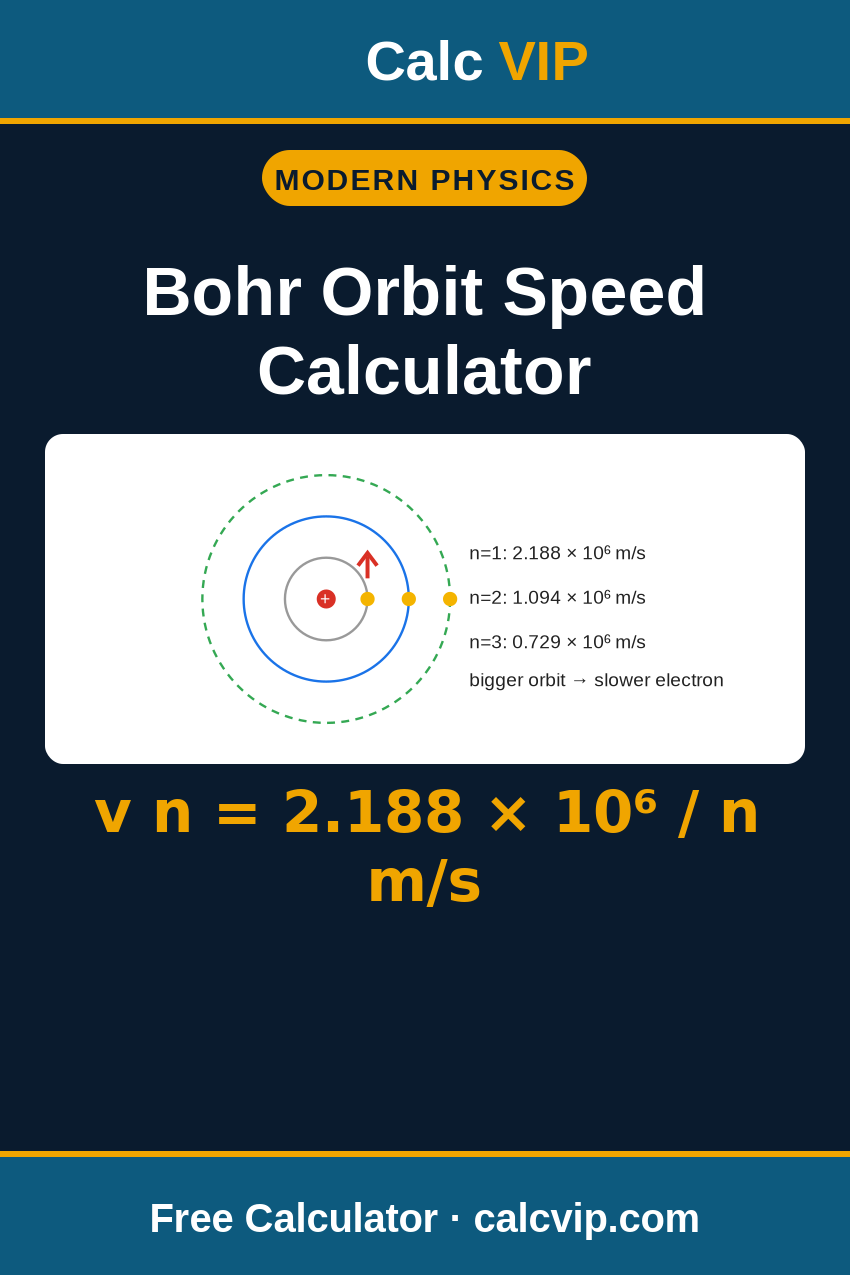
The speeds are startling. In the ground state the electron circles at 2.188 × 10⁶ m/s — fast enough to lap the nucleus 6.6 million billion times per second — yet that is only 0.73% of light speed, slow enough that non-relativistic arithmetic works beautifully. Each higher shell is larger, slower and more weakly bound, following patterns so clean they fit on one line each: speed falls as 1/n, energies fall as 1/n², radius grows as n². And the energy bookkeeping has a signature split that this calculator displays in full: the kinetic energy is always positive, the potential energy always exactly twice as large and negative, and the total exactly the negative of the kinetic — a fingerprint of all inverse-square orbits, from electrons to planets.
Modern quantum mechanics replaced Bohr's circles with probability clouds, but it kept his numbers: for hydrogen, the energies −13.6/n² eV are exact, and the "speed" survives as the electron's characteristic velocity in each state. The Bohr picture remains the fastest route to intuition about atoms — why they are the size they are, why their spectra fall in series, why exciting an electron slows it down. Enter a shell number and this calculator gives you the complete mechanical portrait of that state: speed, speed as a fraction of c, and all three energies.
Formula
vn = 2.188 × 10⁶ / n m/s • KE = +13.6 / n² eV • PE = −27.2 / n² eV • E = −13.6 / n² eV • radius rn = 0.0529 × n² nm
The four formulas are one piece of physics viewed from four sides. Bohr's two ingredients — the Coulomb attraction supplying the centripetal force, and angular momentum quantised in units of ħ (mvr = nħ) — fix the radius first: r grows as n² because higher angular momentum at weaker attraction means a wider circle. The speed then follows from the force balance, v = 2.188 × 10⁶/n, the constant being αc, the fine-structure constant times light speed. The energies come from the virial theorem, which governs every inverse-square orbit: KE = −E and PE = 2E, so once the total E = −13.6/n² eV is known, the split is automatic — kinetic is the mirror of the total, potential is twice the total. Rearrangements worth memorising: the shell from a measured speed is n = 2.188 × 10⁶/v; the photon from a jump is Ephoton = 13.6 × (1/nlower² − 1/nupper²) eV, the Rydberg formula in energy dress. This calculator evaluates the first four quantities for any n you give it.
| Symbol | Meaning | Units |
|---|---|---|
| n | shell (principal quantum) number — 1, 2, 3, … | whole number |
| vn | electron speed in shell n, = αc/n | m/s (and fraction of c) |
| KE, PE, E | kinetic, potential and total energy — KE = −E, PE = 2E | eV |
| rn | orbit radius, = 0.0529 n² nm (0.0529 nm = Bohr radius a₀) | nm |
| α | fine-structure constant ≈ 1/137 — sets the speed scale of atoms | dimensionless |
The virial split: why KE is half of |PE|, always
Students meeting the energy triplet — KE = +13.6/n², PE = −27.2/n², E = −13.6/n² — often memorise it as a coincidence of hydrogen. It is a theorem. For any particle held in a circular orbit by an inverse-square force, gravity or Coulomb alike, the kinetic energy is exactly half the magnitude of the potential energy, and the total is exactly −KE. It is called the virial theorem, and it produces the Bohr atom's strangest behaviour: to speed the electron up, you must remove energy from the atom. Drop the electron from n = 2 to n = 1 and the atom loses 10.2 eV (emitted as a photon) — yet the electron ends up moving twice as fast, its kinetic energy rising by 10.2 eV, because the potential energy fell by 20.4 eV and paid for both. Satellites obey the same perverse arithmetic: drag removes energy from a low orbit, and the satellite responds by falling lower and moving faster. The calculator's three energies are a standing exhibit of the theorem — check any shell and the split KE : PE : E = +1 : −2 : −1 stares back.
The theorem also explains the sign conventions that confuse beginners. The total energy is negative because the electron is bound: zero energy is defined as electron and proton at rest at infinite separation, and reaching that freedom from any shell costs energy — 13.6 eV from n = 1, only 0.136 eV from n = 10. The ladder of shells is a well, not a staircase, and "higher shell" means closer to the rim: slower, larger, feebler, and one small push from escape.
How to use
- Enter the shell number n — a whole number, 1 or more (1 is the ground state).
- Click "Calculate Speed & Energies".
- Read the orbital speed in m/s and as a fraction of c, plus the kinetic, potential and total energies in eV.
- Use the outputs together: the energy to free the electron from shell n is |E| (13.6 eV from n = 1); the photon emitted falling from shell m to shell n carries Em − En of the totals — for example 3 → 2 gives −1.511 − (−3.40) = 1.889 eV, the red Hα line at about 657 nm.
Worked examples
Example 1 — the n = 2 shell. For the n = 2 shell of hydrogen:
v₂ = 2.188 × 10⁶ / 2 = 1.094 × 10⁶ m/s (0.00365 c)
KE = 13.6 / 4 = +3.40 eV
PE = −27.2 / 4 = −6.80 eV
Total E = 3.40 − 6.80 = −3.40 eV ✓ (matches −13.6 / n²)
This is hydrogen's first excited state — the shelf from which all the visible Balmer lines are emitted as electrons fall home to it.
Example 2 — the ground state, n = 1, in full. The fastest, tightest shell:
v₁ = 2.188 × 10⁶ m/s = 0.007293 c; KE = +13.6 eV, PE = −27.2 eV, E = −13.6 eV; radius r₁ = 0.0529 nm.
The orbital period is 2πr/v = 2π × 5.29 × 10−11 ÷ 2.188 × 10⁶ = 1.52 × 10⁻¹⁶ s — the electron completes 6.58 × 10¹⁵ circuits per second. Hold that frequency for Example 6, where it performs a magic trick.
Example 3 — n = 3. The shell that launches the red Balmer line:
v₃ = 2.188 × 10⁶ / 3 = 7.293 × 10⁵ m/s (0.002431 c)
KE = 13.6 / 9 = +1.511 eV, PE = −3.022 eV, E = −1.511 eV, radius = 0.0529 × 9 = 0.476 nm.
Nine times the ground state's radius, a third of its speed, a ninth of its binding — the n² and 1/n scalings compounding.
Example 4 — n = 5. Deeper into the ladder:
v₅ = 2.188 × 10⁶ / 5 = 4.376 × 10⁵ m/s (0.001459 c)
KE = 13.6 / 25 = +0.544 eV, PE = −1.088 eV, E = −0.544 eV, radius = 0.0529 × 25 = 1.32 nm.
An electron here is bound by barely half an electronvolt — a warm room's thermal energy (kT ≈ 0.026 eV) cannot free it, but a single visible photon can.
Example 5 — the photon from a fall, 3 → 2. Subtract the totals from Examples 1 and 3:
Ephoton = E₃ − E₂ = (−1.511) − (−3.40) = 1.889 eV
λ = hc/E = ≈ 657 nm — deep red.
This is Hα, the most important spectral line in astronomy: the glow of hydrogen nebulae, the red fringe of every emission spectrum, computed here from nothing but two shells' energy bookkeeping.
Example 6 — n = 100: a Rydberg giant. Push the calculator to an extreme laboratories actually reach:
v₁₀₀ = 2.188 × 10⁴ m/s, E = −13.6 / 10,000 = −0.00136 eV, radius = 0.0529 × 10,000 = 529 nm — an atom half a micrometre across, visible-microscope sized, bound by a thousandth of an electronvolt.
Its orbital frequency is 6.583 × 10¹⁵ / 100³ = 6.58 × 10⁹ Hz — and the photon from a 101 → 100 jump has, by the correspondence principle, essentially that same frequency: radio waves. Astronomers detect exactly these transitions (the radio recombination lines) from interstellar hydrogen clouds.
Bohr speeds in real life
All of spectroscopy. Every spectral line of hydrogen — and, with the Z-scaled version of these formulas, of hydrogen-like ions — is a difference of the totals this calculator lists. The Balmer series lighting up nebulae, the Lyman series mapping intergalactic gas: all are subtractions of −13.6/n² values.
Rydberg-atom technology. Atoms excited to n = 50–100 are exquisitely sensitive electric-field antennas: their enormous size (Example 6) and feeble binding make them the basis of quantum sensors that measure radio fields to single-photon levels, and of neutral-atom quantum computers whose gates exploit Rydberg interactions.
Radio astronomy. The recombination lines of Example 6 — electrons cascading between shells near n = 100 in space — are observed across the galaxy at GHz frequencies, tracing ionised gas that no optical telescope can see through dust to find.
Plasma and fusion diagnostics. The brightness ratio of hydrogen lines (Hα at 657 nm among them) reports temperature and density inside tokamaks and industrial plasmas. The line positions come from this page; the intensities turn them into thermometers.
Why atoms are the size they are. The Bohr radius, 0.0529 nm, sets the scale of all chemistry: bond lengths are a few a₀, and the speed αc sets atomic energy scales (the hartree, 27.2 eV, is PE's magnitude at n = 1). Materials science quietly runs on constants this model named.
Atomic clocks and masers. Precision timekeeping counts transitions between atomic states whose energies descend from these formulas; the hydrogen maser, still among the most stable frequency standards ever built, ticks on a hyperfine cousin of the levels computed here.
De Broglie's rescue: the orbit is a standing wave
Bohr postulated quantised angular momentum without knowing why nature should insist on it. A decade later de Broglie supplied the reason: the electron is a wave, with wavelength λ = h/(mv), and an orbit survives only if the wave joins up with itself — circumference = a whole number of wavelengths, 2πr = nλ. Test it with this calculator's ground state: λ = 6.626 × 10⁻³⁴ ÷ (9.11 × 10−31 × 2.188 × 10⁶) = 3.32 × 10⁻¹⁰ m, and 2πr₁ = 2π × 5.29 × 10−11 = 3.32 × 10⁻¹⁰ m. Exact agreement — one wavelength wraps the first orbit, n wavelengths wrap the nth, and any in-between "orbit" would have its wave interfere itself out of existence. Bohr's arbitrary postulate became a boundary condition, and the road from this picture to Schrödinger's equation — where the standing waves become orbitals and the energies stay exactly −13.6/n² — is the founding story of quantum mechanics.
Quick reference: hydrogen's shells at a glance
| n | Speed (m/s) | Speed (c) | KE (eV) | Total E (eV) | Radius (nm) |
|---|---|---|---|---|---|
| 1 | 2.188 × 10⁶ | 0.007293 | +13.6 | −13.6 | 0.0529 |
| 2 | 1.094 × 10⁶ | 0.003647 | +3.40 | −3.40 | 0.2116 |
| 3 | 7.293 × 10⁵ | 0.002431 | +1.511 | −1.511 | 0.4761 |
| 4 | 5.470 × 10⁵ | 0.001823 | +0.850 | −0.850 | 0.8464 |
| 5 | 4.376 × 10⁵ | 0.001459 | +0.544 | −0.544 | 1.3225 |
| 6 | 3.647 × 10⁵ | 0.001216 | +0.378 | −0.378 | 1.9044 |
Three scalings organise the whole table: speed ÷ n, energies ÷ n², radius × n². Learn those and the calculator becomes a check rather than a crutch — you can estimate any shell in your head and reserve the tool for the decimals.
Common mistakes
- Expecting the electron to speed up as it climbs shells. It slows: v falls as 1/n. Exciting an atom makes its electron larger-orbiting and slower, because the energy added goes into potential energy twice over (the virial split), leaving kinetic energy lower.
- Reporting the kinetic energy as negative. KE is +13.6/n², always positive. The negative quantities are PE and the total. A negative "kinetic energy" in an answer is a sign error announcing itself.
- Applying the formulas raw to multi-electron atoms. These constants are hydrogen's (and, Z-scaled, hydrogen-like ions'). In helium and beyond, electron–electron repulsion and screening change everything; the formulas survive only as rough estimates with an effective Z.
- Starting n at 0. There is no n = 0 shell — the formulas would divide by zero, and physically the ground state is n = 1. (The harmonic oscillator is the system whose counting starts at 0; the atom's starts at 1.)
- Confusing the radius and speed scalings. Radius grows as n² while speed falls as 1/n — so the orbital period grows as n³ (a Kepler echo: period² ∝ radius³). Mixing up which power belongs to which quantity scrambles every estimate downstream.
FAQ
Why does the electron slow down in higher shells?
Higher shells are farther from the nucleus, so the electric attraction is weaker. A weaker pull needs a slower circular speed to balance it — and the energy is shared between a larger orbit and a smaller speed.
Is 2.188 × 10⁶ m/s exact?
It equals αc, where α ≈ 1/137 is the fine-structure constant and c is the speed of light. The Bohr ground-state speed is therefore αc ≈ 0.00729 c.
Do real electrons really orbit like this?
Not exactly — modern quantum mechanics replaces orbits with orbitals (probability clouds). But the Bohr speeds and energies for hydrogen are correct, which is why the model is still taught.
What is the Bohr radius?
The n = 1 orbit radius, a₀ = 0.0529 nm — half an ångström, roughly the size scale of every atom. All Bohr radii are a₀ × n², and Schrödinger's theory keeps a₀ as the hydrogen wavefunction's natural length. Chemists' bond lengths are small multiples of it.
What changes for hydrogen-like ions such as He⁺?
The nuclear charge Z multiplies the attraction: speeds scale by Z and energies by Z². For He⁺ (Z = 2), the ground-state speed is 2 × 2.188 × 10⁶ = 4.376 × 10⁶ m/s and the binding energy is 4 × 13.6 = 54.4 eV. Same formulas, rescaled — a testament to how completely the one-electron problem is solved by this model.
Why doesn't the orbiting electron radiate and crash, as classical physics demands?
Bohr simply postulated that permitted orbits are stationary — the model's founding act of defiance. Quantum mechanics later justified it: the ground state is the lowest energy state that exists, so there is nowhere for the electron to fall to, and excited states are standing-wave patterns that persist until a jump occurs.
How much energy ionises hydrogen from an excited state?
Exactly |En| = 13.6/n² eV. From n = 2 it takes only 3.40 eV — visible/near-UV light can do it — which is why excited hydrogen in nebulae is so readily ionised by starlight, and why the Balmer continuum (absorption from n = 2) shapes stellar spectra.
Is the speed ever relativistic in hydrogen?
Not seriously: the maximum, αc ≈ 0.73% of c, keeps relativistic corrections at the level of the fine structure — tiny splittings of spectral lines (about one part in 10⁴ of the energies here), which precision spectroscopy measures and the Bohr model famously cannot explain. For heavy hydrogen-like ions (uranium U⁹¹⁺, Z = 92), v approaches 0.67c and relativity takes over.
What is the correspondence principle, in this calculator's language?
Bohr's rule that quantum results must merge into classical ones for large n. Here: at large n the photon frequency from an (n+1) → n jump tends to the orbital frequency v/(2πr) = 6.583 × 10¹⁵/n³ Hz — the atom starts radiating like a classical circling charge, exactly as Example 6 shows at n = 100.
Why is 13.6 eV such a famous number?
It is hydrogen's ionisation energy, the ground-state depth of the well on this page, and the natural energy unit of atomic physics (twice it, 27.2 eV, is the hartree). Every atomic energy in this calculator is 13.6 eV divided by a perfect square — the whole of hydrogen spectroscopy is that one number, fractioned.