 Calc
Blackbody Temperature Calculator – Stefan–Boltzmann Law Solved for T
 Created by Yuki Tanaka · Physics Editor · Modern Physics · Last updated: November 2026
Use this free Blackbody Temperature Calculator to work the Stefan–Boltzmann law backwards: if you know how much power a hot surface radiates, its area and its emissivity, this finds the surface temperature.
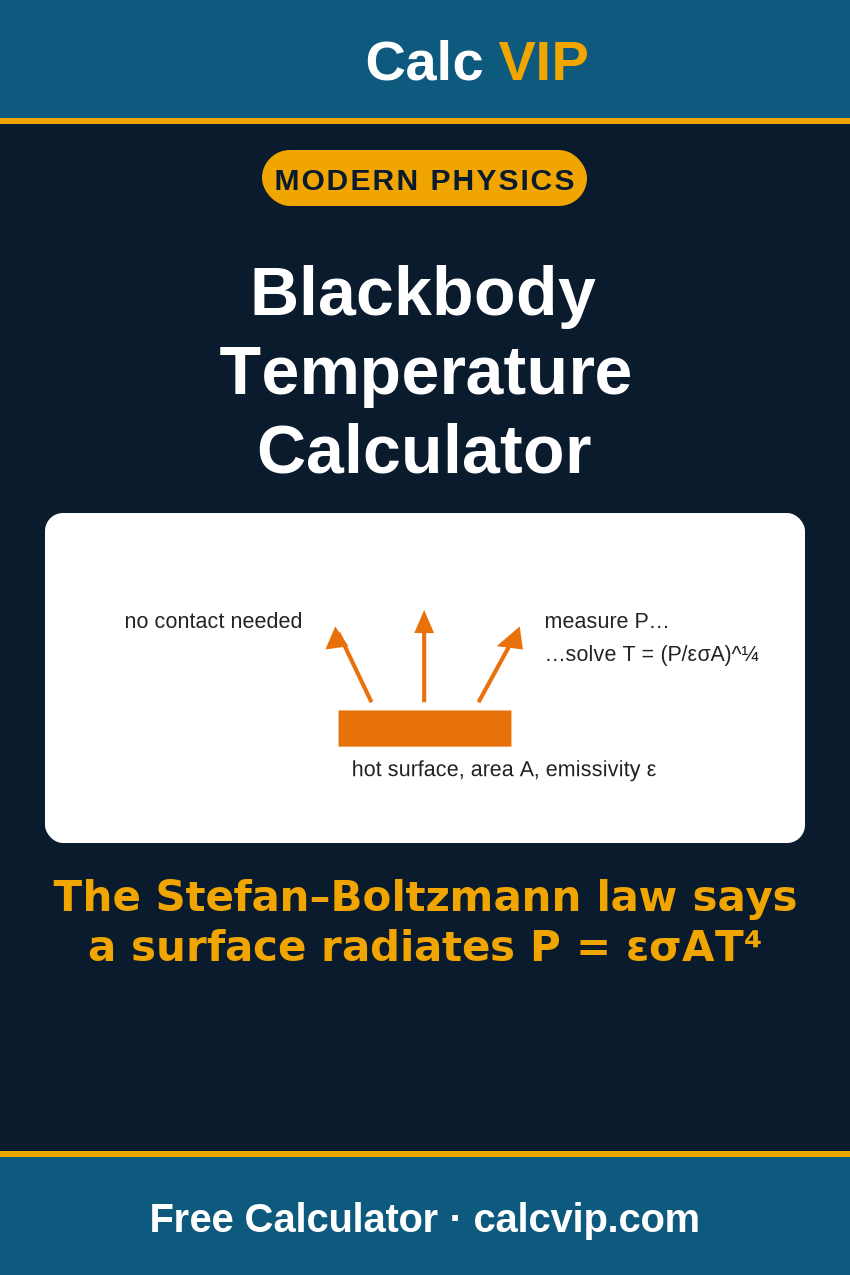
The Stefan–Boltzmann law is usually met running forwards: give it a temperature and it returns the radiated power, P = εσAT⁴. This calculator runs it in reverse, which is how the law earns its living in the real world. A furnace, a filament, a star — you can measure how much power a hot body radiates and how large its surface is, but you often cannot touch it with a thermometer. Solving for T gives T = (P/(εσA))1/4: the temperature inferred from radiation alone, the working principle behind every infrared thermometer and every published stellar temperature.
Three ingredients enter. The power P is the total electromagnetic energy leaving the surface each second — all wavelengths together, the whole blackbody curve integrated. The area A is the radiating surface (for a sphere, 4πr²; getting this wrong by confusing radius with diameter is the classic blunder). And ε, the emissivity, demotes a perfect blackbody (ε = 1) to a real surface: matt and dark surfaces approach 1, oxidised metals sit around 0.6–0.8, polished metals can fall to 0.05. The constant σ = 5.67 × 10⁻⁸ W/(m²·K⁴) — itself built from Boltzmann's constant, Planck's constant and c — does the rest.
The fourth root gives this calculation its forgiving character. Because power scales as T⁴, temperature responds to power changes with a shrug: double the power and T rises by only 21/4 ≈ 1.19, a 19% rise; multiply power by 16 and T merely doubles. Errors shrink the same way — a 16% error in measured power becomes a 4% error in temperature. That robustness is why radiation thermometry works at all across the enormous range this page's examples cover, from the 255 K effective temperature of the whole Earth to the 5,770 K surface of the Sun, with one formula and one constant.
Formula
The Stefan–Boltzmann law says a surface radiates P = εσAT⁴, where σ = 5.67 × 10⁻⁸ W/(m²·K⁴). Solving for temperature gives T = (P / (εσA))1/4 — the fourth root. The rearrangement is worth writing in flux form too: with F = P/A the power per square metre, T = (F/(εσ))1/4, which is how planetary scientists use it (a planet's F is set by its star's light). In Celsius, subtract 273.15 at the end — the law itself knows only kelvin. Because of the fourth power, doubling the temperature multiplies the radiated power by 16, so this method is very sensitive for measuring hot objects without touching them — and, by the same token, forgiving of measurement error, as the worked examples quantify.
| Symbol | Meaning | Units |
|---|---|---|
| T | surface temperature (absolute) | K (and °C) |
| P | total radiated power, all wavelengths | W |
| A | radiating surface area | m² |
| ε | emissivity, 0 (perfect reflector) to 1 (blackbody) | dimensionless |
| σ | Stefan–Boltzmann constant, 5.67 × 10⁻⁸ | W/(m²·K⁴) |
Gross radiation versus net: the trap inside the simple formula
The law's P is the power a surface emits, but surfaces also absorb radiation from their surroundings, and a body in a warm room trades both ways. The net loss is Pnet = εσA(T⁴ − Tsurroundings⁴). A human body illustrates the stakes: at 310 K with ε = 0.98 and A = 1.9 m², gross emission is about 975 W — a startling figure for an organism whose metabolism idles near 100 W. The resolution is the surroundings term: walls at 293 K radiate most of it straight back, cutting the net radiative loss to about 197 W — and clothing plus a cooler skin temperature bring the true figure down toward the ~100 W scale of the metabolic budget itself. This calculator computes the emission-side temperature, the right tool for objects far hotter than their surroundings (furnaces, filaments, stars), where the surroundings term is a rounding error. For near-room-temperature work, apply the net formula before blaming the arithmetic.
Emissivity is the second trap, and the larger one in practice. The same steel plate at the same true temperature radiates 0.8 of blackbody power when oxidised and 0.1 when polished; an infrared thermometer that assumes ε = 1 will report the polished plate hundreds of degrees cold. Professional practice is to measure or look up ε for the actual surface, or to paint a patch of known high-ε coating as a reference spot. The calculator exposes ε as an input precisely because it is the user's chief responsibility in the whole computation — σ is exact, areas are measurable, but emissivity is a property of a surface's history.
How to use
- Enter the total radiated power in watts.
- Enter the radiating surface area in square metres.
- Enter the emissivity: 1 for an ideal blackbody, about 0.9 for most dull surfaces, much less for shiny metal.
- Click "Calculate Temperature" to get T in kelvin and degrees Celsius.
Worked examples
Example 1 — the blackbody plate. A perfect blackbody plate (ε = 1) of area A = 0.01 m² radiates P = 1000 W.
T = (1000 / (1 × 5.67 × 10⁻⁸ × 0.01))1/4 = (1.764 × 10¹²)1/4 = 1152 K
In Celsius: 1152 − 273 = 879 °C — glowing bright orange, like a heating-element coil.
Example 2 — the Sun. The Sun radiates P = 3.828 × 10²⁶ W from a sphere of radius 6.96 × 10⁸ m, so A = 4πr² = 6.09 × 10¹⁸ m².
T = (3.828 × 10²⁶/(5.67 × 10⁻⁸ × 6.09 × 10¹⁸))1/4 = 5771 K — the Sun's effective temperature, agreeing with the Wien's-law value (5,796 K) from its 500 nm peak. Two independent radiation laws, one temperature.
Example 3 — a heating element. An element radiates P = 2000 W from A = 0.005 m² of oxidised surface, ε = 0.85.
T = (2000/(0.85 × 5.67 × 10⁻⁸ × 0.005))1/4 = 1697 K = 1424 °C. (Real elements also lose heat by convection and conduction, so their true temperature sits somewhat lower — the radiation-only figure is the ceiling.)
Example 4 — the whole Earth. Earth radiates to space about P = 1.22 × 10¹⁷ W from A = 5.1 × 10¹⁴ m².
T = (1.22 × 10¹⁷/(5.67 × 10⁻⁸ × 5.1 × 10¹⁴))1/4 = 255 K — the planet's effective temperature. The surface averages 288 K; the 33 K difference is the greenhouse effect, measured with this formula.
Example 5 — a light-bulb filament. A filament radiates most of its 60 W from about A = 6 × 10⁻⁵ m² of tungsten, ε ≈ 0.35.
T = (60/(0.35 × 5.67 × 10⁻⁸ × 6 × 10⁻⁵))1/4 = 2664 K — hot enough to glow near-white, cool enough (just) not to melt the tungsten (melting point 3,695 K). Filament design lives in the narrow corridor this calculation defines.
Example 6 — the human body, forwards. Skin at 310 K, ε = 0.98, A = 1.9 m² radiates P = εσAT⁴ = 0.98 × 5.67 × 10⁻⁸ × 1.9 × 310⁴ ≈ 975 W gross.
Run backwards through the calculator, 975 W returns 310 K exactly — but remember the net story from the concept section: the room radiates most of it straight back.
Blackbody temperatures in real life
Infrared thermometers and thermal cameras. Every non-contact thermometer is this formula with a measured P and an assumed ε — which is why good ones let you dial the emissivity, and why readings on polished metal lie.
Stellar astrophysics. A star's luminosity plus its radius (from parallax and angular size) gives its effective temperature — the foundational number of stellar classification, obtained with no probe and no contact.
Planetary climate science. Comparing a planet's radiation temperature (255 K for Earth) with its surface temperature isolates the greenhouse contribution — the same arithmetic scores Venus (runaway) and Mars (feeble).
Furnace and kiln control. Radiation pyrometers sight through peepholes and infer melt temperatures from emitted power, surviving environments that would destroy any contact probe.
Spacecraft thermal design. Satellites balance absorbed sunlight against εσAT⁴ emission to hold operating temperatures; radiator panels are sized by solving this equation for A.
Fire investigation and safety. Estimating the temperature a fire reached from the radiant exposure of surviving materials runs the Stefan–Boltzmann law backwards through charred evidence.
Quick reference: radiated flux versus temperature (ε = 1)
| Flux F = P/A (W/m²) | T (K) | T (°C) | Comparable emitter |
|---|---|---|---|
| 100 | 205 | −68 | a cold outer-planet moon |
| 240 | 255 | −18 | Earth to space |
| 1,000 | 364 | 91 | a hot rooftop in summer sun |
| 10,000 | 648 | 375 | a hot oven's inner wall |
| 100,000 | 1,152 | 879 | Example 1's plate |
| 1,000,000 | 2,049 | 1,776 | approaching steel-melting heat |
The table's lesson is the fourth root's compression: a ten-thousandfold range of flux — from a frozen moon to a furnace — fits inside a tenfold range of temperature. Radiation thermometry is correspondingly hard to fool with small errors and correspondingly demanding about emissivity.
Emissivity errors, priced exactly
Because T depends on the fourth root of 1/ε, an emissivity mistake has an exact price. Suppose a surface's true emissivity is 0.8 but the thermometer assumes 1. The instrument solves T = (P/(σA))1/4 while nature used Ttrue = (P/(0.8σA))1/4, so the reading is low by a factor 0.81/4 = 0.946 — a true 1,500 K surface reports as 1,419 K, an 81-degree lie from a 20% emissivity error. With ε truly 0.5 (a semi-polished metal), the factor is 0.841 and 1,500 K reports as 1,261 K. For a gentler case, a true ε of 0.9 misread as 1 costs a factor 0.91/4 = 0.974 — 1,500 K reporting as 1,461 K — which is why slightly oxidised surfaces forgive casual pyrometry while bright metals punish it. Read the same mathematics optimistically: the fourth root is your friend — even a factor-of-two emissivity blunder costs only 16% in temperature — but at furnace temperatures 16% is hundreds of degrees, and no other input to this calculator can hurt you as much. Measure ε, tape a known-emissivity patch to the surface, or use two-colour pyrometry, which takes the ratio of emission at two wavelengths and cancels ε to first order — the professional's escape from this section's arithmetic.
Closing the loop: the Sun's temperature from a satellite measurement
Example 2 began with the Sun's total power, 3.828 × 10²⁶ W — but nobody measured that at the Sun. It is assembled on Earth, and the assembly is worth seeing because it is this formula's finest hour. A satellite above the atmosphere measures the solar flux at Earth's orbit: the solar constant, 1,361 W/m². Spread that flux over the sphere of radius 1 AU (1.496 × 10¹¹ m) centred on the Sun: L = 1,361 × 4π × (1.496 × 10¹¹)² = 3.828 × 10²⁶ W. Divide by the Sun's surface area from its measured radius, take the fourth root as in Example 2, and out comes 5,771 K — a star's surface temperature derived from a flux measurement made 150 million kilometres away, a radius, and σ. Wien's law independently returns 5,796 K from the spectrum's peak. When two long chains of inference, sharing almost no steps, agree to half a percent, the Stefan–Boltzmann law stops being a formula and becomes a fact of nature you can build on — as every infrared thermometer, climate model and stellar catalogue does.
Planets as blackbodies: effective temperature versus surface truth
A planet is this calculator's largest worked example, and its most instructive liar. A planet intercepts sunlight over its disc (πR²) but radiates from its whole sphere (4πR²), so the average absorbed flux per square metre of surface is S(1 − A)/4, with S the solar flux at its orbit and A its albedo. Run the numbers: Venus, S = 2,600 W/m² and A = 0.75, absorbs 162.5 W/m² on average, giving T = (162.5/σ)1/4 = 231 K. Its actual surface bakes at 737 K — the difference, over 500 degrees, is the runaway greenhouse effect of its crushing CO₂ atmosphere, the largest such discrepancy in the solar system. Mars, S = 586 W/m² and A = 0.25, absorbs 109.9 W/m² and computes to 210 K, close to its measured mean — a thin atmosphere levies only a few degrees of greenhouse tax. Earth, from Example 4, sits between: 255 K effective against 288 K actual. The pattern is the method's real output: the gap between the blackbody temperature and the thermometer temperature is a direct measure of an atmosphere's insulating power, obtainable from orbit with this one formula — which is why exoplanet science quotes "equilibrium temperatures" computed exactly this way for worlds we will never touch.
Common mistakes
- Using diameter where area needs radius. For a sphere A = 4πr². Feeding the diameter as r quadruples the area and cuts the inferred temperature by a factor of 41/4 ≈ 1.41.
- Ignoring emissivity. Assuming ε = 1 for polished metal (true ε ≈ 0.05–0.1) underestimates T wildly — the calculator will happily return a temperature hundreds of kelvin low. Emissivity is the input that deserves your care.
- Confusing gross with net radiation. Near room temperature, surroundings radiate back almost as much as the object emits. Apply Pnet = εσA(T⁴ − T₀⁴) reasoning before trusting a near-ambient result.
- Working in Celsius inside the formula. T⁴ must be kelvin. 879 °C is 1,152 K; cubing the Celsius number by accident produces fantasy temperatures.
- Taking the square or cube root. The inverse of T⁴ is the fourth root — on a calculator, the x1/4 or double-square-root key (√ then √ again). A single √ leaves you with T², off by orders of magnitude.
FAQ
Why the fourth root?
Because radiated power grows with T⁴. Taking the fourth root undoes that: T = (P/(εσA))^(1/4). It also means a 16× error in power only causes a 2× error in temperature.
What emissivity should I use?
Matt black surfaces are close to 1, human skin is about 0.98, oxidised metal around 0.6–0.8, and polished metal can be as low as 0.05. A wrong emissivity is the biggest error source in real infrared thermometers.
Does this give the temperature of a star?
Yes, in principle: from a star's total luminosity and radius (which gives its area), the same formula yields its effective surface temperature.
How accurate is a temperature from radiation alone?
As good as your emissivity and area. With ε known to a few percent and P measured well, T is good to about a percent — the fourth root quarters every fractional error in the inputs. With ε guessed for a shiny surface, all bets are off.
Why do stars have "effective" temperatures?
Because a star has no solid surface and no single temperature; the effective temperature is defined as the blackbody temperature that would radiate the star's total power from its measured size — exactly this calculator's output.
Can this find the temperature of a planet's surface?
It finds the temperature of the layer that radiates to space — for Earth, effectively the mid-troposphere, hence 255 K rather than the surface's 288 K. The discrepancy is not an error; it is the greenhouse effect quantified.
What if I only know the flux, not P and A separately?
Use the flux form: T = (F/(εσ))1/4. Enter P and A as any pair with the right ratio — for instance P = F and A = 1 — and the calculator returns the same T.
Does colour enter this calculation at all?
No — this law integrates over all wavelengths. Colour enters through the companion Wien's law, which reads the spectrum's peak. The two together characterise a glowing body completely.
Why is σ so small?
Because it is built from atomic-scale constants (σ = 2π⁵k⁴/(15c²h³)): radiation is feeble per atom, and only the T⁴ pile-up of countless photons makes hot objects blaze. The smallness of σ is why room-temperature objects radiate a mere ~460 W/m² (at 300 K) instead of vaporising.
What is the hottest temperature this method has measured?
Radiation thermometry extends to stellar interiors inferred from surfaces, to fusion plasmas diagnosed by their emission, and to the 2.725 K cosmic background at the cold extreme — the same formula, forty orders of magnitude of power apart.