 Calc
Capillary Solver Calculator – Surface Tension or Tube Radius from Capillary Rise
 Created by Elena Petrova · Physics Editor · Fluids & Rotation · Last updated: November 2026
Use this free Capillary Solver Calculator to solve the capillary rise equation for surface tension or tube radius. Surface tension pulls a wetting liquid up a narrow tube — measure the rise and you can work out the surface tension, or predict the rise for a tube of known radius.
Stand a narrow glass tube in water and the water climbs it, uninvited and unpowered, defying gravity by a few centimetres of quiet determination. The climber is surface tension: the liquid's surface, pulled upward where it meets the wall, drags the column with it until the column's own weight calls a halt. The height of that halt encodes two secrets — the liquid's surface tension and the tube's radius — in one equation, h = 2γcosθ/(ρgr). This solver unlocks it in both directions: measure the rise and the radius to weigh a surface tension, or know the tension and predict (or choose) the radius a task requires.
The inverse proportion to radius is the phenomenon's signature. Halve the tube and the rise doubles; shrink the passage to the width of the pores in soil or the vessels in a plant stem and the climb is measured in metres. Capillarity is negligible in buckets and dominant in sponges — it is a force of small scales, because surface tension acts along the circle where liquid meets wall (a length) while gravity acts on the whole column (a volume), and as passages shrink, lengths defeat volumes. Every technology that moves liquid without a pump — wicks, blotting paper, microfluidic chips, the soil above the water table — is this ratio at work.
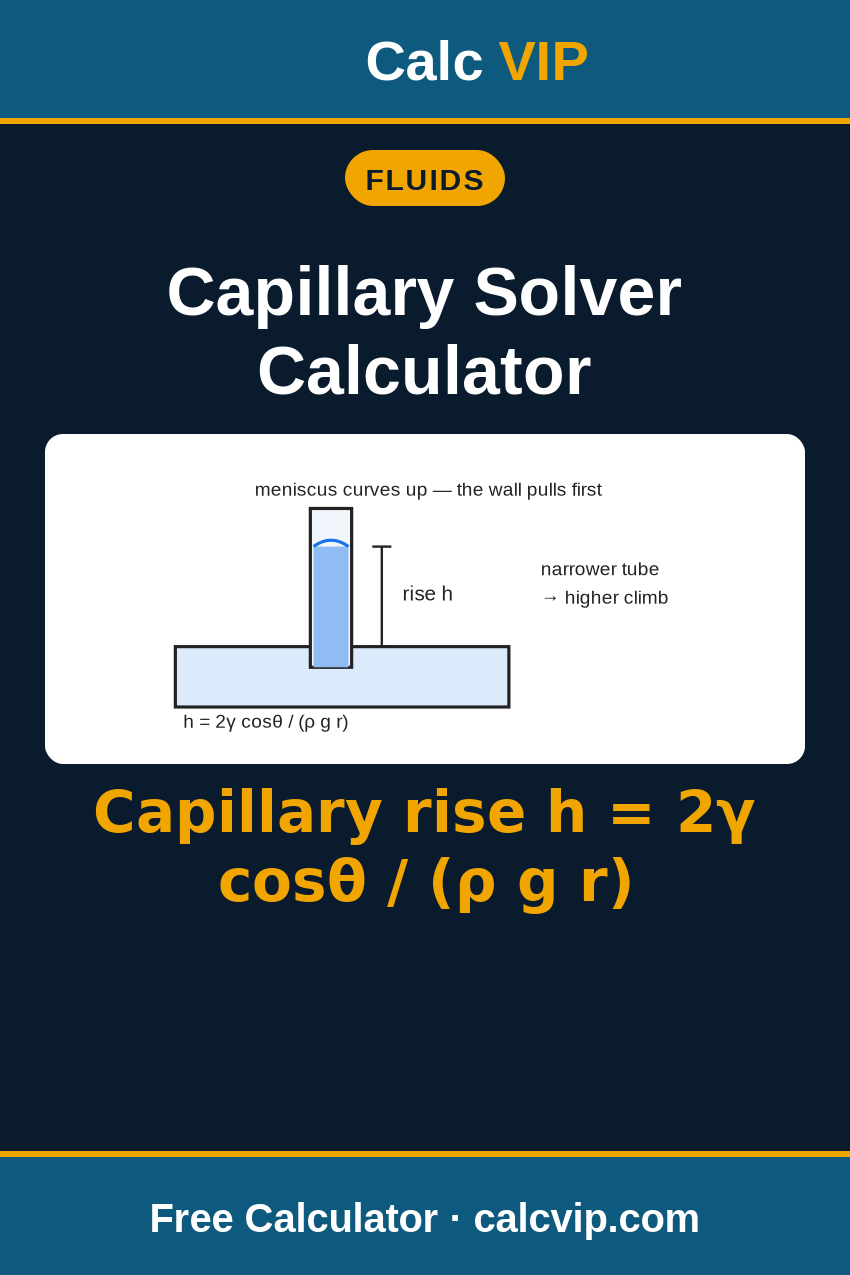
The third actor, easily overlooked, is the contact angle θ. It records how eagerly the liquid wets the wall: water on clean glass spreads eagerly at θ ≈ 0°, maximising the climb; water on wax sulks at about 105° and climbs reluctantly or not at all; mercury on glass, at about 140°, refuses so completely that its level in a tube is pushed below the reservoir — capillary depression, the same equation with a negative sign. The solver takes θ as an input rather than assuming it, because in real materials the angle, as much as the tension, is the story.
Formula
Capillary rise h = 2γ cosθ / (ρ g r) • rearranged: γ = h ρ g r / (2 cosθ), and r = 2γ cosθ / (ρ g h); γ in N/m, ρ in kg/m³, r in metres, h in metres
The derivation is a two-force balance. Surface tension pulls up along the contact circle of length 2πr with force γ × 2πr × cosθ (only the vertical component counts); the column's weight pulls down with ρg × πr²h. Equating them, π and one r cancel, leaving h proportional to γ and to 1/r. The cancellation is the physics in miniature: circumference (one power of r) fights volume (two powers), so smallness wins. This solver works in the laboratory's practical units — rise and radius in millimetres, density in kg/m³, angle in degrees — and handles depression automatically when cosθ turns negative.
| Symbol | Meaning | Units |
|---|---|---|
| h | capillary rise (negative = depression) | mm here, m in the formula |
| γ | surface tension of the liquid | N/m (water ≈ 0.0728) |
| θ | contact angle between liquid and wall | degrees (0° water/glass; 140° mercury/glass) |
| ρ | liquid density | kg/m³ |
| r | internal radius of the tube or pore | mm here, m in the formula |
The meniscus: where the pulling happens
Look closely at the top of the column and the surface is not flat but curved — concave for a wetting liquid, the edges climbing the wall ahead of the centre. That curve, the meniscus, is the visible signature of the contest between adhesion (liquid-to-wall attraction) and cohesion (liquid-to-liquid attraction). Where adhesion wins, the surface is dragged up at the rim, surface tension acts along the tilted surface, and its vertical component hauls the column after it. The same curvature has a pressure consequence — the Young–Laplace law: the pressure just beneath a curved surface differs from the air's by 2γcosθ/r, and it is that pressure deficit, balancing ρgh, that an alternative derivation of the rise uses. Two viewpoints, one equation: force around a circle, or pressure under a curve.
The contact angle is the meniscus's report on the wall's chemistry, and it is fussy in instructive ways. Grease a glass tube's interior and water's angle climbs from near 0° towards 90°, strangling the rise; laboratory glassware is scrupulously cleaned for exactly this reason. Temperature matters too — surface tension falls as liquids warm (water's γ drops about 0.15% per degree near room temperature), so precise work quotes the temperature alongside the tension. And a moving meniscus shows a different angle from a still one, a hysteresis that makes the rise measured on the way up differ slightly from the fall measured on the way down — real surfaces keep small secrets that ideal equations politely ignore.
How to use
- Choose what to solve for: surface tension γ from a measured rise and radius, or tube radius r from a desired rise and a known γ.
- Enter the capillary rise in millimetres (measure to the bottom of the meniscus for a wetting liquid).
- Enter the tube radius in millimetres — half the internal diameter — or the surface tension in N/m, as the mode requires.
- Enter the liquid's density and the contact angle (0° pre-filled for water on clean glass), then click "Solve" to finish.
Worked examples
Example 1 — the classroom measurement. Water (γ = 0.0728 N/m, ρ = 1,000 kg/m³, θ = 0°) in a tube of radius 0.5 mm.
h = 2 × 0.0728 × 1 ÷ (1,000 × 9.81 × 0.0005) = 29.68 mm. Run backwards through this solver, a measured rise of 29.68 mm in that tube returns γ = 0.0728 N/m — the standard undergraduate determination of surface tension, accurate to a percent with school glassware.
Example 2 — choosing a tube for a target rise. A demonstrator wants water to climb exactly 50 mm. r = 2 × 0.0728 ÷ (1,000 × 9.81 × 0.05) = 0.297 mm — a tube of about 0.6 mm bore. The radius mode is how capillary devices are specified before they are built.
Example 3 — ethanol's weaker climb. Ethanol (γ = 0.0223 N/m, ρ = 789 kg/m³, θ ≈ 0°) in the same 0.5 mm tube: h = 2 × 0.0223 ÷ (789 × 9.81 × 0.0005) = 11.52 mm. Lower tension and lower density fight; tension loses — the rise is barely a third of water's, a ranking you can verify in any laboratory.
Example 4 — mercury's depression. Mercury (γ = 0.4655 N/m, ρ = 13,595 kg/m³, θ = 140°, cosθ = −0.766) in a 0.5 mm tube: h = 2 × 0.4655 × (−0.766) ÷ (13,595 × 9.81 × 0.0005) = −10.70 mm. The negative sign is a 10.7 mm fall below the reservoir level — the correction that precision barometer readers (the barometer calculator's cousins) must add back.
Example 5 — the fine tube. Water in a tube of radius 0.1 mm: h = 2 × 0.0728 ÷ (1,000 × 9.81 × 0.0001) = 148.4 mm. Fifteen centimetres from a hair's breadth of glass — the scale at which capillarity stops being a curiosity and becomes a pump.
Example 6 — the soil's invisible reservoir. Treat a fine soil pore as a tube of radius 10 µm (0.01 mm): h = 2 × 0.0728 ÷ (1,000 × 9.81 × 0.00001) = 1.48 m. Groundwater genuinely climbs about this far above the water table in fine soils — the capillary fringe that keeps topsoil moist, feeds plant roots between rains, and carries dissolved salts upward to blight foundations and farmland alike.
Capillarity in real life
Plants and soil. Example 6's fringe is agriculture's hidden irrigation; the same physics in xylem vessels assists (though transpiration pull leads) the rise of sap. Soil scientists map the fringe to predict salinity and foundation damp.
Wicks and lamps. A candle wick, an oil lamp and a kerosene heater all lift fuel against gravity through fibre gaps sized by this equation — too coarse and the flame starves, too fine and it floods slowly.
Paper diagnostics. Lateral-flow tests — pregnancy tests, rapid antigen tests — are capillary pumps with no moving parts: the strip's pore size sets the flow speed, and the timing of the result is this formula expressed in cellulose.
Rising damp in buildings. Brick and mortar are bundles of fine pores; ground moisture climbs them by exactly Example 6's mechanism, typically a metre or so, until evaporation balances the rise — and the damp-proof course is a deliberate break in the capillary path.
Ink and printing. Fountain-pen feeds, inkjet paper coatings and fabric printing all meter liquids through engineered capillaries; the pen that writes without blotting is a radius chosen by this solver's logic.
Microfluidics and spaceflight. Lab-on-a-chip devices steer reagents by capillary valves, and spacecraft fuel tanks use capillary vanes to keep propellant at the outlet in weightlessness — where gravity's side of the balance vanishes and surface tension rules alone.
Beyond the single tube: pores, bundles and Jurin's law
Real capillary systems are rarely one clean tube. A sponge, a soil or a paper strip is a bundle of irregular passages, and the equation survives by reinterpretation: r becomes an effective pore radius, inferred from the rise itself (run this solver backwards on a measured climb and the bundle confesses its effective radius). The historical name for the rise law, Jurin's law, honours the 18th-century observation that h × r is constant for a given liquid — the quick-reference table below is that constancy displayed. Two refinements matter in practice. First, irregular pores fill at their narrowest throats and empty at their widest, so wetting and drying follow different paths — the hysteresis behind soil-moisture curves that refuse to retrace themselves. Second, in very fine pores the climb is slow: the Washburn equation adds time to the story, with the column advancing as the square root of elapsed time, which is why a tall fringe takes days to establish and a diagnostic strip takes its measured minute.
Surface tension itself can be tuned, and the tuning is an industry. Surfactants — soap, detergents, wetting agents — crowd into the surface and cut γ dramatically: soapy water near 0.03 N/m climbs less than half as high as pure water in the same tube, which is precisely why detergent solutions spread and penetrate where plain water beads and hesitates. Firefighting foams, agricultural sprays (which must wet waxy leaves, an angle problem as much as a tension one), and enhanced oil recovery all dose surfactants to move the γ and θ in this equation to chosen values. Temperature tunes more gently in the same direction: warm water's lower tension is one reason hot washes wet and wick better than cold ones. The equation's three inputs are three control knobs, and half of applied surface science is knowing which knob a problem is offering you.
Quick reference: water's rise by tube radius (θ = 0°)
| Tube radius | Capillary rise of water |
|---|---|
| 1 mm | 14.84 mm |
| 0.5 mm | 29.68 mm |
| 0.25 mm | 59.37 mm |
| 0.1 mm | 148.4 mm |
| 0.05 mm | 296.8 mm |
| 0.01 mm (fine soil pore) | 1.48 m |
Jurin's law in a single glance: the product h × r is the same in every row (about 14.84 mm² for water), so any row can be reconstructed from any other — and a measured rise instantly prices the pore that produced it.
The table also explains a laboratory commonplace: surface-tension measurements use tubes near 0.5 mm radius not by habit but by design — the rise there, about 30 mm, is large enough to read precisely with a ruler yet small enough for a bench apparatus, and the meniscus correction stays negligible. Metrology is often just a well-chosen row of a table like this one.
Common mistakes
- Entering the diameter where the radius belongs. The formula's r is a radius; a diameter typed into the radius box halves the predicted rise (or doubles the inferred γ). Halve every bore measurement before entering it.
- Assuming θ = 0° for every liquid–wall pair. Oils on plastics, water on waxed or greasy glass — real angles wander far from zero, and cosθ punishes the assumption directly. When γ is the unknown, an unmeasured θ is the largest error in the room.
- Reading the rise to the top of the meniscus. For a wetting liquid the convention is the bottom of the meniscus; reading the rim adds a fraction of a millimetre that matters at small rises.
- Ignoring temperature. Surface tension falls as the liquid warms; a γ measured at 30 °C and used at 15 °C is wrong by a couple of percent before any glass is touched.
- Expecting the rise in a dirty tube to match the book. A fingerprint of grease inside the bore changes the local contact angle and can halve the climb. Capillarity is a surface phenomenon and keeps a surface's secrets.
FAQ
Why does the liquid climb at all?
Adhesion between the liquid and the tube wall pulls the edge of the surface up, and surface tension drags the rest of the column with it until the column's weight balances the pull.
What contact angle should I use?
Water on clean glass is nearly 0°. Water on wax is about 105°, and mercury on glass is about 140°, which is why mercury is pushed down instead of rising.
How does capillary action help plants?
It contributes to drawing water up narrow xylem vessels, working together with transpiration pull and root pressure to move water from roots to leaves.
What is the surface tension of common liquids?
Water leads the everyday list at 0.0728 N/m (20 °C); ethanol manages 0.0223, olive oil about 0.032, soapy water drops to roughly 0.03 (which is why soap films behave so differently), and mercury towers at 0.4655 — though its contact angle keeps it from climbing glass.
How high could water rise in the finest possible tube?
The formula promises kilometres as r approaches molecular size, but long before that the assumptions fail: the meniscus cannot form in a passage a few molecules wide, and evaporation and surface roughness take over. Practical fringes in the finest clays reach a few metres.
Why do towels absorb water upward so fast?
The fibres form a dense bundle of fine, well-wetting passages — small effective r, θ near 0° — and the Washburn square-root law makes the first centimetres arrive in seconds. Cotton's chemistry (cellulose loves water) does the rest, which is why synthetic towels, with prouder contact angles, merely push water around.
Does gravity affect the contact angle?
Not materially at these scales — the angle is set by the three surface tensions at the contact line (Young's equation). Gravity shapes the column's height; chemistry shapes the angle; the formula marries them.
Can capillarity lift water to the top of a tall tree?
Not alone — a 100 m tree would need pores of about 0.15 µm working perfectly, and xylem conduits are far wider. Trees climb on transpiration pull, with cohesion of the water column doing the heavy lifting; capillarity assists at the leaf's evaporating surfaces where the menisci actually live.
What is capillary depression used for?
Mostly as a correction: mercury instruments (barometers, manometers) read low by the depression amount, tabulated by tube bore. Deliberately, non-wetting coatings exploit the same physics to make surfaces shed water — the lotus effect is contact-angle engineering.
How do I measure an unknown pore size with this?
Let the material wick a liquid of known γ, ρ and θ, measure the equilibrium rise, and run the radius mode: the r it returns is the effective pore radius — the standard characterisation behind filter and membrane specifications. Repeat with a second liquid of different tension as a cross-check; agreement between the two is the signature that the effective-radius picture is honest for that material.