 Calc
Fission Energy Calculator – Energy from Mass Loss, E = mc²
 Created by Anna Kowalski · Physics Editor · Heat & Atoms · Last updated: November 2026
Use this free Fission Energy Calculator to find the energy released when mass disappears in a nuclear reaction, using E = mc². Choose kilograms (result in joules) or atomic mass units (result in MeV) — the mode used for fission and fusion calculations.
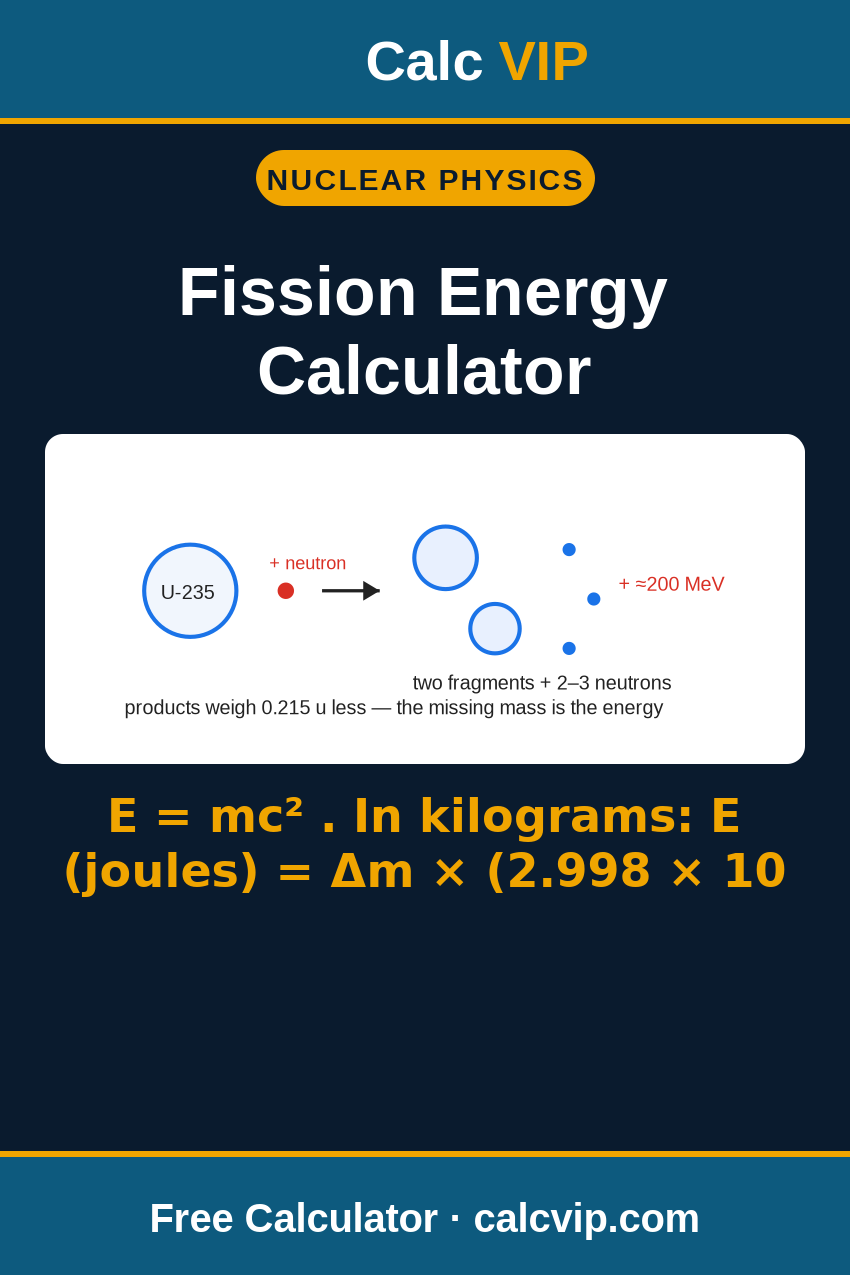
E = mc² is the most famous equation in the world and the least intuitive. It says that mass is not a substance but a store: every kilogram of anything is 9 × 10¹⁶ joules of frozen energy, and when a nuclear reaction's products weigh less than its reactants, the difference has not vanished — it has left, as kinetic energy of the fragments and as radiation. Fission is the industrial exploitation of that bookkeeping. A uranium-235 nucleus that splits loses about 0.215 atomic mass units — barely a tenth of one percent of itself — and releases some 200 MeV in exchange, millions of times more energy per atom than burning carbon ever yields. This calculator applies the exchange rate in both of its working currencies: kilograms to joules, for bulk energy, and atomic mass units to MeV, for single reactions.
The c² in the formula is why the numbers are so violent. The speed of light is 3 × 10⁸ m/s; squared, it becomes 9 × 10¹⁶ — a multiplier so large that a single gram of mass, wholly converted, equals about 21 kilotons of TNT. Real fission converts only about a thousandth of the fuel, yet a kilogram of uranium-235 still delivers some 8 × 10¹³ joules, the output of three million kilograms of coal. Chemistry cannot compete because chemistry never touches the nucleus: burning rearranges electrons and converts a mass fraction so small (about one part in a billion) that no scale could ever detect it.
Choose your mode by the question you are asking. Reactor engineers, weapons physicists reckoning yields, and anyone comparing against electricity bills want kilograms and joules. Nuclear physicists balancing a single reaction — does this fission, this fusion, this decay release energy, and how much? — want atomic mass units and MeV, the natural coin of the nucleus, convertible at 931.5 MeV per unit. The calculator returns both joules and MeV either way, so the two dialects of the nuclear world stay one click apart.
Formula
E = mc². In kilograms: E (joules) = Δm × (2.998 × 10⁸)². In atomic mass units: E (MeV) = Δm × 931.5, because 1 u = 931.5 MeV/c². A typical uranium-235 fission loses about 0.215 u, releasing roughly 200 MeV.
The two modes are the same equation in different clothes. Since 1 u = 1.6605 × 10⁻²⁷ kg, one unit through E = mc² gives 1.6605e-27 × (2.998e8)² = 1.492 × 10⁻¹⁰ J, and dividing by the MeV in joules (1.602 × 10⁻¹³) returns the 931.5 factor — nothing is empirical about it. Rearranged, the equation also answers the reverse question: the mass equivalent of any energy is Δm = E / c², the form that tells you a power station's daily output "weighs" a few grams (Example 5). For single reactions, Δm is not entered from thin air: it is the total mass of the reactants minus the total mass of the products, each side summed from atomic-mass tables — precisely the subtraction the Q-value calculator performs. And for a mole-scale estimate, multiply the per-reaction MeV by 6.022 × 10²³ and convert: 200 MeV per fission is 3.2 × 10⁻¹¹ J, which is why a watt of fission power needs some 3 × 10¹⁰ fissions every second.
| Symbol | Meaning | Units |
|---|---|---|
| E | energy released | joules (J) or MeV |
| Δm | mass lost — reactants minus products | kg, or atomic mass units (u) |
| c | speed of light, 2.998 × 10⁸ | m/s |
| 931.5 | energy equivalent of 1 u | MeV per u |
Where the energy actually goes
"Mass becomes energy" is the slogan; the ledger is more specific. When uranium-235 fissions, the 200 MeV does not appear as a single flash. Roughly 168 MeV leaves as the kinetic energy of the two fragments — heavy, fast, and stopped within micrometres of fuel, which is precisely how a reactor core gets hot. The emitted neutrons carry about 5 MeV, prompt gamma rays about 7 MeV, and the fragments' subsequent beta decays add some 15–20 MeV over the following seconds to years — minus about 10 MeV that escapes as neutrinos, the one portion no engineering can recover. Operators care about the split: the delayed beta-and-gamma share is the "decay heat" that persists after shutdown and must be cooled away, the figure at the centre of every reactor accident timeline.
It is equally important what does not happen: no mass is destroyed. The fragments, neutrons and radiation together carry exactly the energy the missing 0.215 u represents, and if you could gather every product on a scale — including weighing the heat and light by their E/c² — the total would match the starting mass to the last decimal. E = mc² is not a licence for disappearance; it is a conservation law with an exchange rate, and this calculator is the currency desk. The same desk serves fusion (where light nuclei pay the toll), annihilation (where the whole mass is exchanged), and even chemistry, whose tiny exchange is simply too small to notice.
How to use
- Choose the unit of your mass loss — kilograms or atomic mass units (u).
- Enter the mass loss Δm (products weigh less than the starting nucleus/fuel).
- Click the button to get the energy in joules and in MeV.
- For a specific reaction, get Δm from atomic masses: sum the reactants, sum the products, subtract — or use the Q Value Calculator, which does that subtraction and this conversion together.
- To scale a single fission up to a fuel quantity, multiply the per-fission joules by the number of nuclei: (mass in grams / 235) × 6.022 × 10²³ for uranium-235.
Worked examples
Example 1 — one gram, converted completely. A reaction loses 0.001 kg of mass (1 gram).
E = 0.001 × (2.998 × 108)² = 8.99 × 10¹³ J — roughly the energy of a large lightning storm, from one gram.
In u mode: a typical fission mass loss of 0.215 u gives 0.215 × 931.5 = 200.3 MeV per fission. The gram in the first line, expressed as a TNT equivalent, is 8.99e13 / 4.184e12 ≈ 21.5 kilotons — a city-scale explosion latent in a paperclip's worth of mass, released only if all of it converts, which fission never achieves.
Example 2 — one kilogram of uranium-235, fully fissioned. A kilogram holds (1000/235) × 6.022 × 1023 = 2.56 × 1024 nuclei. At 200 MeV = 3.20 × 10⁻¹¹ J per fission, total E = 2.56e24 × 3.20e-11 ≈ 8.2 × 10¹³ J — about 19.6 kilotons of TNT, or the chemical energy of some 3.4 million kilograms of coal. Note the consistency with Example 1: fission converts only ~0.09% of the fuel's mass, so a kilogram of uranium yields roughly what a fully converted gram would.
Example 3 — the price of one watt. One fission gives 3.20 × 10⁻¹¹ J, so sustaining 1 watt — one joule per second — requires 1 / 3.20e-11 ≈ 3.1 × 10¹⁰ fissions per second. Scale that by a billion and you have a power reactor: a 1 GW thermal core runs near 3 × 10¹⁹ fissions per second, a figure worth pausing on — thirty billion billion atomic splittings, every second, choreographed by control rods.
Example 4 — a power station's daily burn. A 3 GW-thermal reactor core (about 1 GW electric) fissions 3e9 × 3.1e10 ≈ 9.4 × 10¹⁹ nuclei per second, or 8.1 × 1024 per day — a mass of uranium-235 of about 3.2 kg per day. Yet the mass actually converted to energy is Δm = E/c² = (3e9 × 86,400) / 8.99e16 ≈ 2.9 grams per day. The other 3.2 kg is still there, rearranged into fission fragments and neutrons; only the 2.9-gram defect left as electricity's ancestor, heat.
Example 5 — the Sun's mass budget. The Sun radiates 3.83 × 1026 joules per second. Dividing by c²: Δm = 3.83e26 / 8.99e16 ≈ 4.26 × 10⁹ kg per second — over four million tonnes of mass converted to light every second, and the Sun is so massive (2 × 10³⁰ kg) that it can afford this for billions of years. To supply that defect it fuses some 600 million tonnes of hydrogen per second into 596 million tonnes of helium; the 4-million-tonne difference is this calculator's output, shining on your face eight minutes later.
Example 6 — fusion fuel, kilogram for kilogram. Deuterium–tritium fusion releases 17.6 MeV per reaction of 5.03 u of fuel. Per kilogram: (1000/5.03) × 6.022e23 = 1.20 × 1026 reactions × 2.82 × 10⁻¹² J ≈ 3.4 × 10¹⁴ J — about four times the energy per kilogram of uranium fission (Example 2), from the lightest fuel in the universe. That factor of four, plus ash that is harmless helium, is the entire economic romance of fusion in one line of arithmetic.
Fission energy in real life
Reactor fuel economics. A single uranium fuel pellet the size of a fingertip contains about 10 grams of uranium and yields, over its life in the core, roughly the energy of a tonne of coal. Utilities buy enrichment and burn-up in exactly the units of this page: joules per kilogram of heavy metal, computed from the 200 MeV figure and the fission rate it implies.
Nuclear weapons yields. Yields are quoted in kilotons because the arithmetic is this calculator's: the Hiroshima device fissioned roughly three-quarters of a kilogram of its uranium-235, of which the mass actually converted was Δm = E/c² ≈ 0.7 grams for its ~15-kiloton yield. Efficiency — the fraction of the core that fissions before it blows apart — is the central design problem the number exposes.
Decay heat and accident safety. About 6–7% of a running reactor's power is the fragments' delayed decay energy (Example: the ≈18 MeV beta-and-gamma share), continuing after shutdown and falling exponentially. Cooling that residual heat — a few hundred megawatts in a large core, initially — is the non-negotiable engineering duty behind every emergency-core-cooling system ever built.
Medical and industrial isotopes. Research reactors fission uranium targets to breed molybdenum-99 (parent of the imaging isotope technetium-99m). The production rate is set by fission rate — Example 3's arithmetic — tying hospital scan schedules directly to E = mc² bookkeeping.
Deep-space power. Radioisotope generators invert the idea: instead of fission, plutonium-238's alpha decay converts a trickle of mass — its total stock will lose only milligrams over a mission — into the few hundred watts that powered Voyager for nearly five decades. Small Δm, patiently spent.
Comparing energy sources honestly. Every "how much better is nuclear?" debate reduces to this page: fission ≈ 8 × 10¹³ J/kg of fuel, fusion fuels ≈ 3 × 10¹⁴ J/kg, coal ≈ 2.4 × 10⁷ J/kg, TNT 4.2 × 10⁶ J/kg. Six to seven orders of magnitude separate the nuclear rows from the chemical ones — the c² multiplier, visible in a single table.
Quick reference: the energy ladder
| Quantity | Energy | Equivalent |
|---|---|---|
| One U-235 fission (Δm = 0.215 u) | 200 MeV = 3.2 × 10⁻¹¹ J | 31 billion fissions make 1 joule... per second, 1 watt |
| 1 gram fully converted | 9.0 × 10¹³ J | ≈ 21.5 kilotons TNT |
| 1 kg U-235 fully fissioned | 8.2 × 10¹³ J | ≈ 3.4 million kg of coal |
| 1 kg D–T fusion fuel | 3.4 × 10¹⁴ J | ≈ 4 × fission, per kg |
| 1 kg fully converted | 9.0 × 10¹⁶ J | ≈ 21.5 megatons TNT |
| 1 kg of coal burned | 2.4 × 10⁷ J | Δm ≈ 2.7 × 10⁻¹⁰ kg — unweighable |
The last row deserves a stare: burning coal obeys E = mc² too — every fire does — but its mass defect is a quarter of a nanogram per kilogram, forever beyond any balance. Nuclear physics did not invent mass-energy conversion; it merely found reactions whose defects a scale, and a power grid, can notice.
Why only a tenth of a percent? The binding-energy connection
Fission's 0.215 u defect is about 0.09% of the uranium nucleus's 236 u, and the binding-energy curve explains the modesty. Uranium sits at 7.59 MeV of binding per nucleon; its fragments sit near 8.4; the gain is only the difference, about 0.8 MeV per nucleon — roughly a tenth of the total binding. The other 90% of the defect stays locked in the fragments, as it must: the products are nuclei too, still bound, still lighter than their own parts. Total conversion — the paperclip-gram of Example 1 — requires matter–antimatter annihilation, the only process with no bound residue. Everything nuclear engineers will ever build lives in the narrow margin between "bound" and "slightly more bound", and as the ladder above shows, that margin is more than enough.
Common mistakes
- Using c instead of c². The multiplier is (3 × 10⁸)² = 9 × 10¹⁶, not 3 × 10⁸. Forgetting the square understates the energy by a factor of three hundred million — the single most common error with this equation, and the easiest to catch with a sanity check against 9 × 10¹³ J per gram.
- Assuming all the fuel's mass converts. Fission converts about 0.09% of the uranium's mass; the rest remains as fragments, neutrons and unburnt fuel. Entering a whole kilogram into E = mc² overstates a real fuel load's yield by a factor of about a thousand.
- Mixing the two modes. 0.215 is the defect in atomic mass units; in kilograms it is 3.57 × 10⁻²⁸ kg. The mode selector exists because the same digits mean wildly different energies in the two systems — check the label before the arithmetic.
- Botching the MeV–joule conversion. 1 MeV = 1.602 × 10⁻¹³ J (it is 10⁶ electron-volts, and one electron-volt is 1.602 × 10⁻¹⁹ J). Slipping to 10−19 understates every fission by a million.
- Forgetting the neutrons in the mass balance. When you compute Δm for a fission from atomic masses, the 2–3 emitted neutrons are products too. Leave one out and the products' mass is understated by 1.008665 u, so the defect — and the energy — comes out overstated by about 940 MeV per missing neutron: an error no rounding can hide.
FAQ
Why is nuclear energy so much bigger than chemical energy?
Burning converts only a tiny fraction of mass (the mass change is unmeasurably small), while fission converts about 0.1% of the fuel's mass directly into energy — millions of times more per kilogram.
Does the mass really vanish?
The rest mass decreases; the 'missing' mass appears as kinetic energy of the fragments and radiation. Total mass-energy is conserved — E = mc² is the exchange rate.
How much energy is in 1 kg of mass?
Fully converted, 1 kg → about 9 × 10¹⁶ J, roughly the energy of a 21-megaton explosion. Real fission converts only about 0.1% of the fuel mass.
Where does the 200 MeV from one fission actually appear?
Mostly as motion: about 168 MeV is the kinetic energy of the two fragments, which stops inside the fuel and becomes heat. Neutrons take ≈5 MeV, prompt gamma rays ≈7 MeV, and the fragments' later beta decays ≈18 MeV spread over time, while ≈10 MeV escapes as neutrinos. A reactor harvests everything except the neutrinos.
How is the energy of a fission measured if the mass loss is so tiny?
Nobody weighs it directly — 0.215 u is 3.6 × 10⁻²⁸ kg. Instead the fragments' kinetic energies are measured in detectors, and they sum to the E = mc² prediction. The agreement between the mass-spectrometer defect and the calorimeter's heat is one of the best-tested balances in physics.
Why can't a reactor explode like a bomb?
The physics of this page is identical, but the engineering is opposite: reactor fuel is only 3–5% uranium-235 (against 90%+ in a weapon), is spread through moderators and structures that absorb neutrons when overheated, and expands to shut itself down. A reactor can melt; it cannot assemble the fast, dense, prompt chain reaction a weapon needs. The energy per fission is the same 200 MeV — the rate is everything.
Does fusion also use this calculator?
Yes — E = mc² is universal. Enter the D–T defect of 0.0189 u in u mode and you get 17.6 MeV per fusion; enter kilograms for bulk fuel. The Q-value calculator is the specialist tool when you want the defect computed from the reactants' and products' masses automatically.
What is the most efficient energy release known?
Matter–antimatter annihilation: 100% conversion, the full 9 × 10¹⁶ J per kilogram of combined fuel. It is also the least practical — antimatter is manufactured atom by atom at CERN-scale cost and stored, with difficulty, in atoms' worth of quantity. Fission's 0.09% looks feeble beside it and miraculous beside chemistry; engineering lives between the two.
How much mass does a nuclear power station 'burn' per year?
A 3 GW-thermal station converts about 2.9 grams per day (Example 4) — roughly one kilogram of mass into energy per year — while rearranging about 1.2 tonnes of uranium-235 into fission products in the same period. The ash masses almost exactly what the fuel did; only the kilogram is missing, and it left as a city's worth of electricity.
Is the mass loss permanent?
Yes, in the only sense that matters: the energy radiated away carries its mass equivalent with it. If the Earth radiated heat into space, the planet's mass falls by E/c² — immeasurably, but truly. Seal the energy in a perfectly reflecting box, though, and the box's total mass never changes: mass-energy is conserved, and conversion only moves the entry between columns.