 Calc
Gamma Ray Energy Calculator – Photon Energy in keV & MeV
 Created by Anna Kowalski · Physics Editor · Heat & Atoms · Last updated: November 2026
Use this free Gamma Ray Energy Calculator to convert a photon's wavelength or frequency into its energy in keV or MeV. Gamma rays and X-rays are the same kind of light — the name depends on where the photon came from and how much energy it carries.
A photon is a packet of energy whose size is set by one thing only: its frequency. Double the frequency and you double the energy; shrink the wavelength a thousandfold and the energy grows a thousandfold. That rigid proportionality, E = hf, is Planck's relation — the founding equation of quantum physics — and this calculator is its working edge, converting between the wavelength or frequency of a photon and its energy in the units of the high-energy world: electronvolts, keV and MeV. At the energies of visible light the packets are a few eV, individually harmless. At gamma-ray energies each single photon carries enough concentrated energy to smash molecules apart — which is why the keV-to-MeV range commands respect, shielding and its own calculator.
The X-ray/gamma-ray boundary confuses everyone once, so let us settle it here. The two are not different kinds of radiation: both are photons, identical in nature, overlapping in energy. The name records the birthplace. Photons emitted by atomic nuclei — in radioactive decay, fission, annihilation — are gamma rays, even modest ones of a few tens of keV. Photons produced by electrons — slammed into X-ray tube targets, or jumping between atomic shells — are X-rays, even at energies above some gamma rays. Energy alone, which is what this calculator computes, cannot tell you the name; origin can. When a hospital says "gamma camera" and a dentist says "X-ray", both are counting photons with the same Planck relation.
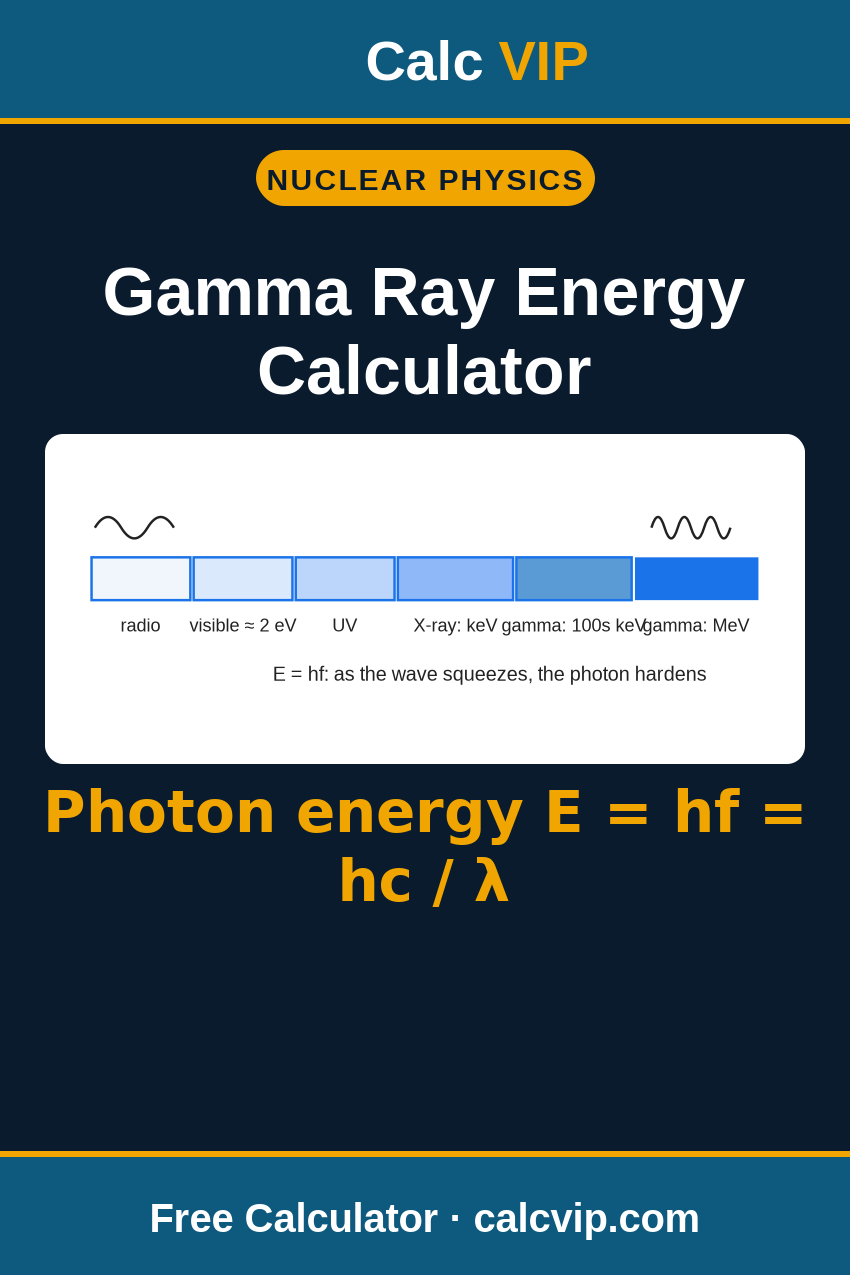
Why convert at all? Because each community speaks a different dialect. Spectroscopists identify radioactive isotopes by their gamma-ray energies the way you would identify voices — caesium-137 sings at 662 keV, cobalt-60 at 1,173 and 1,333 keV, potassium-40 at 1,461 keV — while optical physicists think in wavelengths and radio engineers in frequencies. Detector datasheets, shielding tables and medical protocols all quote energies. This calculator is the translator among the dialects: give it λ or f, and it returns E in joules, eV, keV and MeV, names the band, and hands back the quantity you did not give it.
Formula
Photon energy E = hf = hc / λ • E in joules (or eV after dividing by 1.602 × 10⁻¹⁹), h = 6.626 × 10⁻³⁴ J·s, c = 3 × 10⁸ m/s, f in hertz, λ in metres.
The constant hc is worth packaging once and for all: hc = 1.9878 × 10⁻²⁵ J·m, which in the units of this subject is E (eV) ≈ 1,240.8 / λ (nm) — the spectroscopist's pocket formula. Green light at 530 nm: 1,240.8 / 530 = 2.34 eV. A 124 keV gamma ray: λ = 1,240.8 / 124,082 eV expressed in nm = 0.01 nm, matching the worked example. Rearrangements: f = E / h and λ = hc / E, and the band boundaries this calculator applies are E ≥ 100 keV → gamma-ray range, 100 eV to 100 keV → X-ray range, below that ultraviolet and under. One more threshold towers over the subject: at 1.022 MeV — twice the electron's rest energy of 511 keV — a photon gains the ability to convert into an electron–positron pair, opening the pair-production interaction that dominates shielding physics at high energy.
| Symbol | Meaning | Units |
|---|---|---|
| E | energy of one photon | J; usually eV, keV or MeV |
| f | photon frequency | hertz (Hz) |
| λ | photon wavelength | metres (m); pm or nm in practice |
| h | Planck's constant | 6.626 × 10⁻³⁴ J·s |
| c | speed of light | 3 × 10⁸ m/s |
Energy decides how a photon interacts
A photon's energy does more than name its band — it selects its fate inside matter, and three interactions take turns dominating. At low energies (up to a few hundred keV in tissue, more in lead) the photoelectric effect rules: the photon vanishes, handing all its energy to one electron. Through the middle range, roughly 100 keV to 10 MeV in tissue, Compton scattering dominates: the photon bounces off an electron, surrendering part of its energy and continuing at a reduced E — which is why scattered radiation around a patient or source is softer than the primary beam, a fact this calculator quantifies by running the scattered wavelength back through E = hc/λ. Above 1.022 MeV, pair production switches on and grows: near a nucleus the photon converts outright into an electron and a positron, and the positron's eventual annihilation returns two 511 keV photons to the story.
This is why a single number, the photon energy, is the master key of radiation work. Shielding half-value layers, detector efficiencies, image contrast in a CT scan, the depth a radiotherapy beam reaches — all are tabulated against E. A 50 keV X-ray photon (λ = 2.48 × 10⁻¹¹ m) is stopped by millimetres of tissue-equivalent material; a 1.33 MeV cobalt photon needs centimetres of lead per halving. Convert wavelength to energy first, and the rest of the discipline's tables become readable.
How to use
- Choose what you know: the photon's wavelength in metres (scientific notation like 1e-11 is the norm at these sizes) or its frequency in hertz.
- Enter the value and click "Calculate Photon Energy".
- Read the energy in joules, keV and MeV, the complementary quantity (frequency if you gave wavelength, and vice versa), and the band the photon falls into.
- To run the calculator backwards — from a known gamma line in keV to its wavelength — use λ = hc/E from the formula section: divide 1.2408 × 10⁻⁶ eV·m by the energy in eV.
Worked examples
Example 1 — the reference photon. λ = 1 × 10⁻¹¹ m (0.01 nm).
E = hc/λ = (6.626 × 10−34 × 3 × 108) / 10−11 = 1.988 × 10⁻¹⁴ J = 124.082 keV (0.124 MeV) — squarely in the gamma-ray range, and about 53,000 times the 2.34 eV carried by a green-light photon. Same formula, same physics; only the wavelength changed.
Example 2 — frequency mode. A photon oscillates at f = 1 × 10¹⁹ Hz.
E = hf = 6.626 × 10−34 × 1019 = 6.626 × 10⁻¹⁵ J = 41.361 keV, and λ = c/f = 3 × 10⁻¹¹ m. This is hard X-ray territory — the top end of a diagnostic CT spectrum.
Example 3 — cobalt-60's higher line, backwards. E = 1.333 MeV. What wavelength and frequency?
λ = hc/E = 1.9878 × 10⁻²⁵ / (1.333 × 106 × 1.602 × 10−19) = 9.31 × 10⁻¹³ m (0.931 pm); f = E/h = 3.22 × 10²⁰ Hz. Its companion line at 1.173 MeV sits at 1.058 pm — the pair of them is cobalt's unmistakable signature in any gamma spectrum.
Example 4 — caesium-137, the commonest line in the world. E = 662 keV: λ = 1.874 × 10⁻¹² m (1.874 pm), f = 1.60 × 10²⁰ Hz. This photon — from fallout monitoring to well-logging sources to the calibration of half the world's detectors — is the reference pitch of gamma spectroscopy.
Example 5 — a medical X-ray photon. E = 50 keV: λ = 1.2408 × 10⁻⁶ / 50,000 = 2.48 × 10⁻¹¹ m (0.0248 nm), f = 1.21 × 10¹⁹ Hz. Photons like this form the working middle of a mammography-to-CT spectrum: energetic enough to cross a body, gentle enough to be absorbed differentially by bone and tissue — the contrast that makes the image.
Example 6 — the annihilation photon. When a positron meets an electron, two photons of 511 keV fly apart. λ = 2.428 × 10⁻¹² m (2.428 pm) — a number with a secret identity: it equals the Compton wavelength of the electron, h/(mec), because the photon's energy is exactly one electron's rest energy. PET scanners are built to catch these two photons in coincidence, back to back.
Photon energy in real life
Gamma spectroscopy and isotope identification. A detector that measures each photon's energy builds a spectrum of peaks; matching peaks against known lines — 662 for Cs-137, 1,461 for K-40, 59.5 keV for americium-241 (λ = 2.085 × 10⁻¹¹ m) — identifies the isotopes present in soil, food, scrap metal or a suspect package, non-destructively.
PET imaging. Positron emission tomography is applied Example 6: the tracer's positrons annihilate in the patient, and rings of detectors register pairs of 511 keV photons arriving simultaneously on opposite sides, drawing lines through the emission point millions of times a second.
Radiotherapy beams. Cobalt-60 units treat with the 1.17/1.33 MeV pair; linear accelerators produce bremsstrahlung spectra peaking in the MeV range. Penetration, dose distribution and shielding all follow from the photon energies, via the interaction physics above.
Food irradiation and sterilisation. Co-60 and Cs-137 irradiators bathe products in MeV photons — energetic enough to penetrate pallets and shred microbial DNA, far below any threshold for inducing radioactivity in the food itself, a distinction only the energy scale makes clear.
Astronomy's most violent sky. Gamma-ray bursts and blazar jets emit photons of GeV and beyond — wavelengths below 10−15 m — announcing the most energetic events since the Big Bang. The same E = hf, extrapolated twelve orders of magnitude, reads them.
Smoke detectors and gauges. Americium-241's soft 59.5 keV gamma (and its alpha particles) ionise the air in a smoke detector's chamber; industrial thickness and level gauges use Cs-137 and Co-60 lines chosen, via this calculator's conversions, to suit the material being measured.
Gamma lines: why nuclei emit exact energies
A nucleus, like an atom, has a ladder of energy levels, and a gamma ray is the rung it descends, paid out as one photon. That is why gamma spectra are lines, not smears: each transition has a fixed energy difference, and E = hf turns it into a fixed frequency. Cobalt-60's decay chain pauses at two rungs of nickel-60, emitting 1.173 and then 1.333 MeV, every time, identically, in every laboratory on Earth. The precision cuts both ways: because the lines are exact, an unknown spectrum can be attributed to its isotopes with confidence; and because they are exact, a detector's energy calibration can be checked against them to fractions of a percent. The calculator's conversions are the dictionary between the nuclear ladder (keV) and the electromagnetic description (Hz, metres) of the same event.
The electronvolt: the natural currency of this subject
Why does nobody quote gamma rays in joules? Because the numbers are unusable — 1.988 × 10⁻¹⁴ J tells no one anything at a glance. The electronvolt is defined as the energy an electron gains crossing one volt, 1 eV = 1.602 × 10⁻¹⁹ J, and it rescales the photon world into human-sized figures: room-temperature thermal energy ≈ 0.025 eV, chemical bonds a few eV, atomic ionisation tens of eV, X-rays thousands (keV), gamma rays millions (MeV). It also interlocks with the rest of nuclear physics — the same eV prices the neutron energies of the Neutron Wavelength Calculator, the mass defect's 931.5 MeV per atomic mass unit, and the Q-values of decays. Learn to think in eV and the whole of this batch of calculators starts quoting prices in a currency you can compare across pages.
Quick reference: landmark photon energies
| Photon | Energy | Wavelength |
|---|---|---|
| green light | 2.34 eV | 530 nm |
| americium-241 gamma | 59.5 keV | 20.85 pm |
| this page's example | 124.082 keV | 10 pm |
| annihilation photon | 511 keV | 2.428 pm |
| caesium-137 gamma | 662 keV | 1.874 pm |
| pair-production threshold | 1.022 MeV | 1.214 pm |
| cobalt-60 gammas | 1.173 / 1.333 MeV | 1.058 / 0.931 pm |
| potassium-40 gamma | 1.461 MeV | 0.849 pm |
Read down the wavelength column and watch the photon shrink from a green wave you can see to a packet a thousand times smaller than an atom — with nothing changing but the number this calculator converts.
Common mistakes
- Confusing photon energy with beam intensity. E = hf prices one photon. A beam's power is that price times the number of photons per second — a dim MeV source can deliver less dose than a fierce keV one. Energy per photon and photons per second are separate dials.
- Slipping between metres and nanometres. The pocket formula E(eV) ≈ 1,240.8/λ works only with λ in nanometres; the SI formula needs metres. A gamma wavelength entered as "0.01" (meaning nm) instead of 1e-11 m inflates the wavelength a billionfold.
- Assuming gamma always beats X-ray in energy. The bands overlap and the names record origin, not energy — a 59.5 keV gamma ray from americium is softer than the 120 keV X-rays of a CT scanner.
- Forgetting the pair-production threshold. Below 1.022 MeV pair production is impossible no matter the intensity — energy conservation forbids creating two 511 keV rest masses from less. Shielding behaviour changes qualitatively at this line.
- Quoting frequency in GHz or wavelength in Å inside E = hf. The formula wants hertz and metres. Every prefix must be expanded — 1019 Hz, not "10 EHz-ish" — before the multiplication means anything.
FAQ
What energy are medical X-rays?
Diagnostic X-ray tubes produce photons mostly between about 20 and 120 keV. CT scanners work near the top of that range so the beam can pass through the body.
How energetic are the gamma rays from cobalt-60?
Co-60 emits two famous gamma lines at 1.173 MeV and 1.333 MeV — about ten times the energy of the worked example, which is why it needs thick lead or concrete shielding.
Can a gamma photon have less energy than an X-ray photon?
Yes — the bands overlap. The distinction is the source: photons from nuclear transitions are called gamma rays even at modest energies, while photons from electron shells or X-ray tubes are called X-rays.
What is the energy of a 1 MeV photon in joules?
E = 106 × 1.602 × 10−19 = 1.602 × 10⁻¹³ J. Tiny as a joule figure — but concentrated in a single packet that can ionise thousands of molecules along its electron's track, which is the whole character of radiation.
How do gamma detectors measure photon energy?
By absorbing the photon completely and measuring the total charge or light produced: in a scintillator, the flash brightness is proportional to E; in a germanium detector, the number of electron–hole pairs is. Calibrated against known lines like 662 keV, the pulse height becomes an energy reading.
Why is 511 keV so special?
It is the rest energy of the electron, E = mec², and therefore the energy of each photon when an electron and positron annihilate. It is also half the pair-production threshold, and the most commonly encountered exact energy in nuclear medicine.
Can gamma rays be focused or reflected like light?
Barely. Their wavelengths are so short and their interaction with matter so dominated by absorption and scattering that ordinary lenses and mirrors fail; grazing-incidence mirrors work for X-rays up to tens of keV, and gamma-ray "lenses" using crystal diffraction exist only as experiments. Collimation — absorbing every photon not travelling the right way — is the practical tool.
Do higher-energy photons travel faster?
No. All photons in vacuum travel at c regardless of energy; the energy lives in the frequency, not the speed. (In matter, dispersion can make phase velocities differ minutely, but the signal speed never exceeds c.)
What photon energy corresponds to the cosmic microwave background?
Its spectrum peaks near 160 GHz, i.e. E ≈ 6.6 × 10⁻⁴ eV — a million times below visible light and two billion times below a Co-60 gamma. One formula, E = hf, spans the coldest light in the universe and its most violent.
Why do shielding tables quote energies instead of wavelengths?
Because every interaction cross-section — photoelectric, Compton, pair production — is a function of photon energy (and target Z), and because sources are specified by their emission lines in keV and MeV. Wavelength is the natural language of optics; energy is the natural language of the nuclear world this calculator serves.