 Calc
Moment of Inertia from Energy Calculator – I = 2·KE/ω² and KE = ½Iω²
 Created by Rachel Novak · Senior Editor · All Topics · Last updated: November 2026
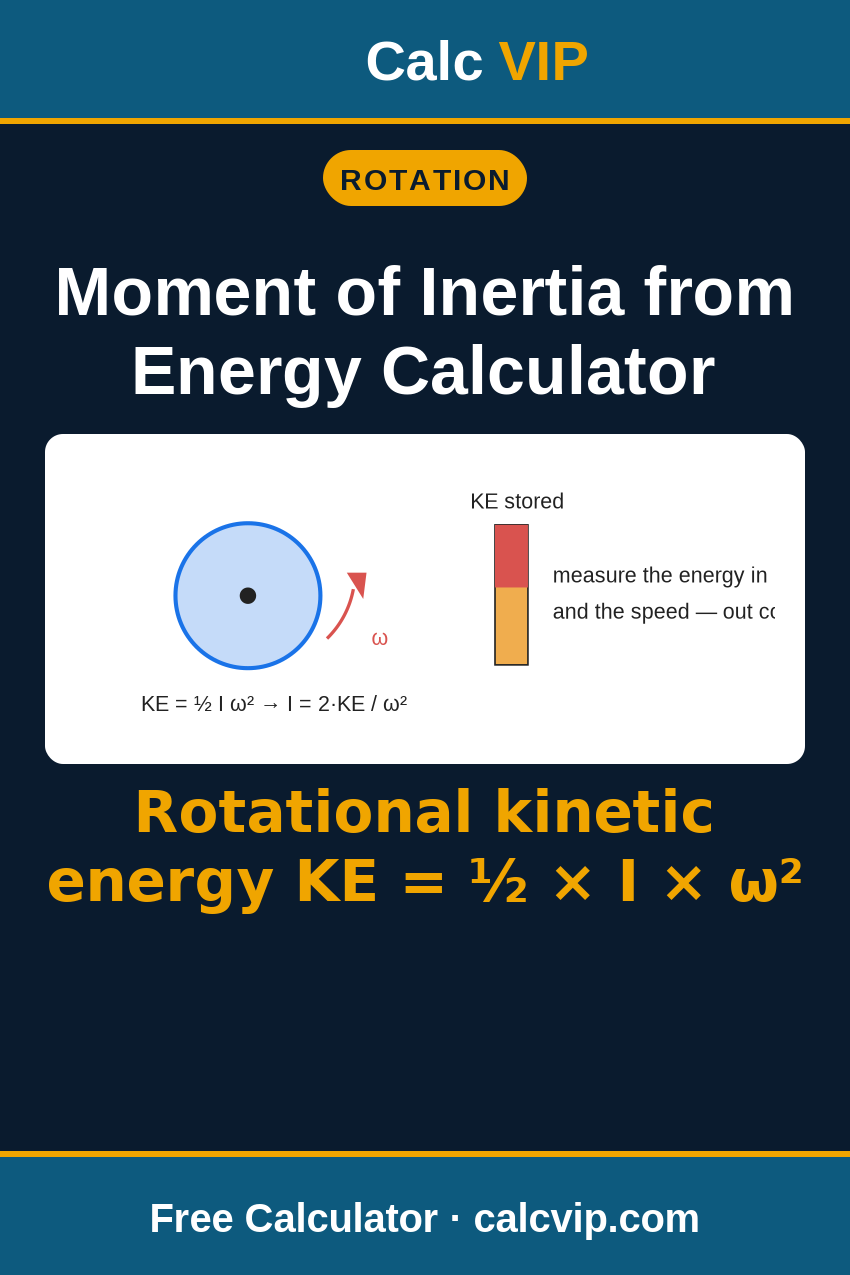
Use this free Moment of Inertia from Energy Calculator to find a rotating object's moment of inertia from its rotational kinetic energy and spin speed, using I = 2 × KE / ω² — or run it backwards to get KE from I and ω.
The moment of inertia is the one property of a rotating machine that you cannot weigh, measure with a ruler, or read off a drawing with any confidence — yet it decides how the machine spins up, how much energy it stores, and how it responds to every torque. Fortunately, nature offers a back door: spin the object up to a known angular speed, measure the energy that took, and the inertia falls out of KE = ½Iω² rearranged as I = 2KE/ω². Energy and speed are both easy to meter; inertia is not. This calculator is that back door, in both directions.
The underlying equation, KE = ½Iω², is the rotational twin of ½mv², and the family resemblance is exact: I plays the role of mass, ω the role of velocity, and the same one-half and square appear. That square is the personality of the formula. Double the spin speed and the stored energy quadruples — which is why high-speed flywheels store so much in so little hardware, why a grinder's wheel is dangerous long after the switch is off, and why this solver divides by ω²: small errors in the speed become doubled errors in the inferred inertia.
Use the forward direction (I and ω → KE) to size energy storage, estimate stopping hazards, or check a rotor's energy against its housing's rating. Use the reverse (KE and ω → I) as a measuring instrument: for prototypes, salvaged machinery, irregular castings and 3D-printed rotors whose inertia no formula covers. Either way, the only inputs are an energy in joules and an angular speed in radians per second — the two most measurable quantities in rotating machinery.
Formulas
Rotational kinetic energy KE = ½ × I × ω² • moment of inertia I = 2 × KE / ω² • KE in joules (J), I in kg·m², ω in rad/s
One more rearrangement completes the set: ω = √(2KE / I), the speed a rotor reaches when a known energy has been poured into a known inertia — the spin-up question, answered by running this calculator's logic in your head. In practice the energy you measure is rarely the motor's electrical input: bearings, windage and gear meshes take their cut, so an honest measurement uses the energy that actually arrived in the rotor — from a coast-down test (time the decay, fit the loss), a calibrated drive's torque integral, or the drop in a flywheel's own speed as it delivers work. The cleaner the energy figure, the truer the I.
| Symbol | Meaning | Units |
|---|---|---|
| KE | rotational kinetic energy | joules (J) |
| I | moment of inertia about the spin axis | kg·m² |
| ω | angular speed | rad/s |
Why the square on ω runs the whole subject
Because energy grows with ω², speed is always the cheapest place to find more storage or more trouble. A flywheel designer choosing between doubling the wheel's inertia and doubling its speed gets four times the energy from the speed — at the price of four times the centrifugal stress, which is the real limit. The same square explains the long spin-down of high-speed tools: a grinding wheel at ω = 300 rad/s with I = 0.08 kg·m² holds KE = ½ × 0.08 × 300² = 3,600 J — comparable to a rifle bullet's energy, spread around a rim — and friction drains it only slowly because at half speed it still holds a quarter of that.
The square also sets the measurement strategy this calculator embodies. Infer I at high ω and your energy measurement is large and easy to read, while ω itself is precisely measurable with a tachometer — but remember the sensitivity runs both ways: a 5% error in ω becomes a 10% error in I, because ω is squared. Measure the speed with more care than feels necessary; the formula will thank you.
How to use
- Choose the mode: find the moment of inertia I, or find the rotational kinetic energy KE. The corresponding input box hides.
- Enter the other quantity together with the angular speed ω in rad/s — convert from rpm with ω = rpm × 2π/60 if needed.
- Click "Calculate" to see the result with the working shown.
- When measuring a real rotor's I, prefer a high test speed: the energy is bigger, easier to measure accurately, and the ω² in the denominator does the rest.
Worked examples
Example 1 — the rotor. A spinning rotor stores KE = 200 J of rotational energy at ω = 10 rad/s:
I = 2 × 200 / 10² = 400 / 100 = 4 kg·m²
Check the reverse: KE = ½ × 4 × 10² = 200 J ✓
Example 2 — a car wheel. A wheel and tyre spinning at ω = 60 rad/s (about 95 km/h road speed) is measured to hold KE = 450 J of rotational energy:
I = 2 × 450 / 60² = 900 / 3600 = 0.25 kg·m² — the figure suspension engineers call the wheel's inertia, and the reason heavy wheels blunt both acceleration and ride.
Example 3 — finding the energy. A grinding wheel with I = 0.08 kg·m² runs at ω = 300 rad/s:
KE = ½ × 0.08 × 300² = 3,600 J. That is the energy the guard must contain if the wheel bursts, and the reason wheels are ring-tested and speed-rated: 3.6 kJ in a brittle disk is not a small hazard.
Example 4 — a storage flywheel. A steel flywheel with I = 150 kg·m² is charged to 3000 rpm:
ω = 3000 × 2π / 60 = 314.1593 rad/s
KE = ½ × 150 × 314.1593² = 7,402,203.3 J ≈ 7.4022 MJ ≈ 2.0562 kWh — a couple of units of electricity in a spinning disk, deliverable in seconds. Run the numbers at 1500 rpm instead and the store falls to a quarter: the ω² law, collecting its tax.
Example 5 — a ceiling fan. A fan's blade assembly coasts with KE = 30 J at ω = 15 rad/s:
I = 2 × 30 / 15² = 60 / 225 = 0.2667 kg·m². Small — but it is exactly why the fan takes seconds, not instants, to stop when switched off, and why its wobble forces at speed are not negligible.
Example 6 — a turbine rotor. A power-station turbine rotor at ω = 157.0796 rad/s (1500 rpm) stores KE = 5 × 10⁷ J:
I = 2 × 5 × 10⁷ / 157.0796² = 10⁸ / 24,674.01 ≈ 4,052.85 kg·m². Fifty megajoules is why turbine halls have massive containment and why a rotor failure is among the most energetic accidents in engineering.
Moment of inertia from energy in real life
Measuring the unmeasurable part. A salvaged motor rotor, a prototype drone propeller, a custom flywheel: none has a trustworthy formula for I, but all can be spun by a measured motor through a measured angle, or timed coasting down against a known friction torque. The energy method turns a workshop afternoon into a specification.
Flywheel battery design. Storage is sold in joules and kWh, hardware in kg·m². Example 4's conversion — 150 kg·m² at 3000 rpm is 2.0562 kWh — is the first line of every flywheel-storage feasibility study, and the ω² term is why commercial units spin at tens of thousands of rpm in vacuum chambers.
Vehicle development. Wheels, brake discs, crankshafts and propshafts all carry rotational KE that the engine must supply and the brakes must absorb. A 1000 kg car at 20 m/s holds ½ × 1000 × 20² = 200,000 J of translational energy; its four wheels add their rotational share on top, which is why lightweight wheels genuinely quicken a car.
Machine safety. Guards, containment rings and emergency brakes are rated in joules. Example 3's grinding wheel (3,600 J) and Example 6's turbine (5 × 10⁷ J) sit at opposite ends of one scale, and this calculator's forward mode is how the number on that scale is obtained.
Amusement rides and centrifuges. A centrifuge rotor's I, found by the energy method during commissioning, sets its spin-up time and drive size; a ride's rotating arm is checked the same way, because the motor must supply ½Iω² every cycle and the brake must remove it.
Hard drives and precision spindles. Tiny rotors, high speeds: a platter stack's I determines how much the drive motor works at spin-up and how much gyroscopic resistance the drive shows when moved — measurable in seconds with this method, where disassembly and CAD estimation would take hours.
Quick reference: KE = ½Iω² at a glance
| I (kg·m²) | ω (rad/s) | KE (J) |
|---|---|---|
| 1 | 10 | 50 |
| 1 | 100 | 5,000 |
| 10 | 100 | 50,000 |
| 0.1 | 1000 | 50,000 |
| 150 | 314.1593 | 7,402,203.3 |
Compare the middle rows: a featherweight 0.1 kg·m² rotor at 1000 rad/s stores exactly what a 10 kg·m² machine at 100 rad/s stores. Speed and inertia are interchangeable currencies for energy — but only speed pays at the squared rate.
Unit discipline closes the topic. Energies arrive in many costumes — kilowatt-hours on a storage spec (1 kWh = 3.6 × 10⁶ J, so Example 4's 7,402,203.3 J is 7,402,203.3 / 3,600,000 = 2.0562 kWh), watt-seconds on a drive datasheet (the same as joules), occasionally calories in older thermal texts (1 cal = 4.184 J). Convert everything to joules before it enters the calculator, and convert ω to rad/s with the same rigour; the formula itself is unit-blind and will faithfully process whatever mixture it is fed, which is precisely the danger.
Measuring I honestly: where the energy figure comes from
The formula is exact; the measurement is the craft. Three practical routes dominate. First, the spin-up method: drive the rotor with a motor of known torque curve and integrate torque × ω over the run — the drive's own data gives the joules delivered, minus losses you estimate from a no-load run. Second, the coast-down method: spin up, cut power, and record ω against time; the rate at which KE falls reveals friction, and fitting the curve returns both I and the loss model. Third, the pendulum methods (bifilar and trifilar suspensions), which avoid spinning altogether and suit delicate parts. All three end at this calculator: two measured quantities, one division, and an I you can defend — provided ω was measured in rad/s and the energy counted only what reached the rotor.
Spin-up time: the energy method's free bonus
Once a rotor's KE at working speed is known, its spin-up time follows from the drive's power: at constant power P, t = KE / P. Example 4's flywheel stores 7,402,203.3 J; a 100 kW charging drive therefore needs at least 7,402,203.3 / 100,000 ≈ 74 seconds to charge it — longer in practice, because real drives deliver rated power only over part of the range and losses nibble throughout. The same division sizes brakes in reverse: a brake that must absorb 3,600 J from Example 3's grinding wheel in 2 seconds is a 1.8 kW heater for those 2 seconds, and must be rated for the energy and the rate. Energy, power and time form a triangle — this calculator supplies the energy corner, and the other two are one division away.
Reading I from a coast-down curve
The coast-down test deserves a closer look because it needs no energy meter at all — only a speed log. Spin the rotor up, cut the drive, and record ω(t). Bearing friction applies a roughly constant small torque τ_f, so L falls linearly: I × Δω = τ_f × Δt. Measure the same rotor's spin-down twice, once plain and once with a known added inertia (a calibrated disk), and the two slopes give two equations in the two unknowns I and τ_f — the classic add-a-known-inertia trick. It is slow, cheap, and accurate to a few percent, which is why it remains the workshop standard a century after it was first used on steam-engine flywheels. A stopwatch, a tachometer and patience are the entire instrument list — the physics does all the rest of the work.
Common mistakes
- Entering rpm as ω. ω must be in rad/s. Typing "3000" for a 3000 rpm rotor (true ω = 314.1593) overstates ω² by about 91 times and understates I by the same factor. Convert with ω = rpm × 2π/60.
- Dropping the factor of 2. I = 2KE/ω², not KE/ω². The 2 is the rearranged ½ from KE = ½Iω²; losing it halves your inertia and every design built on it.
- Counting energy that never reached the rotor. Motor input energy includes gearbox, bearing and windage losses. Using wall-plug joules overstates KE and therefore I. Measure delivered energy, or correct for losses with a no-load test.
- Including translational energy. A rolling wheel has both ½mv² and ½Iω². This calculator's KE is the rotational part only; feeding it the total splits the difference and corrupts I.
- Trusting a sloppy ω. Because ω is squared, a 5% speed error becomes a 10% inertia error — the dominant term in most bad measurements. Use a tachometer or strobe, not the motor's nominal plate speed, which sags under load.
FAQ
Why is this method useful for measuring I?
Moment of inertia is hard to measure directly for an irregular machine part. Spinning it up, measuring its speed and the energy supplied, then using I = 2KE/ω² gives I from easy measurements.
Does the formula work for any shape?
Yes. KE = ½Iω² holds for any rigid body rotating about a fixed axis, whatever its shape — the shape is already hidden inside the value of I.
What if the object is also moving in a straight line?
Then it has translational KE (½mv²) as well. This calculator uses only the rotational part, so use the spin energy alone.
How accurate is the energy method compared with CAD?
For a well-made part with known materials, CAD integration is excellent. For castings, assemblies with fasteners and fluids, or worn machinery, the energy method measures the truth — including everything you forgot to model. Discrepancies of 5–15% between the two are common and usually indict the model, not the measurement.
Can I find ω from KE and I?
Yes: ω = √(2KE/I). It is the one rearrangement the calculator does not offer directly, but it is the spin-up question — how fast will this rotor turn when the drive has delivered this much energy — and it follows from the same equation.
Why do flywheel batteries spin so fast instead of using bigger wheels?
The ω² law: doubling speed quadruples stored energy, while doubling I only doubles it — and a bigger wheel also enlarges the vacuum chamber, bearings and containment. Speed is the cheap axis, limited by material strength rather than size.
What is a typical I for everyday rotors?
A car wheel ≈ 0.25 kg·m² (Example 2), a ceiling-fan rotor ≈ 0.2667 kg·m² (Example 5), a washing-machine drum a few kg·m², and a turbine rotor several thousand (Example 6). The range spans seven orders of magnitude, which is why measuring beats guessing.
Does air resistance spoil the measurement?
At high speeds windage is a real loss and grows steeply with ω. It does not spoil the method — it means your "energy supplied" must be net of windage, estimated from a coast-down test at the same speed, or the test must run in a partial vacuum for the fastest rotors.
Is rotational KE ever converted back usefully?
Constantly: regenerative braking returns a vehicle's KE (both kinds) to the battery; a flywheel UPS returns its ½Iω² to the grid during an outage; a yo-yo returns it to climb the string. The formula is the ledger for all of these exchanges.
Why is there a ½ in KE = ½Iω²?
It comes from adding up ½mv² over every particle of the body, with v = ωr: KE = ½ω² × Σmr² = ½Iω². The ½ is inherited from translational energy; the I is the body's mass distribution summarised in one number.