 Calc
Centripetal Speed Calculator – v = √(Fr/m) with Angular Speed
 Created by James Carter · Physics Writer · Forces & Motion · Last updated: November 2026
Use this free Centripetal Speed Calculator to find how fast an object moves in a circle when you know the centripetal force pulling it to the centre, its mass and the radius — plus its angular speed.
Anything moving in a circle is falling towards the centre the whole time. A ball on a string, a car on a roundabout, the Moon around the Earth — each is constantly being pulled off the straight line it would prefer to follow, and the strength of that inward pull, together with the mass and the size of the circle, fixes exactly one possible speed. Pull harder, or shrink the circle, and the object must move faster to stay on its path; add mass and the same force can only sustain a slower pace. This calculator works the relationship backwards from the force: give it the inward pull, the radius and the mass, and it returns the speed, the angular speed and the centripetal acceleration of the motion.
The backward direction is often the practical one. Engineers measure tensions, friction limits and gravitational pulls directly; the speed those forces can support is the unknown that decides whether a centrifuge holds together, whether a car makes the bend, or whether a satellite stays in its orbit. The same three quantities rearranged answer the forward question too — F = mv²/r — but this page starts where experiments usually start, with a force you can put a number on.
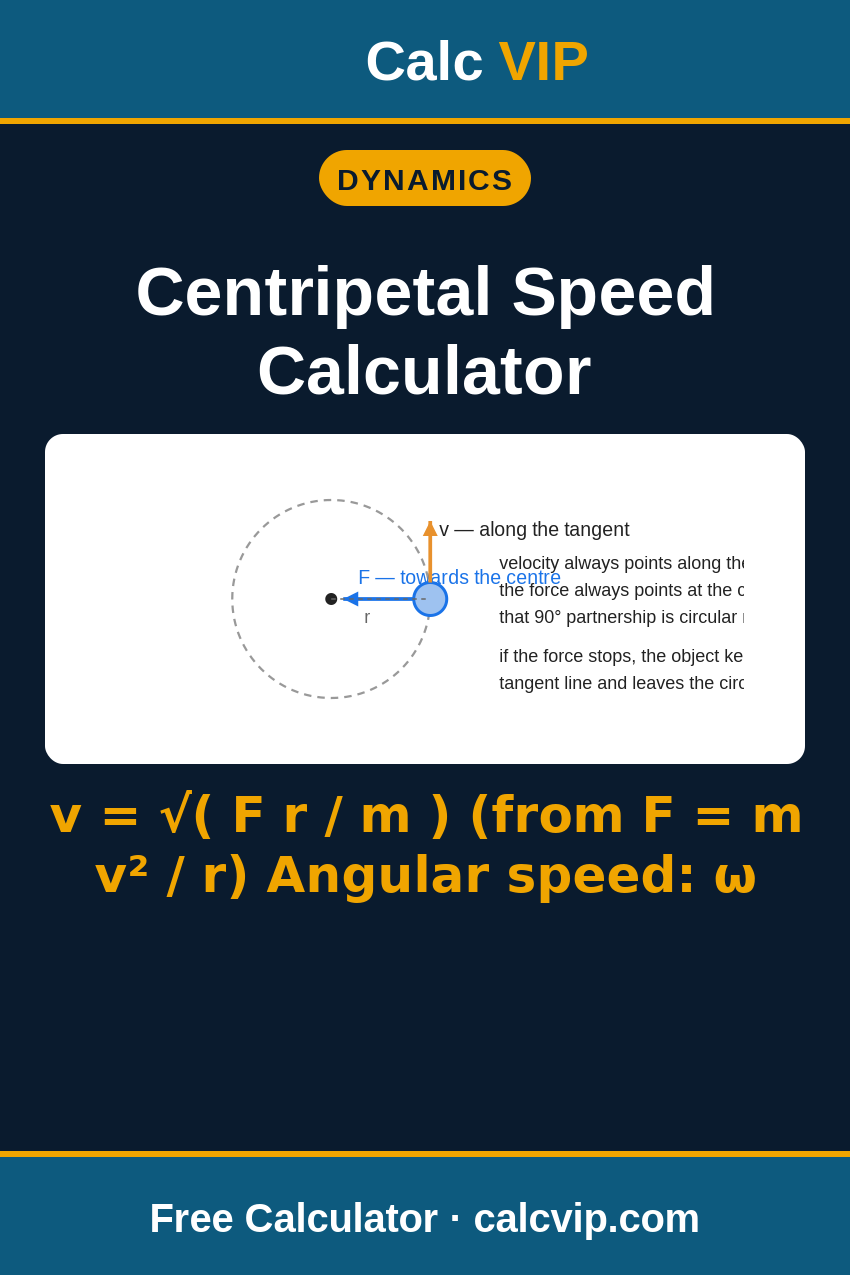
Two companion quantities come along for free. The angular speed ω = v/r says how rapidly the radius line sweeps around, in radians per second — the natural language of rotating machinery. And the centripetal acceleration a = v²/r measures how violently the velocity direction is being bent, usually quoted in multiples of g: a fairground ride at 3 g, a fighter pilot's turn at 9 g, a laboratory centrifuge at hundreds of thousands of g are all this one number wearing different clothes.
Formula
Speed: v = √( F r / m ) (from F = m v² / r)
Angular speed: ω = v / r · Centripetal acceleration: a = v² / r
The family rearranges to expose any one quantity: F = m v² / r finds the force a known motion requires; r = m v² / F finds the circle a force can hold at a given speed; m = F r / v² weighs an object from its motion alone — a trick astronomers use constantly, since a moon's orbit reveals its planet's mass. Two useful bridges connect the set: the acceleration can be written a = F / m (Newton's second law, as it must be) and also a = ω² r, while the speed is v = ω r. Keep force in newtons, radius in metres and mass in kilograms, and the speed emerges in metres per second; multiply by 3.6 for km/h.
| Symbol | Meaning | Units |
|---|---|---|
| v | speed along the circular path (tangential speed) | m/s |
| F | centripetal force — the net inward force | N |
| r | radius of the circular path | m |
| m | mass of the circling object | kg |
| ω | angular speed — angle swept per second | rad/s |
| a | centripetal acceleration, towards the centre | m/s² |
"Centripetal" is a job description, not a force
The most persistent misunderstanding in circular motion is the hunt for a new force called centripetal. There is none. "Centripetal" names the role played by whatever real force — tension, friction, gravity, a normal force, a magnetic pull — happens to point towards the centre. The equation F = mv²/r is Newton's second law with the acceleration of circular motion substituted in: it says the net inward force must equal mass times v²/r, and nature arranges for some real force, or a component of one, to fill the post. When no force can fill it — the string snaps, the tyres lose grip, the orbit decays — the motion simply stops being circular.
This is why the speed depends on the force in the way it does. Rearranged as v = √(Fr/m), the formula says the sustainable speed grows only with the square root of the force: quadruple the tension and you may only double the speed. It also explains the familiar failure modes. A car entering a bend too fast needs mv²/r beyond what friction can supply; the shortfall does not push the car outward — there is no outward force — the car just follows a path of larger radius than the road, which from the driver's seat feels exactly like being flung outwards. The calculator's three outputs together tell the whole story: v for the speedometer, ω for anything that spins, and a for the g-force that people, payloads and structures actually feel.
How to use
- Enter the inward (centripetal) force in newtons — string tension, friction, gravity, etc.
- Enter the radius of the circle and the object's mass.
- Click "Calculate" to get the speed, angular speed and centripetal acceleration.
- Read the acceleration against 9.81 m/s² to feel it as a g-force: 100 m/s² is about 10 g, near the limit of what a trained pilot can withstand.
Worked examples
Example 1 — a ball on a string. A 2 kg ball on a string is swung in a circle of radius 5 m with a tension of 200 N.
v = √(200 × 5 / 2) = √500 = 22.36 m/s (80.5 km/h).
ω = 22.36 / 5 = 4.47 rad/s, and a = v² / r = 100 m/s² — about 10 g towards the centre.
Example 2 — a car on a roundabout. Tyre friction can pull a 1000 kg car inwards with at most 6000 N on a roundabout of radius 50 m: v = √(6000 × 50 / 1000) = √300 = 17.32 m/s (62.35 km/h), with ω = 0.35 rad/s and a = 6 m/s². Enter the roundabout faster than about 62 km/h on this surface and no steering can hold the circle — the required force simply exceeds the friction on offer.
Example 3 — a space station in orbit. Gravity pulls the 500 kg module of a station with about 4330 N at an orbit radius of 6.77 × 10⁶ m from Earth's centre: v = √(4330 × 6.77 × 10⁶ / 500) = 7657 m/s — the familiar 7.66 km/s of low Earth orbit, with a = 8.66 m/s², the local strength of gravity at that height. The station is in free fall the whole time; its speed is what stops the fall from ever landing.
Example 4 — a laboratory centrifuge. A 0.01 kg sample spins at radius 0.1 m under a centripetal force of 50 N: v = √(50 × 0.1 / 0.01) = √500 = 22.36 m/s, ω = 223.61 rad/s and a = 5000 m/s² — about 510 g. Ultracentrifuges push this to hundreds of thousands of g, which is why their rotors are machined like turbine parts and their failure is treated like an explosion.
Example 5 — a hammer thrower. An athlete whirls a 7.26 kg hammer on a wire giving a radius of 2 m, pulling inwards with 2500 N at release pace: v = √(2500 × 2 / 7.26) = 26.24 m/s, ω = 13.12 rad/s, a = 344.35 m/s². The thrower's grip and shoulders supply a quarter of a tonne of inward force — and the instant it is released, the hammer takes the tangent and flies.
Example 6 — a playground merry-go-round. A 30 kg child at radius 3 m is held by friction and the rail with 90 N: v = √(90 × 3 / 30) = √9 = 3 m/s, ω = 1 rad/s, a = 3 m/s². Gentle numbers — but double the spin rate and the required force quadruples, which is why merry-go-rounds get alarming so quickly.
Centripetal speed in real life
Road safety and speed limits. Every bend has a friction budget: the tightest comfortable radius at a given speed follows from the μ a tyre can deliver. Accident investigators run this calculator in reverse after a skid, using the radius of the tyre marks to estimate the speed at which the car left its circle.
Satellite and moon orbits. For a circular orbit, gravity is the centripetal force, and v = √(GM/r) — this calculator with F filled in by Newton. The result sets launch energies, station-keeping budgets and the period of every moon and satellite in the sky.
Centrifuges everywhere. From blood analysers to uranium enrichment, centrifuges are centripetal acceleration as a product: the g-force rating on the datasheet is v²/r, and the rotor's material strength caps the force the rim can supply before the circle fails.
Fairground engineering. Ride designers live inside these numbers: the speed of a rotor or swing carousel is chosen so the acceleration stays thrilling but tolerable — typically 2–4 g — and the restraints are rated for the force at the fastest, heaviest loading.
Cyclotron and particle beams. In a cyclotron a magnetic force bends charged particles into circles; the radius grows as they gain energy until the beam reaches the extraction radius. The same balance, with the magnetic force in the F slot, steers beams in every accelerator and mass spectrometer.
Washing machines and salad spinners. The spin cycle flings water droplets to the drum wall; droplets at a hole find no inward force and leave along the tangent, which is the entire drying mechanism. The drum's rated rpm is a centripetal-force calculation about the laundry's mass and the drum's radius.
From circles to orbits: the same equation with gravity in the chair
Set the centripetal force equal to Newton's gravitational pull, F = GMm/r², and the circling object's own mass cancels: v = √(GM/r). Everything in orbit obeys it — the Moon at 1.02 km/s around Earth, Earth at 29.8 km/s around the Sun, stars around the galactic centre. Two consequences shape astronomy. First, orbital speed falls with the square root of distance, so outer planets crawl while inner ones race. Second, the equation can be turned around to weigh the central body: measure a moon's speed and orbit radius and M falls out — this is how humanity knows the mass of the Sun, of Jupiter, and of the black hole at the Milky Way's centre, none of which will ever sit on a scale. When astronomers found stars in galaxies orbiting faster than the visible mass allows, the same formula delivered the discrepancy that we now call dark matter. Closer to home, the same square-root law schedules every rendezvous in spaceflight: a capsule that must catch a station does not speed up to chase it — speeding up raises its orbit and slows its angular pace — so pilots descend to a smaller, faster circle and let the arithmetic of v = √(GM/r) bring the target to them.
Quick reference: centripetal accelerations you may have felt
| Situation | Typical a | In g |
|---|---|---|
| car on a gentle motorway curve | ≈ 1–2 m/s² | 0.1–0.2 g |
| car at the roundabout limit (Example 2) | 6 m/s² | 0.61 g |
| playground roundabout, brisk spin | ≈ 5–10 m/s² | 0.5–1 g |
| fairground rotor ride | ≈ 30 m/s² | ≈ 3 g |
| fighter jet in a hard turn | ≈ 88 m/s² | ≈ 9 g |
| laboratory centrifuge (Example 4) | 5000 m/s² | ≈ 510 g |
The table's lesson: everyday circular motion is gentle, and g-forces grow frighteningly fast once v² starts climbing — one more reason the square in the formula deserves respect.
Vertical circles: when the force budget changes around the loop
Everything so far assumed the supplying force is steady, but swing the circle upright — a bucket of water overhead, a rollercoaster loop, a stunt plane — and gravity joins or leaves the budget as the object moves. At the top of a vertical circle, both tension and weight point towards the centre, so they share the job: T + mg = mv²/r. At the bottom they oppose: T − mg = mv²/r, and the string or seat must supply the centripetal force plus support the weight. The critical case is the top at minimum speed, where the tension can fall to zero and gravity alone fills the post: mg = mv²/r, giving v = √(gr). For a loop of radius 5 m that is √(9.81 × 5) ≈ 7.0 m/s — slower than that at the top and the object leaves the circle and falls inside it. This calculator handles the horizontal case directly; for vertical circles, adjust the F you enter point by point, adding mg at the top and subtracting it at the bottom.
Common mistakes
- Adding a "centripetal force" on top of the real forces. F in this formula is the real inward force (or the inward component of several). Drawing tension and a separate centripetal force on the same diagram double-counts it.
- Believing something pushes the object outward. There is no centrifugal force in the inertial frame. The object that "flies outwards" is actually flying straight, along the tangent, while the circle curves away beneath it.
- Using the diameter as the radius. It halves the computed force requirement and inflates ω by two. r is always centre-to-path.
- Expecting double force to give double speed. v grows with √F: four times the force buys twice the speed. Designs that chase speed through brute tension hit diminishing returns — and material limits — fast.
- Mixing up ω and revolutions per minute. ω is radians per second. To convert rpm to ω, multiply by 2π/60 ≈ 0.105. A gramophone at 33 rpm turns at ω ≈ 3.5 rad/s, not 33.
FAQ
What provides the centripetal force?
It is not a new force — it is the job done by tension, friction, gravity or a normal force, whichever points to the centre. This calculator works backwards from that force to the speed.
What happens if the string breaks?
The inward force vanishes, so the ball flies off along the tangent — in the direction of v at that instant, not radially outward.
Can I use this for a satellite?
Yes — put F as the gravitational pull on the satellite, r as the orbit radius from the planet's centre, and m as the satellite's mass, and you get the orbital speed for a circular orbit.
Why does the object's mass cancel out for satellites but not here?
Because gravity's pull is itself proportional to the satellite's mass, so m appears on both sides and cancels. For a string or friction, the force is set independently, so the mass stays in the formula and heavier objects need proportionally more force.
What is the difference between speed and angular speed?
Speed v measures metres travelled per second along the path; angular speed ω measures radians swept per second around the centre. They are linked by v = ωr — objects further out travel faster at the same ω, like the rim of a wheel outpacing its hub.
How many revolutions per second is ω = 4.47 rad/s?
Divide by 2π: 4.47 / 6.283 ≈ 0.71 revolutions per second, or about 43 rpm. Example 1's ball circles its centre a little under once per second while travelling at 80 km/h.
Does the centripetal acceleration change the object's speed?
No — it is perpendicular to the velocity, so it changes only the direction, never the magnitude. Speeding up or slowing down requires a tangential force as well, which is a different component entirely.
Why do racing cars use downforce if friction is the centripetal force?
Downforce presses the car onto the road, increasing the normal force and therefore the maximum friction the tyres can offer. It enlarges the F budget in this formula without adding mass — the one legal way to cheat the m in the denominator.
Can the required force ever be zero?
Only if the speed is zero or the radius infinite — which is just straight-line motion. Any genuine circle at any genuine speed needs a genuine inward force.
What limits a centrifuge's speed?
The rotor material. The rim's own mass needs centripetal force too, supplied by the material's tensile strength; beyond a design ω the rotor bursts. That is why ultracentrifuge rotors are small, dense and spun in a vacuum inside armour.