 Calc
Collision Energy Calculator – Kinetic Energy Lost in a Crash
 Created by James Carter · Physics Writer · Forces & Motion · Last updated: November 2026
Use this free Collision Energy Calculator to compare the kinetic energy before and after a perfectly inelastic collision (the objects stick together). It shows exactly how many joules — and what percentage — of the motion energy is lost.
Kinetic Energy Lost in an Inelastic Collision
Every crash is an energy transaction. Before impact, the moving objects hold a definite amount of kinetic energy; after it, the wreck holds less, and the difference has been spent — on bending metal, cracking plastic, heating brakes and tyres, and launching the bang that witnesses hear. This calculator does the full audit for the cleanest case, the collision where the objects stick together: it finds the wreck's final velocity from momentum conservation, totals the kinetic energy on both sides of the event, and reports the loss in joules and as a percentage. Those two numbers — how much energy, and what share of the whole — are the ones crash engineers, insurers and safety designers actually argue about.
The percentage is the subtle one, and the one this page exists to illuminate. Two collisions with identical vehicles at identical speeds can lose wildly different shares of their energy depending on geometry alone: a head-on impact can convert 80% or even 100% of the motion energy, while a rear-end nudge between cars travelling at nearly the same speed may convert barely 1%. Nothing about the cars changed — only the relative motion did. Buried in the examples below is the reason: the spendable energy in any collision is the energy of the relative motion, and relative motion is exactly what a crash eliminates.
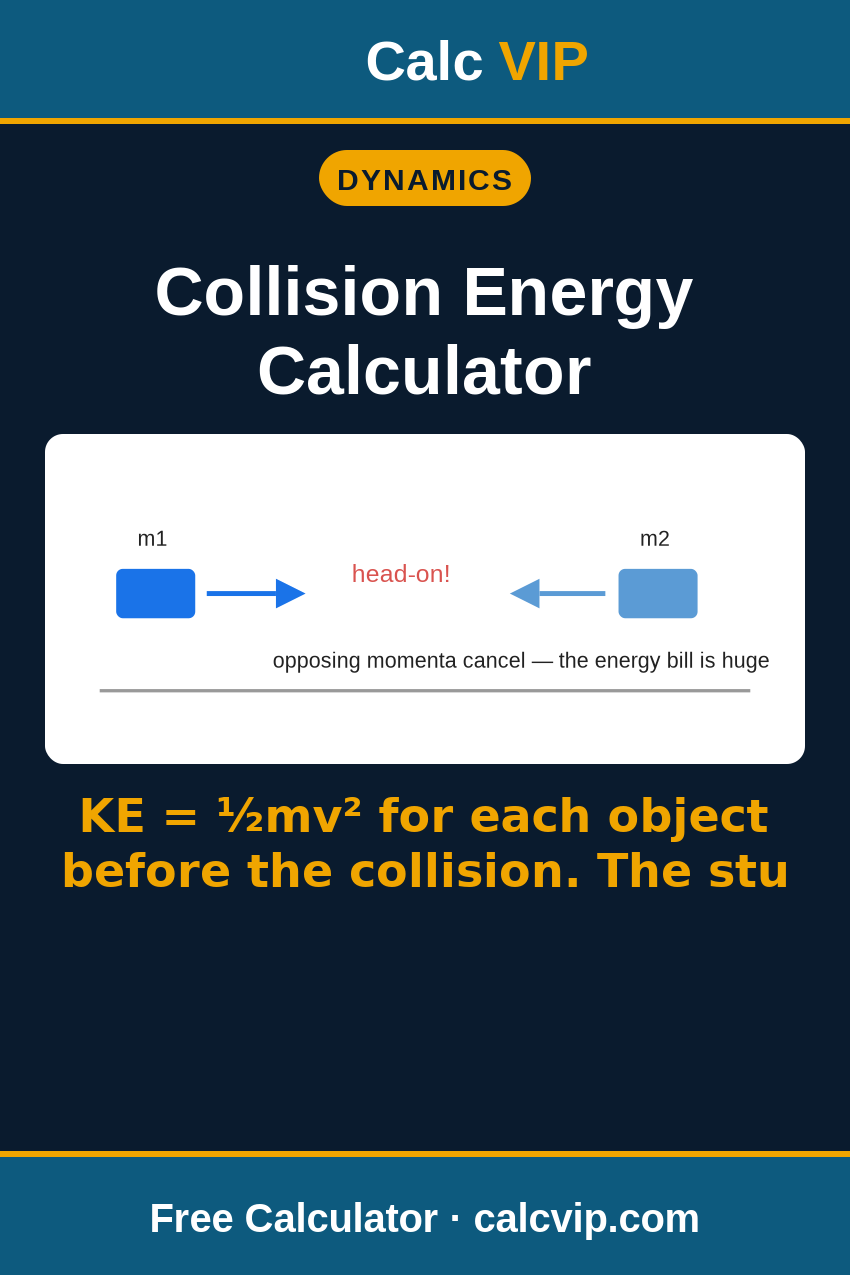
It is worth being clear about what "lost" means, because the word misleads. Energy is never destroyed — the first law of thermodynamics is not negotiable. "Lost" on this page means lost as kinetic energy of the objects: converted into internal energy of deformed material, into heat, into sound. For a vehicle designer that conversion is the entire job. The total amount is fixed by the masses and speeds before anyone designs anything; all that engineering can decide is where those joules go and over what distance they are absorbed — which is the difference between a crash that totals a car and a crash that injures its occupants.
Formula
KE = ½mv² for each object before the collision. The stuck-together pair moves at v' = (m1v1 + m2v2) / (m1 + m2) (momentum conservation), with combined KE = ½(m1 + m2)v'². Energy lost = KE before − KE after, and % lost = (lost / KE before) × 100.
There is a shortcut that reveals what the loss really depends on. The energy converted in a sticking collision is exactly ½ × μ × (v1 − v2)², where μ = m1m2 / (m1 + m2) is called the reduced mass and (v1 − v2) is the relative speed — the rate at which the gap between the objects was closing. Test it on Example 1 below: μ = (2 × 2)/4 = 1 kg, relative speed = 6 − (−2) = 8 m/s, and ½ × 1 × 64 = 32 J — the same loss the long way round. The shortcut makes the physics transparent: the loss knows nothing about how fast the pair was travelling together through the world, only about how fast they were approaching each other. A collision analysed in the centre-of-mass frame shows the same thing — the energy of the shared drift can never be spent, and everything else can.
| Symbol | Meaning | Units |
|---|---|---|
| m1, m2 | masses of the two objects | kg |
| v1, v2 | velocities before the collision (signed) | m/s |
| v' | velocity of the stuck pair afterwards | m/s |
| KE lost | kinetic energy converted to heat, sound, deformation | joules (J) |
| μ (mu) | reduced mass, m1m2 / (m1 + m2) | kg |
Only the relative motion can be spent
Split any two-object system's kinetic energy into two parts and the whole subject of collision energy becomes clear. One part belongs to the centre of mass — the energy of the total mass gliding along at the centre-of-mass velocity. Momentum conservation guards that part absolutely: no internal collision can touch it, which is why a wreck always keeps drifting in the direction the momentum dictates. The other part belongs to the motion of the objects relative to each other — the closing-in and, after a bounce, the separating. That part, and only that part, is available to be converted. A perfectly inelastic collision spends all of it, because afterwards there is no relative motion left. An elastic collision spends none of it. Every real crash spends some fraction in between, and the fraction is a property of materials and structure — how much the objects behave like clay and how much like springs.
This is why the same two cars can produce a 1% loss or an 80% loss. In the rear-end case (Example 4) the cars share almost all their motion; only a 5 m/s sliver is relative, so only the energy of that sliver — 7,500 J out of 615,000 J — can possibly be converted, and the "crash" is a nudge. In the head-on case (Example 1) almost all the motion is relative: the objects were spending their energy budget on approaching each other, so almost all of it is spendable, and 80% is spent. Drivers sense this instinctively — closing speed is what frightens, and closing speed is what physics charges for.
How to use
- Enter both masses in kg and both velocities in m/s, using a negative velocity for head-on motion.
- Remember the calculator assumes the objects stick together — the case with the greatest possible energy loss for those masses and speeds.
- Click "Calculate Energy Lost" to see the final velocity of the pair, KE before, KE after, joules lost and the percentage lost.
- Interpret the pair of numbers together: the joules say how much energy the structures had to absorb; the percentage says how completely the relative motion was extinguished. Either one alone can mislead.
Worked examples
Example 1 — head-on carts. Two 2 kg carts collide head-on: one at 6 m/s, the other at −2 m/s, and they stick.
v' = (2 × 6 + 2 × (−2)) / 4 = 8 / 4 = 2 m/s.
KE before = ½ × 2 × 6² + ½ × 2 × 2² = 36 + 4 = 40 J.
KE after = ½ × 4 × 2² = 8 J.
Energy lost = 40 − 8 = 32 J, which is 80% of the original kinetic energy. The reduced-mass shortcut agrees: μ = 1 kg, relative speed 8 m/s, ½ × 1 × 8² = 32 J.
Example 2 — truck meets car, head-on. An 8,000 kg truck at 10 m/s hits a 1,000 kg car coming the other way at −8 m/s, and the wreckage moves as one. v' = (8,000 × 10 + 1,000 × (−8)) / 9,000 = 72,000 / 9,000 = 8 m/s — the truck's momentum dominates, so the wreck continues in the truck's direction. KE before = ½ × 8,000 × 100 + ½ × 1,000 × 64 = 400,000 + 32,000 = 432,000 J. KE after = ½ × 9,000 × 64 = 288,000 J. Lost = 144,000 J, but "only" 33.3% — a huge absolute energy, absorbed mostly by the car's structure, yet a minority share, because so much of the system's energy was the truck's unstoppable shared drift.
Example 3 — the 100% case. Two 1.5 kg trolleys approach at 4 m/s and −4 m/s and stick. v' = 0 m/s. KE before = ½ × 1.5 × 16 + ½ × 1.5 × 16 = 24 J; KE after = 0 J; lost = 24 J (100%). Equal and opposite momenta mean the centre of mass was never moving, so none of the energy was protected — all of it was relative motion, and all of it is spent.
Example 4 — the gentle rear-end nudge. A 1,200 kg car at 25 m/s rolls into the back of an identical car travelling the same way at 20 m/s, and they lock bumpers. v' = (1,200 × 25 + 1,200 × 20) / 2,400 = 22.5 m/s. KE before = ½ × 1,200 × 625 + ½ × 1,200 × 400 = 375,000 + 240,000 = 615,000 J. KE after = ½ × 2,400 × 22.5² = 607,500 J. Lost = just 7,500 J (1.22%). The cars were carrying over half a megajoule between them, yet the crash could only spend the energy of their 5 m/s closing speed — the rest was shared motion that no collision can touch.
Example 5 — bullet into a block. A 0.01 kg bullet at 300 m/s embeds in a stationary 0.99 kg block. v' = (0.01 × 300) / 1 = 3 m/s. KE before = ½ × 0.01 × 300² = 450 J; KE after = ½ × 1 × 3² = 4.5 J. Lost = 445.5 J (99%) — spent shredding wood fibres and heating the bullet's path. It is the most lopsided ledger on this page: a light, fast striker against a heavy target surrenders essentially everything, which is exactly why the ballistic pendulum can measure bullet speeds from a gentle swing.
Example 6 — snowballs. A 0.3 kg snowball at 5 m/s splats into a 0.2 kg snowball coming at −1 m/s, merging into one. v' = (0.3 × 5 + 0.2 × (−1)) / 0.5 = 1.3 / 0.5 = 2.6 m/s. KE before = ½ × 0.3 × 25 + ½ × 0.2 × 1 = 3.75 + 0.1 = 3.85 J; KE after = ½ × 0.5 × 2.6² = 1.69 J. Lost = 2.16 J (56.1%) — spent compacting snow, which is why a snowball fight's merged snowball feels denser than either parent.
Collision energy in real life
Crash-test programmes. When a test car hits a barrier at 50 km/h, essentially all of its kinetic energy — for a 1,200 kg car, about 116,000 J — must be converted in about a tenth of a second. Star ratings are, in large part, marks for how gracefully a structure spends that energy: steadily, over distance, and anywhere except the passenger cell.
Crumple zones. A crumple zone does not reduce the energy to be lost — the masses and speeds have already decided that. It controls the rate and place of conversion: folding metal over half a metre keeps the force survivable, exactly the distance-over-which-energy-is-spent trade that work = force × distance describes.
Railway buffers and dock fenders. The rubber and hydraulic buffers at terminus platforms and harbour walls exist to absorb the lost-energy term of slow, heavy sticking collisions — a ferry of thousands of tonnes arriving at a fraction of a metre per second still carries a megajoule-scale relative-motion budget.
NASA's DART impact. In 2022 the DART spacecraft (about 570 kg) struck the asteroid moonlet Dimorphos at roughly 6.15 km/s. The impact was deeply inelastic — the spacecraft was destroyed and buried its kinetic energy, about ½ × 570 × 6,150² ≈ 1.08 × 10¹⁰ J, into the rubble — yet the momentum transfer still shortened Dimorphos's orbit measurably, a planetary-defence proof of this page's two ledgers working at once.
Drop testing products. A phone falling 1.5 m arrives at about 5.4 m/s; its kinetic energy (for 0.2 kg, about 2.9 J) must go somewhere in the few millimetres of case and screen flex available. Drop-test engineers live inside this calculator, trading case compliance against the joules that must not reach the glass.
Pile driving. A pile driver is a collision-energy machine run in reverse intention: the hammer's kinetic energy is deliberately spent driving the pile into the ground. The useful "loss" is the work done against the soil — a reminder that converted energy is only wasted when it converts in the wrong place.
What the lost joules could have done
Joules are abstract until they are priced in familiar work. The 32 J lost by the head-on carts in Example 1 would lift a 3.26 kg mass by one metre against gravity (32 ÷ 9.81 ≈ 3.26) — a bag of sugar raised to a shelf, spent instead in a bang and two bent couplings. The truck-and-car loss of 144,000 J equals about 0.04 kWh of electricity, or enough heat to raise a third of a litre of water from cold to boiling (144,000 ÷ (4,186 × 100) ≈ 0.34 kg of water through 100 °C) — delivered not over minutes but in the blink of the crash, which is why it tears structures rather than warming them gently. And the bullet's modest 445.5 J, enough to lift 45 kg by a metre, was concentrated into a few cubic centimetres of wood. Energy loss figures become engineering the moment they are divided by the time and volume available to absorb them.
Quick reference: reading a collision-energy result
| Situation | Typical % lost | Why |
|---|---|---|
| equal momenta head-on | 100% | centre of mass at rest; nothing is protected |
| head-on, unequal momenta | 30–90% | most motion is relative; the wreck keeps the surplus momentum's drift |
| moving into stationary, equal masses | 50% | half the energy was centre-of-mass drift |
| rear-end, similar speeds | around 1–5% | only the small closing speed is relative motion |
| light & fast into heavy & still | 95–99%+ | almost none of the striker's energy is protected drift |
Use the table as a smell test. If a sticking-collision calculation returns a loss outside the pattern its geometry suggests — a rear-end nudge "losing" 60%, say — the error is almost always a sign: a head-on velocity entered positive, or a same-direction velocity entered negative.
Common mistakes
- Judging a crash by speeds instead of energies. Kinetic energy scales with v², so "twice as fast" is four times the energy to absorb. Comparing the speeds in a crash report understates high-speed impacts and overstates slow ones.
- Dividing by the wrong total for the percentage. % lost is measured against KE before, always. Dividing by KE after inflates the figure and can even produce percentages above 100 — an instant tell that the books are wrong.
- Assuming every head-on collision loses 100%. Total conversion needs the total momentum to be exactly zero. A truck meeting a car head-on (Example 2) loses a third, not everything, because the wreck keeps moving with the surplus momentum.
- Sign errors on the velocities. Head-on motion must carry opposite signs. The percentage lost is exquisitely sensitive to this: one wrong sign converts a head-on crash into a rear-end nudge and can shrink the computed loss by a factor of fifty.
- Treating "lost" as "destroyed". The joules persist as heat, sound and deformation. Forgetting this leads to double-counting in energy audits — and to missing the design question, which is never whether the energy goes, but where.
FAQ
Where does the lost kinetic energy go?
It is not destroyed — it becomes heat, sound, and the work of crumpling and deforming the objects. Total energy is conserved; only the share stored as motion decreases.
Why do head-on collisions lose so much energy?
The opposing momenta partly cancel, so the wreck ends up moving slowly — and since KE depends on velocity squared, slow final motion means very little KE survives.
Can 100% of the kinetic energy be lost?
Yes — if the total momentum is zero (equal momenta head-on), the stuck pair ends at rest and all of the KE is converted. That is the worst case for energy loss.
Why does this calculator assume the objects stick together?
Because sticking gives the maximum possible loss for the given masses and speeds — the conservative figure a designer needs. Real collisions usually bounce slightly, keeping a little relative motion, so they convert slightly less than this calculator reports.
What if the objects bounce apart instead of sticking?
Then some relative motion survives and the loss is smaller — anywhere down to zero for a perfectly elastic bounce. The sticking result and the elastic result bracket every real outcome between them, which is why the two calculators are natural companions.
What is the reduced-mass shortcut?
The converted energy equals ½ μ (v1 − v2)², with μ = m1m2 / (m1 + m2). It shows the loss depends only on the reduced mass and the closing speed — not on how fast the pair was travelling together. It is the fastest way to estimate a collision's energy bill.
Does a heavier vehicle always lose a smaller percentage?
Not automatically — the percentage tracks the momenta, not the masses alone. A heavy vehicle moving slowly can carry less momentum than a light, fast one. What mass does guarantee is that the heavier partner's velocity changes less, which is a different (and for its occupants, valuable) fact.
How do crumple zones change the answer?
They do not change the joules or the percentage at all — those are fixed by the masses and velocities before impact. They change the distance and time over which the conversion happens, and therefore the force. Same energy, gentler spending.
Can the energy lost ever be negative — a gain?
Not in a passive collision. A gain means stored energy was released during the event — a spring, a charge, a battery fire — and then the event is part explosion and must be analysed with that energy source included.
Why is the final velocity asked for at all, if I only want the energy?
Because the surviving kinetic energy is the wreck's motion energy, and you cannot compute it without the wreck's velocity. Momentum conservation is the only route to that velocity — the energy audit has to pass through the momentum ledger first.