 Calc
Collision Velocity Solver – Sticking (Perfectly Inelastic) Collision Calculator
 Created by James Carter · Physics Writer · Forces & Motion · Last updated: November 2026
Use this free Collision Velocity Solver to work out perfectly inelastic (sticking) collisions, where two objects collide and move together as one. Find the final velocity, a missing mass, or a missing velocity using conservation of momentum.
Most collisions in textbooks bounce; most collisions in the real world crumple, couple, stick or splat. Railway wagons clang together and roll off as one train. A lump of clay hits a wall and stays there. A spacecraft docks and becomes a single vehicle. These are perfectly inelastic collisions — "perfectly" because the sticking is complete — and they are the easiest collisions in physics to solve exactly, because one conservation law does all the work. Total momentum cannot change during the brief violence of the impact, and afterwards there is only one object with one velocity, so the momentum total directly dictates that velocity. This calculator solves the event forwards (the final velocity) and backwards (a missing mass or a missing incoming velocity, given how things ended up).
The backwards modes are not a gimmick; they are how the real world uses this equation. Accident investigators measure the speed of the tangled wreck and work backwards to how fast each car was travelling. Coupling tests weigh a wagon by how much it slows the wagon that hits it. Mission planners choose a docking approach speed from the velocity the combined station can tolerate afterwards. Whenever two things become one, the same mass-weighted average decides the outcome — and the heavier partner always drags the answer closer to its own velocity, a bias the worked examples make concrete.
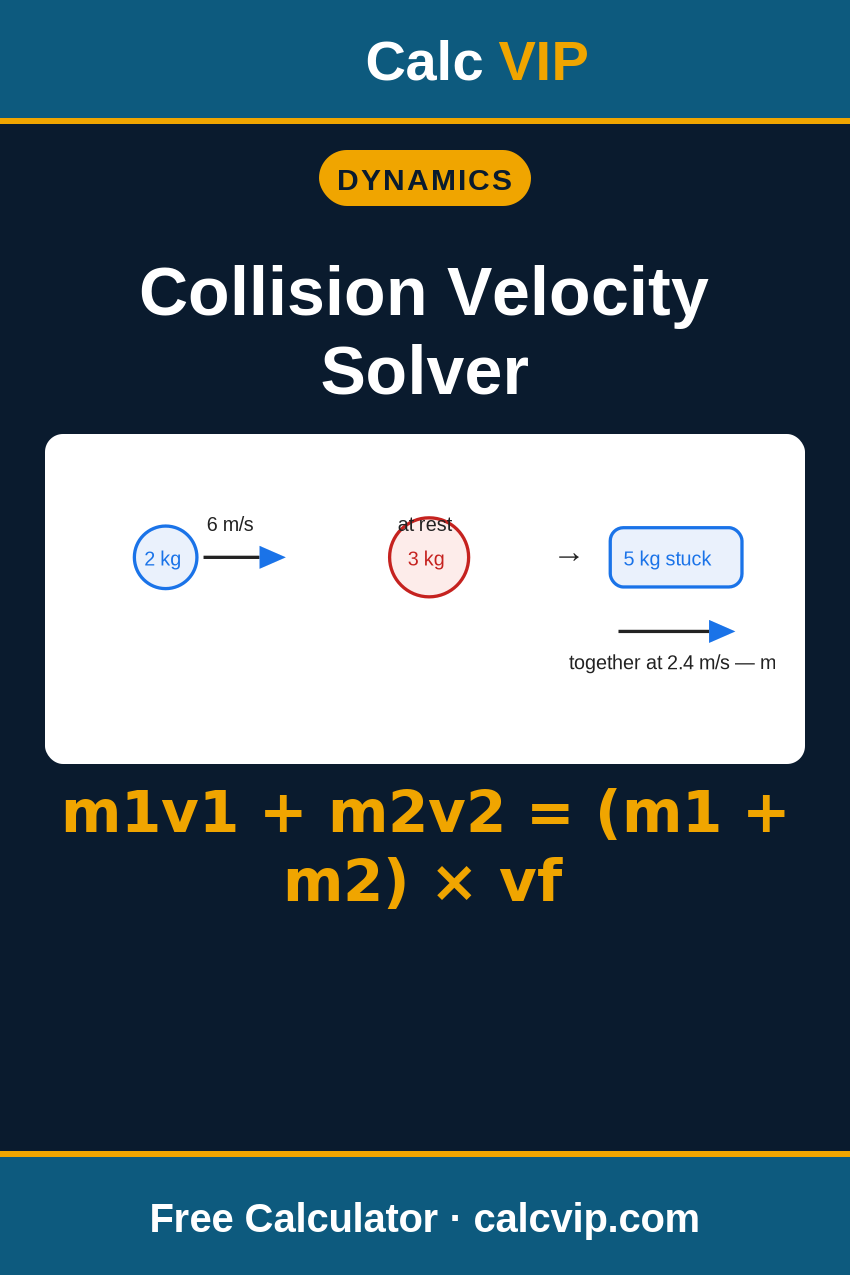
One warning belongs up front, because it surprises everyone: while momentum survives a sticking collision untouched, kinetic energy does not — a sticking collision destroys the maximum possible amount of it, converting the difference into heat, sound and bent metal. The final velocity this calculator returns is therefore always bought at an energy price, and the depth section below itemises the bill for the headline example: three-fifths of the kinetic energy simply vanishes from the motion ledger.
Formula
Conservation of momentum, sticking case: m1v1 + m2v2 = (m1 + m2) × vf • so vf = (m1v1 + m2v2) ÷ (m1 + m2)
The final velocity is the total momentum divided by the total mass — a mass-weighted average of the two incoming velocities. The equation rearranges for the calculator's other two modes: m2 = m1(v1 − vf) ÷ (vf − v2) recovers an unknown second mass from the observed outcome, and v2 = [(m1 + m2)vf − m1v1] ÷ m2 recovers an unknown incoming velocity. Signs are the whole game in head-on cases: pick a positive direction, and any velocity pointing the other way enters negative — before the collision, and in the answer, whose sign then reports which way the combined mass travels. Masses, by contrast, are never negative, and if the m2 mode returns one, the velocities entered cannot describe a real sticking collision — a built-in consistency check that investigators quietly rely on.
| Symbol | Meaning | Units |
|---|---|---|
| m1, m2 | masses of the two objects | kg |
| v1, v2 | their velocities before the collision (signed) | m/s |
| vf | shared velocity of the combined mass afterwards | m/s |
Why the answer is a weighted average — and why the heavy partner wins
Look at the formula's shape: vf = (m1v1 + m2v2) ÷ (m1 + m2). Each velocity is weighted by its own mass before averaging, so the result always lies between v1 and v2 — and always closer to whichever object is heavier. A 2 kg cart at 6 m/s meeting a 3 kg cart at rest lands at 2.4 m/s: not the plain average of 3, because the stationary 3 kg casts a heavier vote for staying slow. Swap the masses and the same collision ends at 3.6 m/s. The combined mass cannot end up faster than the fastest input or slower than the slowest (with signs respected): momentum conservation forbids inventing or destroying motion, it only redistributes it across the merged mass.
This is also why the formula is identical to the centre-of-mass velocity of the two objects. The centre of mass sails through the collision at one unchanging velocity — internal forces cannot deflect it — and once the objects stick, they have no choice but to travel with their centre of mass. A sticking collision is the moment two separate motions surrender to the average they were always carrying. Head-on cases dramatise it: equal masses at +20 and −15 m/s hold a total momentum of only +5 units per kilogram pair, so the wreck creeps forward at 2.5 m/s, the furious approach speeds having cancelled in the average.
How to use
- Choose what to find: the final velocity vf, the unknown mass m2, or the unknown incoming velocity v2. The form hides the field you are solving for and reveals the vf field when a backwards mode needs it.
- Enter the masses in kilograms and the velocities in metres per second, using negative values for anything moving in the opposite direction.
- For the m2 and v2 modes, also enter the observed final velocity vf — the wreck's speed, the coupled wagons' speed, the docked pair's drift.
- Click "Solve Collision". A negative vf means the combined mass travels in the negative direction; a negative m2 result means the numbers entered describe no possible sticking collision — recheck the signs.
Worked examples
Example 1 — the carts (final velocity mode). A 2 kg cart at 6 m/s hits a stationary 3 kg cart and they stick: vf = (2 × 6 + 3 × 0) ÷ (2 + 3) = 12 ÷ 5 = 2.4 m/s. Run backwards from that outcome, m2 = 2 × (6 − 2.4) ÷ (2.4 − 0) = 3 kg — the original mass recovered exactly.
Example 2 — the head-on. Two 1,000 kg cars approach at 20 m/s and −15 m/s and tangle together: vf = (20,000 − 15,000) ÷ 2,000 = 2.5 m/s in the first car's direction. Thirty-five metres per second of closing speed collapses to a slow creep, because the momenta nearly cancel — the most dangerous-looking case is, for the wreck's final motion, nearly a standstill.
Example 3 — lorry meets parked car. An 8,000 kg lorry at 10 m/s strikes a stationary 1,000 kg car and the two lock together: vf = 80,000 ÷ 9,000 = 8.89 m/s. The lorry surrenders barely a ninth of its speed — the weighted average bowing to the heavy partner, and the reason a lorry's momentum is so unforgiving to whatever it collects.
Example 4 — weighing by collision (m2 mode). A 5 kg test mass slides at 10 m/s into an unknown stationary load; afterwards the pair moves at 4 m/s. m2 = 5 × (10 − 4) ÷ (4 − 0) = 7.5 kg. No scales involved: the slowdown itself is the weighing, the principle behind impact-based mass measurement from lab trolleys to spacecraft rendezvous analysis.
Example 5 — how fast was it coming? (v2 mode). Two 2 kg pucks stick and glide off at 3 m/s; the first was timed at 8 m/s. v2 = [(2 + 2) × 3 − 2 × 8] ÷ 2 = (12 − 16) ÷ 2 = −2 m/s — the second puck was approaching at 2 m/s from the other side. A negative answer is not an error; it is the reconstruction reporting a head-on.
Example 6 — the energy bill. Example 1's carts carried KE = ½ × 2 × 6² = 36 J before impact and ½ × 5 × 2.4² = 14.4 J after: 21.6 J — exactly 60% — was destroyed as heat, sound and deformation. The surviving fraction when a moving mass hits a stationary one is m1 ÷ (m1 + m2); the lost fraction is m2 ÷ (m1 + m2) = 3/5. Momentum kept its books perfectly while energy paid for the sticking — the signature of every perfectly inelastic collision.
Sticking collisions in real life
Railway coupling. Shunting is Example 1 at ten-tonne scale: a moving wagon couples to a standing rake and the whole consist rolls on at the weighted-average speed. Yard speeds are chosen from this formula so the coupling shock stays within the drawgear's limits.
Accident reconstruction. When two cars tangle and slide together, investigators measure the wreck's speed from skid marks and run the v2 or m2 modes backwards to each car's approach speed — Example 5 is a courtroom calculation.
Spacecraft docking. A capsule that hard-docks becomes one vehicle with its station; the combined drift velocity is this formula's output, and approach speeds are budgeted so the merged pair barely notices the arrival.
The ballistic pendulum. A bullet embeds in a hanging block — a sticking collision — and the block's swing height then reveals the shared velocity, letting a 19th-century apparatus measure bullet speeds from two applications of school physics.
Asteroid deflection rehearsals. An impactor that buries itself in an asteroid delivers its momentum to the combined mass; mission analysis starts from exactly this weighted average before refinements about ejected debris are layered on.
Clay, snowballs and hail. Anything that splats and stays — clay on a wall, a snowball on a coat, hail accumulating on a roof — is a sticking collision, and the force it exerts is the momentum it surrenders divided by the splat time.
The energy that disappears — and where it goes
Example 6's 60% loss is not sloppiness; it is a theorem. Of all collisions that conserve momentum between two objects, the sticking outcome keeps the least kinetic energy, because any relative motion remaining between the parts is motion that could still be extracted — sticking extracts all of it. The surviving energy is exactly the energy of the centre of mass's own motion, ½(m1 + m2)vf², which no internal event can touch. The lost share goes to real places: the crumpling of metal (which is why car fronts are designed to fold progressively), the warming of clay and brake-like interfaces, the bang you hear, and in extreme cases sparks and fracture. Engineers read the formula both ways: to protect occupants, maximise the controlled conversion of that doomed energy into bent sacrificial structure; to preserve a coupled train or a docked station, minimise the relative speed so there is little energy to dispose of in the first place.
The lorry of Example 3 shows the gentle end of the same theorem. Its kinetic energy falls from ½ × 8,000 × 10² = 400,000 J to ½ × 9,000 × 8.89² ≈ 355,556 J — a loss of only about 11%, exactly the fraction m2 ÷ (m1 + m2) = 1,000 ÷ 9,000. When the moving partner vastly outweighs the stationary one, sticking is nearly free energetically; when the stationary partner dominates, almost everything is spent. One ratio, m2 ÷ (m1 + m2), prices every stationary-target sticking collision in advance — worth computing before any of the velocities, because it tells you whether the event will be a coupling or a catastrophe. The equal-mass case sits exactly between the extremes: the first row of the quick-reference table (1 kg at 10 m/s into a stationary 1 kg) loses precisely half its kinetic energy, 50 J becoming 25 J, the surviving half being the centre-of-mass motion that no collision can spend.
Quick reference: final velocities at a glance
| m1 | v1 | m2 | v2 | vf |
|---|---|---|---|---|
| 1 kg | 10 m/s | 1 kg | 0 | 5 m/s |
| 10 kg | 3 m/s | 2 kg | 0 | 2.5 m/s |
| 1 kg | 20 m/s | 4 kg | −5 m/s | 0 — dead stop |
| 3 kg | −6 m/s | 1 kg | 6 m/s | −3 m/s |
The third row is the showpiece: a light fast object and a heavy slow one carrying exactly opposite momenta (20 versus −20 kg·m/s) annihilate each other's motion entirely. Total momentum zero before means total stillness after — the combined mass has nowhere to go.
Common mistakes
- Using this solver for bouncing collisions. If the objects separate afterwards, there are two unknown final velocities and momentum alone cannot fix them — that needs the elastic-collision treatment. This page is strictly for outcomes that move as one.
- Sign errors in head-on cases. Opposite directions must carry opposite signs before entering numbers. Entering both approach speeds as positive invents momentum and can double the predicted wreck speed.
- Expecting kinetic energy to survive. It never does in a sticking collision — Example 6's 60% loss is typical, not a miscalculation. If a "conserved KE" check fails on a sticking problem, the check is wrong, not the physics.
- Reading a negative m2 as a real answer. The m2 mode returns a negative mass when the entered velocities are inconsistent with any sticking collision (for instance, a vf outside the range between v2 and v1). Treat it as the equation rejecting the story, and recheck signs and measurements.
- Setting vf = v2 in the m2 mode. That divides by zero — physically, if the combined mass ends at exactly object 2's velocity, object 1 contributed nothing, and no finite m2 explains it. The calculator flags the case; the fix is better data, not a workaround.
FAQ
What is a perfectly inelastic collision?
It is a collision where the two objects stick together and move as one combined mass. Momentum is conserved, but some kinetic energy is lost as heat, sound and deformation — the most kinetic energy that can be lost.
Why does the final velocity drop when objects stick?
The same total momentum is now shared by a larger combined mass, so the speed must fall to keep m × v the same.
Can the objects move backwards after sticking?
Yes — if the total momentum before the collision is negative (the heavier/faster object was moving in the negative direction), the combined mass moves in that direction too.
What if the objects bounce instead of sticking?
Then this calculator does not apply: each object leaves with its own velocity, and you need both momentum conservation and a second condition — kinetic-energy conservation for elastic collisions, or a measured coefficient of restitution for real ones. Sticking is the special, fully determined case where the two final velocities collapse into one.
Why is momentum conserved but kinetic energy not?
Momentum conservation follows from Newton's third law: the collision forces are equal, opposite and simultaneous, so their impulses cancel exactly. Kinetic energy has no such protection — the same forces do net work deforming the objects, and that work leaves the motion ledger as heat, sound and damage.
Can the final velocity be higher than both incoming velocities?
No. vf is a mass-weighted average of v1 and v2, and an average never exceeds its largest ingredient (nor undercuts its smallest, signs included). If a calculation suggests otherwise, a sign or a mass has been mistyped.
Do real car crashes really stick?
Often enough for this to be the standard first model: cars tangle, interlock and slide together, especially in rear-end and low-speed impacts. At higher speeds some parts separate, and investigators then treat the main tangled mass with this formula and the debris separately — the sticking model remains the backbone of the reconstruction.
What happens with three or more objects?
The same law, extended: vf = (m1v1 + m2v2 + m3v3 + …) ÷ (m1 + m2 + m3 + …). A wagon coupling into a rake of five wagons is one such sum. This calculator handles the two-body case; chain events can be built up pairwise, collision by collision.
Why does the wreck in a head-on sometimes barely move?
Because momenta cancel. Equal and opposite momenta sum to zero, so the combined mass must be stationary however violent the impact was — the violence shows up in the energy column (nearly all of it destroyed), not in the wreck's motion.
Is a person catching a ball a sticking collision?
Yes — ball and catcher move together afterwards, which is why the catcher's hands ride backwards: the shared velocity is fixed by this formula, and stretching the catching time is the only way to soften the force of arriving at it.